

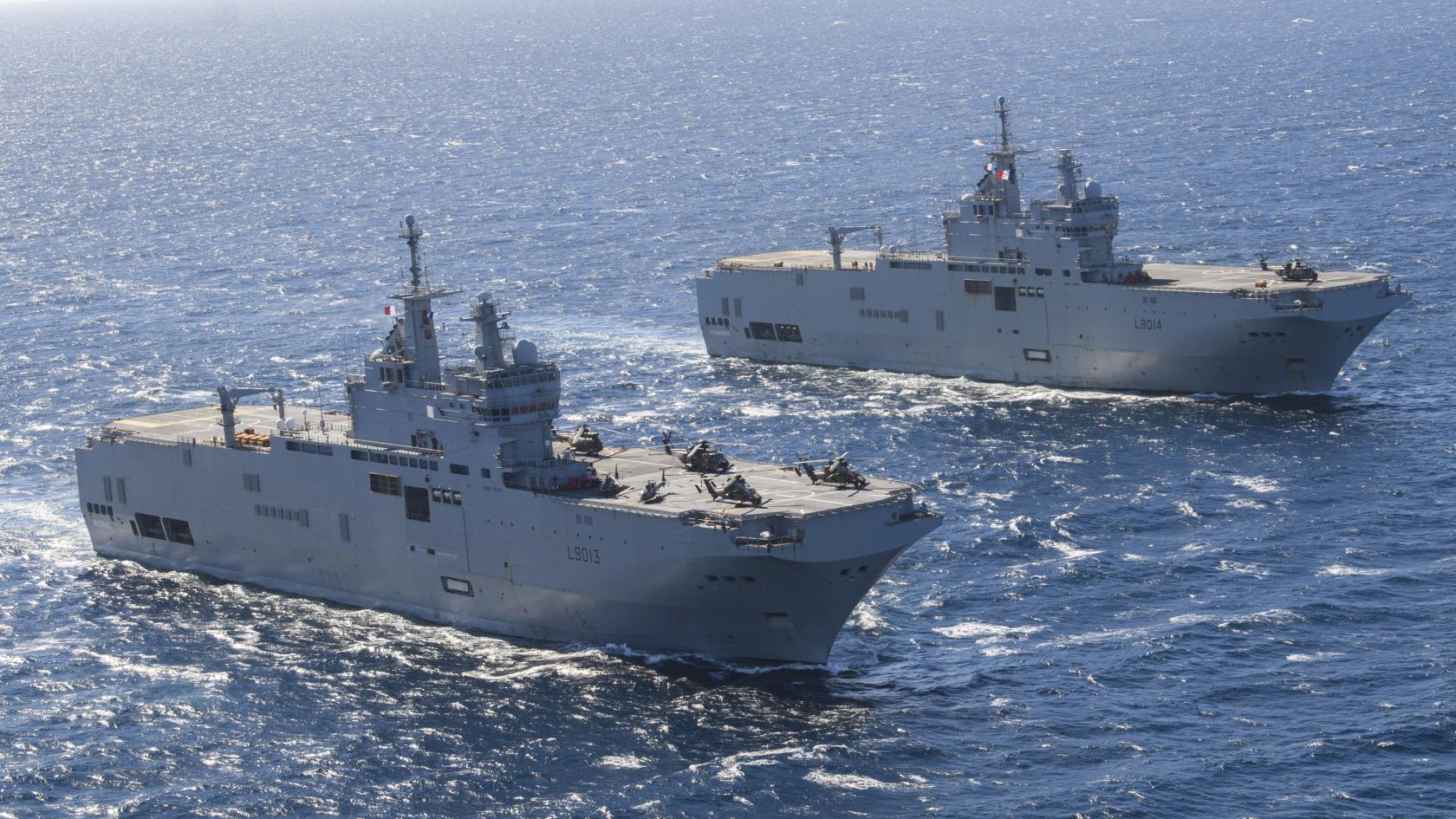
A consortium led by CNN MCO with Thales and CS Group has started modernising the French Navy’s three amphibious helicopter carriers with a new inertial navigation system intended to improve resilience in contested electronic environments.
The work is part of the Navy’s maintenance and modernisation effort managed by the Fleet Support Service. According to the release, installation of the upgraded system on the first ship, Mistral, has been completed during its maintenance period in Toulon.
The broader programme covers the PHA class vessels Mistral, Tonnerre and Dixmude, as well as in service support for the replenishment ship Somme. CNN MCO’s contract, awarded in 2022, includes more than forty modernisation studies and has already produced about fifty upgrades across the three vessels.
The project addresses obsolescence in critical navigation systems by replacing older equipment with Thales’ TopAxyz units. Thales describes these inertial systems as operating on internally controlled data from onboard sensors without reliance on external signals. The company presents this as an advantage in environments where radionavigation systems may be jammed or spoofed. Florent Chauvancy of Thales said “we’re proud to play a part in providing resilient navigation solutions for France’s naval vessels as a prerequisite for ensuring freedom of action by armed forces at sea.”
CS Group is responsible for integrating the Thales units into a complete navigation suite that it provides to the Navy. The company’s role includes integrating navigation sensors, distributing data securely and ensuring cyber resilience. Frédéric Dussart of CS Group said the partnership underscores the value of domestic expertise and supports what he called coherent integration of the navigation chain.
CNN MCO is handling engineering, installation and testing. The company said it has devoted nearly 1,500 hours of engineering work to retrofit studies so far. Deputy Director Céline Barazer was quoted saying “this programme confirms CNN MCO’s ability to carry out complex upgrades in shipboard environments.”
The release states that installation across the three carriers will follow their routine maintenance timetables through 2027, with Dixmude and Tonnerre scheduled after Mistral. CNN MCO and the Fleet Support Service plan to coordinate installation windows to maintain operational availability at sea.


The RN Should have purchased the 2 that was denied to Russia and later sold to Egypt. That would have solved the current lack of assault ships for the Royal Marines.
Can you imagine the outcry form the Unions?, plus it would set a precedent that we only order British made warships.
Bae had an Ocean replacement design years ago. An order should have been placed.
But we did not have a lack of assault ships..as well as two 80,000 ton carriers we had two perfectly good 20,000 ton assault ships.. with a good decade of life left in each.. we did not need anything else until the idiots Simply did not recruit the crews needed to deploy them and then sold them for pocket change..
We did not hit a crisis of shipbuilding we hit a crisis of in year budget stupidity that cost us half a billion pounds of capital ship investment.
i have to admit I found that decision shocking. UK always been an expeditionary force. ships are vital for that, cargo planes can’t move mass likes ships can. The Albion class only served 2 decades, you figure that these should have served at least a decade longer, maybe two. ofc there are upkeep and modernization costs, but that is true and expected for any military platform that is meant to serve 30 to 40 years. obviously manufacturers are happier if you renew more often and squeeze every penny out of your wallet.
I get the feeling the MoD is in the habit of throwing the baby out with the bathwater, like Crowsnest which is now operational but planned to be retired after just a few years, or not modernizing Tranche1 Typhoons and simply scraping about a third of the fleet (pretty sure Spain manged to modernize their T1)
it’s hard to understand, obv bean counters have their reasons, but bean counters don’t fight wars.
not to mention UK has a bigger defense budget than most NATO countries, like France and Italy. I just don’t see much bang for buck -> maybe bean counters should focus on that
We should get three of something similar for MRSS, make sure it’s a through deck design for more future versatility.
This is why I think MRSS needs to be split.. essentially MRSS is replacing 6 ships 2 20,000 ton ships and 4 15-16,000 ton ships.. there is no way the RN can run 6 20,000+ ships.. personally I think it needs to go for 2 large deck classic amphibious vessels ( if they were really cleaver they would build them to take fixed wing drones and even a F35b flight), something similar to Trieste and then 4 10-15,000 ton littoral combatants.
You’re assuming we even get 6 ships
If we want to keep things all British BAE a while back had a useful looking LHD concept. Kind of a Ocean-Albion 2 in 1. If there’s a need to keep the two carriers as “carriers” having a LHD or two would make good sense especially for regional reinforcements. Does the UK need 4 10-15 tonne littoral combatants? Would having 4-6 smaller GP/land attack capable frigates suffice or, have these in addition?
Jacob K has put this better them me below.
MRSS is not helicopter focused, not like we have decent marine Helos anyway
The Elliade Strike flight deck looks like it takes up over 1/2 the length of the ship. That’s substantial even if multi-role.
When you look at the French navy and Italian navy amphibious capabilities you can really see where the RNs capabilities have declined.. and amphibious capability is one of those areas.. it’s easy to blame the government but a lot of what the government does is guided by the executive agencies ( army, navy and airforce ) as executive agencies are not passive recipients of instructions ( although they like to allow the public to think they are). So you do have to wonder if this is in part to due to inter service fuckwittery that the UK seems to be very very good at.. the RAF not pushing hard for maritime patrol aircraft, diverting from F35b, no organic airborne anti ship missiles shows a lack of engagement in maritime power from the boys in blue.. the complete lack of any movement on medium lift helicopters and the dropping of focused fixed wing tactical transports shows a lack of willingness to support the army.. the RN dumping its amphibious capability shows a lack of willingness to get involved in anything to do with the land and the armies reciprocated utter unwillingness to train any of its battalions in amphibious operations shows a complete lack of contemplating the sea.
Is it any wonder we have the idiocy of losing our amphibious vessels.. after all it was the navies choice to crew or not crew Bulwark.
More important ships to crew than Bulwark
Just an interesting thought experiment what would we do if china decided it was having the Falklands? And was going to dumped a couple of brigades of heavy amphibious combined arms brigades on the island… not something that would happen now.. but in a decade when china wanted a bridgehead into the Antarctic and a secure south Atlantic bastion.. after all who would come and help ?
It’s an interesting question. In 10 years time, China will have at least two perhaps three CATOBAR carriers, along with a very sizeable amphibious force, not to mention a load of Type 54 frigates and Type 55 destroyers, along with a number of the Type 95 SSNs. On paper, by that stage they “should” be on par with the USN. One question would be, would they get support from Argentina, or will Argentina turn their backs on them, for daring to take the Malvinas away from them? Without Argentina’s support, they will be very isolated logistically, I doubt Chile will support them. The USA will be apoplectic if China takes the Falklands, as that would give China a significant chunk of Antarctica. But as importantly, it means USN carriers that are too big to go through the Panama canal, may have to change their route to the Pacific. Plus it means the PLAN could/would try to interfere with their passage if they continued to use the Southern Passage. So I’d say there would be a good chance for the USA to support the UK in reclaiming the islands?
The major issue for the UK, is lack of mass, compared to the War in 1982, then the RN had a significantly larger fleet, where less than half was deployed to the Falklands. Today we would have to pull everything available to conduct such a mission. In that time frame, will we have any serious amphibious capabilities? Will we actually have MRSS, as there would be nothing else to use? However, unlike Argentina in 1982, China would have significantly better offensive and defensive capabilities. They’d likely put satellites over the island, to give them both communications with their homeland, but also to observe the South Atlantic Ocean. Which when backed up with anti-ship ballistic missiles, will give a wide area of maritime denial around the islands. Next up, China has a “Hawkeye” copy, the KJ600, with likely similar/nearish capabilities. If the Type 003/004 carrier/s stay in the vicinity. This will give the Chinese a fixed airwing of 40 aircraft for the Type 003, whereas the Type 004 could have upward of 60. Made up with J15T, J15DTs and J35s. Which is not counting fixed wing drone aircraft. Giving the PLAN a sizeable and pretty capable air wing. Not forgetting that the PLAN would definitely deploy a number of the latest Type 095 SSNs, North and East of the Falklands lying in wait for a task group.
In ten years time, where will the RN be? The T23s will have likely all been retired due to unrecoverable wear and tear, leaving us with perhaps 3 to 4 T26s and 5 T31 frigates. At least one T26 will have to stay behind, to do the TAPS requirement for the CASD. But if both classes have Mk41, will they be armed with TLAM or Stratus? All the T45s will have been through their PiP and possibly their Sea Viper Evolution, Dragonfire is also probably fitted. Will the ship still have NSM, or will they have Stratus-LO/RS? All the Astute SSNs will be in service. Will there be a AUKUS-SSN in trials? If the 1SL has his way, we may have a few T92 and T93s to bolster the numbers. The other major issue is the RFA, again considerably smaller than it was in 1982, will their be enough ships/crew to support a major task group going south. Will we have an anti-satellite capability? As something will need to be done with the Chinese surveillance satellites in particular.
I would like to think we will have more F35Bs by that time, perhaps enough to put both carriers to sea. But what will they be armed with, will Spear-3 or a longer ranged stand-off weapon be integrated, what about Meteor? If all three issues are sorted, then the F35 will be a very capable and potent aircraft. Will the carriers have a better AEW platform, as this will be crucial against PLAN aircraft, especially the J35. Similarly will the F35 have a loyal wingman type drone by this stage? A problem I foresee are the amphibious helicopters. Will they be equally split between the carriers or will one carrier predominantly operate them? Mixing amphibious ops with combat air is not a good idea, as both interfere with each other, when it comes to deck space and requirements. But then if you put all the fixed wing on one carrier and rotary on the other. If one gets taken out, you have lost a significant and perhaps irreversible capability.
In a missile based war, logistics is a key factor. How deep is your magazine depth, can you replace used assets quickly? The operation in and around the Red Sea have shown how quickly a ship can expend its missiles. But also the lengths that ships have to go to to get their magazines replenished. For the PLAN, they will need to make sure they take sufficient quantities of missiles, so they can be replenished. Otherwise they will quickly run out and have to wait for replenishment from China. Unless they get support from Argentina to forward base materiel, I’d imagine them running out fairly quickly. For the UK, it will be no different, but I suspect countries such as Brazil would support our cause, at least logistically. Allowing our ships to dock for replenishment, especially if supported by the USA.
One thing that would count in our favour, is perhaps the weather. The Hermes and Invincible managed to maintain over 90% air operations, in some of the worst weather and seas encountered. It has been speculated, that a CATOBAR carrier would be down to less than 50%. With a ski ramp and vertical landing recovery, the F35Bs, can operate from a carrier in far worse weather than traditional carrier based fixed wing aircraft. If China has control of the islands and MPA, which is likely been heavily damaged. How quickly they repair the runway will depend on whether their jets remain on the carrier/s, which will affect availability.
For this scenario, the UK trying to reclaim the islands on its own, it will be outgunned. Only with direct US involvement would there be any chance of recovery. We simply don’t have the mass to fight an attritional war against the PLAN, nor the dedicated amphibious capabilities to get a large number of troops and equipment on to a beach. Additionally in 10 years time will the RFA be in a better position to support such a venture? Though I’d like to think we’d manage to get a few SF on to the islands, to observe and cause merry hell when needed.
Nice thought experiment, probably not a short term win.
If the Chinese were of the mond to invade a UK overseas territory I doubt they would constrain their operations to the south Atlantic. Their Sub fleet would appear in the arctic and North Atlantic as well as mid Atlantic.
RN bases would be hit and ships neutralised. The only thing that will prevent china is the fear that the west stop trading with them, this would sink their economy.
The US will need to deal with China before it becomes a problem for us.
No I don’t think they would go that far, the Chinese are a clever bunch they love their political warfare to ensure isolation.. if in a theoretical future attack on the Falklands they attacked the UK or RN in the North Atlantic it would trigger article five and they would be at war with NATO.. the south Atlantic is ours alone.. no one else wants us there and no one would likely support us.
i very much doubt that. Falklands is not Taiwan
why would China want Falklands? it is not on their strategic shipping route. China already does business with Latin America so not sure what they would get? except worse relations with a lot of countries.
frankly Singapour has more to eventually worry about. China has a base in Djibouti alongside France and US. China has made a deal with a Myanmar to build bases on its island chain in the Andaman Sea.
China is first focused on Taiwan and South China Seas, then comes Japan’s islands and Indian Ocean for key supply routes, and finally the Arctic routes as ice melts.
If China has plans for the Med and the Atlantic, it is super long term, because it is going to be a while before they have enough might and reach to actually be a credible threat there
my 2 cents
obviously I don’t have a crystal ball. maybe Falklands waters have some undiscovered biggest ressource deposits in the world, then yeah you should start worrying then, but probably not China, more likely to be Uncle Sam (cf Greenland remarks, as well as Venezuela because of “drugs” sounds like WMD lies again just to get to their fossil fuels, we know how much Tango man loves fossil fuels and hates electricity 😉 )
The think about the Falklands that everyone forgets is that it literally is the gate and key to the Antarctic.. essentially whoever controls the Falklands controls the Antarctic peninsula infrastructure and whoever controls the Antarctic peninsula’s infrastructure can essentially control most of the Antarctic.. and the Antarctic is the last great untapped frontier…when that gun goes off the snow is going to turn red.
Hello? The French maintaining and keeping Amphibious ships we hear from all quarters are obsolete.
Well well!
all quarters within your country, outside no one thinks these are obsolete
obsolete how?
it’s an amphibious/LHD that has proven its worth in Lybia as a base for Tiger helo missions,
it was instrumental in ferrying the bulk of french equipment to Sahel via Ivory Coast.
it has a hospital to treat casualties
its deck is fully compatible with all NATO rotary air assets (incl V22 Osprey and Chinook, but too big for hangar elevators)
it can transport all NATO vehicles, (incl host 2x US LCAC hovercraft)
it has Link 11, 16 and 22 for NATO interoperability
is it the best, biggest and most capable? no. It corresponds to France’s needs and has served well without issue.
France doesn’t have a budget or army the size of US or need comparable capabilities, like the Wasp class which operate US Marine Corps F35B
Neither of you got the sarcasm and bitterness in my post.
They’re not obsolete at all. But our blasted government and various commentators see them as such.
fair enough 🙂
We should go with ships like these instead of the MRSS. Far more versatile, better in the amphibious role (something we sorely lack).
Did a basic estimate calculation, for the price of 6 MRSS based on the Albion in ability but with the radar and missiles required to be capable of independent operation, one of the requirements. You can afford 3 LHDs similar to the Mistral, 1 solid support ship and still have 1 billion spare to spend on other things such as almost three type 31, or helicopters or munitions, etc. I also did a low end estimate price for the MRSS, and I high-end estimate for the LHD and solid support ship, for example for the solid support ships the entire program has cost 1.5 billion for 3 ships but that would also include the development cost yeah I just assumed it would cost half a billion before one of those ships.
The latter plan comes with far more solid support capacity, the albions weren’t actually that good of an assault ship for the carrying capacity, a Mistral for example could hold as many vehicles and troops as both albions and a lot more helicopters, only about a quarter extra of the price. The Juan Carlos Carries even more, is capable of launching fixed wing aircraft and is actually cheaper than a mistral. So the 3 LHD would carry more than these 6 MRSS, and a lot more helicopters, and we would still have a billion spare to spend on other things.
Personally I just don’t understand the MRSS project, it’s trying to do everything and won’t really achieve much of anything.
As an island we should have strong amphibious capacity, but also despite being better at amphibious operations a LHD has actually got more room to fit things for humanitarian efforts and if we really need to stick a load of cargo crates on top you can just put them on the flat deck. They cost almost nothing more than a conventional amphibious assault chip such as the Albion yet are so much better and more versatile.
MRSS is shaping up to be more like a 40 thousand ton LPD by recent concepts so your maths isn’t quite on.
LHDs do cost more and are inherently a more resource intensive ship to use to their full capability
I assumed Albion sized amphibious ability then extra tonnage for the defence and solid supply.
LHD’s do cost more, but for what they do they’re cheaper.
UKDJ did an article a while ago comparing Albions, Mistrals and Juan Carlos. Price comparison was in 2018 USD, using that the Albion cost 493 million, and a Mistral 582 million, and the Juan Carlos 500 million. So yes a Albion is cheaper, however a Mistral can carry twice the number of vehicles, 200 more troops and 8 times as many aircraft (and actually has a hangar. So if looking at capacity the Mistral is actually a cheaper way to acquire the capacity. Then the Juan Carlos carries even more, is fixed wing capable and almost identical price to the Albion anyway.
And I highly don’t we will end up with 40,000 tons as that is larger than a tide class, and only the US and china operates amphibious ships on that size.
LHD are more cost effective when comparing capacity.
And we can only looknon, absolutely green with envy. The slow death of the RN continues…..
Not so slow, in just one year they’ve already retired Type 23 frigates, 2 LPDs, and the Argus will clearly be retired too. At this rate, in 10 years the navy won’t exist, which is apparently what they’re aiming for, just like the army and the RAF. Getting rid of the armed forces is a huge saving; how clever these politicians are.
Indeed. One can get clinical depression when Labour spout ridiculous figures about ‘investment’ in the three services when the actual result is less and less for more and more expense. 20,000 jobs to be maintained with the building of a couple of dozen typhoons. And none for the RAF!!
Absolute bullshine!