

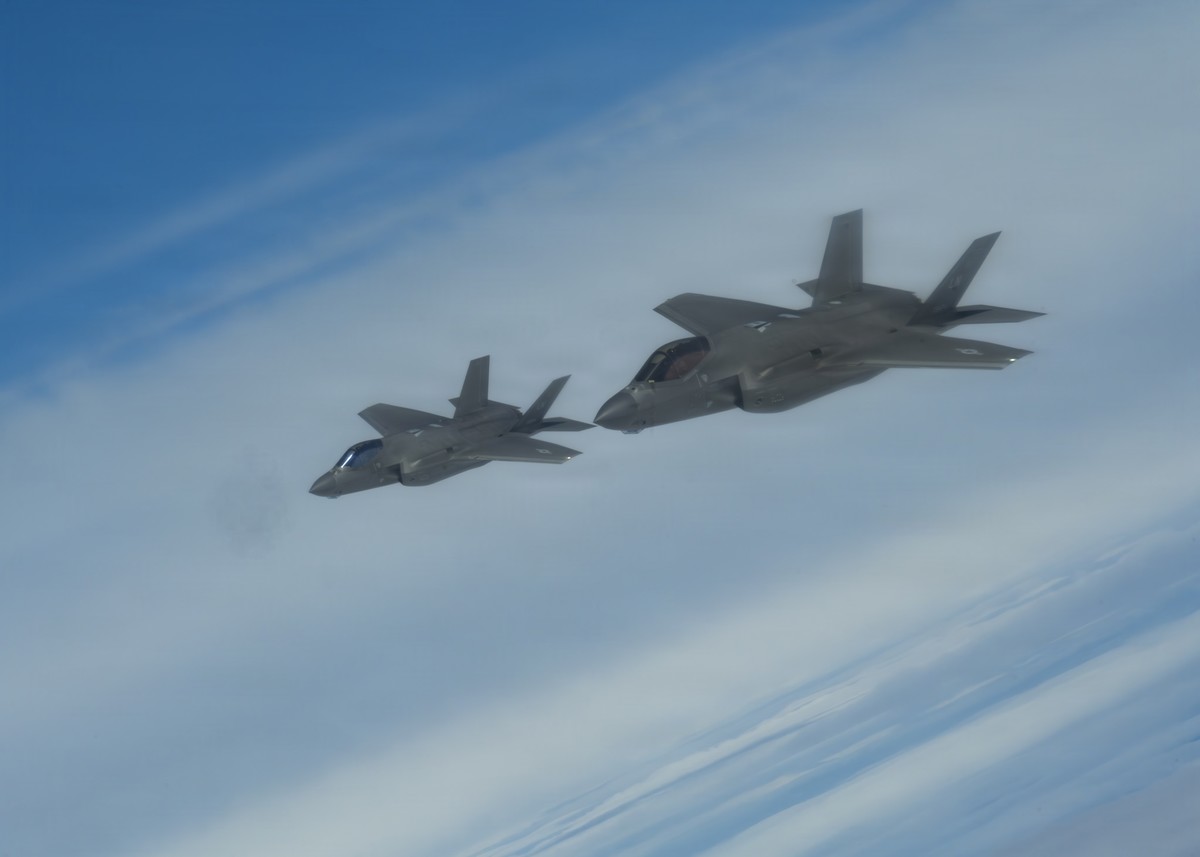
Carl Bildt has said that any Russian aggression in the Baltic would immediately affect the security of Kaliningrad, referencing the concentration of NATO aircraft that has operated around the exclave over the past week.
Writing on Friday, the former Swedish prime minister and foreign minister, now co-chair of the European Council on Foreign Relations, said: “I’m sure Russia has carefully noted the advanced NATO presence in the vicinity of Kaliningrad the last few days. It certainly sent a powerful signal. Any Russian aggression in the Baltic area will immediately impact the security of Kaliningrad.”
He posted alongside a flight tracking image showing two NATO E-3A Sentry airborne early warning aircraft from Geilenkirchen, registered LX-N90444 and LX-N90445, operating over Lithuania and Poland, together with a Multinational MRTT Fleet A330 tanker out of Eindhoven and a United States Air Force KC-135R from RAF Mildenhall.
As we reported this week, allied aircraft have been massing over the Baltic region in numbers and combinations rarely seen outside a declared exercise.
The activity on 18 August involved around 25 aircraft drawn from several member states, operating from Poland and the Baltic states, in a package overseen by the United States. Alongside American and Norwegian fighters and a NATO E-3A, flight trackers logged an EA-37B Compass Call electronic attack aircraft, an ARTEMIS II intelligence platform, Polish Gulfstream G550s, multiple MRTT tankers, a Lithuanian Let L-410 and American AH-64E Apache helicopters, with Polish ground forces participating.
Allied Air Command confirmed the activity but said it could not disclose further detail for operational security reasons. A United States Air Forces in Europe official subsequently confirmed the training was scheduled to run across several days, and further flights followed on 19 and 20 August.
What distinguishes the past week from routine patrolling is the mix of capabilities. Refuelling, airborne command and control, intelligence gathering and electronic attack were airborne simultaneously, which is the shape of a strike package rather than a surveillance sortie.
The presence of the EA-37B in particular has drawn attention. The aircraft is designed to disrupt communications, radar and navigation systems, and the type flew its first operational mission from Souda Bay on 19 August focused on the electromagnetic environment around Kaliningrad.
Kaliningrad is the reason the Baltic sits where it does in NATO planning. The exclave has no land connection to the rest of Russia, hosts the headquarters of the Baltic Fleet at Baltiysk, and carries air defence and missile systems whose reach extends well into allied airspace. It also sits alongside the Suwalki gap, the stretch of Polish and Lithuanian border separating it from Belarus and forming the only land route between the Baltic states and the rest of the alliance.
Bildt’s point cuts in the direction less often stated. The exclave’s geography, usually discussed as a threat to allied reinforcement, also leaves it surrounded by NATO members and dependent on sea and air corridors the alliance could close.
The build-up follows a period of steadily rising activity, recently a Royal Air Force RC-135W Rivet Joint flew a patrol around the exclave on 7 August, returning to RAF Waddington after routing through the North Sea into the Baltic. An Italian Eurofighter operating under NATO command shot down a drone over north-eastern Latvia on 14 August, in an incident Latvia’s armed forces attributed to Russian electromagnetic warfare pushing the aircraft off course. Baltic Air Policing detachments have continued to intercept Russian aircraft transiting between mainland Russia and Kaliningrad, typically flying without transponders or filed flight plans.
Running alongside all of it is Lion Protector 26, the Joint Expeditionary Force exercise which began on 3 August and runs to 12 October across Northern Europe, the North Atlantic and the Baltic, and which opened with the escorted movement of allied military equipment into Latvian ports.






that entire coast. soviet era sun burst missle system prove effective not stupid yet see 100 percent clearly. good. 1 more thing boiling stations convert seawater into usable for summer shortages. weed thing n africa same system exports mainland africa start point for resourses water issues frowned upon whole sale ready made countries might some tax. the book holding cell proper phyco for police not concern mainly jihadi attitude nature controlling face covered chores dont look they are pychos proper like. just saying as per usual sun ak its terrible sad facts im used to it. many men
Capture of Kaliningrad would probably be NATO’s number one target in a Baltic conflict. It’s a piece of sovereign Russian territory that can be quickly isolated and Russia would have no means of retaking it once lost short of getting through all the Baltics states.
Russias complete inability to conduct maneuverer warfare and its inability to overcome fixed defences at anything other than a snails pace suggest it would not be unable to overcome the belt of fixed defences across the Baltics states before NATO reinforcements totally overwhelmed it.
In any fight with NATO the Russias will rely on a bight and hold strategy, hoping for rapid gains that it can hold on to and force NATO to take unacceptable levels of casualties to regain it.
Kaliningrad offers NATO the best option to reverse this tactic, grabbing the Kola Peninsula would be NATO’s second pressure point to apply. Ultimately any war between NATO no Russia can only end in a negotiated settlement or all out nuclear war. NATO has to be mindful of that in a response to any Russia action.
There are possibly a number of ways it could end if Russia did attack..
1) it does not end… Russia simply does not have the man or industrial capacity to overcome NATO if it holds… but NATO decides it’s not triggered a nuclear war by punching Russia out completely.. so some poor innocent country or three becomes a never ending battlefield… essentially just like Ukraine is now..
2) NATO goes full on, Russia realises its going to lose and negotiations a peace
3) NATO folds like a pack of cards, leaves the attacked nation high and dry and negotiates a peace on behalf of the invaded/ attacked Nation ( with Trump in the driving seat I think this is likely)
4) NATO pushes harder than Russia likes and in desperation tries an escalation to de escalate limited nuclear strike… NATO backs down from thrashing Russia and there is a peace treaty
5) as four but NATO responds to the Russian escalation to de escalate nuclear attack by responding with a sub strategic nuclear response.. Russia backs down from Armageddon and there is a peace..
6) as five but Russia responds to NATOs with a larger nuclear attack.. at this point it’s almost inevitable that NATO responds strategically..
Time to actually get the sandbags and air filters ordered for my fallout shelter..
I can’t see NATO taking Kaliningrad, levelling it – a certainty.
Russia must gamble that Kaliningrad, which is not sovereign but occupied, falling, St Petersburg blockaded, with military infrastructure levelled, Kola Peninsular blockaded and levelled and the Bosphorous closed and all Westward seaborne traffic stopped.
Of course, that still leaves Vladivostock but once again, levelled with Russians mercs in Afica also made to lie prone involuntarily and just a tad lifeless.
The only good Russian is a dead Russian and those ones are ones you can trust.
If NATO fully responded and the US upholds its end then the Pacific fleet would level Vladivostock.
One would hope Jonathan, one would hope.
However, if WW3 does kick off, we are hopelessly unprepared for the… ahem… fallout.
Irregular warfare will erupt over Western Europe and where, as the fmr CGS said, eNATO generally has a 3:1 ratio of AR to Full time, we have an inverse ratio and KP duries we performed back in the 80s as part of infantry will seem like a wet dream to the current crop of pollies.
The hard standings for RAF and Army equipment will be mullared and the RN can expect the good news as well: the Russians learn and adapt and we have no depth.
Will China carpe diem on Taiwan and the Phillipines? Probably with combat trained North Koreans also re-educating their southern brethren.
And all because we have had the most inept of pollies in the White House as well as 20+ years of British pollies screwing the armed forces over.
More like 50 to 60 years of the military being screwed over. I have been interested in defence all my life and served as a tech in civil servant in the MoD (I’m disabled so armed forces a no go). The salami slicing cuts of our military capabilities has been going on for as long as I can remember (which is quite awhile now), a long with the loss of research and industrial capability our country has been left hopelessly unprepared for what might be coming. Sadly, it will take decades to rebuild our industrial base and hence our defences. At least we seem to be a few stuttering years into the process now, but it need to accelerate if we are to reestablish our conventional deterrent posture.
The clock is ticking.
Cheers CR
It’s a conversation CR.
We could not sustain WW2 Defence GDP spending, and the militant political activism of the 70s left the Country broken, followed by Thatcher’s appalling Defence review which led to the Falklands but, US Pres. Reagan invigorating spend leading to collapse of the Warsaw Pact and a proclaimed peace dividend.
The underfunded sandbox wars followed by Afghanistan and their UORs gutted the Forces and the banking crisis coming to a head after the previous Conservative banking libralisation saw the Labour Govt sink and the new Cons preach austerity.
So, you can argue 80 years, what is inarguable is that we have the balance wrong between Defence and ‘Care’: wealthy pensioners distraught over their loss of winter fuel payments, people taking PIP for a ride, the rich getting richer and the poor, poorer.
Housing prices have broken all connection with earnings and an economy based on the purchasing of new houses and the subsequent new white goods is broken with local manufacturing jobs replaced by imports and taxes lost to boot.
Here riseth Health n Safety which has seen construction costs sky rocket, unused railway Bay sidings having to be fenced off because someone might walk off the edge…
You have to reset the nation to get Defence spending back to where it needs to be but the lethargy of this nation is it’s downfall.
Generally I agree with your points, especially the 80 years which I nearly put in my post.
I think the big problem is that we lack leadership to pull the country together. There is no clear message around which to rally and work towards. Too many people feel left out and isolated.
My own experience as a disabled person ranges from being included and given a chance and to be honest I seriously lucked out in the early years of my career, being given a chance to do an engineering apprenticeship back in 1979. To then being excluded from a job I could have done because I couldn’t get into the building in 2012! Have you ever had to get down on all fours to hand in your CV? I have. And I didn’t get the job. I got made redundant back ’12 and struggled ever since. I saw a job being advertised online that was close to the kind of work I had being doing for MoD and NATO. It was less than a mile from where I lived, so put on my best suite and went around with CV in hand. Four big steps up to the front door said disabled ‘not welcome’. So I swallowed my pride and got down on all four to knock on the door to hand in my CV. It was the first time in my life that I had really experienced my disability getting in the way to the point of blocking me at every turn, to the point of humiliation!
The way PIP works makes many disabled people including me feel like a criminal because you always feel under suspicion. The fact is a making the public realm accessible to disabled people simply allows them access to goods and services many cannot afford, because they cannot access the working realm..! Many can’t even access their own kitchen or leave their own homes so how the hell they are supposed to access work is beyond me. It is an able bodied world and able bodied people are lucky enough to be able to be ignorant. And that ignorance is a huge obstacle.
Disability activism, such as it is, was founded by WW2 veterans who had seen how their fathers had been treated after WW1 and determined that the same wouldn’t to them. In my experience bugger all as changed, because NO ONE should have to get down on all fours to try to hand in their CV for a job. NO ONE. Drop curbs, disabled toilets, inclusion do not make not when home and jobs are still inaccessible to many.
To add insult for injury I am now expected to prove to numerous organisations from local councils to cinemas that I am actually disabled..! I ware f**king calipers and use a f**king wheelchair to get around and I have to provide documentary evidence every year to one or other organisation that I am disabled..! That is how society demonstrates support for disabled people by treating us with suspicion, as skivers.
Thing is this is the world the disabled vets now live in!
Society needs to chase the crooks playing the system, not punish the those who need the support.
For the record, I would love to live in the world where PIP wasn’t necessary where I my abilities were allowed to shine past my disability. I have 22 years experience as a MoD techie and defence analyst with a Master of Sciences Degree from Cranfield Institute of Technology and my chances of getting a job in the UK are no better an a school leaver with on qualifications. That is what needs to be sorted..!
Sorry, for the rant but mentioning PIP touches a raw nerve and too many people on here are real quick to pick on it without first thinking about why DLA and PIP are there in the first place. Disabled people are an easy target.
CR