


The US Navy has released images showing the Wasp-class amphibious assault ship USS Boxer firing a RIM-116 Rolling Airframe Missile during a live-fire exercise in the Pacific on 7 November.
The drill took place while the ship was operating in the US Third Fleet area of responsibility as part of advanced tactical training.
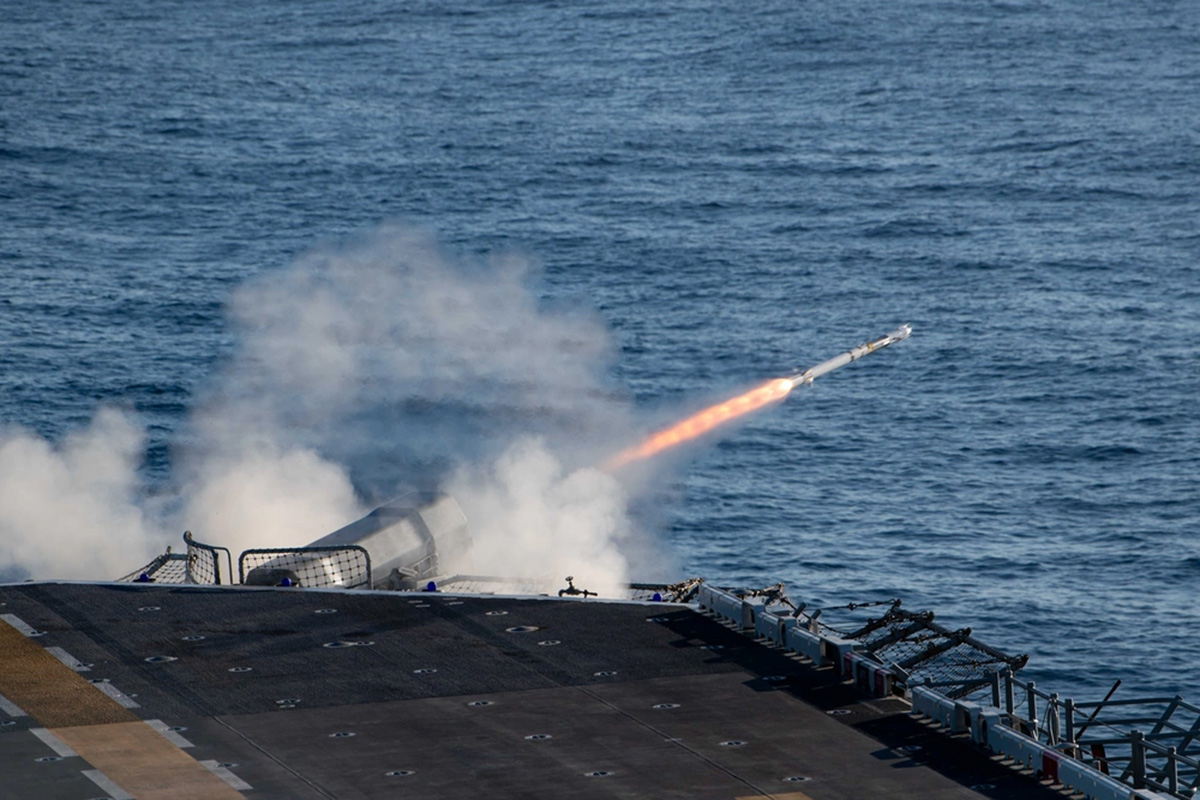
The exercise is another step in Boxer’s return to front-line activity after several years of delays caused by maintenance problems. The ship recently completed a major modernisation package, including upgrades that allow it to operate the F-35B Joint Strike Fighter. After repeated setbacks in 2023 and 2024 that kept the vessel in port, the Navy has been working to restore full reliability ahead of sustained deployments.
USS Boxer is one of eight Wasp-class assault ships that support US Marine Corps expeditionary operations. At full load it displaces more than 40,000 tonnes and can carry a mix of helicopters, MV-22B Ospreys, and either AV-8B Harriers or F-35Bs depending on mission requirements. Its defensive suite includes RAM and Sea Sparrow missiles, Phalanx close-in weapon systems and 25 mm chain guns.
During the recent live-fire, the ship’s RAM launcher engaged a test target as part of routine weapons certification.
The U.S. Navy said the training was intended to sharpen tactical proficiency and ensure that crews remain ready to respond to threats in the Pacific, where Third Fleet is responsible for an area of roughly fifty million square miles stretching from the eastern Pacific to the Arctic.









Very important ships, as time goes on I can see these more and more ending up in the sea control function over the amphibious function.
That’s in part due to the poor production rate of the Ford class. It will be interesting to see how the America class progresses, despite itself suffering from some delays. USS America and Tripoli were designed to have greater air power and control than the rest of the class, the role we’ve seen the Wasps taking on on occasion. Will the USN cave to having any more America class ships built to the spec of the first two ships?
I think it will also very much depend on china and it’s build programmes.. and because of what china is I suspect most of it’s building programmes are aimed to hit a set point of power and capability for 2035.. after this point I think we will either see china throw the PLAN against the USN or settle into maintaining its size..although we may see further expansion out to 2046..but I don’t think we will ( it will simply be replacing and modernising from then on…apart from the SSNs because I think china will build that out to 2046)
If you look at what they have stated they will build, essentially they wanted 8 large deck amphibious assault ships.. they were going for 8 type 75 but shifted to the type 76 after 4.. and have moved to a light carrier sea control hybrid hybrid amphibious vessel, that can launch fixed wing 5th generation fighters… I suspect we will see four of those to make the 8 planned by 2035… after that they may build a new design ( the type 077 because china does not do illogical numbering) to then replace the type 75s… so my bet is china will have 4 sea control ships for 2035 and maybe 8 for 2046. It’s seems the plan for these is long range, global sea control and disruption of enemy shipping and supply routes.
Then we have the lesser know drone carrier programmes.. these are interesting as they are all being built to a very high level of secrecy, the first at Jiangsu Dayang Marine launched 3 years ago with another flat top drone carrier type seeming to be just about commissioning and built in Guangzhou Shipyard International in about a the first has one island structure the second has 2 islands. Both seem to be designed to take predator sized drones. They are about 200meters by 40 meters, Who knows how many of these china will knock out.. they seem to be building them to civilian commercial standards at very very high speed.. so it’s very possible they see a future in which every surface group has a fixed wing drone carrier.
Finally we have the large carrier programme, we know 2 of theses are old STOBAR types and will probably be used for sea control around the first island chain But china has said it’s going to build 6 CATOBAR carriers ( super-carriers) by 2035 and their is zero reason to doubt they will do this.. type 003 has three catapults and is 80,000 tons and 004 is now know to be a 4 catapult design probably at 100,000 tons and even maybe nuclear. It’s likely 004 will be the serial production carrier if it’s nuclear.. if not 005 will be nuclear and become the serial production carrier.
So for 2035 china will have 2 old STOBAR and 6 CATABAR carriers of 60,000 to 100,000 tons, 4 CATOBAR light carrier/amphips at 45,000 tons and an unknown number of 20,000ish ton fixed wing drone carriers… I would imagine that by 2046 china will aim for super carrier parity of 10-11 ( the STOBARs will probably retire at that point) have 8-10 light CATOBAR carrier/amphibious vessels and a a load 20,000 ton drone carriers to support surface action groups and carriers ( it will have 150+ major escorts at that point its will need 80 to provide deployments for it’s carrier and amphibious groups and so will have 70-80 to form surface action groups..so say 10 3 ship surface action groups deployed at any one time.. give it 30 drone carriers to cover those deployments or work with the Carrier battle groups and amphibious groups )…
“Will the USN cave to having any more America class ships built to the spec of the first two ships?”
Hi Jon,
I don’t think so. The third America class ship (Bougainville, LHA-8) is nearing completion already and the design has reverted to having a well deck. Follow-on America class ships are already building and on order, presumably also with well decks. The Bougainville does have a much improved deck layout over the preceding ships though. It adds a large sponson forward of the island for more parking space for aircraft, and also lowered the footprint of the island itself dramatically to free up even more deck space.
A couple of RAM like systems on the QE carriers might work well with the Phalanx’s.
I must admit I was never overly impressed by these units; the 116 itself. But after reading into it the latter variants (which arguably made them viable), they do fit a niche gap. Folk on ukdj’s comments are quick to poo poo Phalanx in favour of 40mm. I’d prefer to keep that good old M61 R2D2 for ultra-close and have 116s for very-close. Ideally the big girls should have a bank of CAMMs (regular-close) tied into the local or remote (T23/26/45) defence grid but that’s wishful thinking.
Several of us have suggested that SEA could adapt it Ancilia decoy launcher for a hybrid decoys and LMM-Starstreak. All UK product. Saran in France have already done it and Thales has similar.
*Safran
Yes I believe the SEA launcher is round agnostic so there would be a possibility of integration of LMM the issue will be motor efflux management.
Then where are you putting the decoys, there’s only so many launching slots
I would never suggest the 40mm replacement for the automated CIWS.. it’s about changing out the human controlled 30mms for 40mms to extend that capacity out from 1km to 8km and provide airburst blast frag warheads which are vital. So the carrier should have 3 CIWS and 3 40mm cannons. It’s not bad ideas to putting a trainable short range air defence missile on a sponsons as well.. the issue is Meduim range vertical launch air defence missiles as they will interrupt flight ops if used… so they are better fired from an escort…
There is another possible option, which would be based on ASRAAM. However, due to the maritime environment, The ASRAAM would need to be in a box launcher to protect it, which is doable. Plus a trainable mount much like the SeaRam or though used by the RIM-116 RAM, may get around the interruption to flight ops. The big question is will the ASRAAM’s imaging infrared (IIR) seeker be suitable against head on threats. I know the latest Block 6 significantly increases the pixel count over the previous seeker. So it will generate a much sharper image of a target, as well as have better discrimination between the target and the surrounding environment. The later RIM-116 uses the seeker from Stinger, ASRAAMS is a step up from that. So I’d say it’s more than capable. Additionally, I ‘ve heard MBDA are working on the next upgrades for ASRAAM. Something to ponder over…
Asraam has a lot of possible ground to air applications.. the RAF have a lot of them..
We should’ve replaced phalanx with this years ago but well as usual we’re broke