

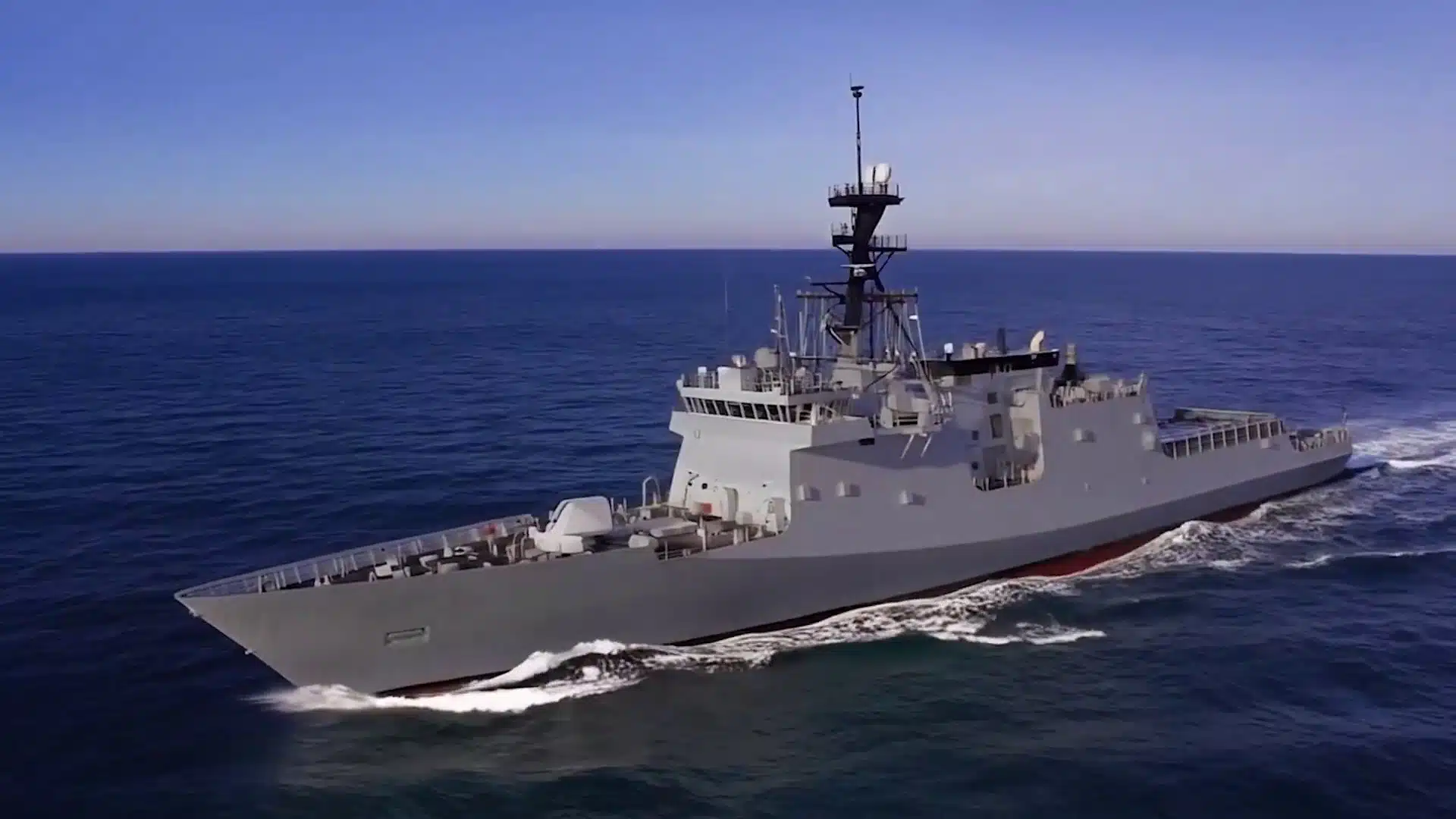
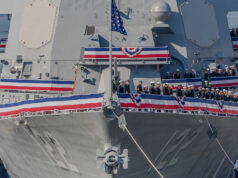
HII’s Ingalls Shipbuilding division has been selected by the US Navy to design and build its future small surface combatant, using a derivative of the Legend-class National Security Cutter, after issues with the FREMM design.
The U.S. Navy has officially cancelled the majority of the Constellation-class frigate program, which was based on the Franco-Italian FREMM design.
The new ship will draw directly on the Ingalls-built cutter programme, which saw 10 vessels delivered to the US Coast Guard over nearly two decades, with the final ship handed over in October 2023. HII says the choice of a mature design is intended to reduce risk, accelerate delivery and provide predictable build schedules.
Announcing the selection, HII president and chief executive Chris Kastner said speed and producibility were central to the Navy’s decision. “Speed matters, and the NSC ship design is stable and produceable and will lead to predictable schedules. I have great confidence in the Ingalls team to execute this program, and in our ongoing efforts with our partners to successfully expand the U.S. shipbuilding industrial base to meet the Navy’s needs.”
I have directed a new Frigate class as part of @POTUS Golden Fleet. Built on a proven American design, in American shipyards, with an American supply chain, this effort is focused on one outcome: delivering combat power to the Fleet fast. pic.twitter.com/ovnASiHYaF
— Secretary of the Navy John C. Phelan (@SECNAV) December 19, 2025
Ingalls Shipbuilding will construct the vessels alongside its existing destroyer and amphibious ship programmes in Pascagoula, Mississippi, using the same build sequence previously employed for the National Security Cutter line. The yard is currently building three major classes of warship for the US Navy, including Arleigh Burke-class Flight III destroyers, America-class amphibious assault ships and San Antonio-class Flight II amphibious transport docks. In parallel, Ingalls is also carrying out modernisation work on the Zumwalt-class destroyers, including integration of the Conventional Prompt Strike hypersonic weapon system, underlining the yard’s role across both new build and advanced upgrade programmes.
HII has invested more than $1 billion in infrastructure, facilities and tooling at Ingalls Shipbuilding in recent years, positioning the yard to support next-generation platforms and increased production rates. As part of its capacity expansion efforts, the company has distributed shipbuilding work to 23 outsourcing partners this year and has established partnerships with international manufacturers. HII has also confirmed it is evaluating options to add an additional shipyard in the United States.



No expert here but this Cutter design seems rather less ambitious than the Consternation ?
Also not sure but Is the USCG still more tonnage than the entire RN ?
It is. Smaller, less armed, lower manning requirements (100 vs 150).
It’s a slightly smaller Type-31. Gunboat diplomacy and missile sponge in combat. For some reason both the RN and USN are vying for this attributable design.
design concept*
Yes, this NSC frigate concept is much more like the first few (pre MK-41) Type-31s will be than the Constellations.
Well we still haven’t got mk41 so….
I think the words of the Secretary for the Navy sums it up. America first even if it’s inferior.
Equally it’s almost Trumpist to make a claim without a hint of a laugh that the choice of a mature, predictable and proven design will solve the problems of the fleet in quality, capability and numbers. If I remember correctly isn’t that pretty much identical to what was said about using the mature, established and proven Fremm design? It will be interesting to see how a relatively old school coastguard cutter design (previously rejected) can likely do better than the Fremm design in any regard (other than cost perhaps) unless it’s fiddled with to a fraction of the degree that the Fremm design was, in which case it would be leaving it a inherently low end solution. Sounds like a decidedly political and nationalistic decision done (expectantly) on the cheap so as to preserve funds for the Golden Ballroom. The Chinese will be quaking no doubt. Can’t wait to see the finished design.
It is half the cost, 895m vs 1.4bn for the connie.
It’s still questionable if the connie will ultimately reach USN damage control requirements of a first rate combatant.
895m for a coastguard cutter?
Bonkers.
Give it time. FREMM was also half the cost of the Constellations, but USN fiddling and a tiny batch meant that the cost has been blown out. North of 20 FREMM’s have been built, and more on the way, and outside of the US none of their users seem to have any issue getting them into service. Meanwhile the USN’s record speaks for itself in this century, Zumwalt, LCS, Constellation. By the time they adopt the Legends, mission creep them, and do massive alterations they’ll easily be billion USD warships, if not more.
It’s worth pointing out too that the coast guard has had so many problems with the NSC that it’s cancelled the 11th and 12th vessels due to contract disputes.
Now a navy which could not accept the Italian FREMM as enough will pick a “frigate” that has about as much capability as a batch 2 river.
I can see all this being canceled again in four years, these vessels offer nothing to the fleet beyond the most basic anti piracy and flag flying missions that the USCG is already doing.
The US military is rapidly reaching a point where its standard tactic of throwing money at a problem is no longer working and its leadership appears ill equipped to deal with reality.
But they do have “Beautiful Words”.
And apparently are going to all be painted Golden.
The problem being that selecting the low risk FREMM solution, became a nightmare, as the naval architects and the US Navy said, can we just ‘ever so slightly’ change everything?
Honestly, they would be better off just building the T31 with mk41..
Except they would ‘can we just tweak it’ again, and end up in a mess…
They will almost certainly add Mk41 to them, and in fairness, Legends do offer a bit more than a River, having a decent combat radar, and CIWS, as well as Decoys already installed.
But yes, the USN will certainly demand changes, and the cost will spiral.
Let’s see how they make a dogs dinner out of this.
The Cutter is a good strong design .
Yes, so I read but It’s going to surely need a lot of re-designing to be a credible Frgate along the lines of the Cancelation class wish list ? Can they get this to work any better ?
I’m just curious at the whole thing.
Looks like the Gibbs & Cox(?) light frigate proposal for the RAN here in Aus a little while back so the design might be more ready to go. Could be “cheap as ships” for the USN. Good luck to them. Might be a competitor for exports.
One might have thought so Halfy but the US Administration is happy to promise anything if it suits its aims while rarely getting close to delivering and you can guarantee whatever the actual result it will be presented as a gold plated do it all super frigate that no other Country can match. Unlikely to be put to the test against much more than drug running speed boats for the most part I suspect. But then we are talking about an Administration that claims to have totally surrounded Venezuela (a Country landlocked to the North, West and South) with its navy so they could be damn useful if they fall out with FIFA and want to do the same to Switzerland.
TDS
“Trump Derangement Syndrome”. I had to look that up ! TTFN.
The term Trump Derangement syndrome is the ultimate in political irony as its now used by both supports and detractors
It’s essentially used to dismiss criticism of trump, and at the same time show his supporters cannot take criticism. It is the ultimate expression of broken dialogue and broken politics.
Spy, a few points.
One – You’re not very good at geography. “…landlocked to the North…”
Two – Switzerland truely is a landlocked country, without a coast, whereas Venezuela has a 2,800 km coastline.
Three – Switzerland has a navy. Not saying it’s has any capability, but it does have a navy that performs SAR, customs and border control.
Four – Switzerland’s merchant navy, the “Merchant Marine of Switzerland”, apparently, largest merchant navy of a landlocked country, the port of Basel on the Rhine allows Switzerland to link to Amsterdam and beyond.
Five – “US Administration is happy to promise anything if it suits its aims” surely this is SOP for any country.
Six – “… while rarely getting close to delivering and you can guarantee whatever the actual result it will be presented as a gold plated …” So all the marvels of the USMIC are gold plated and deemed worthless? Well the LSC’s were not gold plated and received heavy criticism as such, this partially explains why the FF(X) Constellation-class became over burdened with complex requirements, were highly modified and included unique specifications to meet operational, material, and materiel needs.
The US can gold plate the fsck out off their kit, they have the money and the resources to do so; although time is short. It should be remembered that they are not replacing the Arleigh Burke-class destroyers or the Ticonderoga-class cruisers, they are an addition to the Littoral combat ships, designed as affordable, blue-water escorts able to opperate independantly in a combat role or opperate conjointly with a strike group.
The gold platting on the LCS was in the engine room with a top speed of warp nine or 47 knots if you speak pirate.
The admirals thought they could put the other gold plate in modules to make it cheaper.
True, I was thinking about systems/sensors/weapons.
Add to that the original LCS was a 500–1,000 ton ship that could easily do 50 knots.
However, Admiral Vern Clark added a massive helicopter hangar, a larger crew and an additional 3,000+ ton hull. significant internal space was dedicated to high speed leaving less room for weapons, sensors, and fuel, the fuel tanks are considered undersized relative to the extreme consumption of its engines at high speeds.
The 10–15 knots of extra speed meant sacrificing about 40% of the ship’s internal volume for the massive engines, this left the ship with almost no permanent weapons / vertical launch cells and a very short range.
However, so due to engine necessities and size to achive warp factor 9 the LCS were not gold-plated in the systems/sensors/weapons department more likely considered austere.
The swappable modules for specific tasks like the anti-submarine warfare module was eventually cancelled due to technical failures with its towed sonar array. Its mine-countermeasures faced delays and remain too complex and unreliable compared to dedicated mine-hunting ships. Kinda good news for the surface warfare module, even though it relied on short-range Hellfire missiles rather than high-end long-range weapons. The SSMM module gives long-range strike capability, the original Longbow Hellfire missiles 24 per module / 12 per launcher, are effective against small craft and land-attack capability, some LCS have been fitted with the Naval Strike Missile to provide a longer-range anti-ship capability. … so going forward still being improved.
To be more accurate the 2 LCS designs both took very different paths to produce the required power. The AUSTAL LCS 2 went down a very well known combination and a tried and tested route using CODOG with 2 RR MTU 8000 Diesels with 2 LM2500 GT (plus 4 Isotta Fraschini DG for the Electrics) it worked and does the job. There were issues with hull cracks in nine critical areas, but that’s not too surprising considering the design and lack of experience in building large Aluminium warships Which probably explains why they are continuing in USN service
The LCS1 is a very different kettle of fish as they chose CODOG with a RR MT30 GT and 2 2 Colt Pielstick DG (same 4 DGs for electricity). I can’t think of anyone who has ever tried that combination of engines and they didn’t set up a land based Test Facility so when it all went PLOP it shouldn’t have come as a surprise.
Biggest issue was the combining gear box which is always the key to CODOG, COADAG etc etc.
Which explains why Congress insisted on a land test facility for the Constellation Class (🤷🏼♂️ why not just borrow a FREMM) and they have chosen the HII PF, it’s now so short of ships they need tried and tested.
Meanwhile the USN has probably the fastest MCMV Mothership ever built and the USMC are trying to leverage it to carry just about anything that can go in a standard shipping container !
What they should have done was put the MT30 with MTU Diesels just like everyone else does. And yes I know I am biased but it works !
I would really dispute the “The US can gold plate the fsck out off their kit, they have the money and the resources to do so” they actually don’t and this is the problem they are suffering a massive resource issue in shipbuilding.. china has around 230 times the shipbuilding capacity than the US and it is leveraging the hell out of it.. the us can now produce no more that 100,000 tons of ships a year.. china can produce north of 230 million tons.. that’s a massive resource gap and when it come to ship building the US is losing badly.
Switzerland actually doesn’t have a Navy. They have the 10te Motorbootkompanie, which is a company sized unit that is part of the Army (not even a branch of the Army, it falls under the Engineer Corps). Just because it’s on boats, doesn’t make it Navy (or 17 Port and Maritime Regiment RLC would be part of the RN).
“…The US can gold plate the fsck out off their kit, they have the money and the resources to do so; although time is short. It should be remembered that they are not replacing the Arleigh Burke-class destroyers or the Ticonderoga-class cruisers, they are an addition to the Littoral combat ships, designed as affordable, blue-water escorts able to opperate independantly in a combat role or opperate conjointly with a strike group…”
I am very surprised that the USN did not buy the RN Type 23 frigate IP in the early 2000’s to develop their own proper ASW frigate with Mk.41 etc?
I am sure the USN were aware at that point, that it’s fleet of A.B’s where not as good as T23’s where on ASW tastings?
It’s because the US wanted out of the Frigate game completely. The ASW=Frigate thing is a UK classification and for the US Frigate really means “smaller and cheaper than a destroyer.” And an attritable surface escort seemed to be something the USN didn’t want in the 90’s and 2000’s. Instead they went down the LCS route based off of mission modules and a presumption that they’d be chiefly fighting in the Gulf, not forming parts of CSG’s against peer adversaries.
It had space built in for VLS, the design was meant from the start with upgrades in mind. Its meant to handle things like patrolling the caribbean or for somali pirates which will free up arleigh burkes for elsewhere. Same job as the LCS which is why i dont know why they wouldnt just build more LCS!
It’s much less equipped than the FREMM. It will be like an American type-31, a few guns, underarmed, basically a missile sponge in actual combat.
I’d put my money on a Type31 against one of these pimped-up cutters.
The type 31 at launch might be under armed, but it won’t remain so. 32 mk41 vls silos, UAVs, usvs, USSVs . Type 91+93 sloops attached, they’ll become potent
More like an American type 21, I hope I never know anyone serving on a missile sponge.
The Gibbs & Cox light frigate proposals which i think is based on this same hull had two variants, one with 4 mk41, 6×4 NSM & RAM and 2 mk41s, 4×4 NSM, RAM plus 57/76mm so both pretty punchy.
So was the FREMM. We know what happened with that. More gold plating than even our own RN.
It has already needed strengthening with added bit of steel to pass muster for Storm and Hurricane conditions. My guess is they will add bigness of 20% or so to meet warship standards.
We’ll see. USN looks though.
They only need to add 4 meters to the beam and 30meters in length to turn it into an Arleigh Burke. How much could that possibly cost 😀
Jim, it’s a ship, but not how the USN knows a ship…
Steel and air are cheap Jim, heavens, let’s make sure this thing is future proof!
The USN need ship with the capabilities to support a Burke and CSG, that would be the T26.
Not sure this is a great idea. The rate the Arleigh Burkes are being built at, the large surface combatants numbers are going to fall way behind projected targets. Thought the plan was when Ingalls was finished with the cutters, resources would be reutilised for destroyer production. Now it looks like that will not happening, where is that boost to destroyer production going to come from?
Burkes are built across 3 yards, Mississippi, Virginia and Maine. They will continue as planned.
Mississippi has some room, thats where these will be built.
Don’t think any Burkes are built in Virginia. Virginia is just nuclear powered subs and carriers.
The best solution would be to build the same Americanised version of the Type 26 that the Canadians have come up with. But no doubt the foreign heritage was an issue with the MAGAtrons.
I believe they wanted a proven design that was already at sea so T26 was never in the running.
On what planet is a coast guard cutter a warship at sea?
T26 will be at sea quite shortly.
More the issue is the NIH approach which means that the ‘mericanisation process turned it into an unbuildable mess of add ons.
That was the Criteria at the time though, that’s why they settled on Fremm, that’s why I answered Spocks observation/suggestion.
‘Those were the criteria’. ‘That was the criterion’………………..
I agree 100%…. It’s a cutter… nothing more nothing less… i
I think he is talking at this juncture mind not when the Fremm was chosen. Is the T-26 yet proven, would say no as it’s not yet active, but Babcock is describing the T-31 as a proven design so in the eye of the beholder I guess. I think we dodged a bullet but either way this Administration is intent on having all American Stars and Stripes painted on its ships even if it’s just really multi coloured Revlon lipstick on a pig.
Exactly.
Yes are no T26s in service yet, but whatever Frankenfrigate emerges from the rework the Legend class cutter is even further behind and certainly not proven. Three nations have poured over every detail of the T26 design and are now building them, whereas this new design is going to be thrown together in a rush.
Yes, that’s pretty much as I see things too.
My goodness, we seem to have a run of positive and similar thoughts.
The Canadian River Class would fit right in with the USN without needing any real modification.
It’s not the best solution if you go by what they want which is a vessel in service quickly
Exactly, this should have been an ideal opportunity to forge a cooperative program w/ either the RN, RAN or RCN, re respectively, the City Class, Hunter Class or River Class. Would presume Hunter or River Class would be the USN preference due to greater US content incorporated in the design. However, not certain the Canadians would be entirely cooperative, due to unintended carryover from the overarching political relationship over the past year. Perhaps HII will be enlightened enough to include Babcock and/or BAES as subs on the program, because fairly soon the restriction re utilization of a proven design will be NA for both PLCs. 🤔🤞
Hi M8. I’m actually going to swim against the current on this one and say this is a very sensible derision. It always amazes me that the USCG build solid, roomy ships that do the job reliably without any “Bells and Whistles” attached ! Contrast that to the USN who have managed to build the Zumwalts (to expensive to actually buy), the LCS1 which are an engineers nightmare, the Fords which just went a step to far in one go and the Constellation Class which is an unmitigated disaster.
HII suggested doing this and tendered for the original contract but USN picked a very good European design instead and proceeded to change just about everything !
Stretch this design add a decent sensor suite, reduce the acoustic signature and add a couple of MK41’s / NSMs and you have a small patrol Frigate that can be built in large numbers.
The latter is the killer factor, the early ABs are about to start going out of service (AB is 34 years old), they will have to be replaced by new ABs until the DDGX comes on stream in about 10 years. The problem is the USN needs more surface ships so building these does exactly what the Navy needs right now Numbers !
I’d love the USN to build a T26 version but fact is it will take years to get any hulls in the sea whereas HII can just rank these PFs out PDQ and give the Navy time to design a future frigate.
You could be right but unless HII have the modified design ready to go I’m not convinced we will be seeing any soon or an indeed a quick build up after all as a frigate it’s still a paper design, how much re-engineering and structural detailing has been completed? Not sure I have any faith in the Administration’s timelines considering I heard yesterday that they plan to land men on the moon in 2028 that has more to do with the Trump Presidency end date, than any real safe proposition of it happening other than through faith, hope and fantasy rather than through any grasp of innate engineering competency. In reality the only bit that so far works is SLS which was as good as cancelled by the President but resurrected by Congress. Let’s see, on both counts miracles may happen but little to base that upon. US talk and action are becoming a deep disconnect.
ABCR,
Totally understand the stated rationale, however, if projections of PLAN SSK/SSGN/SSN numbers are remotely credible, USN will require every ASW asset (Uncle Sugar’s assets plus any allied ASW vessels made available), in order for USN to survive in the virtually inevitable, near-future, SCS conflict.
I thought the US Pacific fleet+Japan+S Korea+RAN+Taiwan easily outnumber the PLAN, for some considerable time to come.
All the USN need to do is build something capable of matching or more the equivellent main PLAN frigate design.
That & take care not to alienate its regional allies.(Not a MAGA strong point!)
Currently yes the PLAN is out numbered but their rate of ship building is insane. Every 18 months they pump out the same tonnage as the entire royal navy. A couple years and they’ll be ahead.
The other problem for the “Pacific alliance” is that they can’t build ships fast enough to replace any lost before a war would finish. Japan and South Korea could for their lower end vessels but they lack the unlimited budgets. Meanwhile China even during a war still be producing so many ships their fleet would probably still grow despite the losses.
It is scary. But come a serious war, all those shipyards would be hit hard, repeatedly, by missile+ strikes.
They’d also be the most protected place in China. Some would be lost, but some would survive.
“Numbers” ? I read in the article that only 10 of these have been built during a 20 year period.
I think you have hit the key advantage of the Legend option – it takes the heat out of an embarrassing situation and buys the US time to decide what they want.
Unfortunately in Washington DC at the moment collaborating with enemies seems to be a higher priority than collaborating with allies.
The last British ship they commissioned was HMS Macedonian. We never commissioned the USS Chesapeake but broke it up and incorporated her timbers in the Chesapeake flower mill. They tried to buy the timbers back a few years ago but were prevented by grade listing laws. All’s fair.
Nobody is proposing they commision a British ship 🤷🏻♂️ and we certainly don’t have the spare hulls to supply them with one.
Jonno, the US commissioned a load of British warships during WW2 into the USN, chiefly Flower Class corvettes. There also was the time when they had to borrow a RN Carrier to fight the Japanese in the Pacific…
But as Spock said, nobody is proposing giving the US a ship, just the selling them rights to use the design.
They do seem to be making a big deal that the next frigate would be an American design.
I suspect this is a large part of the reason that Former Fox News weekend host Pete Hegseth cancelled it.
They don’t need non of that European crap
Apparently they also don’t need a competition or tender to start a new ship program either.
The River (T26) class is the ship they should have gone for but I’m glad they didn’t as it would have increased T26 cost.
Why do you think the US making T-26 derrivatives would increase cost? In general the more ships you build the lower the unit cost.
Well they’d certainly have to setup the facilities for them first
So? That wouldn’t increase the cost of the City’s, Rivers and Hunter’s.
It would mean it is expensive however. That is why the Austrlian and Canadian designs cost so much, because of the reconstruction of so much infastructure.
And that is relevant to my original question exactly how? Or are you just suddenly caught out and desperately trying to shift goal posts?
Thats not shifting the goalpost, thats explaining why they would in fact cost more than say our T26, besides the fact they couldnt be delivered on the USNs timeline.
And nobody was asking about that. Try reading the original question.
You can’t handle talking about more than 1 topic at a time? Unfortunate
I’m interested in an answer to why Jim thought the cost of T26 would increase, not Moron Hugo going off an a tangent about the bleeding obvious.
That would of applied to the Australian Hunter Class, a few new large buildings had to be built in their main shipyard! But not in the U.S case, most of the infrastructure is already their naval shipyards.
The T-26 variant is being saved for the 4th attempt.
😁😁😁😁
Optimist. I reckon 6th attempt, by which time there’ll actually be T26s in service.
Assuming the Chinese haven’t sunk the USN by then.
🤣😂😁👍
Third time lucky – and the USN is really playing safe!!! An ultra safe ultra low risk solution – the NSC design is bit old but it already meets US naval standards so adopting it as the basis for FF(X) certainly won’t result in a 85% change like FREMM to Constellation. But does the Pascagoula shipyard really have the capacity to get the first of class “in the water” (whatever that means) by 2028, and all 20 in service by the mid-2030’s? It seems very ambitious given the long list of other major programmes that HII is involved with.
I don’t think the NSC meets American damage control standards at all.
It’s currently level 1, with plans to go to level 2+. The LCS is a Level 1+ and the connie has failed to meet level 1 yet. The Burkes and carriers are level 3.
Sounds cheap, I guess it’s only once they add the gold plate to deflect phaser beams it can reach level 3 😀
This is a hugely complex subject but I think we are both probably correct. The Legend NSC was designed and then built conforming to USN Naval Standards, albeit at the lower end in areas such as damage control. But HII has been offering the USN an upgraded frigate version of the design for at least 13 years, maybe far longer in practice. They have probably convinced the USN and DOW that they have a very good handle on the required changes. Seems like Chris may be able to add more detail on the changes needed.
The question for me is does the USA under Trump/MAGA really want to preserve real democracy & freedoms or just become another competing authoratarian dictatorship? Trumps love for Putin indicates the latter.
I can’t believe the Fremm is only level 1. The Connie must have sucked the blood out of it. All this is sad as the US used to build half decent ships, although their cruisers were never much cop.
Meanwhile nothing was as good or comfortable as our old County class from the 20’s and early 30’s which made do with minimum armour so the shells passed straight through causing less damage.
Dare i say,this could be the Constipation Class Frigate !.
Maybe the Hegseth Class? Good for blowing up unarmed speed boats and fishing vessels, but not much else.
Seems a sensible design to fill the lesser roles and allows them to concentrate the ABs and cruisers for going toe to toe with the Chinese Navy.
57mm gun, 16 NSM, RAM on the mock up images, If they squeeze in an 8 cell VLS for 32 quad pack ESSM Block 2.
It won’t be high end ASW like a Fremm but with a hull sonar and dipping helo would be more capable than a T31 , and it will be a decade or more before T31 sees Mk41.
You can’t just put a high end sonar on a noisy OPV and call it an ASW frigate
T31 is a level far above what the vessel will have.
From the USN perspective it’s so low end it will only be able to carry out roles currently assigned to the USCG. The USGC already conducts global security patrols. They would have been better off just buying more legends and expanding the coast guard although it’s worth noting the USGC is refusing to buy more NSC’s despite having funding for two more.
Jim mate,
You need to sleep now !!! (3.14am is way too late/early to be posting here !).
Currently in Thailand on holiday 😀
Isn’t the chosen FF,(x) based on an improved version and isn’t just the cutter painted grey? So we don’t know how much work was put into that , but if chosen presumably it meets the requirements on survivability.
There will be capacity for 40ft containers, and the original frigate proposal was for a 12 cell Mk56.
Ref the T31 , are the diesels rafted? Is there anything more than a torpedo detection sonar. They might get Mk41 but at launch will have a small number of CAMM , guns and hopefully NSM
Not sure how Type 31 is a level above.
They have said they are doing very little from the base cutter.. it’s going to be a very very limited ship.. no ASW etc.
The T-31 engines are not rafted. The Dane’s explored the idea but found it unfeasible.
The T31 has a large hull and to make a modern ship larger than necessary is a good place to start. Besides its also always been planned as a drone mothership. You can also add a TAS reasonably easily which teamed with AI wont make a much larger crew necessary. I believe they will be a success.
Youre rather confident AI can replace an entire ASW team
You need a lot more of a substantial hull to call it a ASW frigate, than just a hull sonar!
‘FREMM?
‘Nice ships, but I wouldn’t want to go to war in one’
Looking at the actual press release this looks the the USN in full panic mode to me.. they know they are losing ground at present and are showing signs of desperation. Some of the direct quotes from senior leaders include:
“We will deliver on a wartime footing, and we will unleash the American industrial base to do it, competition, accountability and real output steel in the water,”
“Other countries will always prioritize their own fleets, not us, ships that depend on foreign industry, That’s why this is an American design backed by American workers, American suppliers and an established logistics and maintenance network. So wherever the ship sails, when the American flag goes into port, it does so with American industry firmly behind it.”
“We believe the future frigate can be in the water in 2028. This design approach will enable us to build in multiple yards using a similar build-to-print methodology,”
“The design [with] little adaptation will meet the CNO’s requirements for a small surface combatant. The current [battle force] requirement is 73, of which we’re meeting less than a third. And so this is kind of an opportunity to build a ship we know how to build, know how to maintain and man.”
The rendering and information shows a ship with only a 57mm gun, 1ram point defence missile system and 8 NSMs… ASW capabilities will be something looked at later.
It looks to me like the USN is preparing for an attrition war ( AKA bloodbath) the admission that if it fights the PLAN it will need to be in lots of places at lots of times and loss lots of ships..a small number of HMS massives will not cut it in a pacific war.
I do think that a 4000 ton ship with no ASW capability and only point defence against air attack with a crew of 140, is asking for even more unnecessary losses.. it’s really essentially going to post war pre Falklands war RN frigate paradigm why they just did not keep FREMM but with a more modest load out such as 12 mk 41s for 36 ESSM.
I think ABC has identified the rationale for the Legend decision – by being a existing US design, it takes the heat out of an embarrassing Constellation situation and buys the USN time to think. An affordable bigger hull with growth potential like the T31 – 10m longer and + 4m beam or a T26/ Fremm sized ship is really what they need but their European choice didn’t work out, reportedly because they insisted in changing too many things. I’m sure they will find useful patrol duties for a dozen or two ‘Legend frigates’.
This news is also a reminder of the humility and prudence the UK displayed when choosing the ‘foreign’ ( not invented here) Arrowhead 140 hull for T31, rather than stretch an existing OPV or corvette. I believe Babcock when they say they could build an ASW T31 with rafted engines or an AAW version with lots of Mk41 vls, if requested. With its Pacific levels of endurance and modest cost T31 might yet come into the US reckoning.
The UK still spent years modifying the T-31 design to meet UK spec. The current timeline for the USN is much faster.
Fair point; but I don’t think it’s an either / or situation. By all means go ahead with the Legend based frigate but don’t build hundreds of a ship that isn’t really big enough for a useful number of Mk41 or a SeaHawk. In parallel, either design your own from scratch or take your time studying something like T31 or T26, with a view to customising a US version. Poland’s Miecznik frigate is a example of what’s possible.
At this point, I would vote more for the MMCS (Steel Hull) like the the one that the Saudi’s are getting. Some of the NSC’s have structural issues, and loading these down with more weight isn’t smart. Unless this thing morphs into a Flight II versions after hull #1 or 2.
As I see it, the USN will want to gold plate this one as well.
So the risk is that the numpties wreck BOTH programmes.
Pantomime Pete will be gone, and perhaps behind bars, by then – so posturing with a shuttlecock in his trousers will suffice for now from his point of view.
The stat that I have found interesting in this debate is that the (allegedly) fantastic Arleigh Burke only has a range of 4400 nautical miles, which is nothing.
Because its full gas turbine propulsion, lots of power but no legs
Thanks.
Bit less of an issue when you have bases all over the world and a massive replenishment fleet.
In an emergency on full power its range is therefore going to be somewhere in the 2000 mile limit. Ouch that’s a serious issue.
No it’s not, that 3 days at Flank speed, that gets you nearly across the Atlantic
Again, with the USN you are rarely much more than 2,000 miles from a USN post that can refuel you, and if you aren’t, then organising a USNS supply ship to accompany you isn’t that big of a stretch.
The US tanker fleet is not doing well, down to only 12-14 ships and most of them are old
I’m not sure you can claim the tanker fleet is not doing well when they are in the process of building 20 50,000t fast replenishment tankers, 4 of which have already entered service?
Their new tanker is massively delayed, out of those 4 only 1 or 2 are actually in service. And their old ones continue to get retired due to various reasons including crew. They are also not fast tankers, they only go 20 knots.
4 are in active service. 2 are launched and undergoing trials, 3 more are currently being assembled. So nope. Try again.
Also “massively delayed?” From placing the order to the first ship entering service took 6 years. By comparison the Tides, which are often touted as the UK getting procurement right and doing a job on the quick by using a foreign contractor, took 5 years from order to first in service.
Do you want to play again?
Oh, “They are not fast Tankers they only go 20knots.” FYI, Tides top speed: 20 knots. HMNoS Maud’s top speed: 20 knots. Etna Class top speed: 21knots. Type 707 Berlin class top speed: 20 knots. The brand new Jacques Chevallier class of fast oilers the French Navy is building’s top speed: 20 knots. The Durance Class oilers they are replacings top speed 19 knots, The Henry J Kaiser’s which the John Lewis oilers are replacing’s top speed? 20 knots.
20 knots is “fast tanker speed.” Civilian tankers average about 15knots top speed, 16-17 is rare.
So nice try, but maybe post some facts next time okay.
Go watch Sal Mecoglano to get actual information on the issues with them rather than just skimming the wiki. Again, most of the class have not deployed beyond the US as of yet due to various issues.
They are massively delayed when you look at the tankers than need replacing, and are being retired now before their replacements are in place.
20 knots is not fast, the Americans have fast tankers, the supply class which they are not replacing, fast means being able to keep up with a sprinting battle group rather than being left behind to enemy fire, not cruising speed.
I now understand why you are struggling with this given you can’t read a two line question without getting confused.
Sorry you don’t understand this subject, that’s not my problem. I’ve explained and given receipts. Come back when you’ve learned to read instead of just watching videos.
Also goalpost shifting seems to be a massive habit of yours, I suggest you learn to shake it.
Hugo now denying moving the goalposts despite repeatedly doing so, going from the US only has a few aging tankers to complaining about a 5knot difference between modern tankers, and getting upset that nobody accepts his personal definition of a fast tanker, instead of the one that everyone in NATO accepts. Bore off Hugo, come back when you can stick to a topic.
Did move any goalposts, you decided to include commercial tankers in a military debate and set them as the “slow” bar.
Please show where you got your evidence exactly other than googling on wiki for 30 seconds
Bog off yourself? All you seem to do is attack people rather than have any kind of legitimate discussion
Nah Hugo. I had a legitimate discussion. You decided to keep shifting the goal posts and crying about your personal definition when you got cornered. You deserved contempt for that.
I was surprised, since the Legend coast guard cutter, the new starting point, has a range of 12,000 nm.
Type 45 and Type 31 are 7000 and 7500.
The original FREMMs are not far short of ours, which is historically a bit unusual for the French, and especially the Italians – who were restricted to the Med.
I think it’s worth remembering that the AB is an early 1980’s design, and if you compare it to contemporary Surface Escorts, 4,000nm range isn’t that unusual (Type 42, Suffren, Audace, and Lütjens, are roughly contemporary with the design phase of the Arliegh Burke’s and they all have 4-5,000nm ranges at economical speeds. The sort of 7,000 plus ranges that modern escorts have didn’t really become widespread until the 90’s, and the US hasn’t designed a new surface escort that has successfully entered service since then.
4400 miles while banging along at up to 35kts for hours – meanwhile, our DDG can’t exceed 30kts
4,400 NM is at a cruising speed of 20 knots.
That’s why I was surprised. These things deploy globally alongside supercarriers which have a major claim to fame that they can go anywhere, forever.
If they are moving in a rush because Trumpski demanded “That! There! By Thursday!”, it would be a stretch to cross the Atlantic even on full tanks, eg the Straits of Gib to Puerto Rico is 3250 NM (ish).
I’m sorry is 5 knots going to change the world or something? Do you plan to outrun a missile?
The Burkes may go a bit faster but they still can’t keep up with the carriers
The irony of Hugo’s comment given how much he values 5 knots elsewhere in this thread…
Well it is in fact an important difference, while 30/35 knots is the sprint speed of most warships a tanker that maxes out at 20 will be left behind
Homeland Security Secretary Kristi Noem (USCG) said when he cancelled the 11th NSC in June ’24 “Huntington Ingalls owed us this cutter over year ago”, construction began in May ’20 and only 15% completed. Maybe HII might pull their socks up for the USN. The hull, propulsion system and propellors not quietened for ASW ops.
A copy of a report on internet – ‘Appendix F’ from Errol Brown RADM Comdt (GS) back in Mar ’04 on significant structural deficiencies that with the NSC design and after 18 months was unable to reach a resolution. As understand NSC is not a Cox & Gibbs design.
I’m a bit perplexed over the USN’s decision to now go with the HII legend class coastguard cutter as their new frigate. When the FFG(X) competition was being run, HII submitted a more heavily armed and I believe stretched cutter design. But it lost to the FREMM. So why is it being resurrected, if the design lost to the FREMM? One of the issues the USN were having with the FREMM was its small VLS count (32 cells). But then the constant design changes didn’t help either. The stretched cutter HII submitted was substantially smaller than the original FREMM let alone what the Constellation was becoming. So how will the cutter come close to what the USN really want? I smell something fishy and some pork barrel politics taking place!
Well this competition was called “FFX” rather than FFGX, I suspect comprises are being made in the vein of getting more ships sooner, even if they’re no good
FWIW…
This ‘small cutter’ is much the same size as a Batch 1 Type 22 Frigate
And the Batch 1 Type 22’s had 12 Sea Wolf and 4 Exocet (and no hangar).
TWZ are reporting that the “first flight” will NOT have a VLS to minimise delays. Even then basic USCG version cost significantly more than T31, which at least has a small CAMM VLS before CIP (and allocated space and “footings” for Mk41 to be added later). T31 is looking like a great deal for the RN (especially they can meet the promised delivery tempo). My hope us for some sort of follow on order in the much delayed Defence Investment Plan.