

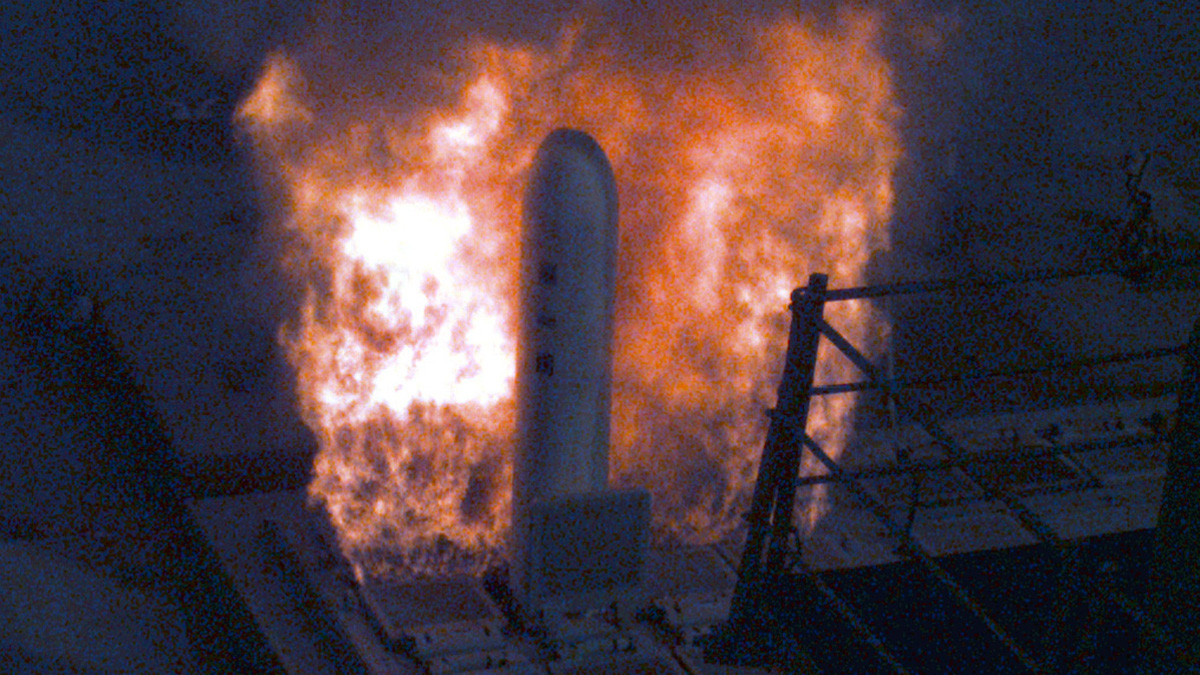
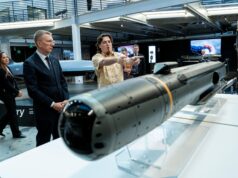
The US Navy has confirmed a major contract modification with Raytheon Missiles and Defense for the production of 350 Block V Tactical Tomahawk cruise missiles, taking the overall contract value to $785.2 million.
The award, published in a Pentagon notice, covers missiles and associated hardware for the US Navy, Army and Marine Corps, along with two Foreign Military Sales customers. It raises the total quantity procured under the contract to date from 131 to 350 and secures deliveries through to January 2029.
Manufacturing and integration work will be spread across more than a dozen US sites. A portion will also take place in the UK, with the Glenrothes facility in Fife tasked with part of the production workshare, reflecting the longstanding transatlantic supply chain for the Tomahawk programme.
The contract lists Glenrothes at 2.9 percent of activity, continuing the site’s role in supporting missile electronics and guidance components. Raytheon’s Scottish presence has been a consistent contributor to UK and US precision weapons programmes, including Tomahawk, Paveway and the Spear family. The Block V upgrade introduces improved navigation, communications and survivability features, forming the baseline for future variants such as the Block Va Maritime Strike Tomahawk (MST).
Funding for the latest order spans multiple services and fiscal years. US Navy procurement accounts for $47.7 million, the Army contributes more than $120 million across FY24 and FY25 missile accounts, and the Marine Corps allocates $82.3 million. Foreign customers are expected to finance nearly $500 million of the package.








I thought Tomahawk production had ceased and only LRASM was going to be produced? If Tomahawk is still being produced then the UK military should definitely order a few.
Horizontal tomohawk production
The torpedo tube launched version that the UK procured ceased production. Thr standard vertical launch version never ceased production, and was never in danger of doing so as far as I know. Japan and Australia have recently placed large orders.
I think the tube launched version may have recommenced production at a later date, but could be wrong.
We should definitely be looking to increase our modest stockpile, even if that means paying over the odds for US inventory.
So there is hope then that type 31+26 frigates could potentially get a load out of tomahawk when they have their mk41 vls tubes fitted. If HMG can just get their arse into gear and actually order something.
If they order that why would the treasury pay for Stratus
If only we were on a war footing.
We could purchase some of the truck based systems that the US army uses and provide a credible conventional deterrent to Putin.
On that the RAF could move to Norway in a crisis. One where the anti ship variety would put the Ru on the back foot.
If only we were on a war footing….
Oh I’m sure we would if there were a threat of the nature that the Govt says there is… oh hang on a minute.
The UK really does need to consider a greater stockpile of these. At present there is no other 2500km range conventional strategic weapon the UK has access to and it should have them in the hundreds.
The ability to hurt Russia is the only way to really have an effective deterrent. We should probably be ordering now because there is a reasonable chance that in a future war with Russia the U.S. may just not sell us anymore (look at Ukraine). The only other question on the board is could the US render them less than sovereign… because let’s be honest so far the only targets we have ever fired tomahawks at are targets the US wanted us to fire them at in support of US policy goals… as our goals become divergent we should only buy them if they are sovereign.
I personally think every part of US tec we buy needs to be looked at in this way… is it possible to ensure sovereign control. Infact I think it now needs to be a standard consideration.. because the way the geopolitical picture is going I’m not sure which future powerblock the Uk will sit in.. will we manage to somehow develop glorious independence ( I think the danger from Russia makes this almost impossible), will we be EU aligned and so In likelihood not close allies with the U.S. if it says on its present path or will we say US aligned and have a more and more fractious relationship with the EU. Because sadly the present option of alignment as close allies with both the US and EU in one happy western family is now sailing into the distance.
We’ll stay NATO aligned. Whether others choose to leave NATO or disregard their commitments is up to them.
Tomahawks aren’t strategic weapons.
Only Block II were capable of 2,500km.
Spock you are confusing nuclear strategic weapons ( which are essentially defined as intercontinental range systems) and the definitions of conventional strategic weapons.. a conventional strategic weapon is any weapon that can attack beyond battlefield ranges and affect a nations ability to support conflict….
“ Chapter 5…A strategic conventional weapon is defined more by its target and effect (striking deep into enemy infrastructure, leadership, or economy) than a single range, but generally involves long-range missiles (often 1,000 km or more), cruise missiles, or advanced aircraft that can reach targets far beyond the battlefield, making them capable of influencing a nation’s strategic potential, even short-range artillery in specific geopolitical contexts.” So yes a tomahawk by its very nature is almost the definitive modern western “strategic weapon”
As for NATO.. sorry but the very moment the US walks away from NATO it ends. NATO is defined by its treaty and its treaty essentially cannot exist without US membership, the U.S. constructed it that way, a number of the articles require US actions. So if the U.S. leaves the members that are left would essentially need to create a new treaty, it would not be NATO and you can pretty much guarantee that the EU will essentially dominate that development..and we would have the choice of joining the a new EU dominated alliance, forming our own with the none aligned nations or forming one with the U.S.. but if the US and EU continue their divergence then NATO will be gone.
Jonathan, on your last point, I think one big variable is that politics in the US, the EU and the UK is shifting at a much faster pace than I’ve seen in my lifetime — which makes any long-term alignment assumptions risky.
Take the EU for example. Right- and far-right parties are no longer fringe protest movements; they’re becoming central players in a number of major states. In Italy, a hard-right government is already in power. In France, the National Rally is polling at or near the top nationally and dominates European elections. In Germany, AfD is now a major national force and is polling first in several eastern states. Austria’s FPO is polling strongly enough to plausibly lead the next government. In the Netherlands, Sweden and Finland, right-wing populists are either in government or propping it up.
That matters because these parties are more nationalist, more sceptical of EU integration, more transactional about alliances, and in some cases less instinctively Atlanticist. So the idea of a stable, coherent “EU position” that the UK can simply align to may be less solid than it looks today.
The same applies to the US. It’s possible that America swings back to a left-leaning administration at the next election, but that doesn’t mean the MAGA movement or the broader inward-looking, transactional strand of US politics is going anywhere. US policy volatility is now a structural feature, not a temporary aberration.
And even here in the UK, the picture isn’t fixed. We could see a Reform-led government under Farage next, which would again pull UK policy in a different direction depending on who is in power in Washington and among the major EU states.
Which is why I’m not convinced the UK’s choice is as binary as EU-aligned versus US-aligned. All three political systems are volatile, and all are likely to look quite different over the next decade. The real challenge for the UK may be managing that volatility — maintaining defence and intelligence ties with both, while accepting that the old assumption of a single, united Western political direction is probably gone for good.
Also, check out the link I sent you about interceptor drones on the other article. I found it interesting and want to know what you think.
Yes the interplay around right wing nationalism in Europe and the EU will be an interesting one.. personally I think it will in the end benefit the EU as it will prevent it going down a rabbit hole of political unification.. which would be a bit of a nightmare from a UK point of view.. I actually think the nationalists movements may just guild it to the place it needs to be, an economic free market backed up by a military alliance focused on European geostrategic needs…
We really should have piggy backed on the order and brought some more. The 60 odd we have in stock isn’t sufficient for a major war scenario.
And launch them from what?
The astute and the upcoming dreadnaughts, plus the p8 are capable of launching them if needed. More than enough platforms, just lack of missiles to do more than an opening salvo.
What about all the mk41s coming on the T26s and T31s? It might be prudent to have some of these TLAMs ready to go, not afterwards. Plus where are the rest of the NSM sets? Only 3 done so far?
I can’t see launching from a surface vessel being overly wise in a peer war, which realistically the only time something like a tomahawk is actually needed over just using jet dropped bombs.
You have no capability for that but good plan
We’re building it
We can’t get any more torpedo launched tomahawks for astute.
Dreadnought will not be using conventional weapons.
P8 can’t carry them
P8 can carry them, the US has them doing so. We just don’t do it.
Dreadnought won’t be carrying many conventional often but in a all out war situation it is capable of doing so if we can get multiple boats at sea
If a war kicks off any extra boat will be putting to sea with more nuclear missiles, to increase deterrence, not being used as an SSGN
That depends on the situation. When needs must options are found.
The key is to have them options available to the planners.
More accurately we can’t do it with P8 because our small stock of tomohawk is all torpedo launch.
Ah ok. I thought I read it was possible to convert them pretty easily but so much inaccurate info out there.
Aren’t we better off with our own cruise missiles? The Tomahawk is a very expensive solution, at $2m unit cost. While it may be the only solution for our current sub-surface fleet, maybe we could look at cheaper indigenous solutions to replace it in future on dreadnought and Astute or the future SSN-A (AUKUS) as well as look at the possibilities for the surface fleet.
The Milanion FP-5 has a unit cost of $500,000 and is a Emirati/British design which has a similar range to Tomahawk and a production line could be set up domestically.
We also have Project Brakestop, which provides a shorter range solution, with the potential to be developed into a longer range weapon. Projected unit cost of that is supposed to be no more than £400,000 ($536,000).
We have the joint french project that will deliver eventually but in the meantime we need stockpiles in case things go south with russia, insanely unlikely but possible.
We have the Stratus project that will deliver eventually, but in the meantime we need stockpiles in case things go south with russia, insanely unlikely but possible.
Although I am unclear on what the range and payload will be on the Stratus
Tomawks are proven but in todays sophisticated ECM capabilities its perhaps long in the tooth although adding a few more to our tiny arsenal is more political sabre rattling than worth real teeth in a full on war.
In the end our armed firces are tiny and insufficient to be able to defend Scotland let alone the entire UK.
We need numbers to increase to 200k ground fighting troops min. Surface navy fleet not less than 50 destroyers and frigates, over 1000 combat aircraft armed with the longest range BVR (Ref PAF Slaughter of the IAF lessons learned) and no less than 1500 MBT, 3000 artillary of various types, huge numbers of ammunition and SSM and 400 drones that will be able to fend off an invasion – forget relying on the Europeans/NATO to defend the UK like WW2 theyll be overun and we’ll be left alone to defend ourselves.
You need boots on the ground in the end and numbers of sustainable military equipment to be able to defend against an invasion is what is needed not just a handful of cruise missiles.