

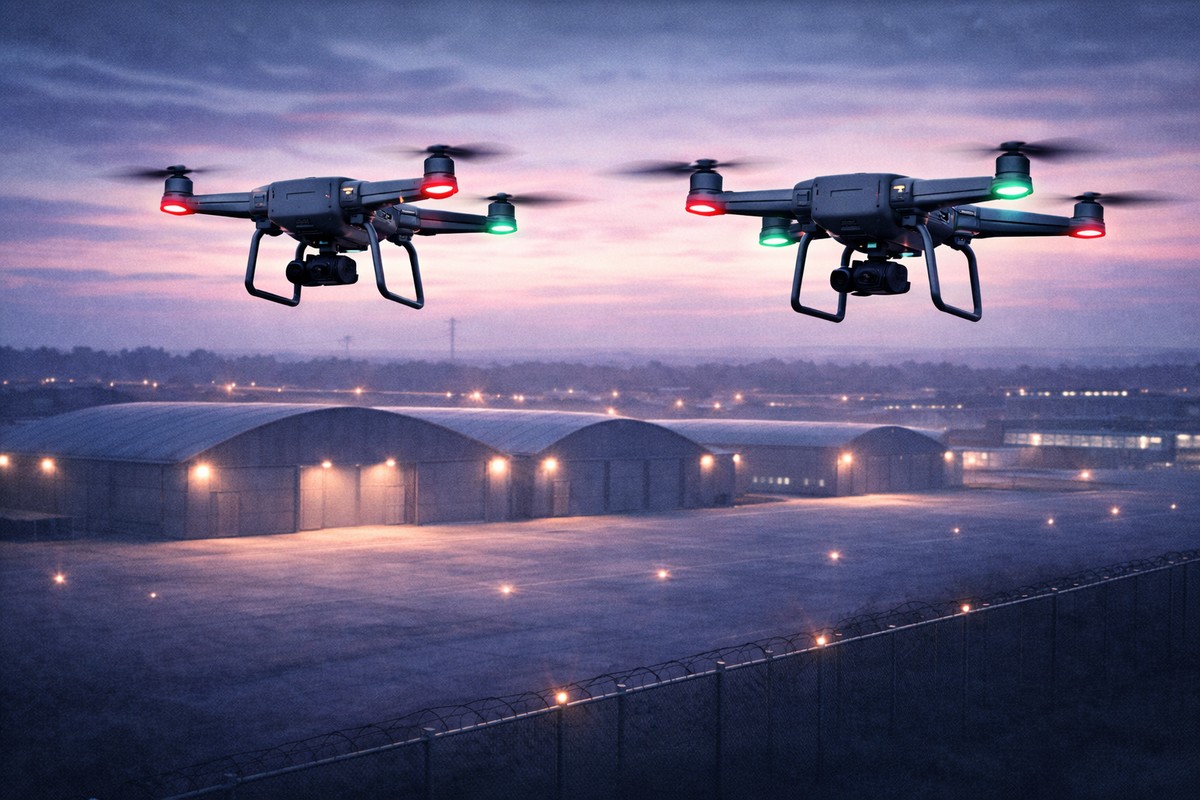
Defence personnel are to be granted new legal powers to counter drones near military sites, following a sharp rise in reported incidents around UK bases.
The measures form part of the Armed Forces Bill, introduced to Parliament last month, and follow confirmation that 266 uncrewed aerial vehicle incidents were recorded near Ministry of Defence sites in 2025. This represents more than double the 126 incidents reported the previous year, highlighting what the government describes as a growing and evolving security challenge.
Under the proposed legislation, authorised defence personnel will be able to take direct action against drones assessed as posing a threat to defence sites, without needing to rely on police intervention. The powers extend beyond aerial systems, allowing action to be taken against land-based and maritime drones, including those capable of operating on or under water.
At present, legislation allowing interference with drones for crime prevention purposes is largely limited to police forces and a small number of other agencies. The changes are intended to allow the Armed Forces to protect their own bases and operations more rapidly and independently.
Defence Secretary John Healey said the rise in incidents demonstrated the changing threat environment. “The doubling of rogue drones near military sites in the UK in the last year underlines the increasing and changing nature of the threats we face,” he said. “Through the Armed Forces Bill, we’re giving our military greater powers to take out and shoot down threatening drones near bases.”
The government says the new powers sit alongside increased investment in counter-drone capability. Spending on Counter Uncrewed Aerial Systems has been quadrupled since the current administration took office, with more than £200 million allocated this year. Ministers argue this reflects the importance of autonomy and counter-drone technology within the Strategic Defence Review.
Recent security measures have included the introduction of restricted airspace around 40 defence sites, the use of drones to guard bases, upgrades to CCTV and integrated monitoring systems, and £20 million in digital investment aimed at modernising base security infrastructure. Automated track-and-detect systems are now operating at several locations, providing continuous surveillance and faster response options.
Healey said these steps were part of a broader effort to improve the protection of defence infrastructure. “The new powers will add to the significant measures introduced by this government to increase the security of military sites, reversing years of under-investment and ensuring bases meet the highest security standards,” he said.





A bit slow off the mark if you ask me. Lightweight drones have been killing people & supplying information in Ukraine (really started in Armenia) since how long ago? Except for the strapped on expensive device, these are much the same & need to be treated as such.
Using Drones to guard bases?
Which Drones? What types have the MoD bought for this?
As for “shooting Drones down” I’d love to see what with?
Physical impact between drones would be my guess.
Can’t imagine using anything that goes bang because of the risk of the falling bullets/shells outside of the base perimeter.
Agree, direct kinetic impact not AA guns, though the later would still be my choice if HMG were ever serious, which we know they’re not.
And where are these anti Drone Drones? Which type, how many have we procured, and who operates them?
Electronic jamming ‘guns’
Yes, the RAF Regiment operate such systems to interfere with Drones.
But a handful operated by a couple of Sqns doesn’t protect the many installations that could do with such assets.
I like to see the reality behind the spin.
It’s 100% spin
Oh, what a speedy response to something that has been known for a while..
I would assume kinetic impact weapons are deemed in most cases too dangerous to surrounding environments. Even electronic devices are going to have to carefully utilised especially if it were a larger drone. If even a small drone was brought down on a nearby road and caused an accident I think we all know what the reaction would be, for good or bad if they get it wrong, will it be restricted to directly over any site, if so could present difficulties at night in particular. So I presume it will very possibly get wound up in red tape and strict processes, but at least a start. Some sort of anti drone drone might give the best option for investigating and safely dealing with them when circumstances are not straightforward.
So can we assume that all MoD bases, large and small and wherever they are, should have ‘detect, warn and track’ equipment..and then some sort of device to deal with the drone(s) – projected net, jammer, kinetic weapon? All would have to be automated.