

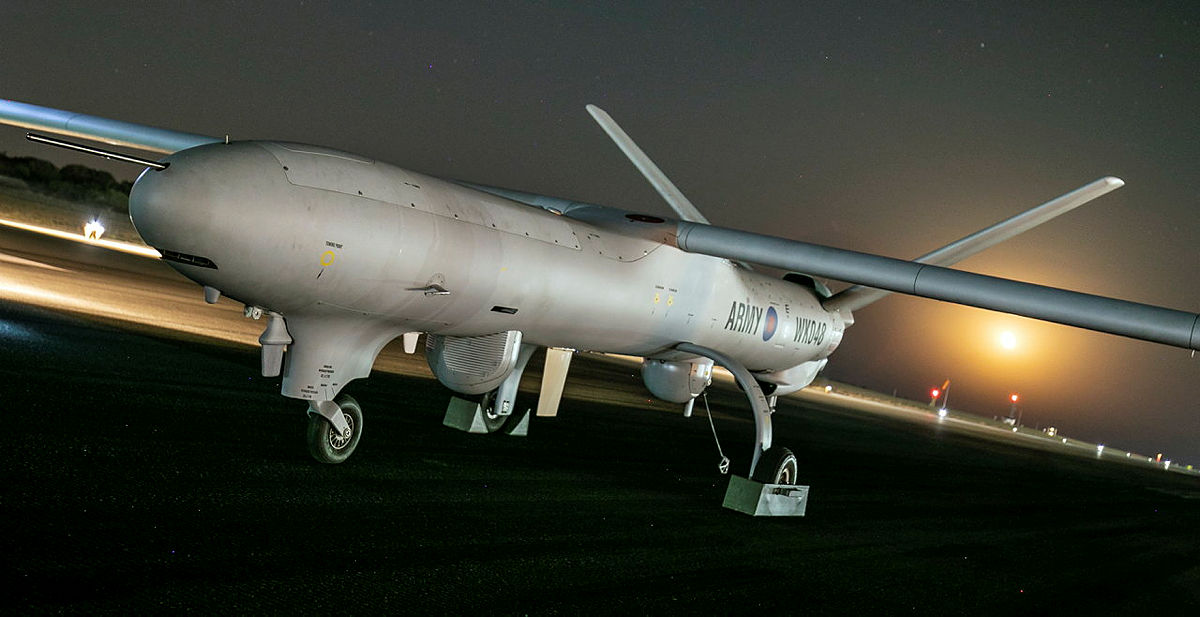
The Ministry of Defence has ruled out gifting the British Army Watchkeeper drone to Ukraine, while confirming continued spending on the retiring system and confirming a delivery date for its replacement under Project Corvus.
In a written response to Conservative MP Mark Francois, Defence Minister Luke Pollard said the government had prioritised newer, more cost-effective unmanned systems rather than transferring Watchkeeper to Ukraine. He said the UK and its partners would continue to equip Kyiv “as best we can to defend its sovereign territory and ensure it is in a position of strength for any peace negotiations,” but added that since Watchkeeper entered service in 2010, “drone technology has evolved at remarkable pace, driven by the extensive use of unmanned systems in the war in Ukraine.”
Pollard said the department had therefore focused on “more cost-effective drones that deliver comparable capability and can operate in the most demanding environments,” rather than older platforms such as Watchkeeper Mk1.
Further answers provided new clarity on the financial tail of the programme following its cancellation. Pollard confirmed that the total budget allocated to Watchkeeper between November 2024, when retirement was announced, and March 2027 amounts to £115.886 million. He said this funding supports the managed withdrawal of the system while the Army transitions to a replacement capability.
That replacement, Project Corvus, is expected to be delivered in November 2026, ahead of Watchkeeper’s planned out-of-service date of March 2027. Pollard said that “with the retirement of Watchkeeper Mk1, the Army will transition rapidly to a new, advanced system that draws on the latest operational lessons and technological innovations.”
Valued at around £130 million, the programme is intended to deliver a next-generation uncrewed aerial system capable of providing 24-hour persistent intelligence, surveillance, target acquisition and reconnaissance in contested environments. The system is designed to support divisional and corps-level operations and to be operated by 47 Regiment Royal Artillery, the unit currently responsible for Watchkeeper. Requirements for Corvus include real-time land and maritime ISTAR, low-latency data sharing across joint and coalition networks, and the ability to operate in GNSS-denied conditions.



I had forgotten this was still going on tbh.
Surely “more cost-effective drones that deliver comparable capability and can operate in the most demanding environments” makes the Windracers Ultra the obvious candidate? British, just as capable and a whole lot cheaper.
Yeah, the Windracers Ultra has two bays underneath that could be used for swappable modules
Three. But the centre bay will most likely be needed for electronics.
That’s a good call. The only two drones that have been certified for use in civilian airspace are the MQ-9B SkyGuardian/ Protector and the Windchaser Ultra Mk2. The RAF have Protector, and the RN are obviously considering Windchaser after having one land and take-off from Prince of Wales.
what about the Tekever AR5? Isn’t that being flown almost daily off Dover in support of border force?
Just checked, yes that’s been approved by the CAA so it could be a contender too, though perhaps a little on the small size compared to the other two options.
So its a nice simple Ultra mk2 procurement…
That is until the MoD get involved, then they will want 3 engined, 5 equipment bays and 3 fuselage mounted saddles, so specially trained monkeys with binoculars and radios can be used as an analogue backup.
I believe the Ajax programme team have just been reallocated to the monkey training team, as they have current experience in all aspects of monkey business.
Why would the Windracer be any more survivable than Watchkeeper?
Probably wouldn’t crash randomly as often, does that count?
It’s mostly the lower cost, that we would be able to continuously replace attrition for much less than the unit price of Watchkeeper.
I think that’s clearly the key mate, cost.
Tier 1 and 2 I think they’re classed as.
I’d be interested to know what will happen with the Watchkeepers. I think I heard they won’t go to Ukraine. If this is because of sensitive tech – could this be stripped and send the airframe and engines and let Ukraine do the rest. Will they be mothballed could they be re-rolled, or sold?
While the explanation has logic, being of Israeli origin I wonder if we were even free to send them to Ukraine? Israel has done everything it can not to upset the Russians over the years as revelations this weekend from the Epstein Files only further signify.
Amazon delivery’s??
They cannot be used freely over the UK apart from a couple of areas of controlled, restricted airspace, such as over Aberporth and SPTA.
There’s still loads of Danger Areas on the Air Charts including offshore ranges available so surely more than a couple…
I guess they have no use for HIRTAs, but that still leaves plenty that are off limits to civilian air traffic.
Yes, there are lots of ranges, danger areas, and such, 16 are operated by Q for the MoD alone.
I referred to those specifically set up for Watchkeeper though. Aberporth, obviously, as that’s where it first flew in the existing old DERA ranges from Aberporth airfield. And then SPTA, as a box of that airspace was created for it flying from Boscombe and then a grass strip at Upavon.
There were plenty of headlines at the time about this with Amesbury, Old Sarum and Salisbury close to the box and the “usual suspects” jumping up and down about privacy and supposed spying.
Our weather was crap, plus the pilots were struggling, so it moved to Cyprus and Ascension as well.
I’d think they’ll all be scrapped myself.
Thanks for that interesting detail.
UAV operations in Ukraine have shown that the ability to fly day, night, and in poor weather is a life saver. Anything that can’t fly on optical, infrared and with modular sensors and payloads is just not good enough.
I’d agree that Watchkeeper sounds last century and very little use in Ukraine that already has FPV, ISTAR and long range precision fire UAV in active use and continuous improvement.
Slava Ukrainia 🇺🇦 Heroyam Slava.
Replacement by this year. A survivable drone in contested airspace is more expensive.
This is the point, they are by their very nature in the firing line, a slow moving fairly large asset that has to fly straight into the teeth of an air defence network.
Ukraine shows us that a systems Watchkeeper will simply be shot out of the sky.
So they have to be cheap enough to be replaceable on a fairly regular basis.
Quite. And do we think buying 24 Windracer as part of Corvus will accomplish that?
It’s just another target, albeit cheaper.
Those 24 will be gone in a week.
Yep, spot on mate.
Please remember that SDR has the approach for UAV future war:
– Innovation hub(s)
– Build at scale not to stock
.
.
So small orders to keep the innovation pipeline hot make sense, and in no way represents the scale that’s required for a hot kinetic war.
For comparison, AFU UAV plans:
2024 1 million
2025 2 million
2026 5 million
So ramping scale exponentially. Excludes private donations so will be more in total. Excludes UGV.
#414MagyarsBirds rule the sky.ua
Nice way of saying they are completely redundant / obsolete, in the modern era and should have been replaced a while ago.
Will the Windracers Ultra referenced above be any more survivable?
The Watchkeeper platform itself is vulnerable, as are most assets, but I don’t believe it’s ISTAR fit was obsolete? I’d read it was queuing targets for Apache before it got the chop.
And I read Corvus might only procure 24. Another 50 % plus cut straight away.
Goodoh.
No idea,.but the response clearly indicates it would not be of any use to Ukraine, as it’s out of date for the modern environment.
AFU already operate an UAV sensor network with ISTAR overwatch, FPV strike, UAV drop munitions and integration to field commanders so they don’t get surprises.
This extends from the contact area (no longer a contact line) back to the logistics and assembly areas up to 20km deep. Further strategic planning and strikes into the military and production sites in the rear beyond 100km.
So Watchkeeper is outdated as you say.
FP-1, FP-2, FP-5 are eliminating billions of high value targets, mainly GBAD and Artillery with command and UAV control centers too. Hilarious irony that Pansir and S-400 can’t hit the FP-* sent to destroy rhem. Export sales …. No.
What isn’t immediately clear is why the s400 are failing. Something we will have to wait a wee while to discover. One theory is Ukraine is sending drones in at short range inside the min operating window, another is saturation attacks. Most likely they are just rubbish but we won’t know until the war has ended and decades after that when historians look into it.
I suspect that AFU know a lot about S-400 capabilities so have designed their countermeasures to those limitations and common operator errors. I can’t prove they have any tropies to study, but that’s possible too.
The previous focus on attacking Crimean GBAD not only provided battle damage assessment but mission package assessment to learn quickly what works.
Were RAF RC135W Rivet Joint watching closely?
You might think that, but I couldn’t possibly comment…
The video of S-400 GBAD operations against AFU long range precision fires shows failure to launch correctly and failure to strike the target, preferring random trajectories into surrounding buildings. Not really defence in any conventional sense.
Surely the point of multiple storage bays are the flexibility of EW countermeasures so that rapid updates are possible to stay ahead of GBAD innovation..
That’s what AFU are doing with some success.
Like Ukraine would want them – gimme a break
I thought tiers 1 and 2 cover little disposable FPV drones, while Protector/MQ9B are up at the top end, medium altitude, long endurance ISR drones, classed as tier 4 or 5.
I may be wrong, haven’t checked it out for a while…
Essentially correct mate.
Tiers 1 to 3.
1 is disposable, and losses are accepted and expected, so need a lot.
2 is attritable, but would of course be better of not lost.
3 is top end, minimal numbers. “High demand, niche, exquisite” just some of the terms used by the MoD spin machine. Equals in some cases, HMG won’t buy enough, especially regards the assets in FAT described as “high demand.”
So what’s this?