

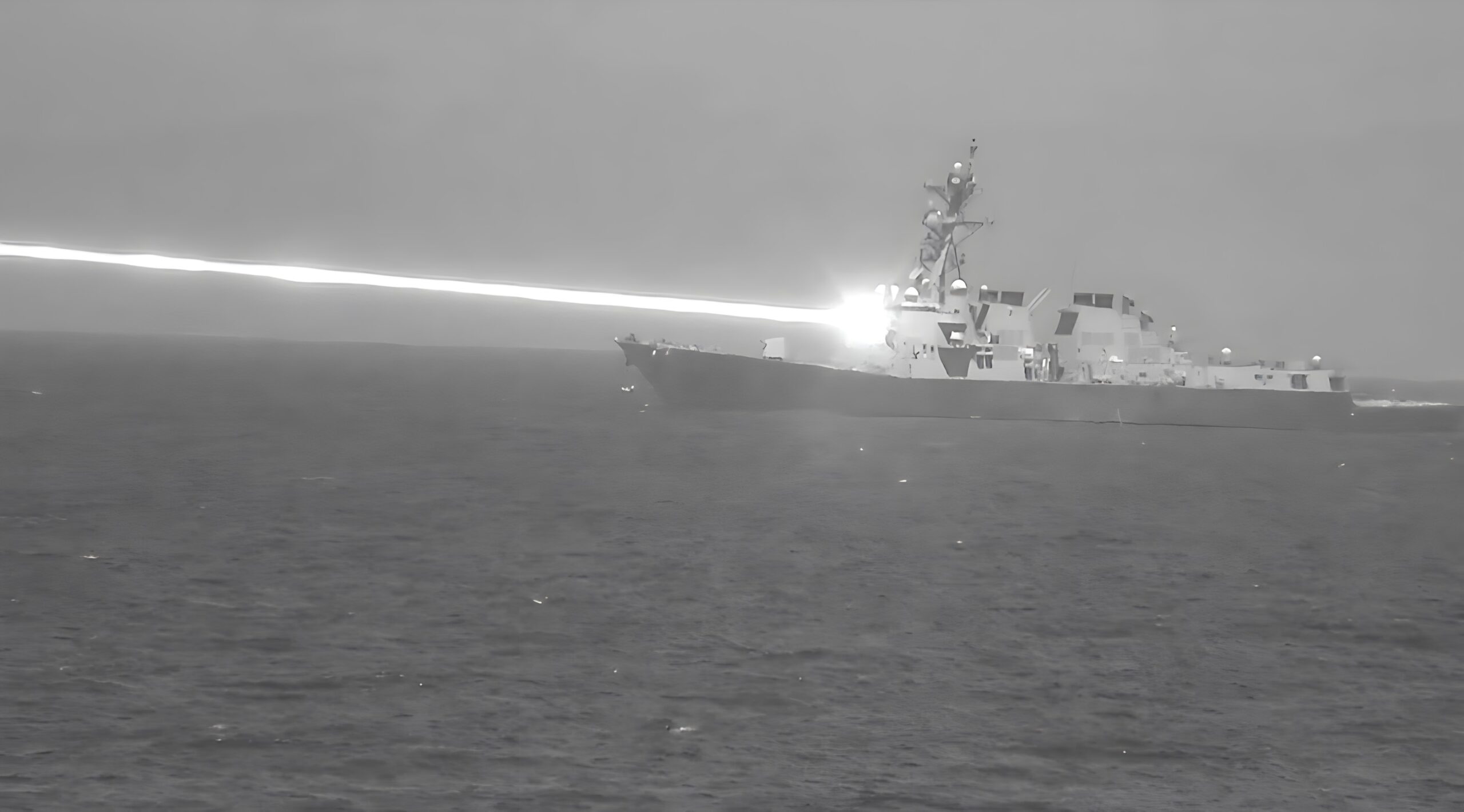
The US Navy has confirmed that a frontline destroyer has successfully used a ship-mounted laser weapon to defeat multiple uncrewed aerial threats during a recent at-sea demonstration.
According to Lockheed Martin, the Arleigh Burke-class destroyer USS Preble employed its High-Energy Laser with Integrated Optical Dazzler and Surveillance system, known as HELIOS, to engage and neutralise four drones during a Navy-run counter-UAS event. The activity took place last year and was disclosed publicly as part of the company’s latest financial update.
Lockheed Martin chief executive Jim Taiclet said the demonstration showed how lasers could provide a practical alternative to traditional missile-based defences for close-range threats. He described the system as having successfully knocked incoming uncrewed aircraft out of the sky, highlighting the potential to conserve expensive interceptor missiles for higher-end targets.
“Speaking of amazing technology, we successfully used the shipboard laser system, Lockheed Martin’s Helios, to knock an incoming UAV right out of the sky. The Helios weapon system successfully neutralised four drone threats in a US Navy-operated counter-UAS drone demonstration at sea, showcasing an opportunity to eliminate drone attacks using lasers and saving US and allied air defence missiles for more advanced threats.
This development of laser weapon systems is just one example of Lockheed Martin’s support of the Homeland Defence Mission, including Golden Dome for America. We also continue to collaborate with government and industry in our prototyping environment at our Center for Innovation in Virginia to support the command and control aspects of Golden Dome.”
HELIOS is a roughly 60-kilowatt class laser integrated directly into the Aegis Combat System, allowing it to be operated alongside conventional radar, sensors and weapons. Installed aboard USS Preble, a Flight IIA Arleigh Burke-class destroyer, the system is designed to perform both so-called soft-kill functions, such as dazzling or degrading optical sensors, and hard-kill engagements by heating and damaging the structure of a target.





Snazzy of them. Hopefully we’ll see a similar headline with a British Destroyer and/or Frigate test firing on drones. Not too shabby our own platform is this close to the USN’s version.
4 drones ? that’s nearly a bleeding Swarm !
This initial system is 2.5x more powerful than DragonFire
Ah but ours is “Ten Times as lethal”.
HELIOS is allegedly 60 kW and Dragon is in the 50 kW range according to Wiki. 2.5 times?
Where does that stat come from? As I understand it Helios is a 60kW class laser and Dragonfire is 50kW class. Has Helios output been upped recently?
The absolute power isn’t really the defining factor.
How well the beam is focused, beam diameter and tracking stability are more significant factors.
Indeed. The demonstrator on USS Ponce didn’t manage to cohere the beams even. Presumably they’ve improved since then.
Currently a Helios Mk 5 Mod 0. The laser on the USS Ponce was the earlier 30kW AN/SEQ-3 Laser Weapon System (LaWS), installed over a decade ago. So this is definitely a step up.
Reputationally, Dragonfire has the tighter focus; however, Helios is designed to take an increased amout of power, up to 150kW. I’ve not heard anything about that upgrade having happened.
Maybe confusion between total power draw and actual beam power? 30% efficiency is about normal for a fibre laser.
I think ‘Just me’ has slightly confused matters unless UKDJ itself have got it wrong. Helios certainly has plans to take it up to at least 150Kw with eventual ambition for US lasers to reach 300Kw in the long term future, though that may be something new or presently undefined. Now I will admit, they have tested a shipboard 50Kw version a good while back though ‘test’ is rather nebulous in nature so not sure what that involved. I had thought however that they were now aiming for this system to hit at least the 100Kw range for future tests (maybe ‘Just me’ got a similar impression), so I was surprised to hear the 60Kw figure. But as others have said out and out power is only part of the effectiveness of a laser weapon anyway, Dragonfire aims to scale up, the Australian laser recently tested is 100Kw I believe though only land tested. Maybe accuracy, effectiveness and overall reliability at the 60Kw level was the emphasis here and certainly a 100Kw laser is going to test a current ship’s systems and energy sustainment so that might be a consideration too. Would be interested to get a more in depth explanation however
Mate, someone has stolen your “Y” 🤔😁
Must have been redacted, seems to be all the rage lately. 🕵️♂️🔍
I caught the culprit. He shall remain nameless however so as not to damage the reputation of the victim of this heinous crime. 🥸
😅😅
I was deeply concerned…
It’ll be a brave Commander who orders weapons tight against an incoming drone except for the lazer.
“Don’t launch any ESSMs against that incoming missile for an intercept at 40km. ESSMs cost $950,000 each! I have a 40% chance of a mission kill with HELIOS at ranges between 8km and 1km. Don’t worry, I got this. Hold my coffee.”