

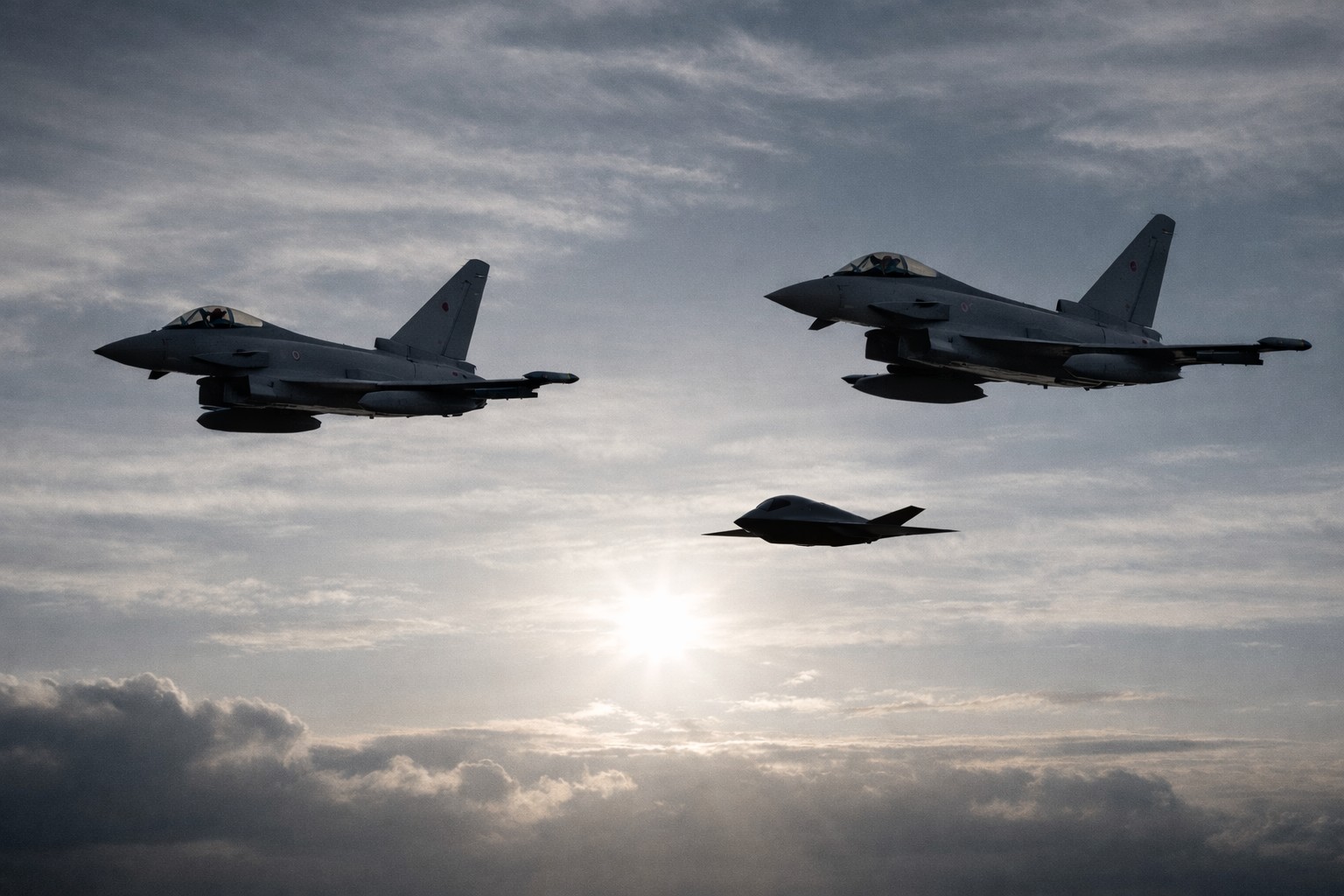
UK defence strategy remains anchored to an outdated model of heavy industrial procurement that is ill-suited to the pace of modern warfare, MPs were told, with witnesses warning that future conflicts will be shaped by rapid prototyping, software-driven iteration and industrial agility rather than decade-long equipment programmes.
Giving evidence to the Defence Committee during its session on the future of warfare, Air Marshal (Retd) Edward Stringer argued that the UK is still designing forces around Cold War-era assumptions centred on large platforms and prolonged specification cycles.
“We are so orientated around designing things that require cutting big amounts of steel,” he said, “agreeing a specification, and then having lawyers argue about it for 20 years.”
Stringer said this approach is fundamentally incompatible with the speed at which modern conflict evolves, particularly in areas such as drones, autonomy and digital systems. Instead, he urged the UK to adopt a model drawn from the software sector. “We need to work out what prototype warfare looks like,” he told MPs. “Create a minimum viable product, get it out to the frontline, get clever young troops working with it, and then send the results back to industry.”
He warned that attempting to define precise requirements a decade in advance was increasingly unrealistic. “You’re trying to work out exactly what you need and then find a way of building it over the next ten years,” Stringer said. “That’s not going to work.”
Pointing to the Strategic Defence Review, he argued that even official policy now recognises the problem. “You cannot define over a ten-year timeframe exactly what you’re going to get,” he said. “You need a system that can build capability possibly only minutes before you actually need it, given the speed design is getting.”
Stringer also challenged the way defence industrial strategy is often framed, arguing that government should stop attempting to pick winners and instead focus on enabling conditions. “The defence industrial strategy is not about picking winners,” he said. “It’s about creating the financial conditions for industry: energy supply, energy costs, compute power. Government needs to set the conditions and then get out of the way.”
Jesse Norman MP suggested that current defence and security strategies were structurally misaligned with the realities described by witnesses, a view Stringer explicitly endorsed.
Sir Hew Strachan, Professor of International Relations at the University of St Andrews, reinforced the argument with historical context, noting that rapid iteration between frontline experience and industrial response has been the norm in major wars. “In wartime, procurement cycles are measured in months,” he said. “There’s continuous feedback from front to rear, design and adaptation, and we’ve lost sight of that entirely.”
Strachan also warned that industrial dependence on allies carries strategic risk, particularly in scenarios where major partners are engaged elsewhere.
“Even the United States does not address its own lack of capacity for the threats it says it faces,” he told MPs. “If it were engaged in a major war with China, it simply would not have the capacity to supply others in the way it does now.”
The discussion also touched on sovereignty and foreign ownership in emerging defence sectors, including drones. Asked whether domestically based subsidiaries of foreign firms should be considered sovereign capability, Stringer said the answer depended on control rather than geography. “It could be either,” he said. “Who owns it? Who owns the output? If you generate the intellectual property and it goes overseas, that’s the real question.”











Plant more trees, we can build drones out of wood.
Well, the next light aircraft trainer under Project Telum could be using plant-based composites made with bio-resins. But could be marketing spin.
Well as long as It’s solar powered, It should get funding.
haha. It looks like hydrogen is the direction.
It’s all up in the air at the moment !
I was thinking just that. Drone Balloons are where its at. No need for land based operators. Highlevel operation. Low radar image is made of correct material. Children can launch them
light aircraft trainer will be still need to be procured RAF UAS, even if at smaller numbers.
In all fairness many native tree species mature quicker than a modern British AFV programme
😁
Plant more sheep and we can knit some.
Absolutely eh? Let’s have no more ships planes or armoured vehicles. Let’s have nothing, knowing we can 3d print anything we want within days to do the job.
AA
If that’s where we are at then it’s a good idea. If a frigate can be sunk by a remote controlled boat, then maybe we should be changing the way we think about what we build to fight wars.
A frigate cannot be sunk by a remote control boat unless your utterly stupid and let someone drive the remote control boat into your frigate.. a well positioned frigate would never be at risk from a remote control boat.
What can a remote control small boat really do.. travel a couple of hundred kilometres in low sea states at maybe 15kns.. that does you sod all good against a surface action group 1000kms away from land.. cutting off your sea lanes.. all the while hiding behind the radar horizon and bombing around at 20+ knots.. and if you even get your drone within that radar horizon the surface action group can deploy any number of kinetic systems to kill it before it gets close.
Well maybe we aren’t fully aware of what the latest remote controlled boats are capable of. And maybe some of the people who make decisions are. It’s easy to just assume everyone else is stupid.
It’s pretty much out there what that they can and cannot do.
China have been doing drone ships and boats longer than anyone else.. they have not serial produced any of them.. instead they are knocking out SSN, electric submarines, frigates, destroyers and carriers like no tomorrow
They have also never really used any of them in combat.
Nobody has used true autonomous vessels in combat.. Ukraine use short range one way suicide surface drones.. essentially radio controlled boats..
Although not so much for sinking frigates, the Russian Poseidon nuclear-powered torpedo drones worry me a bit, which is what I’m sure they are supposed to do. If they actually exist, using Ukrainian suicide boat tactics with what’s essentially a small, AI-driven, unlimited-range nuke, should worry us. I hate yet another blurring of the lines between nuclear and conventional warfare.
I think the suggestion is a little more nuanced. I think it’s a case of having a ‘production line’ producing a constantly evolving product. The MoD has purchased 8 identical Type 26 frigates and 5 identical Type 31 frigates. Tell BAE and Babcock to keep building these but, allow a feedback loop to form where the first ships Coy can send in observations and suggestions for incorporation in units 3, 4, 5 etc….
(Psst, I think you might find that Feedback has been given since the days of Coracles).
T21’s were prime examples.
Sadly, I don’t see it that way. All 8 of the Type 26s will be exactly the same despite the fact that since the ‘Global Combat Ship’ was first conceived, the world has changed. For instance, it’s far more likely now that the T26s will spend more time on ASW duties and not ‘globally combating’! The 5″ gun is therefore fairly irrelevant and could be swapped-out for something more relevant to them operating alone. With the threat from drone swarms, perhaps a 57mm with 3P ammunition would be more in keeping?
Not sure what you mean about the Type 21s? Bought virtually ‘off the shelf’ as a stop-gap between Leanders and the (delayed) Type 22s. Popular with the ship’s coys in peacetime but a little bit vulnerable. All 8 of them built to the same design with little room for improvement after the experience in 1982.
What I meant was, lessons learnt from T21’s design, were applied to say, T23 and T23’s today are virtually nothing like they were when built. Thats “Feedback” in action. (that’s just an example). I’m sure that T45’s also benefit from the same “Feedback” not just power gen but missile type and capacity.
It’ll be Interesting to see just what comes of the long awaited DIP.
I suspect halfwit was referring to the Type 22, delivered in three batches with significant differences between batches (and between individual ships in batch 2).
Your comment about the irrelevance of a gun is interesting in the context of the Type 22. Wisdom at the time was that guns were outdated in the then-modern context so batch 1 and batch 2 had no gun. The Falklands conflict demonstrated how you never know when a big gun might come in handy, and you never know what you might use it for (keeping Argentine soldiers awake night after night so they were exhausted before we landed our troops). Hence batch 3 moved the missile launchers to make room for a Mk 8, and the specification for the Type 23 was also adjusted to include a gun (and the ability to be self-sufficient for air defence).
He must be reading UKDJ and it’s strange fascination with Iron alloys.
Our tanks use ceramic armour, our planes are built from carbon fibre. We use less than 10,000 tonnes of steel a year to make warships.
It’s beyond me the fascination men of a certain age have about iron alloys like it’s 1914 and at the fate of the nation is in the hands of the grand fleet and its big guns.
Why does no one ever seem to get upset about tungsten or aluminium production or our supplies of uranium or gallium. All of these metals are much more important and much harder to source than Iron.
Well I get most upset when Americans say “Aluminum”.
Does that count Jim ?
How many AFVs did the Allies lose 1944-45? Over 10,000.
How many AFVs have the Russians lost in Ukraine? Oh! Over 10,000.
That’s a lot of steel lost in the kind of war we know we may have to fight in 3-5 years time.
Makes me laugh…
UK mod has a pretty decent success rate when uor or rapid procurement has been authorised by gvmt.
Mod still has narrative implying they prefer to make small, rapid purchases to meet immediately percievedoperational requirements rather than long lead lead troubles.
At least the report identifies gvmts as being the main hindrance
If UK procurement is actually oriented around “big steel” acquisitions then one might expect at least one major surface ship to have been delivered over the past decade.