

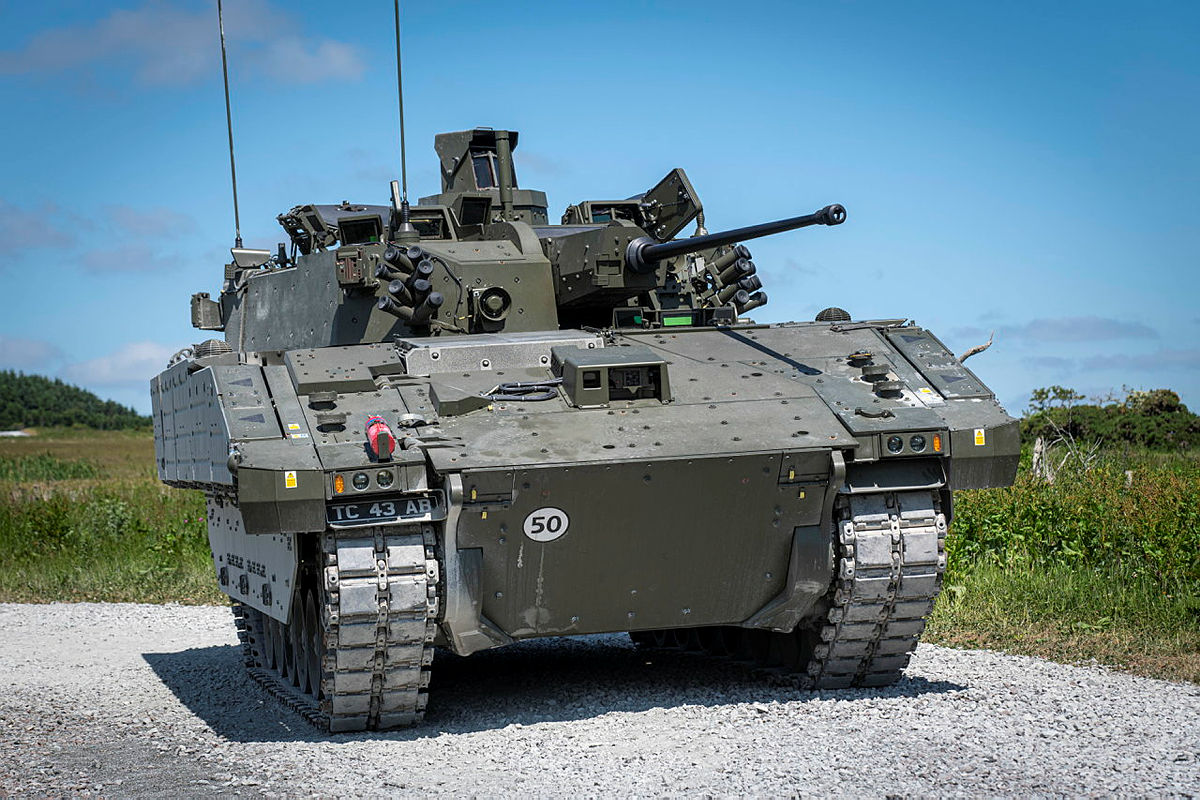
The British Army’s first 100 Ajax armoured fighting vehicles are currently not in service with any unit as they await planned upgrades, the Ministry of Defence has confirmed in a written reply to Parliament.
In an answer published on 6 February, Defence Minister Luke Pollard said the majority of the first 100 Ajax vehicles were withdrawn from units in 2024, with the final example taken out of service by 6 Royal Electrical and Mechanical Engineers (REME) in October 2025. He added that the vehicles are now located in Merthyr Tydfil, Llanelli and the Bicester Holding Area “awaiting planned upgrades to meet the requirements for the current Capability Drop level before being delivered into service.”
The programme has been repeatedly delayed; initial deliveries were originally planned for around 2017 but did not materialise until the mid-2020s, with final delivery of 589 vehicles now expected by the end of the decade.
The description of the initial 100 vehicles reflects that those early examples have not yet been finalised to the Army’s intended standards. Despite Ajax being declared to have achieved Initial Operating Capability (IOC) in late 2025, that status has since been formally withdrawn by ministers following safety concerns. Defence Secretary John Healey told the House of Commons Defence Committee that officials “didn’t have the full facts” ahead of earlier decisions about Ajax readiness, and that the programme must now be “backed or scrapped”, with safety for personnel the overriding priority.
The programme has faced persistent issues with excessive noise and vibration, which in training exercises have been linked to dozens of service personnel becoming unwell, reporting symptoms including nausea, disorientation and hearing problems. In response to such incidents, the Army halted all Ajax use in training and testing while safety investigations and reviews were carried out.
Earlier reviews also identified shortcomings in how safety concerns were communicated within the Ministry of Defence, leading to the removal of the senior responsible officer for the Ajax armoured vehicle programme. Pollard confirmed the dismissal after it emerged that known safety issues had not been fully escalated to ministers before the platform was declared safe for use.



Why, what’s wrong with them ?
Progress? Sounds like they have been able to link at least one root cause to a manufacturing batch and identified a fix – the early hulls?
Withdrawn in 2024, does that mean they are not the hulls that caused illness in trials?
I think there were trials illness problems with the recent ‘drops’. It looks like they have decided to make Ajax work; unsurprising since we don’t have any money for a replacement, which anyway would take time we don’t have. I think they are adopting the sort of approach you would if you had a problem or bug with a piece of application software….the first step is to update to the latest release – bring the early models up to the latest drop standard. Narrow down the issues to hopefully minor easy to fix ones.
Hope so. I read onto “Drop 4” now.
I think what’s happened is that the army knowingly specced a vehicle that was at the weight limit of what could safely be achieved with passive suspension. Any manufacturing quality problems were going to cause problems, and did. It’s interesting to note that BAE developed active suspension for the later, heavier CV90 versions. I think we will end up with something acceptable but the crews will have to observe some operating guidelines; rev / torque limits over some ground conditions so as to avoid resonant vibrations.
Paul, the Army (specifically the relevant Requirements Manager) state a number of requirements in a Key User Requirement document (was a Staff Requirement (Army).
It is up to manufacturers who choose to make a bid to propose kit or a solution that can meet those requirements; GDUK stated that they could build a suitable family of vehicles taking ASCOD2 as a baseline for development.
It us then up to Ministers to make a decision as to who won the Bid.
The blame is on GDUK for failing to build acceptable vehicles and on Ministers for choosing the wrong company.
Blame on the army is for slack Project Management and failing to be assertive enough in their briefings upwards to Ministers on the developmental problems.
Clear and fair enough summary Graham. I am falling into my old trap of overanalysing things. Dogged persistence all round is the name of the game now.
Hate to burst your bubble but these 100 vehicles are sitting outside in the Welsh rain waiting for a decision to upgrade.
Quick! Send for a choir to cheer them up 😂
(psst Paul, Grinch doesn’t like humour, just sayin).
Well, I sympathise. This rain is enough to dampen anyone’s spirits. Still…onwards and upwards. It’s not all bad…Back to the rugby…Italy 15-7 up on Scotland. 🙂
I believe that there are some lovely new sheds over at Ashchurch, which could house….a few of them.
No this was always the plan the first drop vehicles were not final spec vehicles ( they did not have the full armour spec and a few other things). They were built for the army to play with but always had to go back to be made operational vehicles.
Thx. I don’t this invalidates the logic of my post though. Get things up to the latest spec so you have a clear view of remaining issues.
It would be interesting to know which drop vehicles they used on the exercise that highlighted all the problems.. I suspect it’s across all drops unfortunately.
Probably. I think the weight of the vehicles is just too much for the suspension. This article makes an interesting read.
As always, insert the point before the com
interestingengineeringcom/military/f1-engineering-turned-the-cv90
Apparently the issue is also with the lighter APC as well.. which is 7-8 tons lighter.. I did read that a key issue was related to the really poor construction of the hulls.. miss alignment and poor weld quality..essentially bad manufacturing has lead to a catastrophic mix of issues that affect different vehicles in different ways but all end in noise and vibration harm to the poor soldiers nervous systems…
Proudly made in the UK
Or in this case utterly bolloxed in Spain.
What’s right with them you mean
Surely, you are joking? Google reports ad infinitum about this sorry shit show. Essentially SA80 all over again. I hope and expect a fix can be found but why do we have to put ourselves through this labyrinth of incompetence and lying so often? Wirkd beating systems my arse, SA80, Nimrod AEW, CDaring class engines, Ajax. Thank God there are some bright spots.
We should just drop it and buy the new light tank from the americans.They have one hundred of them that they’re not using
Oh no. Not the comfy chair! They need to stop patching.
Even now we still hear about the weight issue! Is it not possible to install heavier rated torsion bars and new shocks up to the job?has this been done and reported because all I can find is that they have replaced the shocks but they are still bottoming out and not up to task!
As far as i am aware the Booker m10 had the kind of upgrades that the Ajax most likely needs. Such as a much better suspension which is ready to buy off the shelf , and maybe rubber tracks .
Use horses, far easier and only need hay.
Russia has been seen doing just that, due to their own vehicle issues aka they all got ko’ed
Judging by the appalling death rates in cities during Victorian times much due to diseases from horse shit I suspect the health issues associated with large adoption of horses would far out way those of the Ajax. Boardwalks and pavements came about as a direct need to separate humans from their effluent it was so dangerous. Make a change from bullshit mind.
Obviously, no alternative but to rework. Considering an alternative tracked vehicle would take at least 4/5 years considering the establishment of a UK plant and pre-service prep and training. An Ajax rework could be concluded considerably quicker than that.
Closer to 10-15 years, as first would have to be selected which alternative vehicle and that would require many rounds of testing and probably even before that an updated requirements document would need to be defined.
Steve, I’m always optimistic.
Steve, if Ajax is canned, and I doubt it will be, the biggest problem is finding another £6.5bn from Rachel from Accounts when she has a black hole. (No sniggering at the back!)
UOR procedure would have to be invoked, and this has been done before when no kinetic conflict involving the BA is ongoing, eg Stillbrew armour on Chieftain. UOR would cut the acquisition process time of suitable vehicles down to months albeit further time would elapse on producing said vehicles (CV90 recce?) in the factory; they would then have to be ‘Britishified’. Possibly some relaxation of the original Requirement might have to be considered and capability enhanced of restored by spiral devlopment.
We will have to see, the economy is at last recovering and starting to grow, which means more money available.
Yeah If its any good at the end of it or just throwing good money after bad. I would have really hoped that over the last couple of years (at minimum) the MoD/Army have been at least looking at , maybe even proof testing, other off the shelf options (and there are now a few) to see if they could at least ‘do a job’. There is nothing that has been said to date to that will convince me this vehicle will actually ever go into full service and , even if it did, that it would do the job it was intended for with any level of success.
I would be surprised if a lot of research hasn’t been going on in the background. We simply don’t know however, the writing has been on the wall for some time that the Ajax programme was problematic.
This particular bit was always planned. The first drop vehicles were not up to operation specification in lots of areas including protection.. they were given to the army to play with and hurt itself on. The plan was to always send them back to the factory for full upgrade.
On a bright side, if and it’s a big if, they manage to find the fix and it’s not too major, then 100 hulls are ready. That is a decent start.
That depends on how you define ‘ready’. The upgrades needed might be such that those hulls might be very difficult or even near impossible to upgrade to it. The fact that we have now had years of doing as little as possible physically to the base platform to negate these issues, doesn’t give me great hope the real solution whatever that may be, is going to be insignificant or perhaps even viable on existing hulls.
Yep, hence the big IF.
This isn’t fixing the “Ajax” major issues, it’s just bringing the 100 up to spec with the others
What upgrades, and who is paying for them?
If the problem is weight from all of the additional armour and the CTA40, the army should maybe consider dropping some of that extra armour if it wants functional vehicles out of the platform.
The large protruding sections on the side are presumably some type of add-on or ERA armour package not featured on any other ASCOD or ASCOD 2 variant; photos from 2016 show them covering the entire side of the vehicle, while later photos have only the upper hull protection. Presumably this was reduced in an early attempt to rectify the issue, but at this stage the entire extra armour package likely needs to be dropped just to get the vehicles usable.
You are misinterpreting those pictures. The full side applique armour come in two parts. Sometimes only the top half is fitted and other times both the top and the bottom.
And most times neither sets are fitted and just a top section of mostly storage bins are installed. This is the peacetime configuration.
I’ve not seen any photos of the full armour kit in use since 2016, but if I’m wrong about that, then fair enough.
I don’t believe I’ve seen any mention of whether or not the vibration issues are significantly worse with the armour kit, but if the vibration issues remains prevalent without it, Ajax is going to need some serious modifications to ever be fit for service
Look harder. Recent Ajax with NEMO had a full set as did Ajax at DSEI. I’d post pictures but they don’t like that here.
wwwdotdefensadotcom/adjuntos/2(4638)dotjpg
Someone explain please. 589 is requirement. Originally it was hulls being out of alignment. 100 are usable. Surely the next 489 probably with up graded suspension can go ahead minus the faults ? 489 is better than 0.
That requires them to design and fit upgraded suspension first, and then test it to make sure it actually fixes the issue.
About 150 have been delivered I believe so this sounds like a sidestep answer to me.
This article is puzzling. The Minister, Luke Pollard, talks about the first 100 completed Ajax vehicles merely awaiting an upgrade to the latest Capability Drop standard, some of which have been waiting since 2024! Why have they been waiting so long for Technology insertion? Gives spiral devlopment a very bad name, especially as the vehicles have been parked up for a very long time (up to 2 years?).
The far bigger issue, seemingly not mentioned by the Minister in Parliament to give a rounded and full answer is that IOC for all the Ajax familiy has been withdrawn and the said Minister and/or Healey is waiting for reports before making a decision as to whether to ‘can’ the vehicle or proceed with as yet unspecified fixes to properly this time cure NVH issues.
Fair enough to answer the routine upgrade question but don’t ignore the ‘elephant in the room’. It’s about time we heard Pollock tell us what his timeframe is for receiving reports and making his ‘Do or Die’ decision. Discussing far more routine tweaks is a distraction.
Welcome to UK politics where transparency, integrity and honestly come to die.
I would suggest it’s because the latest Capability Drop standard does not fix the problem. There is little point in upgrading these to there if you then need to upgrade them again. Do it once & do it right. What right is, is not too clear at the moment (I would have cancelled it 10 or more years ago if it was up to me). It had dud written all over it. A cannon you can’t afford to fire & double its weight without going back to first principles.
German Lynx appears to have done that & Korea shifted its reference from K21 to K9 to make the Redback once they realised where it was going to end up weight wise.
Let’s just replace them with a mega AI or something
Looking like whatever we do with Ajax. It’s never going to be right. Get rid or the nightmare goes on .
Our defence news these days seems to be either denials (“the UK won’t be doing this even though it makes sense/we said we would”), delays (“we’re still waiting for them to be fixed”) and reviews (“we’re going to do really well… at some point”).
Eh, F it, just melt the lot and re make cvrt
How hard/expensive would it be to 3d print an upgraded cvrt??