

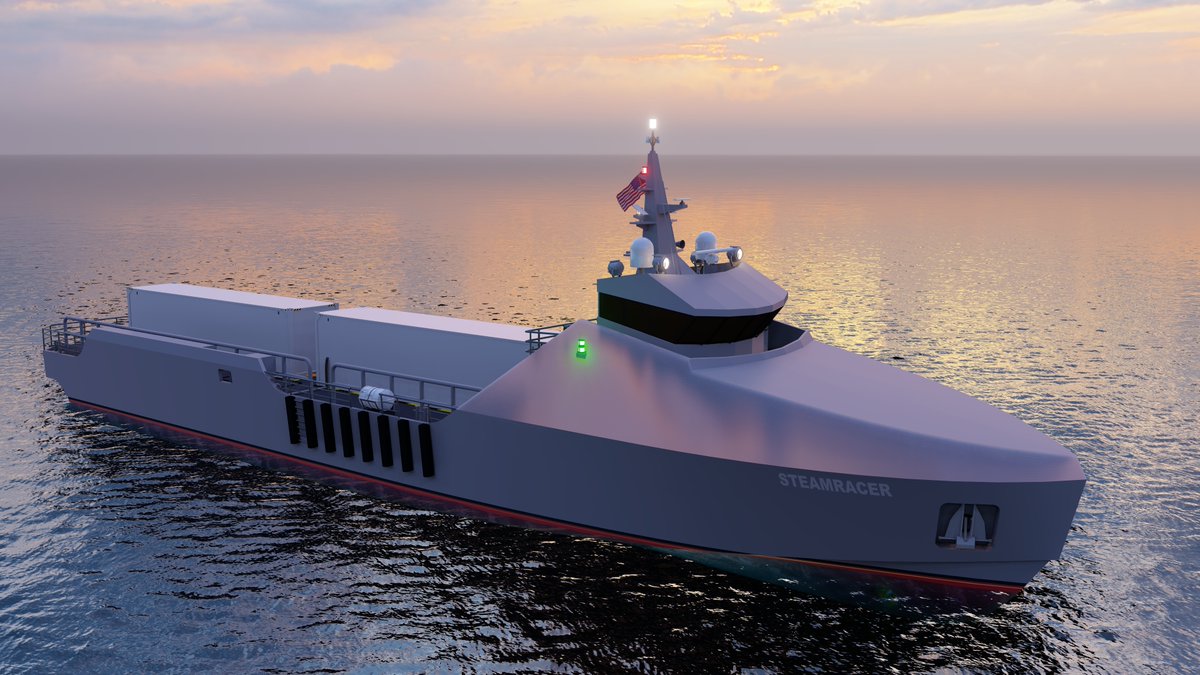
Sea Machines Robotics has announced that its STEAMRACER-class autonomous surface ship has advanced into the U.S. Navy’s final competitive evaluation phase under the Modular Attack Surface Combatant (MASC) programme.
In an update published on 18 February 2026, Sea Machines said it is positioned to provide a purpose-built autonomous vessel based on its existing autonomy technology, which it said has been developed and deployed over the past decade.
The company has invested more than $50 million in venture-backed capital since 2015 to develop and field a fully integrated autonomy stack, aimed at addressing what it described as one of the key technical challenges for unmanned surface vessels: reliable software and hardware integration at scale.
The STEAMRACER-class platform is designed to support fully unmanned maritime operations and is built around what it described as a hardened, AI-enabled remote command architecture. The company said the ship is intended to offer high speed, extended endurance, modular open-deck payload capacity and a secure onboard data environment to support distributed naval operations.
Sea Machines stated that while the vessel is designed for unmanned operations, it is also capable of operating in a limited manned configuration for short durations if required. The company said STEAMRACER is being developed through partnerships with multiple U.S. industrial firms, including St. Johns Ship Building, TOTE Services, Ring Power, Incat Crowther and EMI-W&O. It also said Sierra Nevada Corporation will provide its Maritime Advanced Secure Transmission (MAST) solution to support communications and cybersecurity requirements.
Sea Machines described the vessel as aligned with U.S. Navy efforts to expand unmanned surface vessel production and accelerate the fielding of maritime autonomous systems, stating that it is intended to provide what it called a “ready-now” solution.



“Ready now America first solution”
Their words.
The problem with all of these concepts is the ease with which grey operations could cause massive damage to your capabilities.. there are so many things any enemy could do to these floaty little boats.. which mean unless you want your very expensive tec messed with you are going to have have to keep it close to a crewed vessel..
It sounds wonderful having 20 1000 ton unmanned vessels in the Atlantic.. until on day -1 your enemy runs an old rusty grey fleet tramp into as many of them as it can…
So they don’t replace blue water crewed vessels and I worry that it’s seen as a way to..
What they can do:
Monitor and do sea denial within your own EEZ ( where you can keep an eye on things)
Act as an adjunct to crewed vessels as part of a group ( be the attritional part of the group you send down the threat axis
Act as attritional strike vessels
So you could do some interesting things.. like have a rivers 2 type vessel ( with more self defence) as a mother ship to a group.. have a patrol ship that could be both crewed and uncrewed depending on if your likely to want to board ect.
But the really important thing is that they don’t remove the need for the crewed patrol boat, GP frigate, ASW frigate or AAW destroyer.. they just increase their effectiveness.. and you cannot reduce numbers because physics is physics and 1 ship can only be in one place at one time.
What about even trawler vessels being able to catch these type of vessels and XLUUVs up in their large fishing nets? Assuming if unarmed. For right now to next few years wouldn’t more money better spent on building some extra T31s or AH120/B3 Rivers and maybe 4-6 SSKN’s which can act as motherships/subs while XLUUV technology is still maturing in parallel?
Extra Type 31 is the biggest need for the RN beyond the currently constructed things like the FSS and increasing crew numbers to man all the Tides. Plus they are pretty cheap, 317m a ship currently. Adding the Mk.41 will add more but 32 VLS would cost between 20 and 40m (include spare parts and support) a ship depending on how many cells we purchase, going off public information from recent US and Danish purchases. And hull sonar is only 6m a set so with the purchase sizes each extra ship is probably going to be about £350m each, not a bad price for their firepower, size and range.
Extra SSN are good but very expensive, and the rivers have sort of got the job covered with their incredible availability rates although a b1 replacement is needed sometimes soonish, preferably with a hangar as that would greatly help all of their roles.
What’s actually going to be in these 40′ containers? Can’t see anything revealing, no protrusions, latches on top.
Have you not watched “Storage Wars” ? 😁
Yes, lol, lord oh lord! I thought you might have suggested “frozen food” but these arent aren’t yourv typical reefer units.
I’m guessing they are just a generic place holder, but I have seen a US company mount missiles like tomahawks inside containers and Thales has almost got CAPTAS 4 to fit inside a TEU container so I’d guess the goal is something like that, but it does sort of beg the question, why not just fit actual VLS or the ExLS for a fighting variant and leave the sonar containers on a slightly modified ASW variant, because I have my doubts about the true ability of a TEU to fire missiles in rough seas
No expert here but a couple of thoughts, it does look a rather large beast just to be carrying 4 containers, is this going to also be tanker or other sort of ancillary, there doesn’t appear to be any weapons, and these mock ups normally love sprinkling as many as they can on. What role is this going to perform?
On the vulnerability of unmanned ships in peace time from “grey actors”could you not quite cheaply include accommodation for say 8 people I’m thinking 6 royal marines and a couple of navy (in a royal navy contex, I realise these are us ships), to act as a security/monitoring brief. Still much cheaper that a crewed vessel, would be enough to keep it safe, and easily air lifted off without effecting the operation of the ship in high risk situations or war.
Like I say no expert here. Please feel free to correct me.
I know they have these graphics with Containers, but wouldn’t a better use of these small ships be shadowing a larger ship and being built out with VLS tubes instead? Yeah, okay, you can’t put containers on them, but bringing along an arsenal barge that is predominately running with no crew, could be handy.