

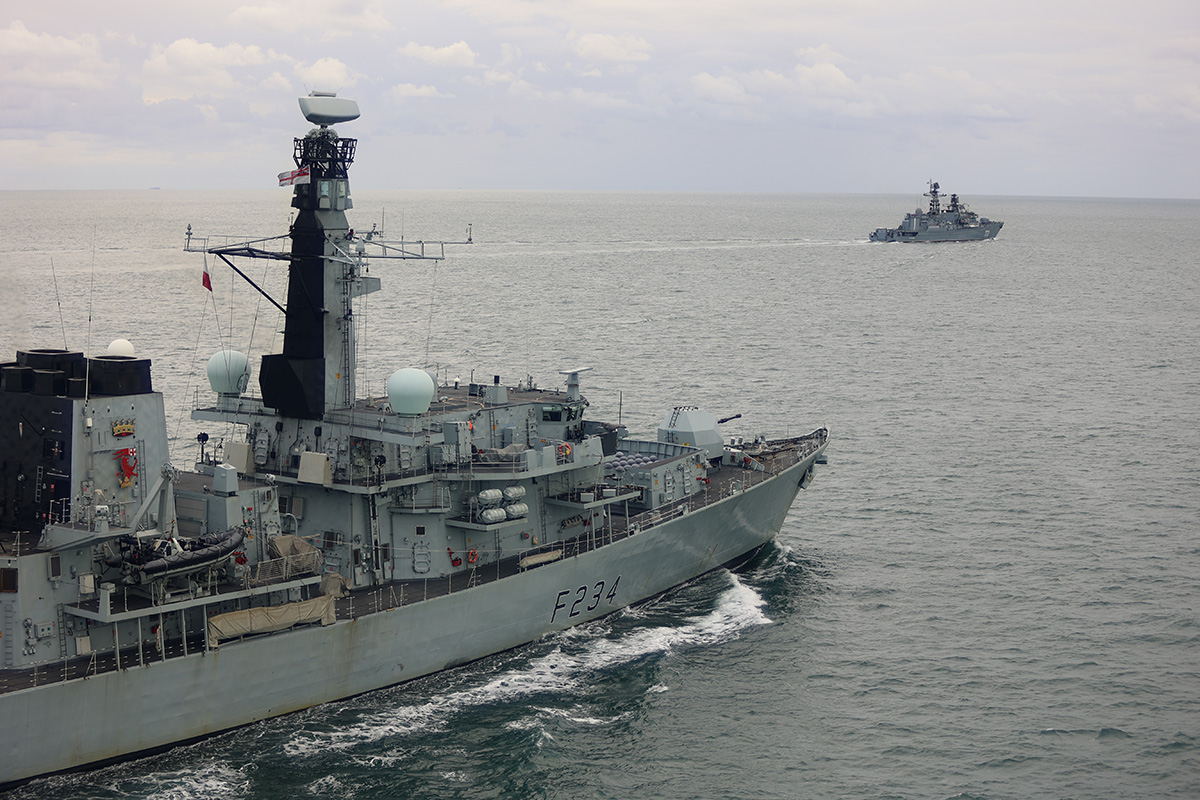
An MP has questioned whether the Royal Navy has enough ships available to sustain operations in the North Atlantic while responding to crises elsewhere, warning that capability must match growing strategic demands.
Speaking during a Westminster Hall debate on NATO and the High Arctic, Labour MP Alex Ballinger raised concerns about naval capacity as the UK faces simultaneous pressures across multiple theatres, including recent deployments connected to tensions in the Middle East.
Ballinger said the issue was not simply whether deployments could be planned on paper, but whether the UK could maintain them without weakening commitments in other regions. “There is a practical, day-to-day test. We are facing concurrent pressures in other theatres, including recent deployments to the Middle East,” he said.
He argued that credibility depends on whether the UK can deploy forces while maintaining other obligations. “The question is not whether we can deploy ships to other regions on paper; it is whether we can do it without hollowing out our commitments to other parts of the world.”
Ballinger linked the issue to wider delays around the Government’s forthcoming Defence Investment Plan, which is expected to outline long-term capability priorities and funding. He said that without a clear and costed plan, strategic messaging risks being undermined.
“We can announce deployments, launch missions and make speeches about the High North, but if we do not publish a clear investment plan that is costed and credible, our adversaries will conclude that the UK strategy is stronger in rhetoric than in reality,” he told MPs.
He noted that the chairs of both the Defence Committee and the Public Accounts Committee had warned that delays to the plan could send negative signals about the UK’s ability to deliver its defence ambitions.
Ballinger also asked the Government whether the Royal Navy has sufficient ships available to operate credibly in the North Atlantic while responding to other security challenges, and what steps were being taken with NATO allies to reassure Denmark and strengthen stability around Greenland.
He told the debate that climate change, Russian military activity and increased competition over undersea infrastructure were raising the strategic importance of the High Arctic. In that context, he argued that deterrence ultimately depends on credible capability.
“Deterrence is built on credibility, credibility is built on capability, and capability requires investment,” he said, adding that ship availability and the Defence Investment Plan would be key tests of the UK’s approach.






He’ll not get far in this government if he keeps displaying so much clarity of thought.
Two things. Firstly, the US build up of forces should have been a pretty good hint. Of course, the US should have informed countries such as the UK anyway – especially if they wanted to use European bases – but that’s a separate issue. Knowing what was going to happen why wasn’t at least one RN ship already on the way to Cyprus when the attack happened? A competent government would have prepared for this. Secondly, we now have absolute proof that we need more surface vessels… yet nothing in the way of attempts to sort this.
The UK surface fleet is half the size it needs to be. Defence is the first and main priority of any government. Excuses will not be good enough when the first drone actually hits London – and eventually it will happen.
The US asked Starmer for the use of two UK bases and was turned down flat. The US was under no obligation to notify the UK about anything after that. Besides, no one in the US trusts a British Prime Minister whose tenure in office depends on the approval of Islamic fanatics who hate the United States.
They did. However, if the US wanted to use British bases then they should have told the British government exactly why or when. I don;’t know if they did. As for obligation – yes, they do have an obligation to inforn allies when they are about to do something that affects those allies, and they should ask, not demand. As for ‘Islamic fanatics who hate the United States’ – sorry, not interested in deranged raving of ignorant MAGA fanatics.
It is clear the US did ask the U.K. to use our bases for a preemptive strike on Iran but was turned down. Arguments about the timing of the attack are rather secondary to that decision and on a point of international law we declined as it seems so did Spain.
Given our own intelligence resources in that part of the world we were obviously aware of what was going to happen but that has not corresponded into enough measures to protect our bases in Cyprus, which is extremely embarrassing for the U.K.
In more sane times our refusal for the use of our bases would have blown over but the fallout between the US and Europe including the U.K. is growing ever wider on the back of numerous recent events.
Unfortunately for the U.K. our current Government is definitely mindful of offending ‘their’ until recently guaranteed Muslim voters so what we have done and what we propose to do in the future over Iran and other related issues is influenced by those considerations. This is one those added benefits that multiculturalism brings and it is only going to get worse and in that regard whilst it pains me for saying it Trumps comments about the U.K. and Europe are based in some degree on reality despite what our politicians might say.
We are living through very difficult times and the beneficiaries are Russia and too a much greater extent China so lets hope the US electorate choose a better President next time and Europe and the U.K. gets it act together so that critical relationship is a more even one because it isn’t now.
I tend to agree with most of your points, though obviously we would have minor differences. Trump isn’t always ‘wrong’ – on defence, I totally agree with his 5% for the UK. For Spain? They don’t need it. They face much less significant threats than the UK. What I do object to is Trump’s threats of course – at the end of the day it is up to the individual country as to how much they should spend on defence. As to Muslim voters – could be true to a limited extent, but no more than other minority groups. The Middle East is a mess and I don’t see anyone coming out of it well – everyone seems to be on morally dubious ground. And I’m being very kind in saying that!
I don’t like Trump and whilst I felt he initially brought an honestly to international diplomacy and called out the slackers he has ventured well beyond that and it is such a shame we don’t have hard power in Europe to be more robust in how respond although I would hope we would be somewhat more diplomatic and factual.
As for the Middle East it is a mess and the sooner we can become less dependent from them for our energy the better but without impoverishing our own people and destroying what industry we have left. Personally I felt the Iranian regime should have been dealt with some years ago because they are real danger to the planet who would given the chance above all other nations use an atomic device. Fingers crossed Donald’s gamble pays off and the regime is overthrown by some more moderate people without too many innocent souls paying the price.
As for the U.K. I fear for the impact of sectarian voting on a larger scale and what that does for the future. You only have to look at Northern Ireland too see the problems it can cause.
Again, mostly agree. As for energy, Trump is an oil man and hates renewables – for us, we don’t have America’s huge oil reserves, oil not a good thing for us. However I think we need to get as much of our oil out of the ground as we can – I’d much rather use our oil than someone else’s – the imprtant thing is to reduce the global amount used, not the source, that matters.
” at the end of the day it is up to the individual country as to how much they should spend on defence”
True but when you have Germany, Holland, Belgium, Denmark et al spending next to nothing for decades on the assumption the 7th Cavalry will come riding to the rescue when the boogeyman comes, you can understand the Yanks getting a little miffed about it.
On the other hand, they’re the ones who start most of the wars! I just did a google AI search – ‘Since World War II, the United States has engaged in military actions, including direct invasions, significant interventions, and prolonged bombings, in over 30 to 70 countries, depending on whether one defines the action as a formal war or a hostile intervention. Major military operations and invasions occurred in nations like Korea, Vietnam, Grenada, Panama, Iraq, and Afghanistan’. Can we really say that the world is a better place for them all? Some of the worst countries in the world have been American allies – thinking, for example, of Saudi.
I think that No one In the World will now trust the US.
So much damage being done.
Half?
Way less than half.
SDR 1998 specified a 32 combatant navy.
Currently we have, at best, a 13 ship navy with RFA, possibly, in an even worse position.
I would say half is a minimum – I agree that I would prefer a lot more, but doubling the size of the surface fleet should be achieveable, and the increased use of drones should also mitigate the need for assets above half to a degree.
The idea that drone frigates will take over from full fat frigates is pure Power Point ATM.
Yes, drone sonar tugs are a thing and could well be used to increase the search area by augmenting the mother ship. But then you need to prosecute and that isn’t in drone territory yet.
Didn’t say that. However, a network of drones – both surface and underwater – would mitigate the shortfall. They have the potential to be a force multiplier.
We lost a third of the surface fleet >100t in the last five years alone, and shrinking has been going on for decades.
What is of more importance is getting the existing fleet operational and available for operation. It is wholly unacceptable that a £1 billion (state of the art?) defence asset should be unavailable for over 3000 days. Imagine trying to run a haulage business or an airline with massive capital tied up in assets, having to make the finance payments and not be able to use them to earn the money to make the payments.
These ships are a total ****show. The Admirals, Industrialists and Civil Servants responsible for this mess will all still collect their medals and knighthoods and the taxpayer will foot the bill for this mess and continue to do so for the following procurement calamities.
At what point does serial incompetence become collective corruption?
That, plus upgrading ships to maximise their armaments, are two areas where money can usefully be put in to provide a short term fix while new ships are being built. The ‘fitted for but not with’ idea needs to be scrapped – fitted for is not fit for purpose!
We are at least a year or two away until we see the first uptick in frigate numbers. ( assuming no more T23s go to scrap during that time)
6-8 years away from full recovery to 13 escorts.
The questions should be about how the MOD /Treasury can help speed up procurement.
More Type 23s will be lost before their replacements enter service that’s an absolute certainty and the earliest date for the entry into service of all 13 new frigates is stated as 2035 but with Norway likely to take 1 or possibly 2 from those currently in build you can expect that to move out until at least 2040 if and it’s a big if we order replacement vessels.
So in summary more pain and gaps to come over an extended period that might be marginally alleviated with an improvement with Type 45 availability.
Hopefully the current humiliation of our politicians (and lives are not lost because of it) does the trick and some further Type 31s are ordered to close the gap in capability and numbers as quickly as possible.
To be clear 19 escorts is nowhere near enough for the commitments the U.K. has and will have into the future.
Never mind the threat uptick that is clear to everyone.
Agree, I think it’s too late to fix the immediate problems in hull numbers. Given the world we’re in a realistic fantasy navy should consist of around 45 escort ships, personally I would go for 15 of each of the 3 classes we are/going to build on a continuous build policy. Cuts in foreign welfare payments should cover the cost.
Fantasy fleet
In many ways, this is a question asked solely to name what everyone knows. I would imagine everyone in that room knows the navy is paper thin and that it will stay that way for years yet. They also know it is a result of decisions made over many years previously. It doesn’t need to be said in public for them to know it. Doing so gets the MP’s name in the media but beyond that, nothing changes
Well it is better to keep the issue in the public eye as it makes defence spending upticks easier to sell to the electorate.
As well as the Greek and French frigates deploying/deployed in the area I now read the Spanish are moving one to the Eastern Med. I can’t help feeling along with all the other negative press that there’s an element of one upmanship going on here. A. To make themselves the go to nations and B. To make the UK look bad. It kind of feels we’re at a crossroads and the government needs to make a decision on which way it’s going to take us.
We could still do with highlighting the B1 Rivers which are due out of service at the trough of the frigate numbers. Something can still be done about that right now, planning a new requirement for cheaper hulls alongside an extension in service. Leave it for two more years and it will be too late to be effective. It’ll just be the usual muddle.
If the B1s are due to be retired in 2 years why aren’t they actively building replacements right now and maybe a couple more? And could they be kept on for 3-5 more years and if do why not a mini-upgrade maybe to ex HMS Clyde level?
Surely the last 72 hrs should have answered his question and made the situation quite clear!
We need the new frigates yesterday. A lot hanging on the skill and efforts of BAE and Babcock now. No pressure! 🙏
If we’re serious about addressing immediate vessel shortfall we’d be buying back the t23s given to Chile (and still operating). Lend lease plugged a gap when needed – we have a similar issue now? Bring back Spey/ Tamar and their crews to be prioritised onto remaining T23/45s.
That assumes Chile wants to sell them & that they don’t need months in refit, but I agree with the sentiment. Personally I think it’s too late for the Royal Navy, we just need to order more of what we’re already building and accept it will be years until we’re more than a regional navy.
In return for the promise of a free t31 in 5 years time they might be tempted. They face no threats
Why assume the Chilean’s would be willing to sell a chunk of their surface forces without replacement?
Tasking River crews to T23/45 will surely only result in another two vessels removed from active use?
Current T23 crews from decommissioned vessels should already be tasked to T23 or T26 (or T31)?
T23s more important than a couple of ‘AT pleasure vessels’
Crewing is not stopping the T23s getting to sea, theyre just buggered.
Argyle?
It’s not like politicians weren’t warned over decades that such scenarios could happen. The Tories and Labour are not fit for government.
Agree 💯
👍 theyve been equally guilty of neglecting to pay the ‘insurance premiums’
It goes beyond the concept of the insurance premium.. the armed forces as insurance is actually their secondary role.. the real problem is their primary role “Deterrence” essentially investing in your armed forces is not just buying car insurance..it’s also taking your driving lessons so you can drive and getting your MOT and service every every year so you or your car does not fail and cause the crash..
👍
Lots of hand wringing, but nothing can be done at this point. Ordering new ships will not result in delivery in less than 10 years. Maybe a little less if from Rosyth. The UK only has facilities to build ships at a certain rate even if the money were found. Given sufficient orders Companies will invest in facilities and manpower as is slowly happening.
Likewise it will take the Navy 5-10 years to build its workforce to man additional ships. The concept of larger unmanned vessels is ‘pie in the sky’.
Part of the problem is that the Geopolitical scenario changes much faster than 5-10 years. Although some might say that we should have seen the Russian threat changing 12 years ago. However given we did not do anything to address things at a few weeks notice I suggest there is little hope of anything changing.
Buying back very old ships (Norfolk, Grafton and Marlborough) is definitely not an answer. We will have to cope with what we have got. i am sure Navy Command are doing their best with what they have. It is the Politicians (on all sides) who have to realise they cannot salmi slice forever without it impacting something.
Yep we essentially need to plan for a 2040 navy and make that more like the navy we said we needed in 1996-97.. with that additional need around the high northern Atlantic Bastion.. our need before the Russians turned back into Ivan was for 32 escorts.
The RFA Royal Fleet auxiliary now have a mandate to strike for the next 6 months
This could cause extreme harm to the RN being able to operate effectively.
Both unions have rejected the misley pay offer again after years of decline and failed promises
Time the UK actually looked at tasking and it’s geostrategic need and ambition as well as deterrent need on numbers instead of how much money we fancy spending.. there are town things in this world we spend our resources on what you want and what you need..
WANT: must be limited to what you can afford to spend on your essentially disposable income…for a very long time we as a nation and the rest of Europe lived in a delusion that defence was more about want than need..
NEED: you must find the money for the need.. you have to buy food, you must have water, you must repair your roof.
So what does the UK need..escort wise ( I’m using the conventional rule of three.. because although it’s possible to get high rates of availability you end up impacting operational readiness and exercises)
Conventional deterrence: ( the ability to actually harm another nation.. by taking sea control of its sealanes and striking from the sea.)
Carrier battles group: 2 AAW destroyers/frigates and 2 ASW frigate’s.. that’s 6 AAW destroyers/frigates and 6 ASW frigates
Support for allies:
Delivery of a brigade by sea.. ( amphibious group/mixed marine and follow on army units) 1 AAW destroyers, 1 GP frigate, 1 ASW frigate that’s 3 AAW, 3GP and 3 ASW frigates
Management of home waters and supporting nuclear deterrent:
1 ASW frigate 2-3 active patrol and mine warfare vessels.. so 3 ASW frigates and 6-9 patrol and mine warfare vessels.
Patrol and presence Atlantic ( north and south)
1 patrol vessel, 1 GP frigate.. 3 patrol and 3 GP frigates
Middle East and Indian Ocean patrol and presence ( the Middle East exploding has show the risk of using patrol vessels alone)
1 patrol and mine warfare and 1 GP frigate.. for 3 patrol and mine warfare and 3 GP frigates
High north and anti Russia bastion
2 second line ASW focused GP frigates for 6 ASW GP frigates
So actually looking at need for the surface combatants
AAW destroyers and frigates ( a second line AAW frigate ) 9
ASW frigates 12
GP frigates 9
ASW GP frigate 6
Patrol and minewarfare vessels 15
So that’s 36 large combatants and 15 smaller combatants.. which is probably about right… because the last actual needs based assessment of fleet numbers ( the 1996 white paper) stated that for a post Cold War geopolitically stable world without any major geostrategic risks to the UK the RN should have 32 large escorts ( 12 AAW, 10 ASW, 10 GP) as well as 10-15 patrol and mine warfare smaller combatants..
Now the fantasy fleet brigade will come out and say 30+ is just a fantasy.. Im say that’s the need.. the fantasy is pretending you can live without paying for your basic needs.. you may feel you can only afford 1000 calories of food a day.. NEED does not care what you think you can afford, you will still slowly starve.
Like it but its s bit of a jump up. The buggers can’t seem to think outside their “19 box” at the moment! Even adding an extra T31 or T26 or some new Rivers or a small fleet of SSKN’s seems too hard.
Yep it’s not about what we will get.. it was more about the fact we are so far below need level that it’s a joke..
Can any of the T23s that have been recently been retired be brought back to life into service for another 2-5years even if just regionally? Would cosalt a few quid and need a bit of rust converter and new paint but at least they’re existing and afloat? Even a couple would he handy. Same for the remaining Albion?
Or a small fleet of 3-4 BAE Leander/AH120 types built as jv at alternate UK/foreign yards? H&W? Ferguson’s? Maybe time ro get creative?
The ones that have been retired are in the same state as argus, unsafe to sail.
Ordering any other ship class now will not close the frigate gap, we will have recieved new frigates by the time they arrive.
What is Albion going to fix?
No they were/are knackered. Some had done 30 years against an 18 year planned life. Bloody good going.
Top and bottom line is after the cold war and the first Gulf war both Conservative government and Tony Blair Labour government of the 1990s made cuts .Then the Cameron Conservative government did huge damage with is little mate Osborne which left us defenceless. And for this government they have no interest or intention of putting any money in Defence despite there words ,we’ve had no new kit or manpower. 😟
Honestly I think although it’s totally sub optimal, they need to look at what could be done to turn the Rivers 2 into patrol frigates/corvettes..
The rivers 2s are actually big hulls.. look at the Deutsche Marines K130 Braunschweig class, it’s a fair bit smaller than a rivers 2, 1810 tons vs 2000 tons, 292 feet vs 297 feet, beam of 43 feet vs 44 feet.. but the German corvette has a decent C band 3D radar, 76mm super rapid medium gun, 2 27mm cannons, 4 300km range anti ship missiles with 200kg warheads, 2 sea ram launchers with a total of 42 missiles, racks for 34 1500Ib mines and a hanger and pad for 2 Skeldar V-200 UAVs… for all the the corvette has a range of 7400km vs Rivers 2 range of 10,000km..
we know the Batch 2s were expensive because the RN put warship level survivability into them and they are big enough to take a decent armament.. so way not turn them into patrol frigates.. give them a 57mm main gun, a 40mm on the back and 36 CAMM ( you can fit 36 CAMM on a 700 ton visby FFS).. I bet they could even stick 4 NSMs on them for good measure… if every other European navy thinks corvettes are a good idea for the north and managing Russia what is our problem really when we have 5 almost frigate sized hulls with a 30mm cannon…
Yes it may take a few years to convert them but at present we still have the 3 rivers 1s to take the patrol boat load.. and I personally believe having patrol boats wandering around east of suez is now well over extending what is safe….
We know politically the RN did not want to over arm the rivers 2s and get corvettes because it might have stopped them getting the frigates they needed.. well, guess what we don’t have the frigates we needed and the RN is now the epitome of UK talking big and carrying a rotten stick..so we are beyond all that now and well into desperate measures.. and the RN has sent its sailors to war in vessels far less well protected than an upgrade Rivers 2 would be ( considering the average 1970s frigate has essentially almost zero self protection against air attack)
The Rivers are basic long range constabulary vessels. Armament is deliberately kept simple to reduce demands for maintenance, crewing and work up. As a consequence the Rivers achieve a very high availability that would be reduced by up-amouring. So you might end up with less hulls actually available for tasking if you try to turn them into corvettes.
Yes but in reality what is the “NEED”… in a peaceful world that is following the international order where your key need its presence work, anti piracy and anti drug, having 8 patrol boats and 6 frigates is lovely for being cost effective..but in a world which can and will go kinetic in a flash.. with wars and conflict across the Americas, Europe, the Middle East and Asia.. with great power conflict on a knife edge and the international order crumbling and you tuning up in a patrol boat with a 30mm cannon makes you not only look like a weak victim, but a laughingstock. When the world turns hard hard power is what matters… and Russia does not really give a shite if we have 5 rivers 2 with 40mm cannons.. but it will add to the measure 5 well armed corvettes…
If we had 20 frigates and not 6 we could by the way justify 8 patrol boats… but we cannot really justify more patrol boats that frigates..
I agree with everything that has been said about the number of ships, but first of all we need to solve the recruitment problem, followed by the maintenance problem. It doesn’t matter how many hulls we have if they are all bobbing up and down in Portsmouth empty.