

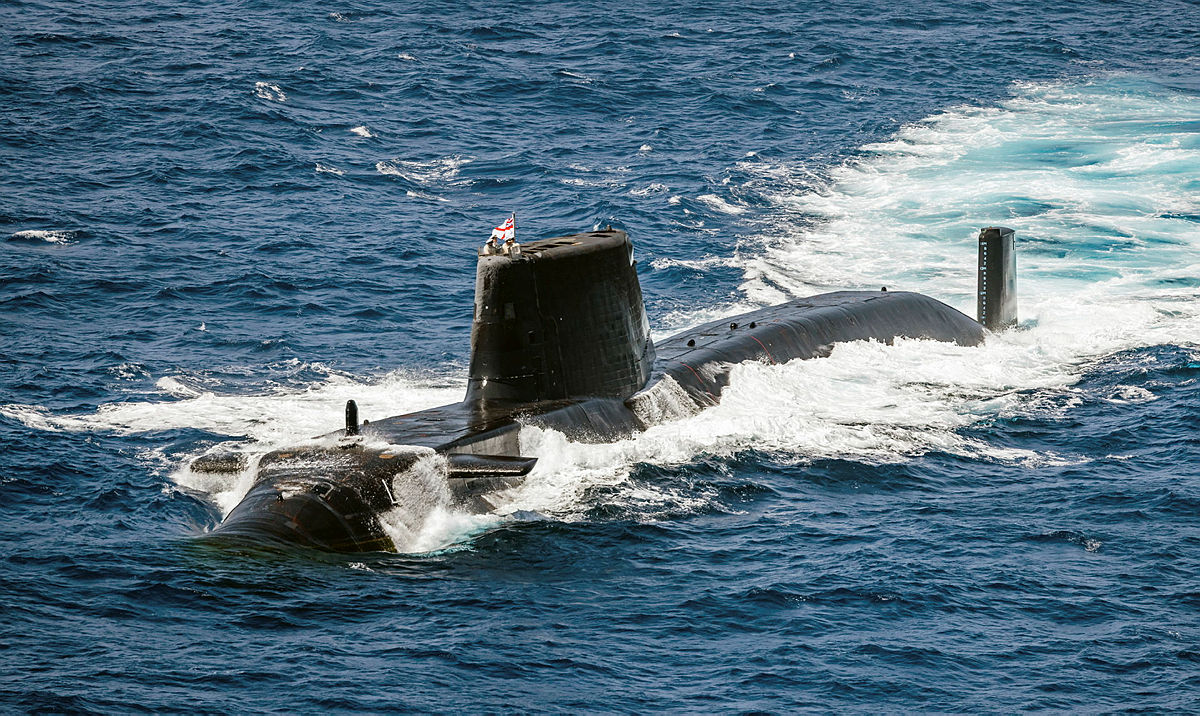
Submarines are not disappearing from the North Atlantic battlespace, but they are likely to operate with less freedom than in the past as more sensors, more platforms and more connected systems are pushed into the water.
That was one of the clearest themes to emerge from a UDT 2026 panel on innovation and transformation in the North Atlantic, which brought together Rear Admiral Paul Flos of the Netherlands Ministry of Defence, Captain James Lovell RN, Captain Christopher Hill RN MBE and Adrian Fryer of Saab UK.
The discussion rejected the idea that submarines are becoming obsolete. It also pushed back on the opposite assumption, that nothing meaningful is changing. Instead, the panel described a more complicated future in which submarines remain central, but will have to operate in a more transparent and more crowded environment.
Asked whether submarines as “lone wolves” were dying, Lovell’s answer was direct. “Are they dying? No,” he said, before arguing that their role was expanding through the integration of new systems, including recoverable autonomous vehicles and other deployable capabilities. He added that future submarines would increasingly be built with those functions in mind rather than having them retrofitted later.
But Lovell also made the key operational point that shaped the discussion, saying “We need to be able to recognise the freedoms of our manoeuvre may not be there as they once were due [to] the amount of platforms that are going to be on.” That is a more important observation than the crude question of whether submarines are finished. The panel’s argument was that they are not finished at all, but they will be operating in seas that are harder to move through unseen.
Flos made the same point more bluntly from a NATO perspective, adding “The main aim of Digital Ocean is to make the sea transparent,” he said, adding that this would make it “much more complicated” for a submarine to remain hidden. That does not mean submarines go away. It means the underwater operating environment is changing around them.
Hill said the Royal Navy has already started work on what the role of the SSN looks like inside a hybrid fleet.
“We’ve kicked off a piece of work… with the role of the submarine, the SSN and the hybrid Navy,” he said. He added that “traditional mission command is expected to continue,” but that greater emphasis would be placed on the submarine’s own organic systems and the capabilities it can launch, carry and employ against a wider range of threats.
None of the speakers suggested uncrewed systems would replace the attack submarine in any simple one-for-one way. In fact, Flos explicitly warned against that sort of political thinking. He said there is a tendency among some politicians to assume that once a new system appears, it replaces the old one and funding can be pulled away. He said that was the wrong lesson to draw, particularly with uncrewed systems, which are often being treated as an easy answer to manpower shortages. “That’s absolutely not true,” he said, adding that at present some of these systems actually demand more people rather than fewer.
The picture presented by the panel was of a mixed fleet, not a replacement fleet. Flos summed that up when he said, “If you want to achieve an effect which is better with people, you do with people, if you can do it in a better way with persistence, [you do it] with persistence.” In other words, the question is not whether everything becomes uncrewed, but which effects are best delivered by which combination of systems.
There was little doubt, however, that uncrewed numbers will rise sharply. Asked whether uncrewed vessels could outnumber crewed ones by the end of the decade, Fryer replied, “Absolutely no doubt, to my mind, 100% yes.”
Lovell was more cautious on exact numbers, but said that if navies are serious about “massive persistence of sensing” then they need to “start fielding things, developing things, and fielding things.”






Ours already have disappeared!
I’ve gained $17,240 only within four weeks by comfortably working part-time from home. Immediately when I had lost my last business, I was very troubled and thankfully I’ve located this project now in this way I’m in a position to receive thousand USD directly from home. Each individual certainly can do this easy work & make more greenbacks online by visiting
following website—.,.,.,.,.—>>> JobatHome1.Com
I do think that one area they have underplayed is gray sub kinetic warfare.. just because the west has forgotten that war is a constant continuum and never ends other nations have not and sensor nets of autonomous vehicles and stationary sensors are going to be a gray warfare playground..it’s going to turn into a sub kinetic battle to neutralise autonomous sensors and then protect them.
The simple reality is a commissioned warship with a crew carries the authority of that nation and to interfere with it is a massive step up the escalation ladder. But to destroy a few drones or sensors in international waters..that’s just playing the game of great powers..
It’s why I think in international waters drones will alway end up needing a Shepard unless they are cheap, disposable and you don’t mind the enemy getting the tec..
That’s why to my mind they should be building the larger more advanced occean going surface drones with optional crews.
The idea of leaving 70 meters of urea higher tec ASW capacity siting mid Atlantic is just asking for Russia or even China to fiddle with it..
Just like the UK now.
Can’t pick your nose without being on CCTV !
Big Brother is watching you 👀👀👀