

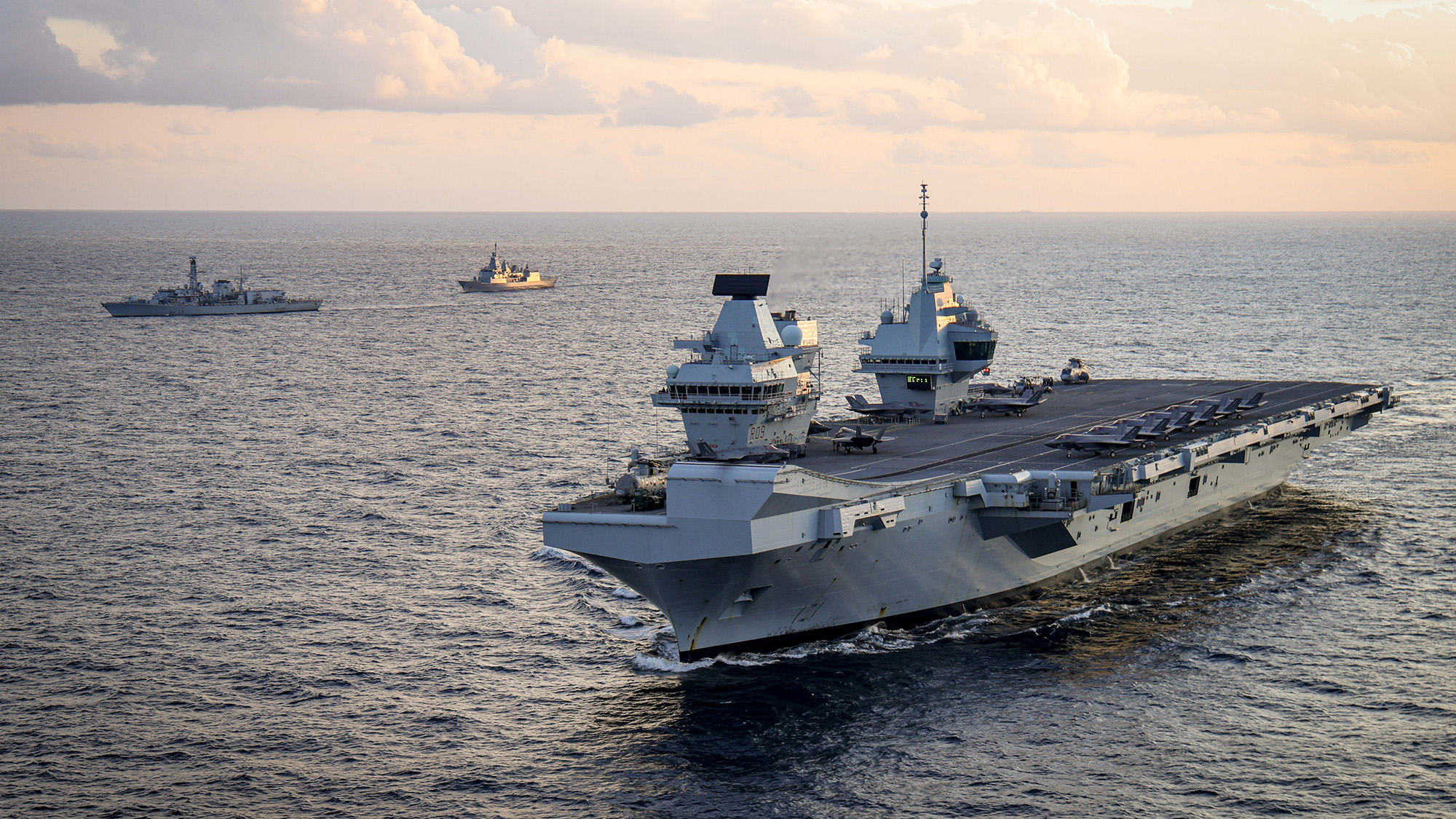
HMS Prince of Wales has departed Scotland for Nordic waters recently, where the aircraft carrier will conduct exercises with NATO and Joint Expeditionary Force partners focused on Atlantic and High North security.
The Royal Navy say that the Portsmouth-based carrier left the Glen Mallan jetty in Loch Long after spending the bank holiday weekend loading ammunition and supplies. She is accompanied by Type 45 destroyer HMS Duncan and tanker RFA Tidespring, with the force operating under the staff of Commander UK Carrier Strike Group, led by Commodore Rich Hewitt.
The first phase of the deployment will take the group to the fjords near Bergen, where they will conduct Exercise Tamber Shield alongside Wildcat helicopters of 815 Naval Air Squadron, P2000 patrol boats, and Norwegian missile craft. The exercise is designed to develop the tactics required to defend high-value assets against small, fast, and manoeuvrable threats in confined waters. The focus will then shift to the open waters of the High North for Dynamic Mongoose, NATO’s primary anti-submarine warfare exercise in Northern Europe.
Captain Ben Power, Commanding Officer of HMS Prince of Wales, said the deployment reflected the carrier’s role as the nation’s flagship. “HMS Prince of Wales stands ready as the nation’s flagship to demonstrate the United Kingdom’s commitment to NATO and the Joint Expeditionary Force. My thanks go to our families who continue to show unwavering support as we deploy for a period away from home waters.”
Commander James Mitchell, Commanding Officer of HMS Duncan, highlighted the destroyer’s contribution to the group. “As a Type 45 destroyer, HMS Duncan brings world-class air defence capability to the Carrier Strike Group, providing essential protection to HMS Prince of Wales and other high-value units. Training alongside our allies in the North Atlantic and High North strengthens our ability to operate as an integrated and resilient force.”
Commodore Hewitt described the deployment in the context of the wider regional security environment. “This 2026 deployment delivers a clear signal of the UK’s steadfast commitment to working with regional partners and securing Europe’s northern flank. In an increasingly volatile environment, our integration with partner nations is vital to safeguarding our mutual interests.”
The High North has become an area of growing strategic focus for NATO since Russia’s full-scale invasion of Ukraine in 2022, with the accession of Finland and Sweden to the alliance significantly extending NATO’s presence in the region.
The JEF, a UK-led grouping of ten northern European nations, has developed into one of the primary frameworks for military cooperation in the area alongside formal NATO structures.
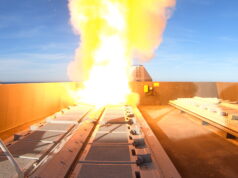
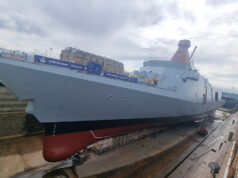
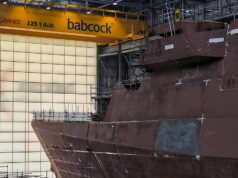
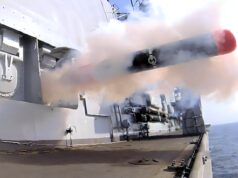




No Aircraft. 🤦♂️
No Guns. 🤦♂️
No VLS. 🤦♂️
No Escorts. 🤦♂️
No Oiler. 🤦♂️
There, that ought to do it. 😊
You do ask for it. 🎈 The balloon will now go up!
I love It mate.
This site Is just so entertaining.
I’ve gained $17,240 only within four weeks by comfortably working part-time from home. Immediately when I had lost my last business, I was very troubled and thankfully I’ve located this project now in this way I’m in a position to receive thousand USD directly from home. Each individual certainly can do this easy work & make more greenbacks online by visiting
following website—.,.,.,.,.—>>> JobatHome1.Com
Annie in particular is deeply entertaining and the perfect riposte I might add with her insight. A little cryptic certainly but she sure knows her aircraft carriers, clearly understanding it’s far cheaper to operate your aircraft from home.
Ahh, but you see, if you don’t have aircraft then you don’t need guns to put on them. If you don’t have escorts then you don’t need vls to arm them with, nor an oiler to keep them topped up.. its genius.
Genius thinking…. you should be a Politician ! 😁
Clearly why they have so few weapons to fire from them, yes makes perfect sense now. We should run the Country like this… oh wait a minute.
😁
The crazy thing is that HMS Prince of Wales has a stronger Royal navy escort than CDG which is in an active war zone and yet I’m guaranteeing some twat comes on here banging on about how amazing the French navy is and how shit we are.
Eh. Every western navy is crap these days, and though I’m a fan, the USN doesn’t get a pass. I just look forward to the day when we’re out of these doldrums and the AUKUS boats and Dreadnoughts are sailing, Type 26 and Type 31 are in the fleet, the French actually start buying their own FDIs instead of selling their build slots and get their new carrier, and the UK can regularly deploy with 24 jets.
Hmm… Maybe the Italians aren’t crap. They’re actually looking decent or at least on-plan.
Have you seen the state of the Russian and Indian navy or Chinas “carrier” fleet.
I’m not sure any navy is doing that well.
There’s a lot to “take away” from the Indian and Chinese fleets though.
Smile 🙂 I can’t help but agree. What is the old saying, “a fleet in being”. Worked for 3rd Reich though with Tirpitz, until well you all know.
simply not even close to being true.
While the escorts provided by Spain, NL and Italy stopped in the Med, the CdG carrier group is now escorted by french navy ships:
– 2 Horizon (Forbin and Chevalier Paul)
– 2 Fremm (Alsace and Languedoc)
– 1 SSN (Suffren class)
– 1 BRF logistics (Jacques Chevalier)
Lastly 2 CMT minhunting ships (Andromede and La Lyre) left France on May 4th and are currently heading east towards Hormuz
You missed one
No crew
Unmanned trials !
No ASW frigate escorting ?
There are two type 23’s deployed in the North Sea and North Atlantic and a third waiting to go.
And 4 In the Portsmouth reserve.