

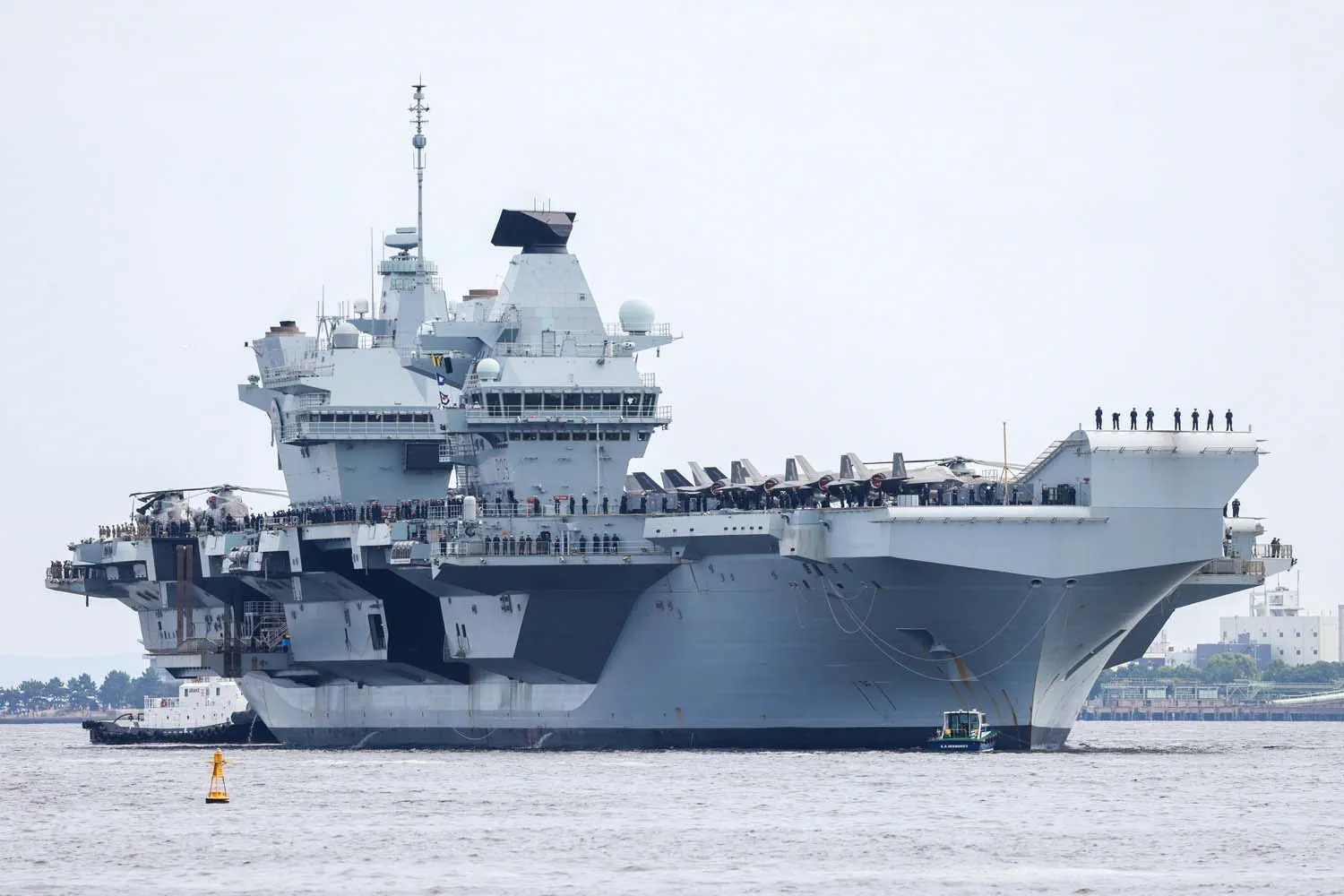
The Chair of the Public Accounts Committee has sharply criticised the Ministry of Defence over its management of F-35 spare parts, after the MoD’s Permanent Secretary wrote to the committee acknowledging that a carrier strike group deployment to the Middle East was conducted with insufficient spares to support the aircraft embarked, the UK Defence Journal understands.
The letter, dated 30 April 2026 and written by Permanent Secretary Jeremy Pocklington, was sent in response to the PAC’s October 2025 report on the UK’s F-35 stealth fighter capability. It reveals that during Operation HIGHMAST, the UK surged 24 F-35B aircraft onto a Queen Elizabeth-class carrier despite the Afloat Spares Pack being sized to support only 12 aircraft.
The shortfall was mitigated by drawing on the Deployable Spares Pack and taking additional spares from the RAF Marham Base Spares Pack, while maritime logistics challenges occasionally led to missed resupply opportunities during the deployment.
PAC Chair Sir Geoffrey Clifton-Brown did not hold back in his response. “At the heart of any military planning is sound logistics. The UK sent an aircraft carrier with 24 F-35 fighter jets on it to the Middle East — with not enough spare parts to support them. Twelve aircraft spare parts packs were sent to service twenty-four aircraft, and it is no surprise that as a result spares had to be shipped out from RAF Marham to make up the difference.”
“In an increasingly dangerous world, our military and the country need more than this half-baked approach from the MoD. Our brave fighting men and women, before being sent into potential harm’s way, must have absolute certainty that they are well-supported in their equipment, with clear and reliable supply lines. But this correspondence shows an entirely unacceptable incompetence that flies in the face of any kind of sensible planning from the Ministry of Defence,” he added.
The Permanent Secretary’s letter also addresses broader F-35 availability challenges. Pocklington states that while incremental improvements are expected through spares investment, workforce growth, and reprioritisation, sustained achievement of availability targets is unlikely under the current global sustainment model. Mission capable rates during Operation HIGHMAST were broadly comparable to the global F-35B average, though the letter notes that post-deployment recovery from the operational tempo and corrosion remediation activity has since reduced those rates.
Corrosion, worsened by maritime exposure, is identified as a growing concern across the programme. The MoD says it is working with UK and US industry partners on deeper inspections and recovery, enhanced preventative practices, and longer-term corrosion-resistant solutions within the broader F-35 programme, while acknowledging a short-term reduction in availability as maintenance activity intensifies to clear the backlog.
On workforce, the letter states that engineering posts for the Lightning Force have been increased to 168, split 58% RAF and 42% Royal Navy, but that current fill rates stand at approximately 75%. The RAF has plans to fill its remaining engineering posts by 2032, a timeline driven by the up to three years required to make engineers fully competent on the aircraft type. RAF Marham is also described as a less preferred posting location, with efforts underway to improve its attractiveness including career path development and infrastructure investment.
On the question of a standoff capability gap before SPEAR-3 is fully integrated, the letter confirms that approval has been given to procure the Small Diameter Bomb II through a Foreign Military Sales arrangement with the United States, providing an interim precision standoff option for the F-35 until SPEAR-3 enters service.
Regarding accommodation at RAF Marham, the letter confirms that four new single living accommodation blocks are under construction, with an overall completion date of May 2027. A third F-35 squadron is planned for 2033, with infrastructure readiness targeted for April 2032, though both timelines remain subject to the finalisation of the Defence Investment Plan.






Hang on a minute.
The 24 F35’s were only embarked for a small fraction of that deployment.
Cynically just to fulfil the promise.
Basically It ticked boxes.
🤦♂️ (that’s for Spock).
I’ve gained $17,240 only within four weeks by comfortably working part-time from home. Immediately when I had lost my last business, I was very troubled and thankfully I’ve located this project now in this way I’m in a position to receive thousand USD directly from home. Each individual certainly can do this easy work & make more greenbacks online by visiting
following website—.,.,.,.,.—>>> JobatHome1.Com
Isn’t this why we run exercises and surge capabilities, sounds like we did this and found the work arounds to make it work as well as the weaknesses in the system.
Yes It Is but the 24 figure had to fulfil the promise otherwise It was another falsity. 24 is the norm not a surge figure, yet more falsity.
What’s annoying is, they went on operations already knowing this. It would have been better to go on exercise properly equipped, to then test what else breaks but, it’s a fair point, learning the workarounds. I dare say, real world, all the pieces of the jigsaw won’t always be in place, for one reason or another.
True Mate- 24 F35’s is not a “surge”
Have we got that many available for the dispersal for the fleet?
24 is a surge because there aren’t enough F-35 in operational condition to embark 24 permanently on the carrier right now. To determine the surge you must look at the number of F-35 you have and the % that are operational rather than the total capacity of the carrier.
not to have enough spares? criminal. the americans saw us coming (again). and rubbed their hands with glee. the gullible brits who won’t spend the extra money for catapults but are happy to pay a premium on an unun proven, air platform for a redulous price. will buy anything. like other programmes the procurement offices are full of imbeciles and the senile. it should be culled or replaced with new people. and managment.
o’m not
totally sold on all the invisible claims towards this aircraft which are mostly hyped. BY THE u.s AND THE MANUFACTURER i still shake my head over the cats and traps omission and the issue won’t go away until a system of some type is fitted. and for their to be no VSTOL variant for the new tempest means when the f 35 is out of date, so will the u.k carriers.
We haven’t enough spares, provisions and weapons for anything full stop. Recently pointed out by Tom Tugendat that the UK had enough gear for 8 days of peer in total, not contradicted by government either. We’re all hat and no cattle.
You might have noticed but no one had enough spare parts. In all aviation products globally no one ever has enough spare parts until they stop making new air planes and start scraping old ones (for spare parts) we had the exact same headlines for Tornado and Typhoon before.
Doesn’t detract anything from what i wrote. Theres nothing behind our on paper force. We wouldn’t last a strawberry picking season in a peer conflict. Russia and China know aswell.
Yeah, the munitions issue is horrific… And that is force-wide. And that’s for the tiny forces that are deployed.
Wasn’t it something like only two weeks at the height of the Cold War in terms of war supplies?
I don’t know Mark but thats clearly not anywhere near enough. You just can’t build munitions or spares/stores in that time frame. If we were serious we would have six months expenditure as a minimum. We would also have a plan to re-provision beyond that point.
It should be made clear t the Americans that as the remaining tier one nation left in the project that for the UK to be messed about is not acceptable.
Well at least they have now confirmed squadron 3.. but 7 years away.. but it does mean a full air wing + OCU for a full surge.
What’s lost in the meantime though.
Yep no DIP makes it hard to put it all together.
Is that confirmation the DIP is 7 years away too
so is the final operational jet force shaping up as 3 sqns of F35+ 5 Typhoons ? Excluding OCUs etc ?
Are 24 F35 really a “surge”? Is this not the standard operating air wing. Good to see a decent number of F35 assets embarked.
No, Yes and agreed.
Every time one of the carriers is at sea it should have a airing embarked so that it available for full at sking at any time
Hi Andy. When the QE carriers were commisioning, the RN were considering one of the two vessels being configured as a”commando carrier” (similar to HMS Hermes in the Falkland in ’82). With Bulwark/Albion gone, it’s likely there will a requirement for that.
It’s going to take 7 years to stand up one new squadron ?? There is so little sense of urgency with this government it’s a joke.
And like everything else about this labour Circus is unacceptable
I was reading Starmer’s statement about the two marches. He talks about his country. Only thing is his is completely different from the rest of us one based on his left wing Marxist reading list from the 1980’s. His is the different World of a tiny sect of Hampstead & Highgate Folks ( that’s to annoy them hopefully!) and ‘Umanrights Lawyers. My family fought for our country. What did his lot do?
In the Navy BTW. FAA, RN and Wrens. In their teens and 20’s.
“Mission capable rates during Operation HIGHMAST were broadly comparable to the global F-35B average, . . . .”
But, don’t mission capability rates have more to do with how well the aircraft are maintained. Granted, its harder to maintain an aircraft at sea and you can’t stock every part, but for crying out loud, your Number One job is to make sure every one of those aircrsft are mission ready.
We Don’t have the Sufficient Aircraft full Stop…!
And All Spares have been a Serious Weak Point of The Navy Since the Falklands …! Little else to Add…!
These issues are not acceptable as such the Americans must be told that they are risking the reduction of orders placed by UK
Too True but the problem is largely US protectionism in my opinion. Same old story, but they are now more unreliable and sadly we see it, having not yet; after how many years; had LM fitted one UK weapon system; rather they have dragged their feet and waited till they have had time to develop/grow their own probably inferior crop.
If Starmer hadn’t done his Marxist best to upset the Yanks and Israeli’s, things might have worked out differently.
Its sad to talk about Labour like this but they just dont get UK Defence any more. The US look after their own.
Corrosion issues?
Sounds like there is a need for a few pallets of WD40 for looking after these delicate flowers….
If it was good enough for NASA, it should be for the RN…😉
It was all an elaborate hoax
I don’t know why folks in the forum are shocked by this news. A quick google search on USAF (largest operator of F35s) F35 readiness rate comes up with 51%. The UK having spares for only 12 of the 24 F35Bs is in line with F35 operations by the largest and best resourced operator of the aircraft. Lockheed Martin, the manufacturer and essentially owner, by design of the support service agreements operators sign, of ALL F35 aircraft globally, is less concerned about availability aircraft to the operators and more focused on maximizing profits. This is one of the many reasons why I continue to believe that the UK cap its F35 acquisitions (of all variants) to no more than 60 – 48 Bs for the carrier and a shared squadron of As with Canada.
I certainly hope you are right about capping the numbers. The F35 is shaping up to be the queen of hanger queens with really poor availability (due its high maintenance needs and backed up by an atrocious global system for parts – that is, an atrocious system for users but great one for Lockheed).
While we have backed ourselves into a corner by being dependent on the F35 for carriers ops, I can’t see that we need a large force beyond that. The F35 is still, at least as far as we know, the best option for SEAD/DEAD missions but its specialist capabilities are overkill for much of the bread and butter stuff and other aircraft would make for better and cheaper options. I feel sorry for any airforce that only operates F35s.
Longer-term, if we do get GCAP it will probably be able to pick up the SEAD/ DEAD roles so we’ll then only really need some F35s for carrier ops (but perhaps fewer of them as they are increasingly supplemented by drones).
Long way off but a man can dream, can’t he?! Be nice not to have to be reliant on such a flaky foreign government and the equally flaky foreign supplier.
Cats and traps have handcuffed the UK to the whim of the Americans I’m doubtful of all the claims made about the aircraft a proven platform such as the rafale, cheaper and more swiftly produced would have been a better idea the savings between the raffle and the f 35 would have been better used on fitting CATOBAR.
Totally agree with you Mr. Reeves> I am of the view that one of the UK carriers be converted into a cats & trap carrier and the UK then populated with whatever aircraft the French put on their PANG carrier, or mix of the French aircraft and the updated F35C (Mark 2) that Lockheed is proposing to develop for the USN. Alternative would be a UK developed navalised aircraft from the GCAP airframe, or a navalised version of the Swedish light fighter follow-on for the Gripen. Whatever the choice, it’s going to be costly for the UK if it wants to maintain carrier based strike capabilities.
given the success of the gripen. i’m surprised a naval varient isn’t on the books
The issue with CATOBAR is the huge training burden and maintaining currency of qualifications. Also airframe life.
F35 with it’s reliance on LM and the USA is not ideal but STOVL remains the only realistic option for UK carrier aviation.
With Hindsight STOVL was a Poor Choice.!.. Taken for Political and Industrial reasons..Part of Our Besty Drive with America..!.
( Special Relationship.!.)
Military and Future Upgrade Considerations were Quitely Set Aside…Its Rather Chained us to the American F35B..!
What was the other non US option ?
I recall, in the early years of its life, the F15A/C earnt itself the same ‘Hangar Queen’ badge of dishonour. Time will tell how the F35 shapes up in that respect.
“ RAF Marham is also described as a less preferred posting location”. If there is ever an uplift in F-35 numbers perhaps another location could be added. RNAS Yeovilton seems an obvious choice. Fairly nice around there. This would also help to recognise the F-35s role in the RN and maybe encourage careers.
Another Fast Jet base would, in some respects, also be a good idea. ‘Eggs in one basket’ is a phrase that comes to mind with 3 squadrons and an OCU all in one place, though accept the arguments over splitting spares and maintenance. It’s all about operational compromises. I always fancied a reopening of Leuchars to fast jets myself.
👍
Yeovilton has near 90 helicopters based there, and no infrastructure for fast jets like F35 without massive costs.
Leuchars as you say, or Leeming.
Apparently DIP is Reported ( Telegraph) to be an Increase in Defence of £18bn over 4Yrs..? Although How they Define this Extra £18bn is Far from Clear..!..Is it like BLAIRS increases..!. Adding Everything up Over 4yrs..??
I read about the £18bn while glancing at the front pages in the supermarket. Glad to know it’s over 4 years making it even less than has already been promised. Starmer promised an extra £6bn a year starting next year. That’s £18bn over three years, pushing us up to 2.5% and another fiddle to take us to 2.6%. However, if as I hope, the £18bn over 4 years is on top of that already promised (and evenly distributed) and without further strings, it would push us up to almost 2.75% of GDP through to the end of the decade. Unfortunately inflation might see that eroded pretty quickly.
Interesting it’s a £££ figure Not % GDP…!
Suggests it’s Not as big as we Think..!
Would Not be Suprised if its Even Back loaded When He and Probably his Goverment are Well Gone..!
2.7%/2.8% by 2030 ??? Probably !..
Your Strings Point is also Well Noted..!
Expect Some Hefty Add Ons…!!
It Does However leave a big Gap from
2030-2035 to get to NATO 3.5%..!!!!
The usual spin, from a man trying to save his neck who should hsve committed that money last year.
No doubt plenty will fall for the sales pitch.