

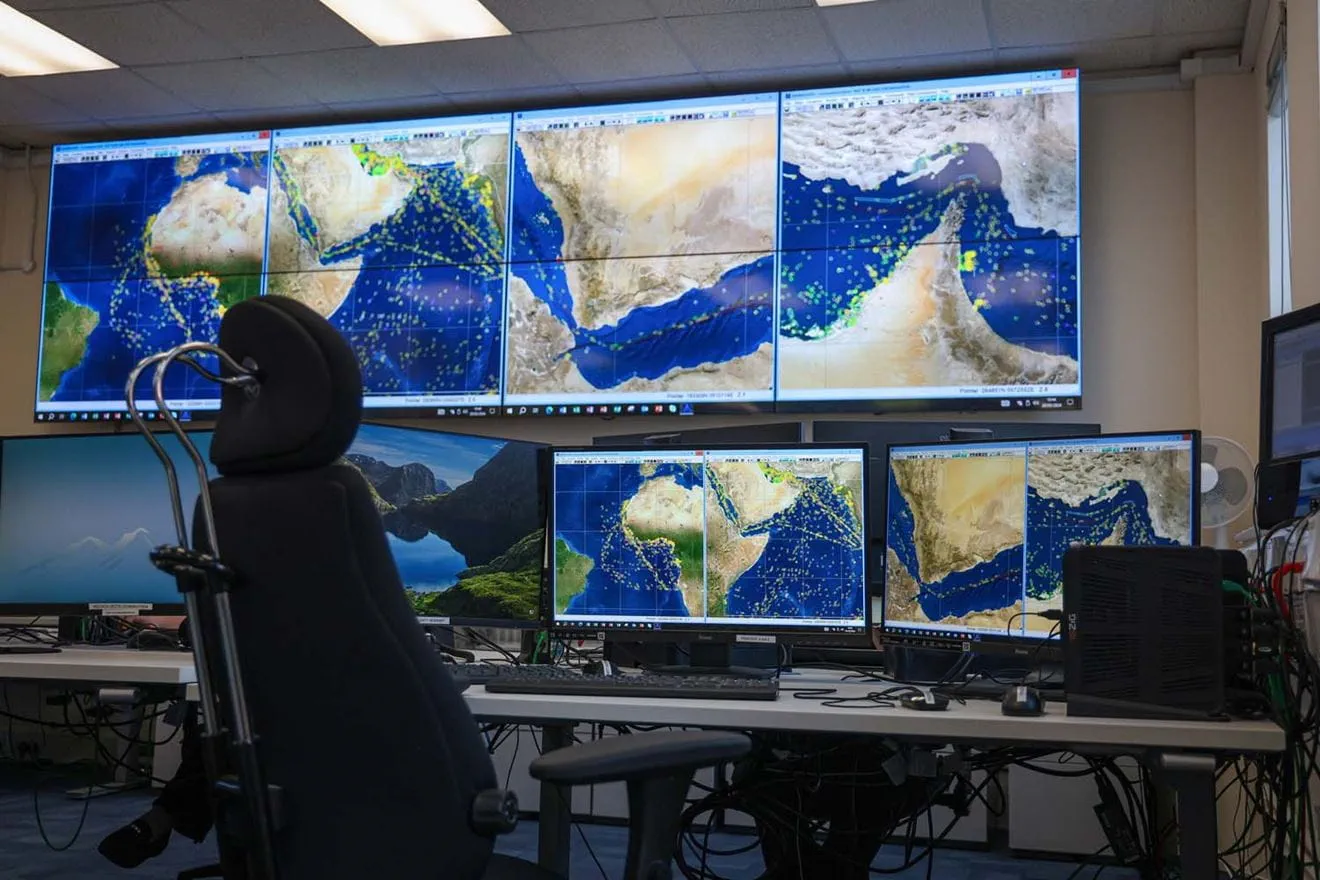
Twenty-seven nations have signed a joint statement affirming political support for an independent multinational military mission to secure freedom of navigation through the Strait of Hormuz, co-led by the United Kingdom and France, the UK Defence Journal understands.
The statement, published on 14 May, follows a Defence Ministers’ summit convened by the UK and France on 12 May at which representatives from 38 nations gathered to announce their backing for the mission. The signatories include Albania, Australia, Bahrain, Belgium, Bulgaria, Canada, Croatia, Czech Republic, Denmark, Estonia, Finland, Germany, Greece, Japan, Kosovo, Latvia, Lithuania, Montenegro, Netherlands, Portugal, Qatar, Republic of Korea, Slovakia, and Sweden, alongside the UK and France.
The statement sets out that the mission will support civilian shipping, provide reassurance to commercial operators, and conduct mine clearance operations. It states that operations will only commence in a permissive environment and in full accordance with international law and national constitutions, and that the mission will maintain clear channels of communication and deconfliction with all relevant states. The signatories describe freedom of navigation as an obligation under the United Nations Convention on the Law of the Sea.
The joint statement is explicit that the mission will be distinct from any other military campaign and is intended to complement rather than replace ongoing diplomatic engagement and de-escalation efforts, which it describes as the primary focus. Nations are encouraged to make further contributions, with the statement noting that necessary national caveats and parliamentary procedures will apply.
The statement builds on a Leaders’ Level Summit co-chaired by the UK and France on 17 April, at which the political framework for the mission was first established.




27 nations out of 195, it’s quite telling that 90% of countries getting oil from the gulf and in Asia and Africa and none of them bar Korea and Japan can be arsed to provide even political support as for this.
Anyone else think maybe we should let China, South Africa and India get their own oil.
*Typo should say are in Asia.
I’ve gained $17,240 only within four weeks by comfortably working part-time from home. Immediately when I had lost my last business, I was very troubled and thankfully I’ve located this project now in this way I’m in a position to receive thousand USD directly from home. Each individual certainly can do this easy work & make more greenbacks online by visiting
following website—.,.,.,.,.—>>> JobatHome1.Com
It seems clear that we do not even need access to Gulf oil (of whatever colour); we can source all the crude and LPG we require from the States (at exactly the same price, but cheaper delivery costs, so why bother?
And that’s before even mentioning the possible use of our own resources once we are rid of Mad Ed.!
And how are prices for US and UK oil determined 🤔
I presume your not advocating for UK and US government appropriation of private assets or price setting given your aversion to socialism 😀
Jim, they are both set on the same international market…..
Yes the same international market that sells gulf crude as well. Everyone can source their oil from the US and UK just like us. If there is less oil the price we pay goes up. That’s why we bother.
Thank you for stating what should be obvious once you’re familiar with the issue, especially when someone has a strong opinion
Even countries that import little or no Gulf oil are still affected because oil is globally priced. For example, the US sources most of its crude domestically and from the Americas, but still sees fuel and inflationary pressure when Middle East supply is threatened.
This is because oil trades as a global commodity. It is bought and sold on international markets, and the benchmark prices such as Brent are set by global supply and demand, not by what any single country physically imports. If a major supply route like Hormuz is disrupted, markets immediately price in scarcity and risk, and that higher price is reflected worldwide.
So even if the UK bought all its oil and LNG from the US or the North Sea, Hormuz would still matter. When around 20% of global supply is at risk, prices rise everywhere regardless of where the barrels physically come from.
You still get higher fuel costs, higher shipping and insurance prices, and wider inflation across the economy. Increased North Sea production would not shield the UK from those global price effects.
This is why the Strait remains strategically critical, and why disruption there has global economic consequences well beyond the region itself. It’s the reason Iran is weaponising it.
Great take JJ at last some sanity. Ask the US consumer what higher oil prices is doing to them and it will get worse as stored reserves decline, the US won’t be selling lots of oil abroad that’s for sure and absolutely not at cheap prices to us.
Just as an aside in case some wonder why ‘Brent Crude’ prices are so prevalent in news when oil prices are regularly mentioned and thus might be naive enough to think it means the North Sea is important in World Crude prices and we may be making a killing as a result, here is the actual reasoning for that term. The Brent field is long gone, Brent Crude refers to the type of oil (and can be used in only particular end uses) that originally came out of that field and the North Sea more generally, and is now applied to this type of oil wherever produced in various places around the World.
OHHHH.
I thought “Brent Crude” was a live Ricky Gervais show 🤔
(for those who never have time to watch TV, It was his David “Brent” character in “The Office”)
Hi Daniele, exactly that. Low in sulphur and other unpleasantness that would otherwise require additional processing to get to the final product.
😳
Hi Joe.
I hadn’t contributed to this one….but thanks for the mention!! 😉
I agree that this is definitely the way things do work. It doesn’t necessarily have to come with the full force of impact on us though.
The government could take a stake in all new oil fields- guaranteeing both a state income from that field and possibly securing a percentage of the supply should they require it. It certainly wouldn’t provide everything we need, but it would help to ease security critical supply and possibly allow some easing of prices domestically (depending very much on how the contracts were written up).
Also and regardless of ownership, if we are producing from our own fields, then we have a surety of supply to our refineries- meaning that they don’t have to shut down if they start to run out of product from elsewhere to process. Companies normally only ship abroad what they don’t have the capacity to process in-country, to keep the cost of producing the final product as low as possible. So the downstream industries have a bit more security against these kinds of impacts, even if the final consumer of those products (domestic or otherwise) is still paying the global rate.
So, while I don’t disagree with you- I do think that getting new fields up and running would reduce the negative impact of this kind of thing happening. Even more so if the government chose to change the way that the fields were licenced to the oil companies (if they are able to at this point).
Don’t get me wrong, there are plenty of good reasons to drill more in the North Sea, energy security, jobs, tax revenue, balance of payments and increasing overall supply. So by all means, ‘drill, baby, drill’.
My point was simply that oil is a global commodity sold on international markets. Even with more domestic production, the UK is still exposed to global price shocks and supply disruptions, which is why getting Hormuz flowing normally again matters to everyone.
In full agreement- Hormuz is a chokepoint that affects the whole world!
It’s actually why net zero is also a security strategy… for the precise reasons you almost expertly laid out
If we are less reliant on oil all together that’s how you effectively mitigate while also creating industry/industries of the future
It’s not popular, I know
That doesn’t mean oil won’t/shouldn’t be part of our energy mix – we actually need oil for things other than energy, makes sense then that over time usage of oil transitions away from providing general energy and is instead more focused and used for the other needs
It’s so logical for multiple high-level national reasons I don’t get why you’d disagree, especially the more you understand the issue
Two points:
1) The US is increasing oil and gas production capacity to help ameliorate the current shortage, particularly for UK and Europe. When Hormuz oil comes back on (as it undoubtedly will do), and if that extra US capacity stays, then total global production will be higher than before the war and the world price might therefore come down.
2) The UK pays for our oil requirements through taxes or borrowing. The UK pumping and selling our own oil generates dollar profits to us, which can be set off against (ie reduce) such taxes or borrowing. That’s the benefit. It also increases world capacity a bit more (see above).
Don’t get me wrong, there are plenty of good reasons to drill more in the North Sea, energy security, jobs, tax revenue, balance of payments and increasing overall supply. So by all means, ‘drill, baby, drill’.
My point was simply that oil is a global commodity sold on international markets. Even with more domestic production, the UK is still exposed to global price shocks and supply disruptions, which is why getting Hormuz flowing normally again matters to everyone.
My simple understanding is uk energy price is linked to volatile gas prices which are more effected by straits of Hormuz. Even if we sourced all our energy from within North Sea we still pay global price. Unsure what incentives uk energy suppliers have to hedge energy prices or even heaven forbid stockpile reserves.
Total delusion William I’m afraid. The US claims to be self sufficient in oil but in reality their supplies are struggling to cope and stored reserves running out fast (the biggest call on reserves occurred last week by the way) and the price of gas there is shooting up like everyone else, World prices hit everyone as they are finding, despite Trump’s obscuring pr. traditionally Canada has supply a good percentage of their oil but they have rather damaged that relationship. Either way for us, buying oil from the US a provenly unreliable ‘partner’ now who uses such matters to blackmail others to join whatever madness is their latest policy, or surrender to their self serving demands is hardly good government policy on our part beyond the opinion of the average village idiot, or grifters running Reform. As for the North Sea never a great gas reserve (we haven’t been self sufficient since 2004) and even oil is now down to the final 8% of reserves and even those who support more drilling (beyond self serving politicians) generally don’t claim it will bring down prices, just give the Govt a bit more tax revenue and perhaps a tad more flexibility in the transformation to more sensible power generation, which has long been anchored to high costs these days sadly by naive decisions in the nineties to rely so heavily on gas powered generation and leaving the problems to future Govts to solve.
As usual you don’t know what you are talking about. The week ending May 8 the US exported 5.5 million bpd of crude oil, up from 4.75 bpd the previous week. What oil the US does import is heavy crude from Canada, Alberta to be specific. That crude runs on a pipeline from Alberta because the Canadians refuse to build pipelines to service their ports for export. Alberta sells that crude at a huge discount because they have no other place to sell it. Canada exports about 4.2 million bpd to the US. So, it’s a wash. Further, Canada didn’t sell any crude to the US 20 years ago but when Venezuelan crude, which serviced the Gulf Refineries, disappeared Albertan crude replaced it. Now that the US virtually controls Venezuela’s oil fields, Venezuelan oil is replacing Canadian crude. The US just doesn’t need Middle East oil as it did 30 years ago.
Is Middle East oil important to the world economy? Yes. It’s not important to the US economy.
But then you’re a provincial Brit who hasn’t the foggiest ideas how the world works outside of your dinky little island.
I’m not sure you understand how markets work pall
Good book for you to read written by a Scotsman, it’s called The Wealth of Nations by Adam Smith
Suggest you brush up on it then come back for a discussion on supply and demand and prices.
It’s a 130,000 words, feels even longer, and other than the term “invisible hand”, which is cool but barely features, supply and demand is better handled by a single graph in any economics text book. Or ask your friendly AI, and save yourself ten hours of reading dense 18th century prose. (Not to say you aren’t right about America and the markets, Jim.)
And you certainly don’t understand them. You sit in your isolated little island, whistling while your country collapses, totally ignorant of the United States and its economy. I presented the energy situation in the US as it exists, not as you would wish it to exist. The supply in the US is equal to its demand.
And I read Adam Smith’s “Wealth of Nations” long before you were even born, pal.
Spy,
Unfortunately, previous HMG did not choose to retain revenue generated from North Sea fields, and initiate a sovereign wealth fund comparable to the Norwegian model. Several trillion in additional assets would have proved beneficial in dealing w/ the credit markets in terms of executing government policies/priorities of whatever stripe. Uncertain re which HMG most responsible for this decision, w/ the attendant resulting consequences throughout the foreseeable future.
John Major was to blame for that, both as Chancellor and PM. Brown could also have done it to less effect, but given that the peace dividend could have gone into the wealth fund too, which would have allowed an easy restoration of defence spending now it’s needed, Major screwed up doubly.
Unfortunately Margaret Thatcher had to spend all that money buying of voters in the South to stay in power.
The people of Scotland were glad to do their bit though 😀
Norway bless them, same reserves of oil gas as uk with a fraction of the population and less rust belt industries to recover from.
William,
We still get over half of our oil and gas from the North Sea.
As well as the US we import from Norway, Libya, Nigeria, Algeria, Canada, Turkey and some from about 12 or 13 other nations.
We don’t have to get everything from the US.
Here here
What seems to be missing is, ignore the location for a sec – the price will of oil is set globally based on supply and demand
That’s it, it’s not really that tricky to grasp.
Even if we were drilling at similar rates to our peak – we would still be affected by the strait.
That’s why oil itself (doesn’t matter where it’s from) is such an exposing factor when used for national energy needs
I tend to agree Jim, 27 sounds impressive superficially but what happened to the other 11 who were represented at the initial meeting, do they not support it or what does this discrepancy even in these initial numbers involved represent exactly? And yes what about 100 odd other Countries a great many of which one might have thought would be interested in coming to some agreement to open and keep open the Straits on acceptable terms to all. Hardly feels like the World uniting does it and indeed when you look at the signees it rather just emphasises the political and strategic divisions in present day World affairs. You get the feeling an awful lot of Countries simply don’t want to be associated with an apparent Western led affair again. When I saw a few African and other Countries in the original coming together I had hoped that situation had been broken. Sadly I can’t see Iran being remotely interested in cooperating with that final list of the (to them) usual suspects. Good on Britain and France at least trying this and hopefully shows future closer cooperation and a united front (with the likes of Germany) for influence and security in Europe and beyond more generally but I fear this example will go the same way as the Board of Peace.
I suspect the other 11 along with India and China are all doing back door deals to get their oil out with Iran and the US. They are all no doubt delighted for the 27 countries to get the straits reopened and restore freedom of navigation but they don’t want to have any expense or damage to their back room relationships by being seen to do the right thing.
The problem of free riding by apparent “super powers” like India and China which have both been humiliated in this crisis by both Iran and the USA and neither has shown any resolve to either look after their own interests or support their Allie’s. Unfortunately both have been shown to be complete paper tigers much the same as they have over the Ukraine war which has negatively affected both India and China greatly.
India is as untrustworthy as they come. There is no way in hell they should be trusted with cutting edge NATO military tech.
Agreed.
Those non-particpitant countries, eg Africa who receive overseas aid from the UK should forfeit it, and it be diverted towards the cost of the UK mission.
To be fair, it’s so hot in the country of Africa that they don’t need oil to heat their homes, so why should they pay, even with our money?!
I think it’s the oil and gas used to drive vehicles, make fertiliser and cook food that’s the real issue not providing central heating in tropical climates.
People in developing countries have far more oil intensive economies than people in developed economies
Thanks Jim,
I assumed that with so much 🌞, a country like Africa would be 100% EV by now, with solar panels on every house.
The country also benefits in the same way Australia does, in that they can cook outside all year round.
On your fertiliser point, Africa being a developing country, there’s probably not much plumbing in houses, so fertiliser everywhere and free!
and air conditioning, Jim.
That would have been a great idea four years ago when we gave aid to countries in Africa.
Keep up 😀
I’ll stand corrected, I thought it was £1.5bn. 2024/2025, at last reckoning.
Africa is not a country, hadn’t you heard?
I know that full well, I omitted the parenthesies, just wanted to make a point, not give a lecture.
Hopefully some of that political backing will be demonstrating in covering some of ours and France’s costs…
“All revved up and nowhere to go” This is just posturing at the moment. Any chance the Gulf states might do something useful? Oman doesn’t even seem to be able to protect its home waters anymore.
27 nations offer “political support” ? Gee, that is brave of them. Any meaningful contribution ?
Jack,
Exactly my thought upon reading this article. In all probability, the coalition of those countries willing to commit significant assets to this mission will be a small subset of the list. Hopefully, the remaining countries will at least contribute financially. 🤔🤞🙄
Degrading Irans military has proved to be a tough nut to crack.
As far as I can see they still have plenty of Ballistic missiles, drones, anti ship missiles and small attack boats.
They dont need anything else to keep the Straits of Hormuz under threat.