

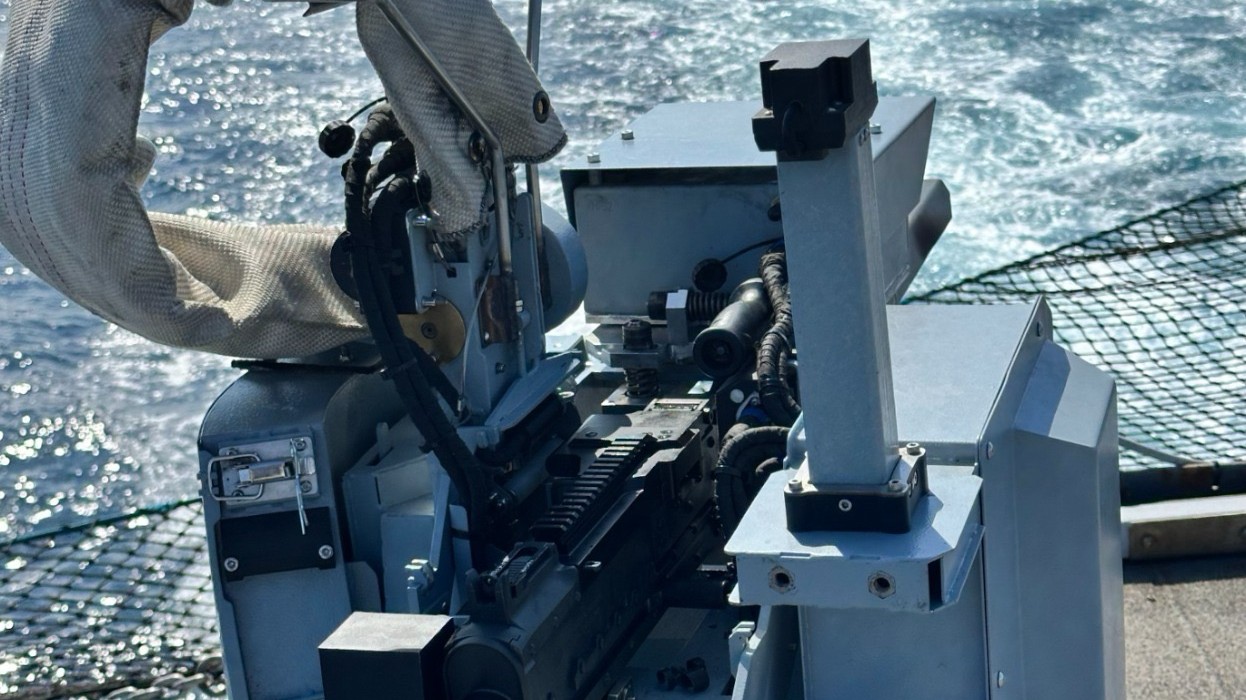
A Ukrainian remote weapon station that shoots down drones with standard 7.62mm rifle ammunition has been tested aboard a NATO member state’s frigate, engaging both an aerial drone and an uncrewed surface vessel during the trial, UGV Robotics stated.
The company did not identify the country or the ship involved.
The system, called Predator, uses thermal and optical cameras along with lasers to detect a target and compute its distance, speed and trajectory. UGV Robotics is part of the UFORCE group and says the weapon has been in use in Ukraine since 2024, deployed specifically against drones since 2025.
According to the company, operational data from Ukraine shows the system neutralises up to 90 per cent of drones within a 200-metre radius and can engage larger targets out to 554 metres, at an average cost of less than €10 per drone destroyed. The company also describes it as the only combat-proven system capable of countering fibre-optic FPV drones.
Those drones are the reason a machine gun on a stabilised mount is being taken seriously as a naval weapon. First-person-view quadcopters flown down a spooled fibre-optic cable receive no radio signal at all, which makes them immune to the jamming that Western forces have relied on as their principal counter-drone measure. Both sides in Ukraine now field them in quantity, and defeating them requires physically hitting the aircraft.
The cost argument follows from the same problem as naval close-in weapon systems fire 20mm or 30mm rounds, and the missiles used against drones in the Red Sea have cost figures in the hundreds of thousands of pounds against targets worth a few thousand. Rifle-calibre ammunition on a directed mount changes that arithmetic, provided the fire control is good enough to hit a small moving target.
UFORCE chairman Oleksiy Honcharuk, a former Ukrainian prime minister, has argued that interceptor systems now provide a workable answer to Shahed-type long-range attack drones while fibre-optic FPVs remain largely unaddressed, and that those drones account for a significant share of casualties on both sides.
The company says the mount is designed for fitting across uncrewed ground vehicles, helicopters, armoured vehicles, static positions, uncrewed surface vessels and larger warships, giving operators the same system across domains.
Remote weapon stations of this kind have been standard on Western armoured vehicles for two decades, allowing a crew member to aim and fire from under armour using a screen and a joystick. Applying them to air defence is newer, and several navies have been experimenting with the idea as small drones and uncrewed boats have moved from novelty to routine threat. The Royal Navy has trialled a range of options against fast attack craft and drones, and fitted Martlet lightweight missiles to Type 45 destroyers, which were used against Houthi drones in the Red Sea.
UFORCE is one of a number of Ukrainian defence groups now marketing systems into NATO markets on the strength of combat use, an argument that has proved effective in a period when few Western products have been tested against a peer opponent. Ukrainian firms have signed agreements with Danish, British and Baltic partners over the past two years, and several NATO governments have set up funding routes to buy Ukrainian designs for their own forces.
UGV Robotics describes the frigate trial as demonstrating the system’s effectiveness in protecting naval platforms, and says it follows recent NATO exercises that highlighted the threat posed by autonomous maritime systems.





I guess a version of this will eventually be on the RWS of every armoured vehicle
These optics could make for effective sniper. Capability
Glorified claypidgeon gun
I suppose the question is do you really want to let a FPV drone within 200 meters of your 1 billion pound destroyers sensitive systems..after all a 5kg blast frag warhead can send out still lethal fragments out to the 300 meters+ mark..
Sounds a little negative.
This solution is so obvious and cheap we can understand why none of the larger companies are interested.
This sort of thing would I’m sure be of interest to small companies if the obvious bureaucracy was removed.
Oh and yes it should not be too much trouble to increase the distance between the weapon and a T45 for example. 🙂
Then why do we have phalanx? Always going to need close protection. Especially if it’s a drone “swarm”.
Would phalanx not be taking out missiles which might have penetrated other measures.
Phalanx is 1000meters to 2000meters.. very very different to 200 meters.. if it’s within 200 meters the possibility of a mission kill creeps in.
Yes but it could still do the job. Phalanx has an EO systemn that can see drones and target them. Do not forget from next year Dragonfire will be fitted to selected T45s, this will make the Ukrainian system unnecessary on laser equipped ships.
This is where your 30-40mm cannon systems with EO come in as you want to be able to engage beyond 1km realistically… 200 meters may be ok on land to protect armoured vehicles or infantry in fox holes… if a blast frag goes off 200 meters from the huge soft target that a destroyers radar your asking for mission kill on a critical ship..
Phalanx is for shredding armored nose cones on sea skimming missiles
Seems a horses for courses type of thing. Nice to have but not for the majority of conflict situations
I would be a little surprised if all conflicts did not employ mass cheap drones in 2026 (with the obvious exception of nuclear war).
It what is being made – everywhere but the west it would appear.
I suggested something akin to the US M45 Quadmount from WW2 months ago.
I suggested something similar to the M45 Quadmount from WW2 months ago. Can be mounted on ships or vehicles, add a cheap radar or some other targeting system and away you go. Far cheaper than some laser, missile or EW system.
It seems that it was conducted from a French La Fayette-class frigate.
From my understanding the RapidDestroyer RF Microwave weapon was only used against radio controlled quadcopter drones, and not fibre controlled ones. In theory the RF weapon should be as effective, as its not designed to directly jam the communications that operate the drone, but instead induces large amounts of electromagnetic interference (EMI) on to the circuitry within the drone. Deliberately overloading components etc, making them fail, and thereby causing the drone to loose control. This along with laser is probably the better overall solution, but if you have a MG to hand, why not use it! As its also a cheap why to kinetically deal with drones.
‘The Royal Navy has trialled a range of options against fast attack craft and drones, and fitted Martlet lightweight missiles to Type 45 destroyers, which were used against Houthi drones in the Red Sea.’.
I am not sure about this, I know a T23 was trialed on a T23 on the 30mm mount but nit taken forward. But I have not seen anything about the missile being fitted to T45. Unless the article is talking about Wildcat carrying the missile.