

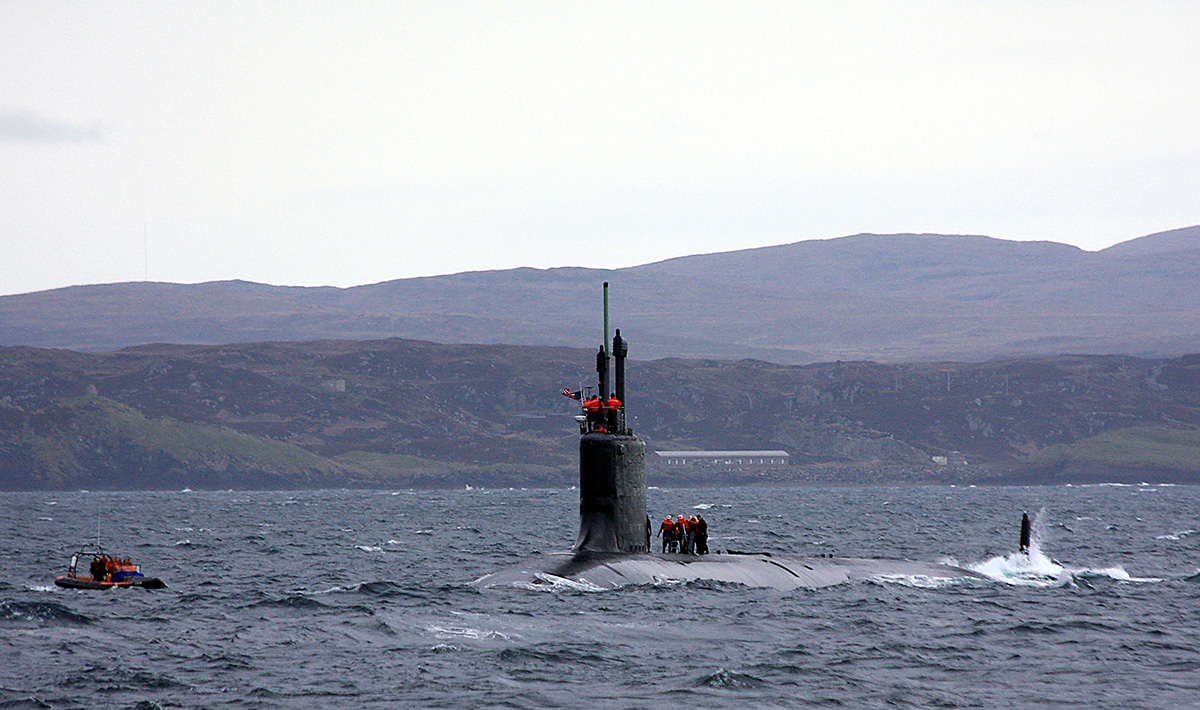
The United States Navy is reclassifying 19 planned Virginia-class submarines fitted with the Virginia Payload Module as guided missile submarines, changing their designation from SSN to SSGN, the service stated.
The change covers Blocks V and VI of the class. It is a designation change rather than a modification, and the boats remain part of the Virginia programme, but it formally separates them from the attack submarines that share the name.
The Virginia Payload Module is an additional hull section inserted into the boat, adding length and four large vertical launch tubes to the two already carried forward. Each tube holds seven Tomahawk cruise missiles, taking the total from 12 in earlier blocks to 40, roughly tripling the strike load a single submarine can carry.
The first of the type, SSGN 803, is estimated to deliver in the 2029 financial year, with deliveries running through to 2038.
Vice Admiral Rob Gaucher, director of submarine programs, said: “This reclassification is a clear acknowledgment of the increased lethality VPM brings to the undersea fight. These VPM-equipped SSGNs will ensure the Navy continues to dominate the undersea domain for decades to come. By integrating this additional payload capacity, we will have the ability to surge strike power to assure our allies, deter aggression, outmatch any adversary, and give our Fleet commanders an incredibly versatile, hard-hitting instrument of national power.”
Admiral Daryl Caudle, the Chief of Naval Operations, tied the announcement to the retirement of the boats the new designation effectively replaces.
He said: “This transition comes at an important moment as USS Georgia, one of the Navy’s four Ohio-class guided-missile submarines, begins the inactivation process after more than four decades of exceptional service. Georgia and her sister ships proved the enduring value of combining undersea stealth with unmatched clandestine strike capability. The next generation of Virginia-class SSGNs builds on that legacy with greater survivability, adaptability, and sustained combat power.”
The four Ohio-class SSGNs were converted from ballistic missile submarines in the 2000s after the arms control treaties then in force required a reduction in the number of boats carrying nuclear weapons. Rather than scrap them, the Navy stripped out the Trident tubes and refitted 22 of them for seven Tomahawks apiece, producing submarines able to carry 154 cruise missiles alongside accommodation for special forces. USS Florida fired more than 90 Tomahawks against Libyan air defences in 2011.
Those boats are now reaching the end of their hulls’ certified lives, and their retirement removes a large slice of the Navy’s undersea strike capacity at once. Nineteen Virginias at 40 missiles each restores the total, though spread across many more platforms.
Vice Admiral Rick Seif, commander of submarine forces, said: “The Submarine Force is defined by our ability to operate undetected and strike without warning. By integrating high-volume precision strike capabilities into these stealth platforms, these SSGNs serve as the ultimate enabler for Distributed Maritime Operations, giving our warfighters the overwhelming, flexible firepower required to win decisively in any theatre.”



Heavily reminiscent of the Cold War “cruiser gap”.
This does raise an interesting question though; if the USN is now only constructing SSGNs and SSBNs, where does that leave the future of the traditional fleet submarine? Options include:
A – a smaller SSN without or with limited VLS
B – a conventional boat to cover the littoral areas that the increasingly large nuclear boats are less effective in
C – an unmanned submarine to do the same
D – nothing; the SSN designation simply disappears as a type
Well I believe that the SSN is still the primary ASW weapon, so the SSN remains and add a sprinkling of C for the GIUK surveillance task, so Type 93.
If we can get on and get TLAM or the future equivalent on surface vessels that enables the SSNs to their primary task, hunting Russian subs in their backyard and forward surveillance.
And yes, before the usual put down smart arse comments, we have to have operational SSN first.
Perhaps we commit to c first and then the operational SSN fleet becomes a nice to have.
Making a couple of SSNs available would eliminate much of the problem and that will come with time.
C remains the most technically challenging option; drone subs are going to depend much more on automated behaviours that surface and air units because of the comms issue, which is a big risk when it comes to armed platforms in waters with friendlies or civilians.
With new tech there are always loads of challenges. That is probably a good thing – we will be better at sorting those challenges than anybody else. We should certainly not be saying “it’s too difficult so therefore we won’t bother”.
Hmmm … wonder whether only a matter of time before SSN-A is redesignated SSGN-A? Future opponents please note a hypothetical comm message: Greetings gentlemen, we are here representing the Royal Navy and/or Royal Australian Navy, please cease and desist from your malfeasance immediately, or we will be forced to take names and kick ass, especially if utilization of SLCM-N is deemed necessary (RN specific case). Not only will your surface fleet disappear, but additionally, very probably a significant proportion of your landmass/population centers. Thank you in advance for your immediate attention to this matter. Regards, HMG and/or His Majesty’s Australian Government (HMAG?). (W.S. Churchill stated that if you have to kill someone, it costs nothing to be polite. 😁) 🤔😉🇦🇺🇬🇧🇺🇲👍
Perfectly logical given the VLS capacity.
In the mix will be two Block V submarines, built without the VPM tubes, to be used for seabed warfare like the USS Jimmy Carter (SSN-23).
It’s a funny one really because when does a submarine with missile tubes move from an SSN to an SSGN
US SSNs have 12 missile tubes, now they are moving to 40 they are classed them as SSGNs
Russian Oscar class SSGNs have 24 missiles.. yet the Yasen class SSN can have 50 missiles…
A nuclear sub with only torpedoe tubes is easy that’s an SSN.. but many SSNs have missile tubes and so when do they become SSGNs…
I think it’s more of a perceived ‘role’ issue. There are some who call the Yasen Ms SSGNs as well. The Oscar’s role was to lob missiles with the boat being designed around the big antiship cruise missiles. The original Virginia’s role was primarily to hunt submarines on the ‘cheap’ (relatively) with a secondary role to lob a handful of cruise missiles with the ship mostly being designed around the sonar and torpedo tubes. However, the cruise missile piece has started to dominate the typical use case for the non-strategic USN submarine fleet and these new subs will be more or less built around the VPM, making them too long to do the traditional SSN role in some environments (probably too long to hang out in the South China Sea’s shallower waters as an example).
As Jomo says the Oscars were built around the vast Granit missiles rather than conventional VLS cruise missiles, so the distinction is possible. It’s also a role thing where the Oscars were specifically designed to attack surface ships with cruise missiles rather than the Yasens which are more flexible.
IMO there was no need to change the Virginia blk5 designation, they are still SSNs as they retain the ASW capacity.
What boats are called can differ from what they are capable of actually doing.
There is nothing wrong with other countries re-classifying them to better fit what they are capable of.