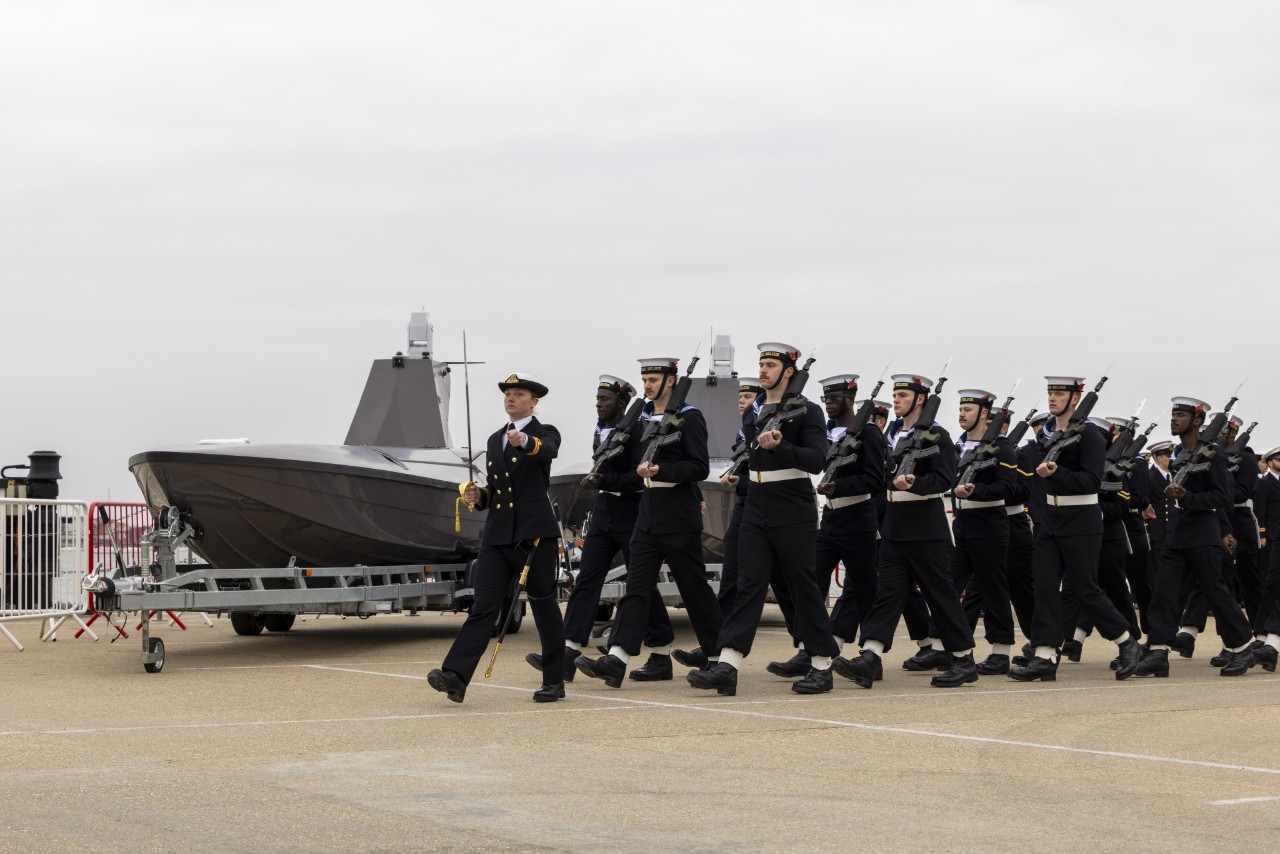
The Royal Navy has commissioned the 1st Autonomous Squadron in Portsmouth, a unit of around 180 personnel, the same as a Type 23 frigate, that will operate uncrewed boats on front-line operations, according to the Royal Navy.
Fleet Commander Vice-Admiral Steve Moorhouse and more than 200 guests attended the ceremony at HMNB Portsmouth on 5 November, which included Kraken and Rattler uncrewed surface vessels being manoeuvred around the harbour from a control hub.
The squadron will initially operate Rattler training vessels and Kraken K3 Scout boats, and is split into two watches to sustain operations around the clock. It replaces Project Beehive, the Navy’s initial programme to buy autonomous boats as a proving ground, and will operate single vessels as well as boats within task groups, while bringing new uncrewed vessels into the fleet. The Royal Navy says the hybrid navy is backed by £1.5 billion over four years.
Wes Streeting, the Defence Secretary, said: “The threat environment we are facing is fundamentally different from that of recent decades. A major determinant of military power now is who can innovate fastest.
“That’s why we are using the biggest sustained increase in defence spending since the Cold War to put the latest autonomous technology in the hands of our sailors, to help them protect our shores and those of our NATO Allies.
“The more ready we are to fight and win, the less likely we are to have to. This investment strengthens our warfighting readiness and therefore our deterrence.”
Vice-Admiral Moorhouse said: “The Royal Navy is doing something it has never done before. We are commissioning the first autonomous squadron in our history.
“That makes this a genuinely historic occasion. For generations, the Fleet has been built around ships, submarines, and aircraft, manned by sailors and Royal Marines. From today, an autonomous squadron takes its place alongside them.
“The seas are becoming more contested, more dangerous and harder to operate in.
“A hybrid navy is about giving our people better tools. It means more reach, more striking power and more options.
“It will help make the Fleet more lethal, harder to knock out of the fight and quicker to adapt. People will remain at the heart of it, as exemplified by all of you here today.”
Commander Helen Coxon, Commanding Officer of the 1st Autonomous Squadron, said: “Today marks the start of something new for the Royal Navy, and I am proud to lead the people who will make it work. The sailors of the 1st Autonomous Squadron are building the skills, the tactics and the confidence to operate uncrewed vessels on the front line.
“Our job now is to put these vessels to work, whether on their own or as part of a task group alongside our allies, and to bring new uncrewed systems into the Fleet as quickly as we responsibly can. Working with Navy Develop, the Disruptive Capabilities and Technologies Office and the Capability Accelerator, we will keep learning, growing and improving.”
The Kraken K3 Scouts are 8.5 metres long, weigh 2.5 tonnes, reach 55 knots, have a range of 600 miles that can be extended to 1,100 miles, and carry a 400kg payload. They have been tested off the south coast in force protection, surveillance and reconnaissance roles, while Rattlers have escorted warships in Scotland while piloted remotely from 500 miles away. The Navy took delivery of 20 Kraken boats under Project Beehive in April, for use by 47 Commando Royal Marines, and Beehive is part of Britain’s contribution to the Strait of Hormuz mission.
The Capability Accelerator, set up in 2025 and partly funded by UK Defence Innovation, has also opened a hub at HMNB Portsmouth. The Royal Navy says Kraken and Rattler show the team adapting off-the-shelf technology for military use in a shorter time. Commander James Wagstaffe, Capability Accelerator Team Leader, said: “The way we develop and deliver capability must evolve if we are to stay ahead of an increasingly complex and fast-changing threat environment.
“The Capability Accelerator has been established to help the National Armaments Group get new technologies into the hands of our sailors faster, reducing the time between identifying an operational need and delivering a capability that makes a real difference.”
He added: “The opening of the Capability Accelerator Hub marks a significant milestone. It provides a dedicated environment where sailors, industry and delivery teams can collaborate, test ideas and rapidly mature innovative solutions into operational capability.
“It will also help us capture lessons, build on success and develop a repeatable model for faster capability delivery across the Royal Navy.
“We have already demonstrated what can be achieved through key maritime programmes. Our ambition now is to build on that momentum, creating a Royal Navy that can adapt as quickly as technology and threats evolve.
“Ultimately, this is about delivering capability faster, maintaining our operational advantage and ensuring the Royal Navy remains ready to meet the challenges of the future.”