

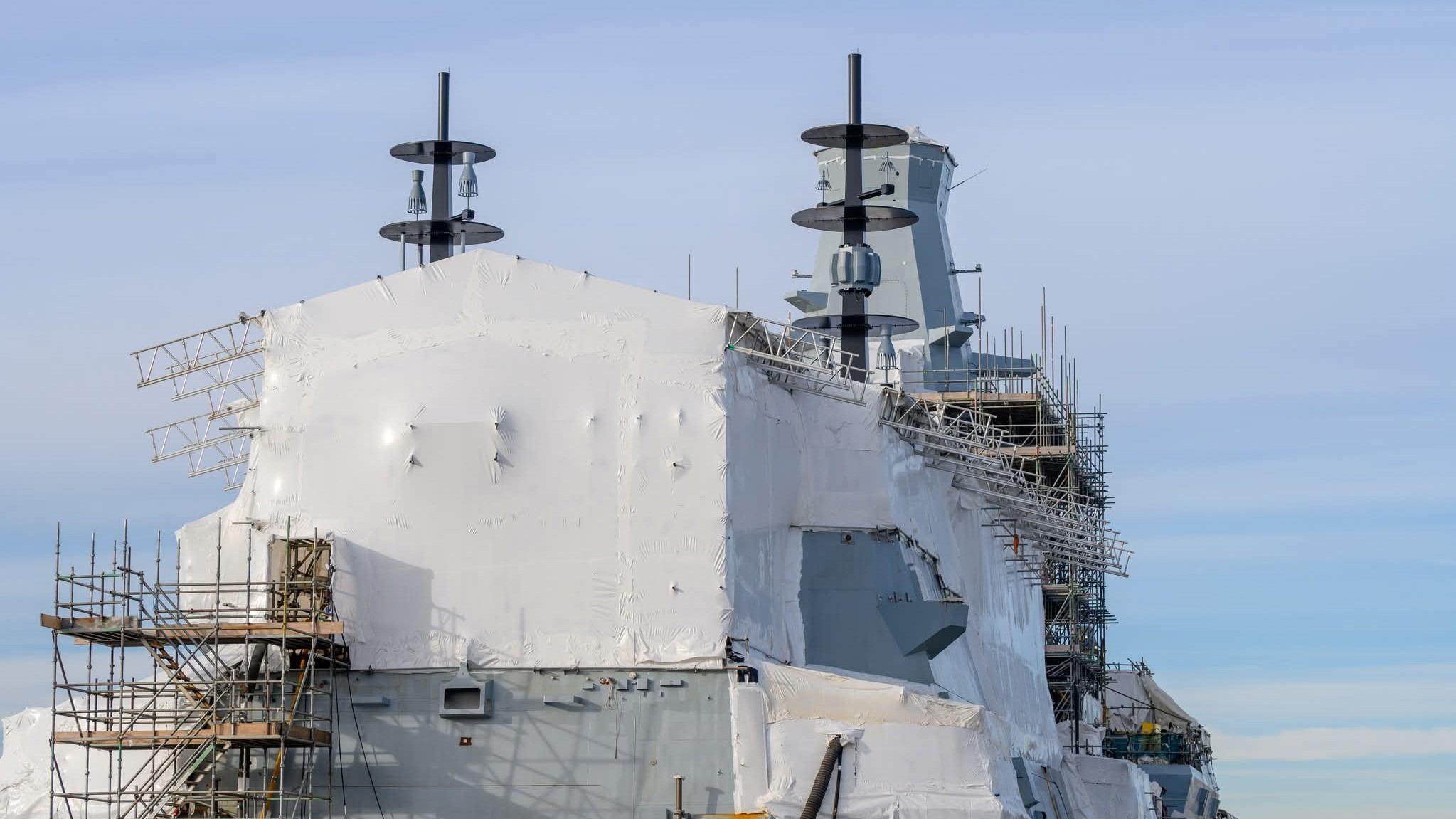
HMS Cardiff, the second of the Royal Navy’s Type 26 anti-submarine frigates, has had two 17-metre pole masts fitted above her mission bay at BAE Systems’ Scotstoun yard on the Clyde, giving the ship her final profile, according to the Royal Navy.
The masts, designed and manufactured by STS Defence, carry the frigate’s secure communications.
The port mast provides 4G connectivity, ship-to-shore satellite communications and a GPS link, while the starboard mast hosts UHF and VHF communications. Each gives 360-degree coverage and is designed to provide the frequency isolation needed to prevent interference from the ship’s own systems.
Pat Browning, National Armaments Director Group Type 26, said: “Seeing HMS Cardiff take on her final profile is a proud moment for the whole Type 26 team.
“Fitting the masts in dry dock demonstrates that, together with industry, we are applying what has been learned from the programme to deliver these ships that will be the backbone of the Royal Navy.”
Cardiff was floated up in dry dock two at Scotstoun in April, and will stay afloat there for the rest of her fitting out. Steel was first cut for her in August 2019, and she was floated off a heavy lift barge at Glen Mallan in September 2024 before being towed to Scotstoun. Her main composite mast, built by Umoe Mandal in Norway, arrived in Glasgow in 2022. Lead ship HMS Glasgow is expected to reach Initial Operating Capability in 2028, and all eight ships are due to be complete by the mid-2030s.







Ships built at a snails pace and they shout about fitting a couple of masts..How about getting them to sea with RN crews anytime soon?
Ioc 2028?FFS! IT’LL BE OBSOLETE WHEN IT FINALLY GETS TO THE FLEET.
How far along are Belfast and the next 31?
I think Belfasts hull is not far from completion, she has yet to be painted.
However BAE might be pacing the work as theres little capacity to fit out a third ship right now.
T26 is already obsolescent. No ship of this level today have only a rotating radar. They have fixed panels always covering 360 and even have dual band,
And even some have dual band.
I think I’d say that T26 is an ASW Frigate, so radar is not critical to that
Also – the fixed panel radars are much bigger and much heavier than the Type 997 units, which means a much more massive mast (more weight, higher centre of gravity, needing more power, more cooling, bigger RCS).
Hunter class is effectively a T26 with this type of Radar, and it’s had to gain huge amounts of weight as a result.
The Type 45 (which IS for air defence) also went this route because a less massive radar and mast means they can be higher above the waterline which means they gain range.
SeaCeptor is designed to operate with the 2 second updates from the rotating radar.
T26 design isn’t an error, it’s a choice.
It’s a choice, but it’s a choice born from the error baked into the specifications of the original ship design process.
I think the choice reason is even worse.: the disinvestment from naval radar by “UK plc” after Horizon class aka T45…
That’s true, though I meant it more in the sense that the specifications will have asked for a low-tier air defence capability, and that’s what was delivered.
I wonder if it dates back to pre-2008, as well, back when it looked like we’d be getting 8-12 T45.
Yeah it is possible, still first ship it was only laid in 2017. The T26 genesis would be interesting to know.
I always found it strange that a class named Global Combat Ship ended with such apparent lack of ambition.
Wasn’t the Sampson reasoning that a lighter rotating radar could be placed higher, making for a more distant horizon and therefore more reaction time against sea skimmers?
Yes. But today there are much more than just sea skimmers and if you cannot track continuously a missile that might be doing evasive maneuvers you cannot update your missiles in flight, plus with ASBM- anti ship ballistic missiles arriving i am expecting zenith facing radar panels will be necessary too.
Sea Viper and Sea Ceptor are both Active Homers – are Radar Updates that critical ?.
Yes with missiles maneuvering including changing altitude.
More for Sea Viper, its much longer range implies that.
It was actually necessary for the radar to be at the height it is in order to meet the demanding target detection requirements. So essentially you are correct but consequently the mast has to be the size it is in order to accommodate Sampson’s size. The rotation means that sufficient coverage can be achieved with fewer active elements. Target update rate is much better that 2 seconds!
Thx. Good to know about the target update rate. Seems to me that, post Falklands the UK made a conscious choice to develop high, light rotating radars rather than the then emerging flat face technology.
One Wonders how our Hybrid Navy will Identify Targets ..???
If T26 is only a mere ASW frigate why does it need to be 8000t?
FDI which is a 4500t frigate has 4 Thales Seafire radar panels, T26 RN is an 8000t frigate.
Because the Type 26 will actually hunt and kill submarines, the FDI not so much.
FDI have Captas 4 sonar too.
To hunt and kill submarines there is need of 8000t?
Indeed not, witness the venerable T23. The T26 has a long history back to the ‘global combat ship’ – hence its displacement, range, Mk45, Mk41s, gucci mission bay, Chinook sized flight deck etc. Also, hence the posts I’ve read saying the Mk45 is a waste of money – put it on T31 and 57mm on T26. I’m not a naval architect but I suspect just being larger and purpose designed does make it significantly quieter for ASW in heavy seas. As you say, Artisan is not leading edge these days but it is probably good enough for target detection and CAMM direction against most drones, cruise AShM and even short range ballistic missiles – non state actors. IRBM (Iran) and hypersonics would be a problem.
T26 has electric propulsion which is an advantage over FDI but that is not related to its size. T23 also has.
I doubt size has that influence on noise, but it makes a more stable platform for the helicopter, so T26 have that advantage by being bigger.
I disagree over Artisan, it is a significant weakness when menaces cannot be tracked continuously specially with evasive maneuvering including position exchange via cross paths, faster speeds. i wonder also about the CMS update.
At 25km range CAMM have no ABM capability.
Aster 30 is said to be able to intercept a BM up to 600km range, Aster 30 B1NT will extend this to ballistic missiles of 1500km range so that one still do not cover the Iranian BM upper range. Only US and Israelis have that in the West.
Why are you asking us? I assume that an expert in the field such as yourself must know the answer already.
HMS Glasgow stands very little chance of being operational in 2028.
Consider. It’s November 2026 and there are no signs of sea trials this year. If they start in maybe February 2027, and first in class might expect 3-4 months of contractor trials, that takes us to mid 2027 for handover. RN would normally expect to take two years before a first operational deployment. Daring was declared operational after about 18 months, but the reality was it was totally unready at that point and couldn’t fire the Sea Viper (Aster) missiles. The actual first operational deployment was about 3 years after handover. If we assume Glasgow is in much better shape (as its primary systems are known-quantity sonar and Merlins) and that we aren’t still trying to figure out what goes in the Mk41 VLS, Stratus won’t be ready and are we pushing ahead with the Aster tests, I think 2 years is more reasonable than the squeezed 18 months needed to hit a December 2028 target date. It may be declared operational for form’s sake, but it isn’t going to be patrolling the North Atlantic hunting subs until well into 2029.
The RN exposure is ASW capability. I think Glasgow will be able to do the T23 replacement job by 2028: TSA, Artisan, Sea Ceptor, Merlin ops. ‘Operational’ will need to be phased. Missiles for the Mk41 can wait.
Hooray we got some masts, how about getting more than one at sea ASAP, prior to our Wes and his 1000 days to war…….Never mind we will be ok, we have the unfunded (sorry now its funded by promise of other department cuts next year) that will get us ready for war by 2035….”Wes, Wes? did you say 1000 days mate”
👍
The problem I see it, is essentially ships 1 and 2 of both the T26 and T31 are scrunching up and as first in class trials take about double the time.. I think we are going to see the RN having to run second stage sea trials on 4 frigates at the same time.. 2 of those being first in class trials, I’m not sure they have the man power. Even in the 1990s they were running run frigate through trials at a time.. and they had a hell of the lot more people then..
One at a time…
No Radar yet. This is pathetic. The build speed is worse than the Spanish completing their pre 1930’s designed destroyers in the 1950’s and who were still flying Ju 52’s in the ’60’s. How far have we fallen?
Stopping the design of the T83’s will cost us dear. We need to bring back the Admiralty Design Office. I nstaed we will replace the Rivers with Norwegian OPV’s and wonder why we lost our own ability. So stupid I sometimes wonder if it isn’t all an enemy agent inside the Government or MOD.
Poles? WOW. The most reliable Poles the UK is likely to have are several hundred miles to the east where they recognise what a threat is.
They will probably have a greater GDP per capita by the time these two frigates enter service.
Probably. They way were going Streetings “war” will be over by the time a 26 gets commissioned. 🫣
But it’s total GDP that matters more for defence, hence the huge difference in the size of the UK’s and Poland’s defence budgets: $90 billion compared to around $44 billion, even though the Poles are spending 4.8% vs the UK’s 2.5%. The media and Youtubers talk up Poland because it’s investing a huge amount in its land forces and the Sky Sabre-derived air defence system, but Poland has some significant vulnerabilities. Obviously, the main one is a total lack of a sovereign nuclear deterrent, though the Polish air force is also quite weak, and its domestic defence sector is small and not very advanced—hence why it’s so dependent on importing military hardware. On the nuclear front, if the US walked away from NATO (admittedly less likely given the recent elections in the US), Poland would be relying on a nuclear umbrella provided by France and the UK. The former would not seem like a good bet either if Le Pen gains power.
It has masts !! Masts I tell you!! Not one, but two!! Twice as lethal , twice as agiile, twice as innovative.!!
Left hand down a bit Number One.
😂 you are a bad man!
The 3 wise monkeys, Wes Streeting, John Healey and Douglas Alexander visited BAE Scotstoun earlier this week. See no evil, hear no evil, speak no evil 🙂
3 Charlatans, the rest stayed home
Apparently Glasgow does not even have the 997 radar fitted yet. She was due to go to sea trials next month.
Please dear, don’t be such a drama Queen, simply plug in and play, innit?
All will run smoothly and the Australians, Canadians and Norwegians are not in the least bit perturbed by our leisurely pace, are they?
Give it a week and Glasgow will be flying the Union Jack, have some faith man, trust your betters.
Meanwhile, Al Carns did a 90min Youtube and he was scathing about the Armed Forces.
Brother, there’s almost no chance that Glasgow will see the water before January.
I dunno, Streeting, Healey and Alexander visit Scotstoun, POW is in Oslo for some conference or other, Kongsberg announce T92 drone design…..maybe something is in the air.
Wonder how long it will take our HYBRID NAVY to get thru Trials…?
IMHO the CCV / uncrewed drone idea is doomed already.
Too many unknowns a challenges to solve.
ATM there is no decision on the size of the drone ship (too small and they won’t be stable in high seas) too big and they will
take as long to build a crewed frigate.
I reckon even if we solve the technical challenges this fleet is a good 10 years away at least.
I can tell you that those masts were manufactured in 2018/19 and have been in storage ever since. STS Defence’s customer was Rohde & Schwarz who have the main ship-wide comms contract.
Far too slow. I did a google search to see how long it takes China to launch a frigate once the first steel has been cut… ‘For a standard Chinese Navy (PLAN) frigate (such as the Type 054A Type 054A frigate), the total time from the initial steel-cutting (first metal cut) to official commissioning and entry into service generally spans about 2 to 3 years’ – Cardiff will be NINE years! We really, really need to get out act together!
Of course it is slow: the RN procurement budget is far too small to fund all the new ships and unmanned vessels on order, even if the build rate is stretched over a 10-year programme.
Hence production rates have to be slowed down to fit the budget.
The RN’s surface vessels budget is only £1.8 bn.a year. With a T26 costing £1.2bn, a T31 around £400m, that’s the year’s budget more or less gobbled up. And that’s before paying.for the three Resurgent class solid support ships… plus the planned 3-6 Norwegian MHC offshore support vessels… plus the replacements for Protector and Scott…..plus this fleet.of unmanne vessels.
The core problem is that defence spending, particularly over the last 14 years, has been far below what was needed to replace the growing number of ageing vessels. Made worse by.the Sea Lords robbing the frigate budget to pay for the vanity carriers, which we couldn’t feasibly afford, resulting in the gallant T23s dropping like flies and the RN needing to build two classes of frigates simultaneously in a rush, to which the budget does not stretch.
It’s all very well to demand that HMG just finds lots more money for defence. We have got the max that HMG can squeeze out of the public finances for now. Reality is that the UK is living well beyond its means, as evidenced by the ever-increasing government debt and massive cost of interest thereon. The publoc finances are already at austerity levels.
Defence needs a very big dollop of cash just to right the ship after a few decades of serious underfunding. It can only be accomplished by a SAFE-type scheme as the EU is operating.
Press release from Labour Party Central. All bollocks.