

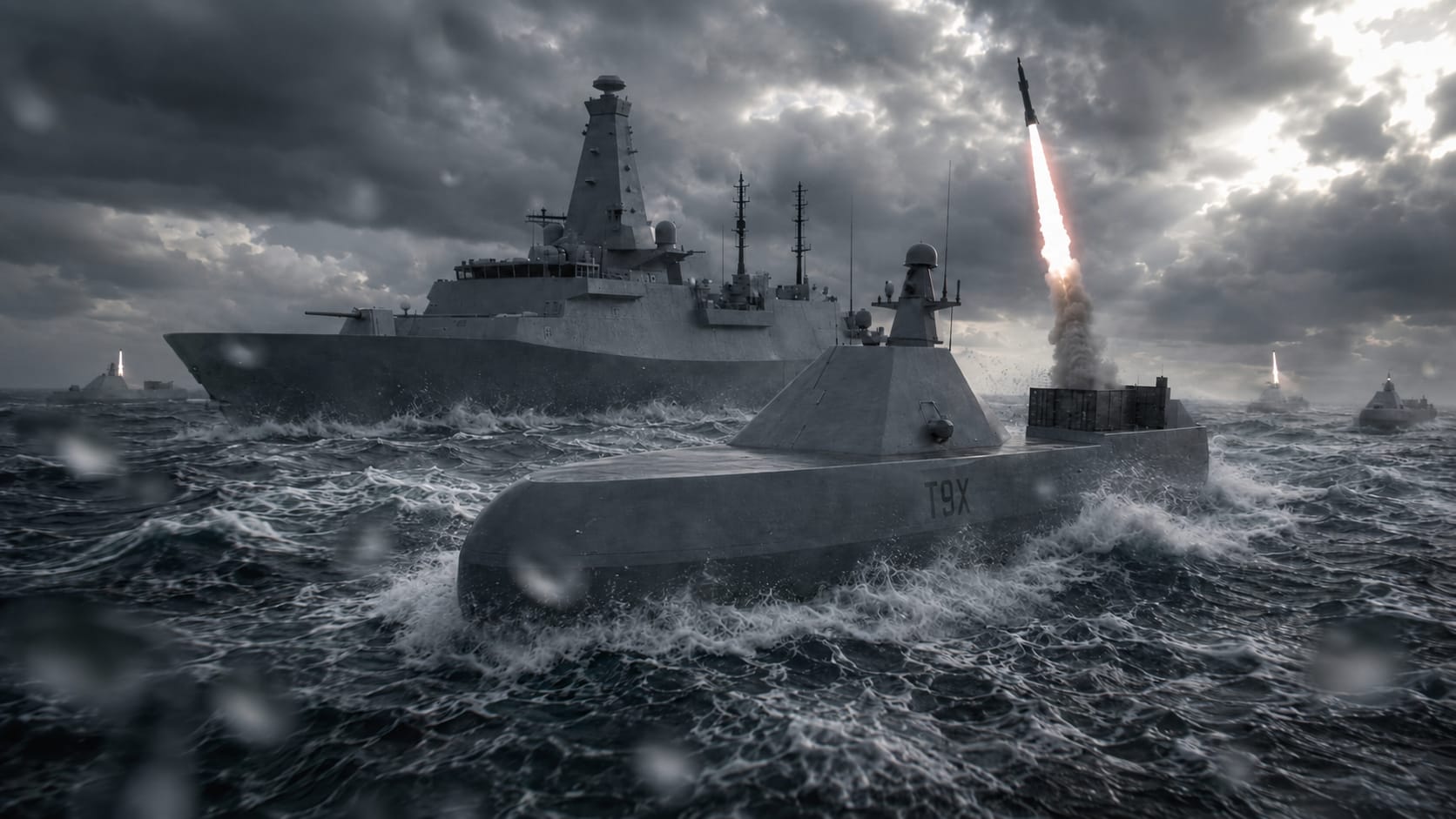
War games examining the Royal Navy’s planned shift towards crewed and uncrewed systems are claimed to have produced roughly three times the missile capacity for a North Atlantic conflict, according to a former senior Royal Navy officer.
War games examining the Royal Navy’s planned Hybrid Navy concept are claimed to have produced a substantial increase in combat mass and roughly three times the missile capacity available for a North Atlantic conflict, the UK Defence Journal understands.
The assessment comes from Rear Admiral (retired) James Parkin CB CBE, a former Royal Navy Director Develop, writing for the Council on Geostrategy’s Britain’s World magazine. Parkin argues that the combination of high-end crewed warships with larger numbers of autonomous and remotely operated systems offers one of the few realistic routes to increasing naval mass without a corresponding rise in personnel or the cost associated with building additional major warships.
He writes that testing of the concept through hybrid war games has produced what he describes as a substantial increase in combat mass and “roughly threefold missile capacity for a North Atlantic contest”. The figure is presented as a claimed result of war gaming rather than an operationally demonstrated capability, but it provides an indication of the scale of effect being sought through the Royal Navy’s future force structure.
The Hybrid Navy concept was formalised in the 2025 Strategic Defence Review, which envisaged highly capable crewed submarines, warships and aircraft operating alongside much larger numbers of uncrewed systems. The 2026 Defence Investment Plan subsequently described a network of crewed ships and uncrewed surface and underwater vessels connected through a Maritime Fighting Web, alongside plans for at least six Common Combat Vessels and autonomous collaborative aircraft under Projects VANQUISH and PANTHEON.
Parkin argues that the concept should not be interpreted as a replacement for conventional warships. He warns against drawing direct conclusions from Ukraine’s use of uncrewed vessels in the Black Sea, distinguishing between sea denial in a relatively enclosed maritime environment and the sea control required by Britain and NATO across the North Atlantic.
He writes: “Cheap, massed, and precise systems matter, but Britain must protect oceanic trade routes, nuclear-power ballistic missile submarine (SSBN) bastions, and NATO strike groups operating far from friendly ports.” Parkin argues that the Hybrid Navy must therefore remain centred on high-end crewed platforms, with uncrewed systems providing additional sensing, weapons capacity and persistent presence.
The memorandum also identifies regulatory constraints as a potentially significant obstacle. According to Parkin, the permissions required to operate uncrewed surface vessels larger than 24 metres routinely in British waters have yet to be established. He states that no uncrewed vessel above that size has so far received either Maritime and Coastguard Agency or Defence Maritime Regulator operating clearance, while neither civilian classification societies nor the Naval Authority and Technical Group have approved such a design.
Parkin argues that addressing this will require more than changes to individual regulations, calling instead for Defence to make greater use of the freedoms already available to it to conduct experimentation. He advocates giving operators greater scope to “learn by doing” and to fail safely during development rather than allowing lengthy approval processes to slow experimentation with new systems.
A second issue identified is the speed at which lessons from trials and operations are fed back into equipment development. Parkin contrasts traditional British defence acquisition cycles, which he says can take months or years to incorporate changes, with the much faster development cycle seen in Ukraine. He cites the so-called “rule of six”: six hours for operator feedback to reach a manufacturer, six days for software updates, six weeks for hardware modifications and six months to replace a system entirely where necessary.
The memorandum argues that a similar continuous feedback model will be required if the Hybrid Navy is to deliver the intended increase in mass and weapons capacity. Parkin also warns that the programme will require specialist maritime knowledge throughout acquisition and development, rather than treating the transition primarily as a conventional programme-management exercise.
The Royal Navy’s underlying challenge is one of numbers and cost as Parkin notes that large complex European warships can now cost around £2 billion to £2.5 billion per hull, while specialised naval aircraft can approach £100 million each. Against that background, the Hybrid Navy is intended to distribute functions traditionally concentrated aboard individual ships across a much larger network of crewed and uncrewed platforms.
Parkin served in the Royal Navy for 28 years and was Director Develop in Navy Command Headquarters between 2021 and 2025. His assessment is presented as analysis rather than an official Ministry of Defence statement, but it sets out both the potential operational gains and the regulatory, cultural and acquisition challenges involved in turning the Hybrid Navy concept into a deployable force.



How can they increase the fleet size with unmanned systems without a corresponding increase in RFA to fuel and supply them, as well as associated rise in dockyard capacity and specialists to maintain them?
Potentially uncrewed RFA vessels could be used but rigging lines in rough seas would require a trained crew?
Yes, LUSVs themselves may well need a tender type mother vessel to dock them, repair and maybe even rearm in group transit. Something bigger than a Bay or MROSS handling MCM, maybe an adaption of the Elliade MRSS ship?
Its good they’re wanting to maximise the loadouts of these drone ships but equal emphasis should be given to actual ships. The T45s could have been given 2 mk41s or 2 ExLS for more CAMM or still additional CAMM on the Aster silo sides of behind or on hangar roof space. Why didn’t the T26 get a 4 mk41 and CAMM exls? T31 the same? And it’ll cost but a few more T31s would further help maintaining a good mid-high level presence, support helo/uav ops, fly the flag, do humanitarian and port visits, complementing the rest of fleet. I mean this in addition to the CCVs. This obsession with drone ships which if others copy and at scale we might well lose any short-term advantage in anyway.
And you get back to the reasons the Juene Ecole failed.
I had to look that reference up. Thanks, as I was not aware of it. The shear amount of money, energy, build, tech, vls, everything, going into these drones, I’m sure there’ll have their use, but if you added it all up and their timelines, wouldn’t it be sensible, more usrful, can support helo/uavs and still be affordable to get 3-5 additional and known T31/T26s types planned for asap in addition to these CCVs? Additional actual presence for deterrence. Do you need these drone motherships to go everywhere when a simpler T31 suffice? Even add small fleet of SSKs for coastal regional patrols, free up the Astutes, sub drones can be added alongside. It’ll all need to be an expert mix but extra T31s and even Opvs shouldn’t be that hard.
I’m not sure it did to be honest the young school, Mahanian Doctrine and Corbetts Principles of Maritime Strategy all provide a piece of how naval conflict works… they each on their own does not provide the truth.. so none really failed.. Mahanain shows a truth in why you much be able if needed to concentrate power in the battle fleet.. the 21c child of Mahanian thinking is the CBG.. but the young school showed that there are many tools, not just the Main battle fleet, and a fleet without all the tools technology can provide is at risk.. finally Corbett showed us that concentration on its own fails in naval conflict and as maritime conflict is inherently Manoeuvre warfare at its purist.concentration will alway in the end fail..as your enemy will simply refuse to engage and play your game.. bugger of and kill something inconvenient well away from your mighty fleet.. and if they can keep doing that you will lose..
The most successful navy in history, (the RN from the 19c to the beginning of the 20c) essentially showed all three concepts and used them all.. it could mass the battle fleet as Mahanian thinking said you needed to ( and Mahan was remember utterly influenced by the fact all power feared the concentration of the RNs battle fleet).. it used all the technology it could find as the young school said it must and it followed the Corbett pattern of desegregation of sea power and manoeuvre…
The concept may be sound but will the RN be able to make it work. Design deliver and have fully operational several new classes of vessels along with the associated technology all in a decade or so?
Hi Norm,
In peacetime, it would be a tall order given all the various vested interests. However, in wartime things have a tendency to speed up a tad.
I read a story some years ago about a piece of kit, a RF jammer or warning system I think, that was being rushed out onto Lancasters. A couple of ‘boffings’ turned up and fitted the kit hours before take off. The ‘black box’ was taped under the navigator’s seat! OK you couldn’t do that on a modern fighter pulling 6+ g, but you get the idea. Give them third best, the best never arrives and second best is always late.
The hybrid navy will need to be able to adopt the “good enough” philosophy if it is to exploit the opportunities and rapidly developing capabilities of drone technology. Efforts by the MoD to work SME’s seems to be paying off, although much of the work and procurement goes unreported as far as I can tell. Hopefully progress can continue to be made.
Cheers CR
For the dambusters raid in May 1943 the final larger upkeep mine was designed and built, aircraft were modified, crews were trained all in 8 weeks…
And just as well too. The water levels would have dropped in the dams if there was a significant delay potentially leading to a postponement may even to 1944.
The raid had at least one long term secondary effect which was that the Germans withdrew considerable numbers of the Tote force labour organisation away from fortifying the French Coast to rebuild the dams because they were seen as symbols of national pride and strength by the Nazis. The resulting labour short in the west meant that when Rommel inspected the Atlantic Wall in 1944 he found huge gaps and unfinished work. Which was all to the good for the D-Day landings.
Cheers CR
I hope they war game the resupply of ammunition, from manufacture to platform. It’ll probably be planned over the next ten years to coincide with the inevitable capability gap by withdrawing other resources early or delaying the introduction into service. Cynical I know but that is how they’ve worked up to now. Tell the enemy to wait while we naval (sic) gaze!
Add to that the next to non existent defences of naval ports to go along with lack of GBAD elsewhere. Why don’t they seriously act to protect the very defence assets and bases themselves?
More interested in allowing tax avoidance for those who can afford it, and of course the bean-counting short termism of Treasury up against the long term needs of defence. The longer critical things are deferred the greater the eventual cost.
“large complex European warships can now cost around £2 billion to £2.5 billion per hull”
Really? Name two. There is only one European surface warship class I’m aware of (outside of aircraft carriers if you can call those warships) that is projected to cost that much, the German F127, and it’s mostly that expensive because the systems aren’t European. Germany went the full Aegis. That’s not an argument for RN going hybrid.
If you account for inflation, the build costs of the Horizon/Orizzonte/T45 are somewhere around the £1.5bn mark. That has to be the most expensive European escort project. Italy’s DDX and T26 B1 are around half Parkin’s quoted cost, and are still counted expensive in European terms. Most top of the line European warships, recent or planned, sit a little below £1bn a unit.
Parkin also mentions a future AW101 costing £100m. That has to be fantasy. So how can I trust his other numbers?
We aren’t building fewer crewed ships because they are ever more expensive. The ships are ever more expensive because we are building fewer. Perhaps the answer is to find a better way to build together.
Excellent points 👍
Building fewer and filling them with ever more complex and expensive equipment!
Lots of smoke and mirrors around RN hull costs. The ukp 1 billion number often quoted for Type 26 exludes multiple systems and sensors which are provided by the MOD for integration rather than by the shipbuilder and are excluded from the 1 billion figure.. Norways 5 hull deal for T26 is valued at ukp 10 billion $13.5 billion usd.
There is no way T26 costs only 1B, the ship is taking 10 years to be build, when others do it in 3-4 years. so unless they have like 1/2 workforce(or the work force in half salaries) and capital expenditure it is not possible.
Batch 1 cost about £1.3bn per unit. Batch 2 a little under £900m. And yeah, the extended build time has a lot to do with the difference. It also absorbed some one off costs like the stone frigate test systems.
A few years ago, the price per ton in UK was 40% higher than in France and Italy. Inversting in naval shipyard of UK is one of the smartest investment that could be done.
I really do not like this. With our record I can see all sorts of blunders occuring. Why are we going to build four classes of warship, all untried, when we could build one. T83 is dead, so be it, But if the French can build a 4500 ton frigate capable of carrying 32 tubes for Aster plus a whole host of other weapons why can’t we? The Amiral Ronarc’h class is priced at £500 million, has a crew of 125 and an endurance of 45 days. Babcock would be perfectly capable of building them.
But we are building the 7000 ton T31 with Mk41, and huge growth potential.
More of the FFBNW deception from the MOD.
It started with the T45s. Look how long it took to get harpoon onto them , and only now are some T45s are getting the long promised seaceptor added.
I fear the T31s will go the same way .
Well not really,. As the project has already been adapted to fit mk41. That’s a big change capability wise.
All the T45s are getting Sea Ceptor.
And only 24 when it could have been 2 ExLS for 48 or put in another 24 CAMM farm. A wasted opportunity to maximise the loadout even further.
After how many years of service? That is the point I am trying to make.
I’m not a fan of the “how many years of service before” argument. It’s assuming that FFBNW means “We actively plan to fit them but moneys tight right now” rather than “If we need to one day we’ve left the option of more armaments.” Up arming now is a good shout, but I don’t think that it means we should have fitted a CAMM farm in 2014.
Yes, but not as an AAW asset, whcih is what this drone fleet is supposed to be. A replacement primarily for the Type 83.
T83 Dead..? Only because Starmer cut it out of DIP to save himself going cap in hand to No11…!
Hopefully HEALEY will change that direction..!!
Our QEC will need a Air Defence vessel by 2040 and T31 and Drones ain’t going CUT IT Easr of Gibraltar that’s for Sure…!
Dam straight !
I don’t see it being likely Nig e. Decision made. Not his problem now.
“The Amiral Ronarc’h class is priced at £500 million.”
No it is not. It is about 730M pounds.
You’re quite right, including development costs. Still only around half the price of a T26 though.
A balanced view setting out the challenges to achieving the move to a hybrid navy.
The essential ambition is to deliver more combat mass without increasing manpower requirements against a background of the ever greater costs of warships.
But is there a lower risk route to achieving this?
Choosing simpler platforms with high levels of automation alleviates the manpower problems. And, if the build cost can be kept below £500m, or around half the cost of T26 or T45 in today’s money, in theory you get more than twice as many hulls for the same budget.
A larger fleet of lean manned good enough ships might be a less risky choice than the hybrid navy.
Dangers are the Hybrid Navy will become vastly more Expensive and significantly more Maintenance Intensive as it Matures…Platform Creep…The adding on of more expensive things over time…!
And if our adversaries then do exactly the same thing it’ll all become a big messy game of dodgem-ships and sub drones on the high seas and undersea. Hope someone is watching for all the distraction tactics.
Together with who’s going to fix them at sea when things go wrong? Drones in the end take up more and give little in return. Mass numbers of the drones are being taken out well before they get away where near their targets. Although high tech has it’s place, keeping matters with MASS is real deterrent. Even the RN’s OPV’s have similar tonnage to a WW2 Destroyer but no fire power to talk of. Sorry but little faith in the Services ‘Vision’.
You have to question the practicalities of how such a fleet would work.
Does the unmanned fleet rely on persistent data links with a ‘mothership’ how would such a fleet sail and navigate enmasse?
Knock out the mothership or the coms link and you lose the effectiveness of the whole drone fleet?
Ok if we assume the unmanned vessels have AI and are totally autonomous they would still need navigation and mission orders.
How would we guarantee the combat effectiveness in identifying what is hostile what is neutral , what is friendly?
As much as we need to keep up with these developments, I think the commitment is bit premature, and an easy fudge for the MOD
in terms of having a higher hull count.
Data links are the great unknown ..!
Security of Communication will make or break this concept…. The AI/Quantum Revolution MAY claim its first victim without a shot being fired..!?
For what it is worth I think we (the UK) would not go far wrong with just building T26’s and T31’s with a constant logistical chain in place it would work out a lot cheaper than designing new hulls with a totally diffrent logistical back-up. Once we get to 12 of each 24 hulls in total start selling of the older hulls and to maintain a core of 24 frigates in the fleet. If you have a continues build program for the next 20 to 30 years the whole process is cheaper and with regular updates in the design you can keep your fleet up to date and your hulls in good working order.
With a constant supply chain we could then bring down the construction times to 3 to 5 years /hull not the 10 years we are seeing at the moment which will bring the unit cost down even further.
They could also use the T31 hull for the basis of the un-crewed fleet again saving on logistical costs and build time.
Just an idea form an old fart.
Excellent idea too 👍👍
Agreed, need to maintain predictable ship building at slow steady rate.
Yes, if only they’d get out of the fixation with a “19 ship 📦” in fleet size first. Is it that hard? If the sub-sea threat is growing build 1-2 more T26s, if you want more affordable mid level presence build a few more T31s. Add CVVs amd OPVs.
*CCVs
Should be a no brainer, for the T31s and their variants at least.
This is the MOD that gave us AJAX…!
HANDLE WITH CARE PROCEED WITH CAUTION…!
Worth reading the oral evidence of Rupert Pearce to the commons committee on Ajax ; 16th July.
https(colon slash slash) committees (dot) parliament( dot) uk( slash) oralevidence(slash) 18004(slash)html(slash)
Pretty encouraging.
I wonder if AI can scan the stories on this site and locate those relating to the UK and count how many times the words: could; should and planned occur. So little is actually moving beyond the hopeful stage and everything seems to be wishful thinking. Now Capt Burnham is turning to firefighting for soundbites and will no doubt want to use defence budgets to buy new kit there. Just like proper military stuff if the need is there for firefighting aircraft and it will be soon if not now, better stop jabbering and start ordering, the lead time for standard civilian helicopters is measured in years so God know what the wait is for specialist aircraft.
The MOD does seem in recent times to have commissioned or Released a large number of
Concept ideas on the Media at large without Atually placing orders on any…!
As with all exercises, results mean jack shit unless you know the assumptions that lay behind.
Do hope the RN get this drone ship plan right ? It’s all about balance which most navy’s seem to be doing but I do fear our RN are relying to heavily on this idea . 🤔
Not likely as they have gotten few things right in recent times. T45, Sub’s, Minewarfare, lots of effort spend on them but little effect in the end. The older ship classes worked well and delivered when asked, the RN is sad to say nothing today to what it was even 20 years ago.
Agreed the RN are in a very bad way. 🙄
I’m sure it will all work out. Quantum synchronised, cooled gallium nitride Australian radars on Triton lean manned drones. What could possibly go wrong.
Perhaps a future Headline in the TELEGRAPH or some other Tabloid …
NAVY UNABLE TO GET DRONES TO
SEA DUE TO LACK OF MONEY, FACILITIES AND
TRAINED MAINTENANCE PERSONNEL..!
OR.
PROBLEMS WITH NAVIES DRONE DATA
LINK SYSTEM
OR
NAVIES DATE LINK SYSTEM HACKT
BY FOREIGN POWER..!
“Parkin argues that the concept should not be interpreted as a replacement for conventional warships.”
Except that is exactly how the politicians interpret it.
Politicians invariably look at the money rather than the common sense…cover it up with the Words VALUE FOR MONEY…! And So long as it ticks the boxes so there covered it doesn’t necessarily have to work..!
The uncrewed vessel approach is definitely the RN’s 21st century Drednought moment. I hope the current 1SL pulls it
Off like Jackie Fischer.
I do however have some concerns about the approach which seems to be Cost Driven rather then capability driven.
One of the earlier items quite rightly shared concerns around the level & complexity of the support network required for such an expansion of the fleet. With Pompey Dockyard currently looking like a Maritime Theme Park rather than a fully functional dockyard supporting the fleet. I hope that the words & dreams of the RN come true and don’t Fall Foul of the Whitehall beam counters. Shiny new ships that are tied up at South Railway jetty crewed or uncrewed are just sitting Drone Targets.
DREADNOUGHT moment OR HOOD moment..?
I’m not sure how the terms of reference work for these wargames, but surely the missile capacity of the fleet is something that is set in the initial assumptions? So if the teams just assume that VLS will be cheaper on unmanned vessels and so an unmanned fleet would be able to afford more, then lo and behold missile capacity has increased. We don’t know if that’s true and it probably isn’t given the additional requirements of VLS with no routine maintenance.
There may however be more nuance in that the statement is “threefold missile capacity for a North Atlantic contest” so higher availability (still assumed?) also plays a role.
There is not info to understand what the head line grabbing “Royal Navy drone warship fleet could triple missile capacity” means in practice, or when it will be delivered. In the real world, the absolute top priority is to get the first T26 and T31 starting sea trials around the end of this year, and in service by 2028. Also, first steel on Newcastle (T26-06) is expected to be ceremonially cut this month, probably coinciding with an announcement (at last) as to which ship(s) are going to Norway.
This the same Royal Navy that struggles to put even a partial missile load out on all deployed warships?
If this Doesn’t Work.!!! We’re going to look at best very foolish and at worst basically naked and Defenceless..!
I see no articles written about the float out of the two new build ferries by cammell laird on Friday and Saturday
First of all, I love the headline graphic.
With regard to data links being hacked by a foreign power, I suppose preventing this is going to be part of modern naval warfare.
Stating the bleedin obvious but there’ll be no increase in missile capacity without an increase in missile stocks. The Yanks have shown how quickly modern combat can rip through peacetime inventory and having lots more launchers on unmanned vesselswill be a waste if they’re all empty.
BDP,
Excellent point. JDAM-MR (or equivalent) by the cargo hold for all? Please take a number, study the menu options, then place order. 🤔😉
Pardonne moi, JDAM-LR (acronyms 🙄).
.Stating the blooming obvious is what we do…!
Not listening is what the MOD are good at..!
Ten or Twenty years from now I see dockyards full of unserviceable drones either waiting for disposal or being stripped of parts in a desperate attempt to keep the rest of the fleet somewhat operational. These sorts of vessels can be built quickly and cheaply. They aren’t the sort of ship you should be getting too heavily invested in during peacetime. The RN should buy a few for training purposes and proof of concept but I wouldn’t be basing my peacetime fleet around them. Now is the time to be building your major units. The one’s you simply won’t have the time or resources to build when the proverbial hits the fan.
I agree they will need lots of painting and servicing in the North Atlantic where they will spend a substantial length of time underwater as submarines. Also until we get very large capability Torpedoes how do we deal with all the very large derelicts and numerous drones littering the ocean? My guess is the drones will still have about 10-12 ‘in case’ crew.
Jam or desroy the radar/mothership and there is a lot of scrap waiting to be sunk.
Those calling for more warship numbers or the need for T83 perhaps do not fully appreciate that the RN’s procurement budget is now completely maxed out. As far as I can work out, once we deduct the colossal slab of the new DIP money for defence nuclear and the stage payment for GCAP, the RN has had the lion’s share of what remains. There is no more money on the table.
The RN however has got a pretty full order book, with 13 frigates and 3 FSSS ordered, 3 MHC OSVs to follow and 10 more ships pencilled in for the future (4 amphibious transports, 6 CCV frigates). With an outside chance of getting a replacement for Scott and Protector in the thirties.
Plus from the Defence Nuclear budget, the seventh Astute, 4 Dreadnoughts and, in the thirties/forties ‘up to 12’ SSN-A.
This must be the biggest build-up of the fleet for many a year. Of course more escorts are needed, but the money has to go first to repairing the damage done to the fleet over the last 30+ years, which means replacing elderly hulls with new, upping the weapon fit on the escorts with NSM, Mk41 VLS, Dragonfire etc.
The money carved out for the hybrid navy concept is the equivalent of one T26, complete with GFE, £1.5 bn. It is not a lot to deliver the Bastion network and four new classes of unmanned vessels, probably accounting for two dozen little ships in the first phase. There are a lot of operational issues to be solved – if indeed they can be – before any of these come to fruition. The range of tests being carried out with XV Patrick Blackett and XV Excalibur suggests the RN is doing a pretty thorough job of working through the practical and operational challenges of unmanned vessels.
As we only have one escort in the North Atlantic at the moment, tripling the number of missiles we can fire is probably achievable in the long term if somewhat underwhelming.
And they Treasury spending three times as much on the Cells to be loaded… Yeah, no chance.
The Treasury has to get used to a future resembling the late 1930’s. I don’t see Russia dropping its aggressive stance short of another Revolution.
Do we have the capacity to build all the missiles? I think not. Also we would be back into a 1050s frigate situation with drone vessels. We struggled to be able to get enough specialise warships and had to build more GP ones. The Treasury are effectively acting as an arm of the Russians.
The Treasury has been ‘the enemy’ since 1921 after the Germans wrecked Europe.
Where is the Treasury going to get the money from? It would need to either increase taxes, or cut other programs as in welfare. Increasing taxes would break manifesto commitments, and a new General Election need to be called.