

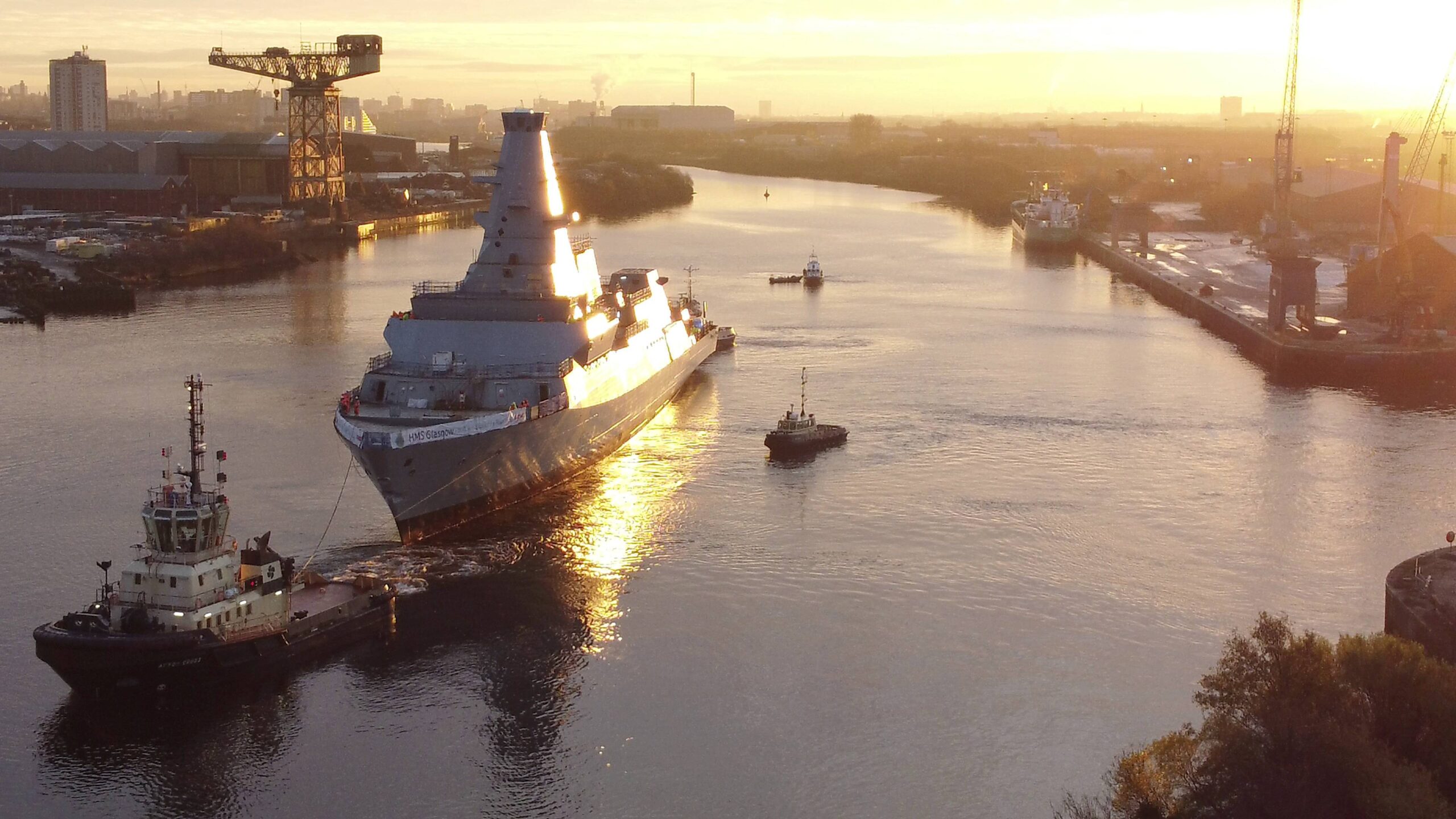
The Royal Navy will not meet its requirement for eight frigates fitted with the Sonar 2087 towed array until 2037 if two Type 26 frigates being built for Britain are sold to Norway, and the government appears to have taken a conscious decision to prioritise defence exports over sovereign capability, according to a report by the Defence Committee.
The committee, chaired by Tan Dhesi, the Labour member for Slough, published its findings following an inquiry that took evidence between March and July this year and included visits to Norway, Denmark and Greenland.
Dhesi said: “The UK needs to be willing to address a hard truth: it does not currently have all the capabilities to operate successfully in the High North. Russian submarine and sabotage forces in the High North pose direct risks to the North Atlantic and the UK, including the nuclear deterrent. Despite this, the Ministry of Defence has accepted a serious anti-submarine warfare gap. Publicly available evidence of low availability among destroyers, frigates and attack submarines calls into question whether the UK can meet its commitments in the High North.”
The report states: “Analysis suggests (Figure 4) Sonar 2087-towed array equipped frigate numbers could remain as low as five vessels for the next three years. This assumes two Type 26 frigates being built for the Royal Navy are sold to Norway, as the latter has ordered at least five Type 26s for £10 billion—which the government says will sustain 4,000 UK jobs. This reinforces the government’s goal to use defence exports to contribute to its Plan for Change, based around its three foundations of good government: economic stability, secure borders and national security.
However, Norway wants its first ship in service by 2029–30. Based on this scenario the Royal Navy will take until 2037 to meet its requirement for eight frigates to be equipped with the Sonar 2087 towed array sensor. In this case the government seems to have taken a conscious decision to prioritise defence exports over sovereign capability.”
A chart published with the report shows the combined Type 23 and Type 26 anti-submarine frigate line falling to two vessels in 2031 before recovering to eight by 2037.
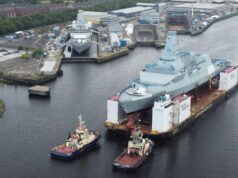
Norway selected the Type 26 in 2025 to replace its Fridtjof Nansen class, in an agreement the Ministry of Defence valued at £10 billion and said would sustain four thousand British jobs. The ships are being built by BAE Systems at Govan and Scotstoun on the Clyde, and Britain’s own order is for eight.
The committee elsewhere records that the Royal Navy has a requirement for eight of its thirteen frigates to carry the Sonar 2087 towed array, that all five remaining Type 23 frigates are fitted with it, and that HMS Richmond and HMS Iron Duke were both decommissioned in mid-2026.
On the wider relationship with Norway, the report describes the 2025 Lunna House agreement and the Type 26 purchase as “therefore strategically more significant than a conventional defence export”, and says a joint class of British and Norwegian anti-submarine frigates “should improve NATO’s ability to detect and track Russian submarines moving from the High North into the North Atlantic”.
The committee’s recommendation asks the government to set out how major naval export programmes, including the Norway agreement and any future uncrewed maritime systems, will support High North deterrence while protecting Royal Navy capabilities, including an assessment of their effect on British delivery timelines, industrial capacity, shared training, sustainment, interoperability and the availability of critical anti-submarine warfare capabilities.
In written evidence to the inquiry the Ministry of Defence described anti-submarine warfare as a core strength of Britain’s armed forces. The government is expected to respond to the report within two months.



We all knew this would be the cost and in my view it was worth the delay.
As much as we all expected this situation it still means that the Royal Navy is still short of ASW frigates and escorts for the carriers. So maybe it is time to think about containerised CAPTAS 2 or 4 for the T31s. Yes I know they are not the all singing and dancing T26 hull but the Danes don’t seem to have a problem with the Absalon design in the ASW role, which after-all is the grandma of the T31.
Agree. But why stop with T31? If containerisation is a feasible option why not trial it on OPVs?
Presumably because it would obstruct the flight deck on the B2s
Yeah, unless you whack it on the back of the flight deck, there’s no other place to put a towed-array.
I agree Ron, but all this extra kit requires funding, none is forthcoming, not a bean. Perhaps the next Government won’t be a bunch of socialist dipshits, intent to spend hundreds of billions on welfare. I won’t hold my breath.
If towed array sonar is to be used most effectively it needs a pair of ships one pinging and a silent listener.
T23 and T26 can do both roles. Only T23 and T26 are good at the silent listening role but the role of the pinger doesn’t necessarily need a silent vessel.
A repurposed oil rig support vessel could quite easily accommodate the pinger role without taking OPV or T31 vessels away from their own vital roles.
Oil rig support vessels also have the potential to hide among other oil rig support vessels so while audible to a submarine identification might be extremely difficult.
It might even be cost effective to use two oil rig support vessels along with a T23 or T26 and a Merlin supported by P8 aircraft, even when all 13 ordered T26 are available.
If we pay them the same and Norway also give BAE money they should surly be able to build 10 by 2035
6th starting 2027
10th by 2030 ish if they can build every 9/10 months
10 in service for 2035
Are you actually serious 9/10 months, or did you mean years.
Well it’s going down to a drumbeat of 12 months so sure it can go to 9/10 with the new hall and paint facility
The bottle neck won’t be the build hall or painting but the outfitting in two dry docks. We will know the drom beat has seriously been increased when they find a third dry dock.
Ship 6 they are aiming 6 year total build…. So probably only two years fitting out.
Hoping vessel 3 is much quicker , it’s now taken longer than vessel 2 in the build hall so hopefully it’s fitting out better
If the ships for Norway are identical and are used for the same job (as was promised) in the same NATO or JEF command, then the numbers will be there anyway whether British or Norwegian. Never enough for either of course but there all the same.
I’m sure I read somewhere this was the case.
Crew numbers has been suggested as an issue with Norway being in a better position to fully crew new vessels as we expand crew availability.
By building for both UK and Norway in tandem the High North benefits from two nations developing crew experience on T26.
Wasn’t the idea that Norway would pick up the slack if the earlier build slots were allocated to their order?
Just another subterfuge to save money and kick the can down the road
221 years ago yesterday was battle of Trafalgar – Lord Nelson must be spinning on top of his column
This shortfall in T26 numbers was inevitable. It is a direct result of the RN’s decision to use its frigate budget to fund the carriers. The result is that, instead of building a frigate every 18 or 24 months once the last T45 was commissioned in 2012, not one frigate has been completed for 14 or 15 years.
No wonder the gallant but ancient T23s are dropping like flies.
The move by the RN was a political gamble. Either HMG would be forced to find more money to rescue the frigate programme, or the MOD would need to switch funds from the Army and RAF procurement budgets to fund the frigates. It worked, up to a point, but at the cost of the other two services and an underfunded and accordingly slowed-down frigate programme. We are now in the daft position of trying to fund and build two frigate classes at the same time, in a gigantic hurry, from yards not yet operating at full speed and without the budget to do so at pace.
The politicians at the time bear a big slice of the responsibility for where we are now.. They were too easily beguiled by the allure of the carriers restoring British expeditionary power East of Suez, with the attached status and prestige. The hard reality.is that we don’t have the ships, particularly frigates, to man a carrier strike group, and the naval strategic focus is on the North Atlantic, where the carriers’ role and value is questionable.
Hey ho, we seem to blunder from one sweeping procurement blunder to another, ably helped by admirals of Lord West”s time and generals of the Carter era.
Sadly I think you are correct, in the end the RN and government wanted to play carrier battlegroups with the US and did not foresee the resurgence of Russian aggression in the high north and European waters.. this is unfortunately a side effect of the End of History and the Last Man by Francis Fukuyama, an numpty who was so full of himself he took western politicians with him on his mad “ the west had won”…
In the end the RN would have been better served by duel role 3 30,000 ton ships that could take up to 2 squadrons of F35s or an amphibious airborne group.
BAES can I believe build two frigates at the same time at Govan. In a near-wartime scenario, we should be running two production lines at the same time, one for the RN ships and one for the Norwegian ones, at least from ship 3 onwards. That way the RN might have more than 4 x T26s by 2035.
A grateful government, general public and MOD would need to dig deep to once more bail out the RN, which seems to have such difficulties living within its budget.
BAES is short of workforce to build two frigates at once. (It is likely short of the workforce to build one frigate at a time on any accererated timescale). We would need to lure in welders, platemaker, electricians from elsewhere in the world (including Norway) and find the money to pay them at more than bargain basement rates.
If the bottleneck is the fitting out at Scotstoun, then maybe we would need to look at fitting out somewhere else, such as the Norwegian ones in Norway or wherever.
And so on. It wouldn’t be to BAES’s liking, as they have a nice steady income stream for the next two decades, if they proceed at their current leisurely pace. But needs must.
The Government prioritises exports ahead of soveriegn capability.
You don’t say!!!! They also prioritise the MIC, jobs, and their fat cat profits as well, not much is said about that.
Yep, spot on mate. Labour spent years screaming at the Tories from the opposition benches about the lack of defence spending.
Then they jumped into the driver’s seat, had their Defence review, then did absolutely fuck*k all. More cuts, no sustained investment.
SDSR25 should have been based on 3.5% by 2030, that’s what’s actually required, we all know it, as do the government.
Can’t wait to see what happens when GCAP and AUKUS get into their stride in the next two years and swallow multiple billions a year each, while spending lags at 2.7%.
I expect more deep cuts, (something has to give), I suspect it will be the Army that pays the price, as it’s investment decisions on new kit are deliberately shoved past 2035.
If containerised captas has been developed then it behooves us to try it out on ..say ..T31 ( eventually) and a River B2.
A containerised system is obviously meant to go on non-stealthy platforms, or at least, not dedicated sub hunters, as those sorts of assets would already be fitted with.
I understand the argument that a River is/might be noisy…but has testing actually been done on a “noisy” platform? Surely there are filters than can be put in place to exclude own-ships noise? Would testing reveal not excellent results, but at least usable results?
Yes a container might get in the way of lillypad helicopter operations, but the inclusion of a pair of Malloy T150 heavy lift drones would/might mitigate the loss somewhat, especially if armed or even able to drop a lightweight scare depth charge ( kingfisher round???)
AA
What’s with the “If” you know its been developed, Thales hasn’t been in anyway quiet about it, the first containerised CAPTAS 1 is due next year for Ireland.
The commitment to export is too optimistic given the slow build rate.
IMHO, the ideal compromise would be the first 4 hulls go to the RN
Then the UK wouldn’t have got the contract from Norway given their timeframe, so its a case of pick one evil over another.
There is a solution, but it requires an extra £1bn or so of funding.
It would require:
1. CAPTAS-2 or 4 for T31’s, including any necessary work on the vessels themselves.
2. Improve T26 delivery speed by investing heavily in Scotstoun for more fit-out availability through infrastructure and 24/7 shifts and sub-contracting more blocks to other yards (Cammell Laird).
I’m guessing completely here but we could then have something like 3 x T26 and 3 x T31’s available for some form of ASW work by around 2030.
The problem is there is no money and we’d need a large influx of skilled people to cover the workload.
We all knew this was the price of the deal, and IMHO it’s completely worth it. The fact that some of the early T26s operating in the high North will be Norwegian and not British seems pretty irrelevant, given they both have effectively identical roles. We do not fight alone, and this deal allows us to make money supplying the best kit to our closest ally. Absolutely the right decision.
20 percent of the UK isn’t working. Those that are working are often either part time, zero hours or government jobs worth paper shufflers. What is missing is the will to use these people to do the work we need doing, building ships, tanks, guns, bullets etc