

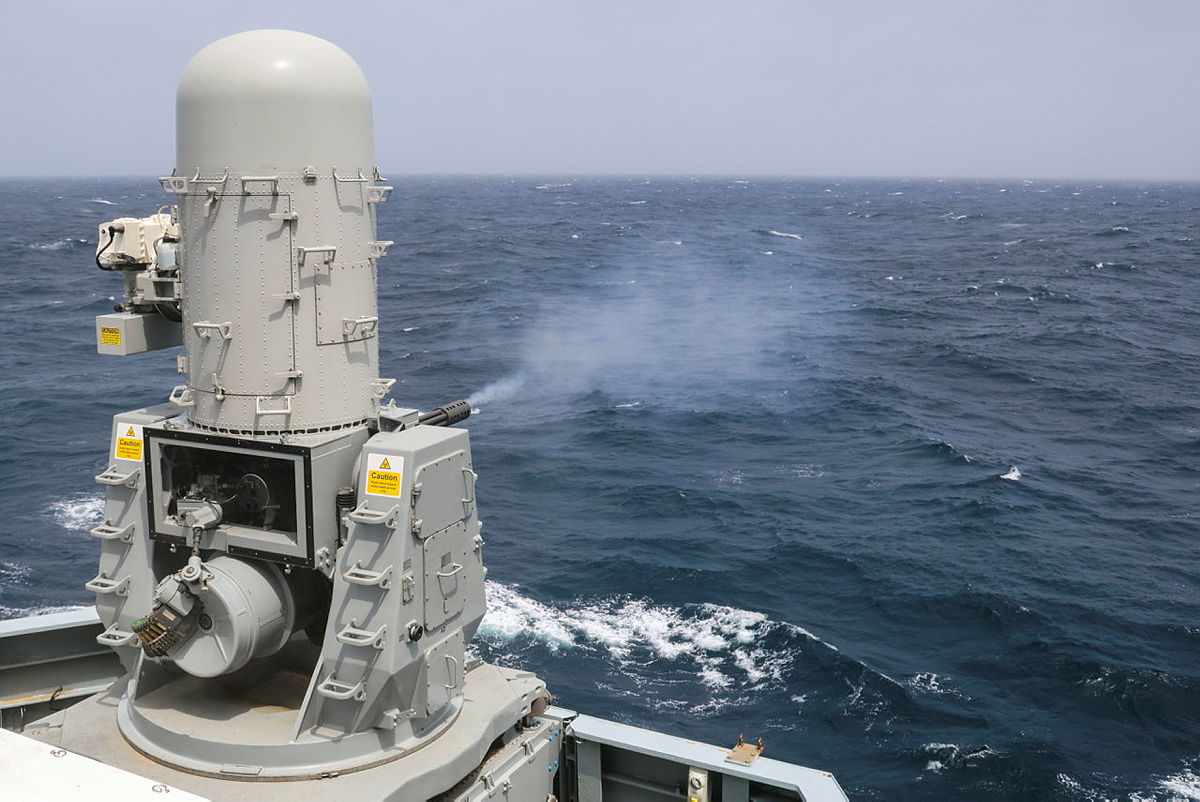
HMS Dragon has carried out live gunnery serials in the Arabian Sea, testing her Phalanx close-in weapon system and 30mm guns while operating in the Middle East.
Imagery from the ship shows a gun crew in anti-flash clothing and body armour working one of the 30mm mounts, and a Phalanx system firing. The serials also covered quickdraw drills, the practice designed to bring weapons to bear at short notice against a close-range surface threat.
According to the Royal Navy, the Portsmouth-based destroyer is conducting operations in the region in preparation for and support to a potential multinational mission. Her tasking covers area air defence, maintaining freedom of navigation and maritime security, and supporting the return of commercial shipping through the Strait of Hormuz.
Dragon remains in the region alongside RFA Lyme Bay, with both operating out of the UK Joint Logistics Support Base at Duqm in Oman.
Dragon is the fourth of the six Type 45 air defence destroyers, commissioned in 2012 and named in the ship’s badge and markings after the Welsh dragon, a nod to her affiliation with Cardiff. The class carries the Sea Viper missile system with Aster 15 and Aster 30 rounds fired from a 48-cell Sylver vertical launcher, paired with the Sampson multi-function radar mounted at the masthead, an arrangement designed to defend a task group against saturation missile attack.
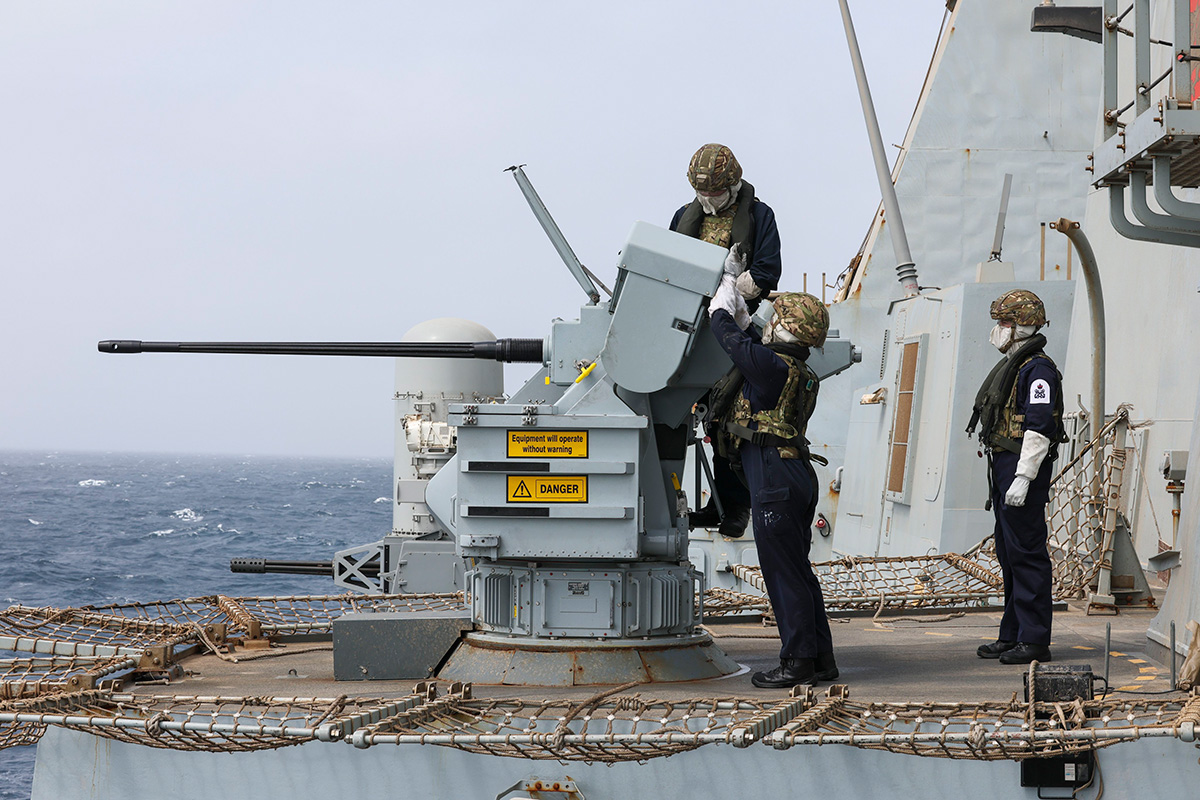
The close-range weapons exercised in the Arabian Sea sit at the opposite end of that layered defence as Phalanx is a radar-directed 20mm rotary cannon that engages targets automatically once cued, intended as the last line against missiles or fast attack craft that have penetrated the outer defences.
The 30mm mounts, manually operated from a director, are aimed at small boats and slow-moving threats, the sort of engagement that has become routine in Gulf waters.
The class has undergone a substantial upgrade programme in recent years. The Power Improvement Project replaced the original diesel generators with more powerful units after propulsion failures in warm waters affected availability across the fleet, and the ships are being fitted with Sea Ceptor missiles under the Sea Viper Evolution programme, increasing magazine depth against drones and anti-ship missiles.
Sister ship HMS Diamond shot down Houthi drones and an anti-ship ballistic missile in the Red Sea during 2023 and 2024, marking the first time a Royal Navy warship had engaged a ballistic missile at sea, and HMS Duncan subsequently took over the task. The Strait of Hormuz, through which roughly a fifth of global oil supply passes, has seen commercial traffic reduced during the recent periods of regional escalation.
The Duqm facility on Oman’s south eastern coast gives the Royal Navy a dock and support base outside the Gulf itself, meaning ships need not transit the strait for maintenance.







I was under the impression that the Sea Ceptor would be installed in new VLS forward of the existing VLS not packed into the existing VLS. It is possible the author means that Sea Ceptor will be quad packed into a new VLS. Perhaps a 6 cell VLS. I would be good to fit 2 such VLS to give 48 Sea Ceptors. I would also like to see the 4.5 gun replaced with the 56mm for better anti-air. Their is also the fitting of NSM no doubt 8 will be fitted I think there is room for 16 – this should be done too. Dragonfire will be fitted as an anti-drone measure. If feasible it would also be good to replace the side Phalanx with 40mm to give commonality with Type 31. One of the removed Phalanx could be relocated to the hanger roof. These upgrades would significantly inprove anti-air.
I’m sure someone in the MOD has costed the withdrawal of the 4.5″ to replace them for 57mm on at least the t45..! The t23 and its guns will of course be probably gone by 2030…!
It would be good for commonality and supply chain. Not to mention its capabilities.
It is 24 Sea Ceptor VLS cells in the Type 26 style mushroom farms being added in front of the Sylver VLS.
Yes that is what I thought. Thanks for the confermation.
Sea Ceptor will not be quad packed on the T45. The T45 installation will be 24 missiles forward of the existing VLS in the ‘Mushroom Farm’ format. They will have to find a new gym.
I think the RN missed a trick by not fitting MK41 – I think it was designed to take 16 forward of the current VLS. That way they could have quad-peaked Sea Ceptor. Instead of 24they could have got 64. That would have given real combat persistence. Also you could have swapped out some cells for SPEAR 5 (Stratus LO).
Was all the imagery beamed straight to the PLAN HQ?
40mm cant go were the Phalanx are; deck penetrating, plus Phalanx still has its place.
40mm Bofors is available in a non deck penetration version
Not sure the Navy would want two different mountings…
Functionally the same mounting – just a feed chute on the penetrating mount and a magazine underneath.. the non penetrating mount is the navy’s preferred option for most fits. Carries 200 rounds onboard.
Yes it is but limited to the rounds on mount…. it would be preferable to have the full magazine.
Many nations are replacing phalanx with searam
Anti-flash gear with MTP ballistic plates and helmets are genuinely some of the best looking combat dress there is. So aesthetic abd functional.
Phalanx to be replaced by Dragonfire would be the only CISW upgrade/change to T45 configuration I’m guessing?
Additional Phalanx created would find homes elsewhere on RFA vessels etc.
Wonder if we’ll get this kind of headline from ROYAL NAVY Drones in the Gulf in the future..? OR will they ever venture out of the Atlantic..?
Dragon fire is supposed to be in addition. Currently it will struggle with a missile due to the required time on target whilst Phalanx doesn’t need “time on target”
My bad! Single Dragonfire unit to be mounted on hangar roof then?
Sounds like a plan….
Dragonfire cannot stop missiles currently – it is really good for drones and boats.
Dragon is expected to return to the UK next month. October at a push. No replacement seems possible. Duncan is currently under going maintenance before accompany POW again on the second phase of Operation Firecrest in northern European waters. Daring is due to rejoin to the fleet “soon”, but sending her to straight to the Arabian Sea and a war zone would seem unlikely. So that leaves just Dauntless as a possibility, she about to become operational again after completing her own essential maintenance period and subsequent sea trials & training. But she is expected to be designated Fleet Ready Escort and tasked with keeping an eye on the Russian Navy in the English Channel and North Sea. It has become militarily and politically highly embarrassing that the Russia is stationing modern frigates just outside UK territorial waters, and we can usually only counter with old and barely armed OPVs. Time for a RN show of strength, at least for the media!
“Designed to defend against a saturation missile attack” – – as long as it is comprised of less than 48 threats! And then what about the next wave? And how long to resupply?
Cynical I know but it is not beyond the bounds of possibility that a potential aggressor will factor that number into their own calculations?