

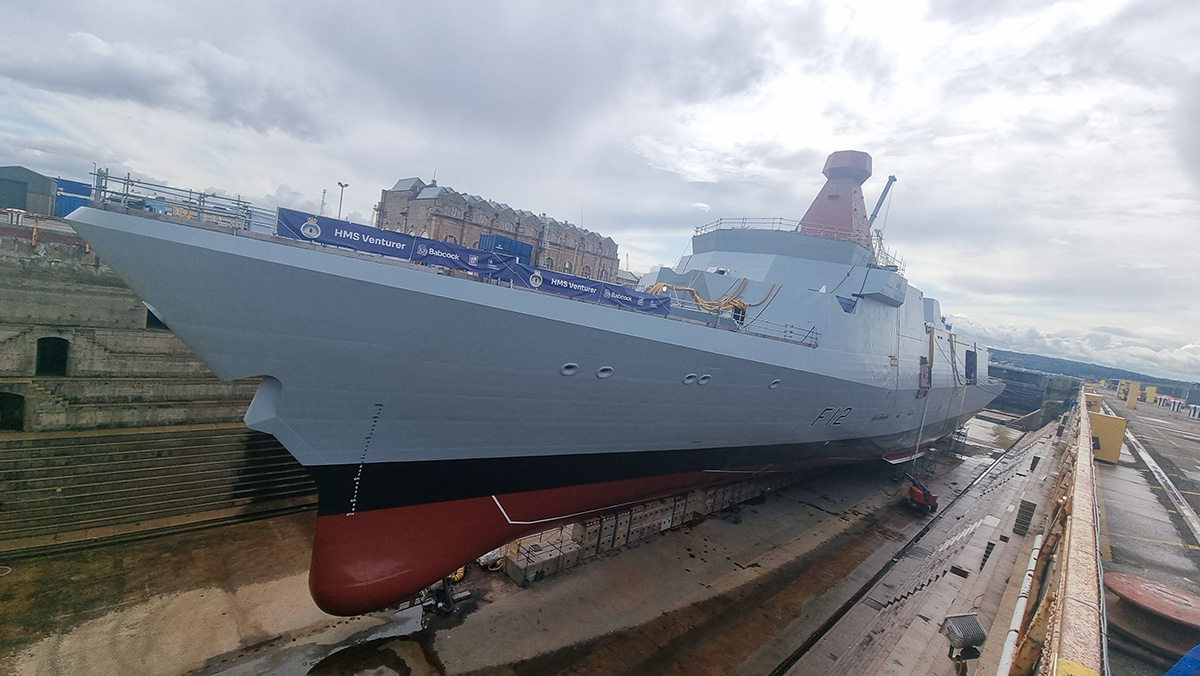
The Ministry of Defence continues to monitor Babcock’s financial position and delivery performance on the Type 31 frigate programme and is working with the company to manage schedule risks, while declining to comment on the cumulative loss the firm has taken on the fixed-price contract, according to an answer given in Parliament.
Ben Obese-Jecty, the Conservative member for Huntingdon, asked what information the department holds on the total cumulative loss sustained to date by Babcock on the fixed-price contract for the Type 31, and what assessment had been made of the potential impact of that loss on the delivery schedule.
Luke Pollard, Minister for Defence Industry and Readiness, said: “The Ministry of Defence does not comment on the detailed commercial or financial performance of its suppliers beyond information placed in the public domain by those companies. The Department continues to monitor Babcock’s financial position and delivery performance in relation to the Type 31 programme. We continue to work with closely with Babcock to support, monitor, and manage schedule risks and ensure delivery of the five Type 31 frigates.”
Babcock won the Type 31 competition in 2019 with a fixed-price contract worth £1.25 billion for five ships. The company has disclosed charges against the programme in its own annual results, including a £100 million charge announced in 2023.
The ships are being built in a covered assembly hall at Rosyth. HMS Venturer was launched in 2024 and is fitting out, with Active, Formidable, Bulldog and Campbeltown following. Pollard confirmed in a separate answer the same day that five Type 31 frigates are expected in service by the early 2030s.
The design, Arrowhead 140, is derived from the Danish Iver Huitfeldt class. Poland has ordered three ships to the same design for its Miecznik programme, being built at Gdynia under licence, and Indonesia has ordered a variant.

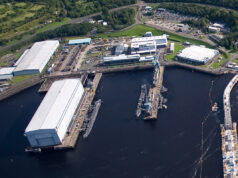



It’s hard to deal with these delays when you can see the ships rolling out of the build hall at a rapid pace. We have four desperately needed new frigates at Rosyth and the Clyde sitting in dry docks for internal fitting which seems to take forever.
At the initial £250m for each frigate it seems ridiculously cheap. Makes you wonder why they didn’t even order a few more at that price?
Because they quite literally were only budgeted for those five hulls.
And no plans to lifex the T45s – yes let’s use Babcock and the T31 as the basis for the CCV! What could possibly go wrong?!
The original Tory “Lidl Frigate” spec in 2019 under Boris, where the contract was kept strictly bare bones to meet the £250 million price cap. It was only supposed to carry light defensive guns; 57mm and 40mm and local anti-air missiles, Sea Ceptor.
Then came a Tory u-turn in May 2023 as they realised that the surface fleet lacked heavy offensive teeth (NSS!) the Conservative First Sea Lord, Admiral Sir Ben Key, announced that the T-31 would, after all, be fitted with 32 strike length cells of the American Mk 41 VLS … However, they didn’t allocate the specific budget to buy the missiles 🙁
Then Labour won gov and they locked-in funding in June 2026. Labour eventualy released its DIP and locked in £1.6 billion in new funding to fully weaponise the T-31 fleet, ensuring the Mk 41 launchers are fully integrated and funded rather than just leaving an empty structural space.
The £1.6 billion funding package completely altered the ship’s combat profile. Beyond the VLS cells, the final design has been upgraded with NSM, this gives the T-31 a 5th generation, long-range anti-ship and land-attack capability spanning over 100 nautical miles. They get specialist smart gun ammunition to combat drone swarms and small surface attack boats, the budget funds advanced, programmable ammunition for the ship’s Bofors 57mm and 40mm guns, allowing them to detonate mid-air to shred aerial threats. Also, because the Mk 41 VLS is the “strike-length” variant, it gives the Royal Navy the option to load these budget frigates with a land-attack strike flexibility, Tomahawk cruise missiles / future Anglo-French cruise missiles down the line, completely transforming them into strategic strike platforms.
The late-stage design pivot is the exact reason why Babcock announced a new £140 million financial charge on the program. Because construction on the first two ships; HMS Venturer and HMS Active, had already begun under the old “basic” design, engineers have now been forced to perform massive amounts of complex “rework” late in the outfitting phase … tearing out corridors, shifting cabling, and altering bulkheads to create the physical cavity needed to fit the massive Mk 41 VLS silos. Thankfully, the Digital Twin has proven invaluable in the fit/re-fit, making things a lot easier.
The Conservatives designed a large but weakly armed patrol ship to save money, changed their mind in 2023 to add the missile silos, and then Labour wrote the £1.6 billion check to actually buy the VLS, advanced Norwegian anti-ship missiles, smart ammunition and other components.
But … has the VLS been ordered?
It has turned the Type 31 from a low-end utility vessel into a highly lethal frontline warship … when they arrive … and then years later when they pop back to dock for a “Capability Insertion Period” to get all the ‘nasty goodies’ fitted.
No word of a Mk41 order.
@FieldLander
well … funny you should say that, I was just reading about those as I don’t recall an order for the T-31
If VLS modules for the T-31 haven’t been ordered, then I hope the following is true, because the order que is very long.
The United Kingdom and Australia stand together at the absolute top of the United States defense trade framework, a position that reflects decades of joint operations and deeply integrated intelligence sharing through the Five Eyes alliance. Historic legislative overhauls under the AUKUS security pact, sees both nations have been granted unprecedented state-to-state priority, effectively dismantling traditional export barriers. Under the finalised ITAR section 126.7 exemptions, the United States has established a license-free defense trade environment uniquely shared with the UK and Australia, positioning their procurement teams at the absolute front of the queue for critical military technologies. This streamlined, government-to-government arrangement allows for the rapid allocation of manufacturing slots or stockpile components to guarantee that the Royal Navy, the Royal Australian Navy, and the United States Navy remain entirely interoperable. While domestic technical delays may occur whilst finalising missile integration studies for equipment like the Mark 41 vertical launching system, the underlying industrial pipeline from the Americans is legally prioritised to support both the UK and Australian homelands above almost all other global customers.
LM corporate data shows that the waiting list is historically large, driven by an surge in global missile defence procurement. The scale of the backlog is reflected through record breaking overall backlog where Lockheed Martin total corporate backlog has reached an all time high of US$292 billion.
The missiles and fire control segment, alongside the rotary and mission systems division which physically manufactures the vertical launching system units and Aegis combat software, represents the fastest growing and highest volume portion of that backlog due to international demand to replenish weapon stockpiles. This is intensified by the large US and allied order book, meaning the current production pipeline at the Middle River, Maryland facility is locked out for years.
Those continuous multi hundred million dollar Pentagon block orders to supply modules simultaneously for the United States Navy Arleigh Burke class destroyers and Constellation class frigates, Canada surface combatants, Spain F 105 frigates, and the Royal Netherlands Navy new vessels. On top of the uncontracted Type 31 frigate plans, the United Kingdom government already has a firm, active spot further up the Lockheed Martin production line because BAE Systems previously placed a major order for the T-26 program, securing the physical delivery of 24 strike length Mark 41 cells per ship for the first batch of the Clyde built vessels.
The waiting list is essentially measured in multi year blocks of factory capacity rather than a simple waiting list number, and because the manufacturing lines are entirely full, any nation without the special state to state diplomatic overrides shared by the United Kingdom and Australia … faces a severe delay before a steel missile module can be laid down for them.
Interesting info
Good posts which put the T31 program into perspective.
Great post, Magenta. Thank you.
Well said. An excellent contribution to the discussion we are all trying to have.
Makes me wonder about the Norwegian T26s.
If Norwegian ships they come from the existing UK order then Mk41s will be on order and will be fitted.
I do not know that additional Mk41s have been ordered beyond the initial batch (ships 1 to 5) described above.
Maybe they will have something to put in them.
Given the state of the T23s, the urgent need is surely to get the T26s into TSA ASW service, for which they don’t really the Mk41. Might the ones on order be fitted to some T31s ?
@magenta has written a largely fictitious account of the Type 31’s history complete with falsehoods and misstatements in detail and in whole.
I presume the history originated from Labour party central.
hat was fictitious?
@Grinch,
Ahh Grinch, why are you always so angry? so argy-bargy? …ffs peace out dude!
“…magenta has written a largely fictitious account of the Type 31’s history complete with falsehoods and misstatements in detail and in whole.
I presume the history originated from Labour party central.”
I’m going to shift the burden of proof entirely back onto you, I stand by my comments. I try very hard to be correct and truthful.
Please point out the “LARGELY FICTITIOUS account of the Type 31’s history. Point out the FALSEHOODS and MISSTATEMENTS in DETAIL and in WHOLE. You made the sweeping statements, now you have to prove your assertions, either do that or stfu!
Considering the core of my comment rests on public MoD announcements (May 2023 First Sea Lord speech on Mk 41 VLS), official stock exchange filings (Babcock’s £140m charge for redesign rework), and Lockheed Martin’s public backlog figures.
Your use of dramatic words to try to discredit me is just rhetorical noise rather than substance. Well over 50% of what I wrote is verifiable public record, whereas, you didn’t actually correct me on a single point, but, I’m not going to discuss a single point with you as you used the term ‘largely’ – “Largely” = >50%, you can’t, you’re just throwing hyperbole around because you do not have the factual grounds to debate me on all the specifics. If you believe the majority of those documented naval engineering facts are fictitious, please show specifically where my, the official MoD and corporate statements are wrong.
I am not a labour voter per se, I’m a swing voter / floating voter, not affiliated with a particular political party and will vote across party lines in every single instance. (see my handle and work it out). I consider myself as an inconsistent voter. I vote for the best option at the time. Assuming you are a Pom, the 2024 UK general election, tracked a record-breaking voter volatility, with nearly 38% of voters actively considering alternative parties before casting their ballot, come the vote, nearly 50% of the entire UK electorate actually changed their vote in 2024, marking the highest rate of voter switching since 1931 … Only a fool would align themselves to a single party, year in, year out with extreme devotion to the party, regardless who the leader is … like a cult.
In political science, there is actually a recognised phenomenon that mirrors my thoughts. As major broad church parties lose mass electoral support and fall out of power, the moderate, casual voters drop off first. What remains is often a much smaller, far more ideologically intense core of “true believers”. When that happens, the internal debates tend to become echo chambers; get sharper and more dogmatic, which can make the party look even stranger or more isolated to the general public outside the bubble. It also explains why online political discussions get so defensive so quickly; like you, who snapped at my Type 31 analysis … when a party’s core support contracts, some supporters start treating objective technical details, procurement facts, or basic timelines as “partisan attacks” simply because the facts don’t match the party line they want to believe … This equally applies to Jono in my opinion, he’s another frothing at the mouth blinkered numpty. But hey! I defend your right to voice your opinions, even as you try to take my home country down the gurgler. … (you probably think the ‘Great’ in Great Britain means awesome.) This is why MGBGA, doesn’t work. MUKGA all the way my old mucka.
There are no falsehoods, misstatements or fictitious accounts about the timeline or the engineering realities. my comment maps extremely closely with well documented public defence announcements, financial reports, and legislative changes over recent years. Personally, when I see someone online dismiss an analysis as …”originating from Labour Party central” or “fictitious,” it is usually an emotional or politically defensive reaction rather than a factual rebuttal. I am looking for a factual rebuttal that is substantial enough to make me withdraw my comments, and will happily do so. But I don’t think you can. You’re all snooty because I had a frivolous pop at your beloved conservative gov. Grow up child.
“They get specialist smart gun ammunition to combat drone swarms and small surface attack boats, the budget funds advanced, programmable ammunition for the ship’s Bofors 57mm and 40mm guns, allowing them to detonate mid-air to shred aerial threats.”
That is really extraordinary, reading that who would have thought that Royal Navy already had proximity fuzes in 1943?
@AlexS,
OMG Yes! What is extraordinary that anyone could be that dense … they even had ships, tanks, areoplanes back in 1943! and guess what, they have all evolved and progressed, anyone who thinks differently is a numpty.
The 1943 Variable Time (VT) proximity fuze is widely celebrated as one of the great technical breakthroughs of WWII, it was a brilliant invention that introduced basic radio-based distance sensing, however, modern 3P programmable ammunition is vastly different.
A 1943 fuze was an analogue radio trigger that simply went off when it bumped into a reflection, it couldn’t tell the difference between a wave crest, a cloud, or an aircraft.
Smart, programmable 3P rounds highlights a genuinely sophisticated capability, specifically the ability to feed microsecond-level timing and multi-mode instructions via inductive programming in the barrel to counter clutter and asymmetric threats. each round carries its own compact computer silicon chip capable of executing millions of calculations per second. They receive real-time target data from the ship’s fire-control radar as the shell moves up the barrel past the muzzle, where an inductive coil wraps around the outside. Without touching the shell physically, it transfers electrical power and digital instructions into the microchip in a few milliseconds, telling the chip exactly what mode to use and when to count down from the moment it leaves the barrel. Many smart fuzes don’t even carry a traditional battery; which would degrade in storage or crack under G-forces, instead, a tiny micro-generator or setback pin creates a micro-current from the physical shock and spin of the launch itself, waking up the silicon chip the second the gun fires.
This allows them to execute complex engagement profiles; gated time-bursts through sea clutter or delayed internal hull detonation, tailored specifically to the exact threat being engaged. The microprocessing operate in real-time with sensor feedback, digital network links. Continuous data exchange; evaluates target context and adjusts flight path millisecond by millisecond.
It is quite hilarious that you are trying to convince everyone here that the two systems have equivalence … Next you will be telling us that WWII area bombing, where an Avro Lancaster carrying 1,000lb GP gravity bombs dropped via optical bombsights and relying on manual calculation of wind speed, altitude, and air speed, its precision measured in ‘hundreds of yards’. Thus, destroying a single factory required hundreds of aircraft dropping thousands of individual unguided bombs to guarantee enough hits within a broad target area … were just as good.
by comparison, modern stand-off precision / loitering munitions JDAM GPS-guided kits, Storm Shadow, Switchblade loitering munitions etc. have inertial navigation, GPS receiver arrays, terrain-contour matching (TERPROM), they employ terminal infrared or laser seekers that drive controllable tail fins. A modern strike aircraft can release a weapon 50 km away that glides autonomously, selects its exact point of entry into a specific room of a fortified structure, or loiter over a tactical zone for 40 minutes awaiting target recognition before diving … One weapon achieves what once required an entire air fleet.
Maybe, just maybe you have solved the UK’s dfence budget, the MoD can sell off all the high tech kit, buy some old shit from yesteryear and put a tab on the bar for the lads with all the savings.
… numpty.
Sounds like a mismanaged ballsup. Why not keep the first few T31s at a non mk41 spec, to replace B1 Rivers and order an additional three and the later 2 for 5 at the fuller 4x mk41 spec?
Or, go a hybrid CAMM farm/mk41 aka T26? The MNP variant showed 2 mk41s in the B 40mm position and they could potentially place a CAMM farm on the upper deck, either containerised or or mounted on flat racks.
@QuentinD63,
The options you’ve outlined highlight the frustration naval architects and procurement analysts have had with the T-31 programme. What should have been a clean, phased capability insertion instead turned into a structural and financial nightmare.
Why not keep hulls 1 and 2 “light” and introduce mk 41 on hulls 3 – 5? In a sane procurement strategy, this is what would have happened. In fact, that was effectively the MoD’s plan when they announced the 32-cell Mk 41 retrofit in May 2023. By then HMS Venturer (hull 1) was already well advanced in structural assembly at Rosyth, and HMS Active (hull 2) was already under construction.
… Mk 41 is a deep-strike, deck-penetrating system requiring significant structural deck strengthening, specific fire-suppression systems, high-voltage electrical cabling, and specialised cooling infrastructure running through the hull. Instead of building hulls 1 and 2 purely to the original light specification and doing a clean structural update on hull 3 (Formidable), the MoD demanded that Babcock adjust the internal layout mid-build across the entire class to ensure the structural plumbing for Mk 41 was baked into all five hulls from day one. Attempting to modify steelwork, bulkheads, and deck penetrations after blocks had already been fabricated forced Babcock into out of sequence rework, the trigger for their £140m financial charge.
Replacing the Batch 1 River class offshore patrol vessels (OPVs) with the first couple of T-31s sounds logical on paper, but it runs into an operational mismatch. A Batch 1 River operates with a lean crew of around 35 – 45 personnel, whereas a T-31 requires a core crew of roughly 100. Deploying a 5,700-ton frigate to do constabulary tasks, like fishery protection or Caribbean disaster relief consumes far more fuel, maintenance, and crew manpower than a dedicated OPV. The primary driver for the T-31 was never replacing OPVs, it was filling the gap left by the retiring general purpose T-23 frigates. Retaining the early T-31s as mere “glorified patrol ships” would have left the Royal Navy critically short of credible escort hulls for NATO task groups.
The idea of combining a dedicated “CAMM farm” alongside Mk 41 VLS cells, similar to the T-26 City-class arrangement, is engineering wise … the most sensible layout. Standard Sea Ceptor (CAMM) uses cold-launch technology in simple, lightweight structural “mushroom” farm silos. They don’t require the hot-launch blast-deflection plenums, heavy structural deck reinforcement, or high-temperature exhaust management that Mk 41 requires. Quad packing CAMM into Mk 41 cells using ExLS works, but then again, it eats up valuable strike length real estate that ought to be reserved for Tomahawk, FC/ASW, or anti-ballistic missiles.
The Arrowhead 140 hull has ample deck space. Placing a standalone CAMM farm on the upper deck or amidships superstructure while leaving the forward deep-well position strictly for 32 Mk 41 cells, this would have given the ship maximum strike flexibility without wasting heavy Mk 41 cells on short/medium-range point defence. Your suggestion of mounting containerised CAMM cells or flat-rack launchers, similar to the Mission Module / MNP concepts, is entirely technically feasible on the Arrowhead 140 deck layout … MBDA has already demonstrated containerised/palletised CAMM launchers. According to wikipedia the Miecznik (Polish Wicher-class) and Indonesian Red White variants of the Arrowhead 140 utilise the forward B-position for extra VLS capacity or secondary guns. So placing modular, bolt-on CAMM racks on the upper deck or mission bay roof would have kept the lower deck structural modifications to an absolute minimum.
The Royal Navy’s surface fleet management traditionally (maybe they are changing, I don’t know) prefer fully integrated, permanently wired combat management systems rather than containerised “plug-and-play” weapon fits on frontline escorts, they fear that “temporary” fits end up becoming permanent compromises. However, when looking the strategic reality, hull shortages, and technology cycles they have little alternatives, they are being forced into embracing containerised and modular payloads. For low to medium intensity operations, uncrewed systems, mine warfare, and secondary strike capacity, containerised and modular payloads are the only viable path forward for … a navy facing strict budget caps. The Royal Navy will still demand fully integrated, permanently installed core systems, like primary sonars, main guns, and primary VLS cells for its high end T-26 air/sub-surface escorts. But for the T-31s, RFAs, and future surface platforms, “plug-and-play” is shifting from an experimental novelty into an operational necessity.
The mess down at Rosyth was caused by political and procurement goalpost-shifting, this is all normal; when you look back over the last forty years, the pattern is remarkably consistent. Long periods of underfunding, delayed order placement, spec-creep, political cold feet, and constant tinkering that … cripple yards, blow out budgets, and leave the fleet drastically short of hulls.
I’ll say this though, the fundamental issues driving Britain’s frustrating history with frigate procurement and the Royal Navy’s historical record with frigate procurement isn’t bad because British engineers don’t know how to build ships; it is bad because political vacillation, short-term Treasury budgeting, and constant requirement changes routinely undermine the yards before the first piece of steel is even cut. (or after the steel is cut, like T-31’s, where I’m positive that Babcock got cracking with the build before the design was fixed, as they wanted a head start on the “fitting out“ phase, as this is where the real choke point happens.)
Had the MoD accepted a clean two batch strategy, or adopted a dedicated, upper-deck CAMM farm while leaving the lower hull pre-framed for a future Mk 41 insertion, Babcock could have built hulls 1 and 2 without tearing up completed structural plans. Trying to force a full strike-length Mk 41 to fit into an active, price-capped assembly line halfway through construction, means, we get the worst of both worlds … contract disputes, costly out-of-sequence rework, and delivery delays.
… but that’s the norm.
Good post. Our UK ‘normal’ culture is indeed the problem. The indecision will get you every tine. Changing ones self is difficult.
Hull fabrication seems to happen at pace.
Fit-out is slow, this is the process that needs addressing/improving.
Also, how many dry docks are available at one time? Is there space for more fitting out?
Do you need to fit out in a dry dock?
No idea, but they come out of the ‘shed’ sans a main mast and most Weapon System equipment.
I believe the Polish Type 31’s will be fitted out alongside rather than in a dry dock. Bit they were completed to a higher level before they were launched.
O/T , but as reported by NLO, all 5 batch 2 Rivers will be fitted with an expensive Helicopter Visual Aids Landing System which facilitates night time operations. Given how tight budgets are it seems a lot to spend unless you are planning to make more use of their landing deck.
If they’re spending money on these B2 why they don’t fit a hangar for a Wildcat and UAV, to clean the back deck area up a bit? Could still keep the crane.
I read somewhere recently that the Germany Navy is ordering the UK MSI SeaHawk 30mm mounts for its F128 frigates. So maybe the RN should not be too quick to get rid of them then…lol
I think the idea might be to make it easier for allied forces helicopters to lily pad on the Rivers. The US coastguard have already tested MH60 Jayhawk. We won’t be maintaining helos on Rivers so no hanger. But they can re-arm and refuel. Maybe there’s a way they can work in partnership with frigates to cover a bigger area?
Remember these are part of the CLOWN BRIGADE Expected to develope the HYBRID NAVY into a WORKABLE model and IN SERVICE within 10/15 yrs..! With No t45 extension and a cancelled t83..!
Lifebelt Anyone..??