

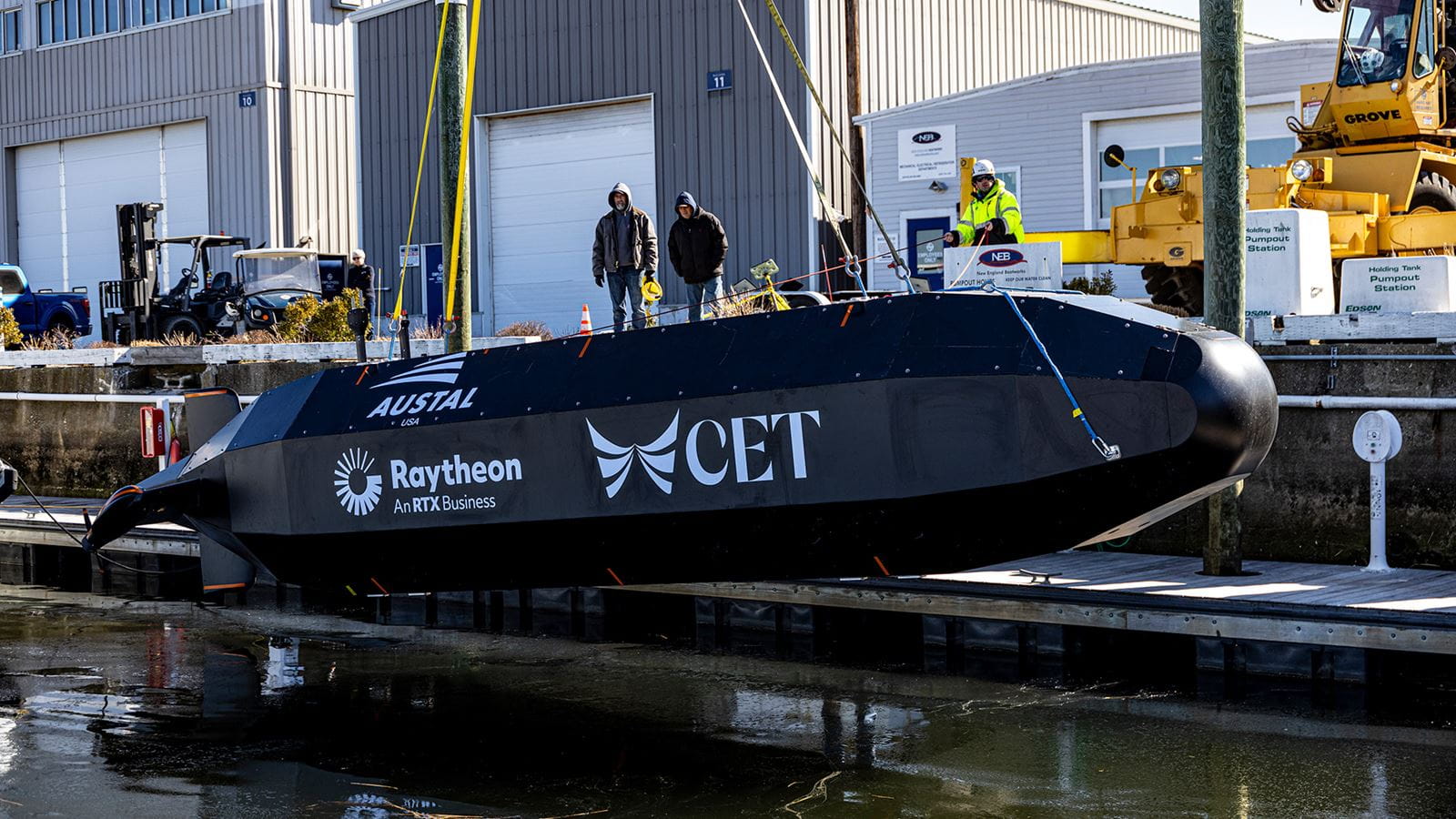
Raytheon and Composite Energy Technologies have demonstrated a new uncrewed undersea vehicle launching from beneath the surface during a United States Navy exercise, the first time the service has seen the integrated capability in the water, the companies stated.
The vehicle, called HADALUS, completed a series of missions on a Navy undersea test range and demonstrated the ability to launch while submerged. The companies say the work points towards a single uncrewed platform performing detect, reacquire and engage functions within one mission.
HADALUS is 34 feet long with a six-foot cross section and an endurance the companies put at more than 2,000 nautical miles. Its hull is a free-flooded carbon fibre exoskeleton, an arrangement in which water is allowed into the structure rather than kept out, which removes the need for a heavy pressure-tight body and allows a lighter and cheaper vehicle carrying more payload.
Cost is the argument the companies are making. They say the vehicle is designed to come in at roughly a third to a fifth of the price of comparable long-endurance vehicles, offering what they describe as a scalable path to fielding affordable undersea capability.
Jen Gauthier, vice president of naval systems and sustainment at Raytheon, said: “This demonstration is an important step in a broader roadmap to deliver autonomous, end-to-end undersea capabilities that are far less detectable than surface platforms. By tightly coupling design, integration and at-sea experimentation, we’ve proven we can bring new autonomous solutions to the fleet quickly and cost-effectively.”
The two companies took the vehicle from a conceptual sketch to a prototype demonstrated in water in under 18 months, funded by their own investment, covering the design and build of the vehicle along with integration of the launcher, sonar and electronics.
Chase Hogoboom, chief executive and president of Composite Energy Technologies, said: “HADALUS demonstrates that the undersea industrial base can move with greater speed and dynamism than traditional development cycles allow. By combining CET’s advanced composite vehicle architecture with Raytheon’s mission systems, sensors and integration expertise, we have created a highly capable platform that can be produced at a fraction of the cost of conventional alternatives.”
An uncrewed vehicle that can find a target and then engage it is a step beyond what most undersea drones currently do, which is search, survey and report. Existing large vehicles such as Boeing’s Orca are configured principally for mine laying and payload delivery, while the bulk of the fleet handles survey and reconnaissance and hands its findings to a manned platform to act on.
Britain has pursued similar ground through the Royal Navy’s Project Cetus, a large uncrewed submersible built by MSubs of Plymouth and delivered in 2024 for trials work, and through the autonomous mine countermeasures systems now entering service. The Strategic Defence Review of 2025 set out an intention to pair crewed submarines with uncrewed underwater vehicles as part of the Atlantic Bastion effort to monitor the North Atlantic.


Seems to demonstrate that unmanned subs can do anything required.
Small vessel, Small Range..
The rapid development of such drones must be a worry to those concerned about stealth / survivability of large manned submersibles in the middle to latter half of this century.
The thing is they will alway suffer against SSNs in the same way as any crewed AIP boat will..
Size and power, because ability to detect really is a function of size and power..
1) big hull means a bigger aperture array.. so greater detection for passive
2) more power mean more power to your active sensors so a greater detection
3) carting a big towed array takes power
4) sensors need processing power to manage the clutter in an undersea environment.. and processing power takes up space and needs lots of power generation.
5) propulsion is the best way to evade and propulsion takes power and lots of it..
Essentially the reason the SSNs is the nasties killer in the open ocean is because it can use its massive sensors and processing power to detect enemy before the enemy detects them.. and that needs massive power to cart it all around and power it. It can then use its massive levels of power to drive its population systems to where it wants to be fast, to either evade or attack.. without limits…
Essentially these drones are going to be great for area denial… but how are you going to get the concentrations needed for the 50 million KM2 of the North Atlantic.. because even 100 of these is spitting in the wind and if they cannot keep up with a SSN it will simply evade them or even just kill them at its leisure from distance.
I can see them in the end making AIP boat opperations pretty impossible or pointless, as an AIP has limits on its sensors, processing, speed and endurance as they can replace most AIP operations if you arm them… but an SSN hidden in the deep with the best most powerful sensors on the planet and pretty much unlimited endurance and speed…
Do not make sense to use them for combat unless deployed near SSN naval bases or choke points.
They will not have the necessary energy to move fast for combat.
It makes more sense to used them as slow mobile sensors then deploy micro comms buoys to ask for an helicopter, helicopter drone or patrol aircraft.
The problem with submarines is they are slow compared to air vehicles.
Surely despite all the valid technical on paper limitations, there remains the point that the terrorist uses, ie we only have to get lucky once. On the other hand an expensive very capable submarine (or other platform) taking one of these out not only achieves very little it likely is in danger of giving away its own relative position making it more potentially more vulnerable. I think it’s like drones more generally, the potential danger was dismissed because they seemed so relatively low tech in a world increasingly boasting of its platform’s high end capabilities or lethality. Equally this is the Stone Age of these undersea drones capabilities or strategic use being explored and exploited. Watch this space I would say, after all General Foch claimed that aircraft would have no discernible effect on the battlefield, while perhaps even more indicative of inward focused self delusion main frame producer Honeywell claimed that there would be no interest or point in having a computer in the household. Too easy to dismiss the effect of unproven technology even by those in the business, indeed sometimes because of.
Ohh they will have affect, possibly huge effect in some areas.. but they will not replace, no amount of small electric powered drones can replace an SSN the concentration of power and capability is overwhelming .. where as you will never get enough SSNs to replace a fleet of say 200 electric powered drones.. who can cover many points and impact on many points at once.. it’s the old Corbett vs Mahan debate.. concentration vs dispersed power.. they are both right at the same time.