

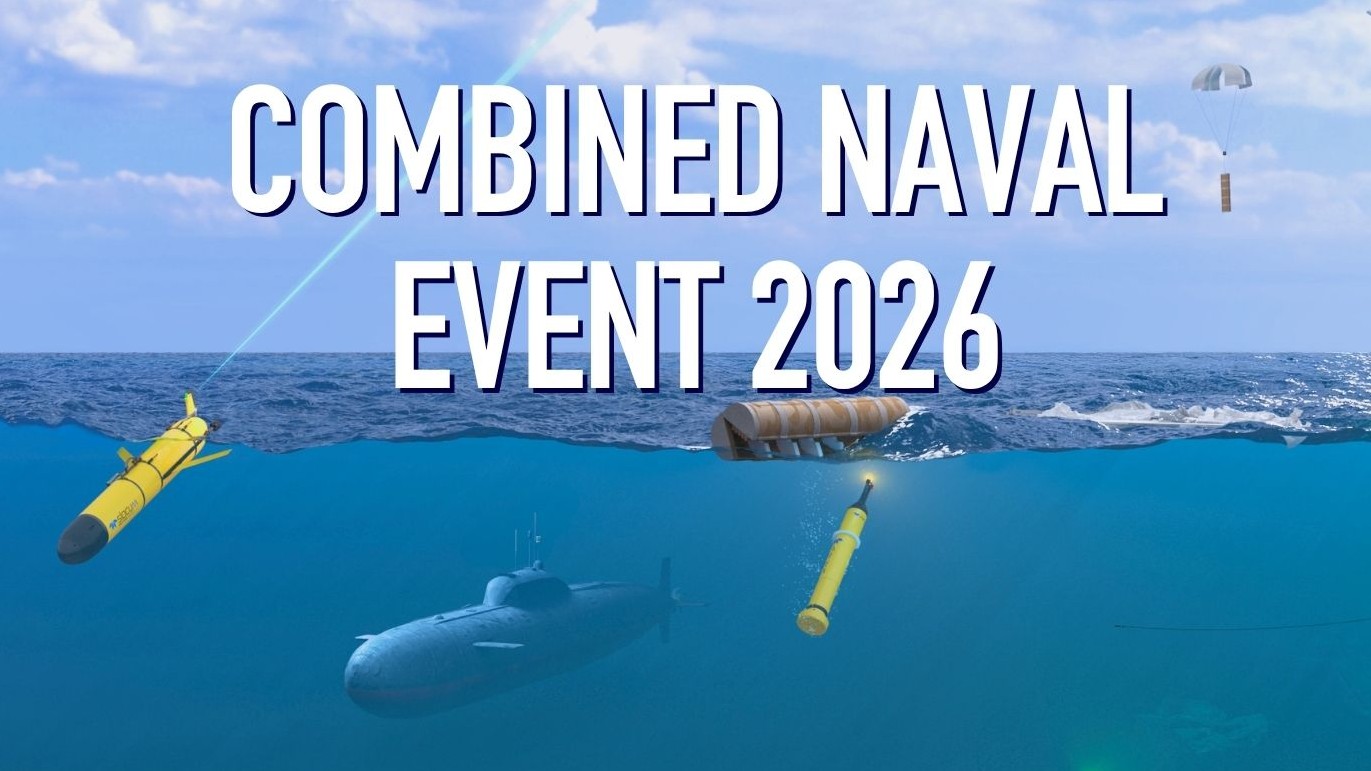
The Royal Navy’s transition toward a Hybrid Navy model, integrating crewed and uncrewed platforms across air, surface, and underwater domains, is moving from concept to reality, according to a long-form feature published by Navy Leaders ahead of the Combined Naval Event at Farnborough. It is well worth reading in full.
The feature, entitled Sensor Sensibilities: Building Blocks for a Hybrid Navy, draws on interviews with Captain Mohayed Magzoub, the Royal Navy’s Head of Force Development, and William Egan, a Senior Vice President at Teledyne Marine, one of the industry partners working to bring programmes like Atlantic Bastion and Atlantic Net into service. Magzoub spoke on the Hybrid Navy concept at Navy Leaders’ Navy Tech and Seabed Defence 2026 conferences in Gothenburg.
When First Sea Lord General Sir Gwyn Jenkins took the role in May 2025, he called for a fleet guided by a simple but powerful principle: “uncrewed wherever possible; crewed only where necessary.” At DSEI 2025 he described his ambition as “a dispersed but digitally connected fleet of crewed, uncrewed, and autonomous platforms that will redefine maritime military power” and pledged that “we will have our first [Atlantic] Bastion sensors in the water next year.”
Magzoub laid out the operational and financial case for the shift. “There’s a big range of anticipated benefits: cost is one of them. But there’s also our ability to de-latch our capability from our crewing. We can increase our capability considerably without having to have the commensurate increase in people…. Improvements in survivability, by shifting from platform survivability to force-level survivability. I think it has a huge impact on our ability to introduce capability quickly, more quickly than we can today. And at the pace of relevance, we can put our capability in the right place at the right time.”
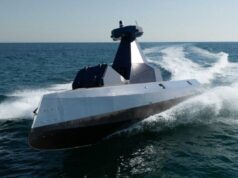
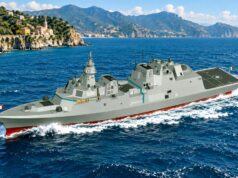
The feature explores a model in which traditional frigates and destroyers give way to lean-crewed Common Combat Vessels acting as command and control nodes, flanked by large uncrewed surface vessels handling diverse roles such as air defence or anti-submarine warfare as missions demand. The first CCVs are likely to be Type 45 destroyers, with that role subsequently adopted by the incoming Type 26 and Type 31 frigates.
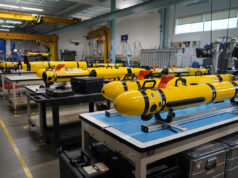
Trust in autonomous systems runs through the feature as a central concern. Egan observed that “trust is the currency of the Hybrid Navy…. that uncrewed systems will perform reliably, integrate seamlessly and deliver the sort of effects commanders need without constant human intervention. Really that trust is only earned through operational experiment, not PowerPoints, not lab demonstrations.” Teledyne’s participation in the SeaSEC Harbour Challenge Day was cited as a practical example, with the company’s systems successfully detecting and classifying underwater targets in real time in a live harbour environment rather than a controlled trial.
Progress on the ground is already visible as the RN’s Peregrine drones and Malloy T-150s have been used on exercises and declared ready for operational use, while the Proteus rotary uncrewed aerial system is in development with Leonardo and has reached the test-flight stage. The RN acquired XV Excalibur, its first extra-large unmanned underwater vehicle, in May 2025. Twenty drone boats from Kraken Technology Group were announced for testing and development in March 2026, and the Maritime Mine Counter Measures programme delivered its second system in April.
Those attending CNE at Farnborough will find the themes covered in the Navy Leaders feature directly relevant to the discussions taking place on the floor. For those who cannot attend, it is one of the more substantive recent treatments of where the Royal Navy is actually heading and why. The full piece is well worth your time and can be read at navyleaders.com.



I bet the intern who came up with Sensor Sensibilities was chuffed with themselves!
Those who are not attending CNE have to input their personal data btw
I’ve gained $17,240 only within four weeks by comfortably working part-time from home. Immediately when I had lost my last business, I was very troubled and thankfully I’ve located this project now in this way I’m in a position to receive thousand USD directly from home. Each individual certainly can do this easy work & make more greenbacks online by visiting
following website—.,.,.,.,.—>>> JobatHome1.Com
Just looked Captain Magzoub up, impressive CV with his legal background.
Good to see a Muslim ( assuming he is? ) reaching a higher rank in the senior service.
That assumption always makes me laugh. I’m white English, am I supposed to be a Cristian ? A friend called Mohamed Is the leader of the local Mosque, I have had a fair few chats about what makes him “A Muslim”, why are his babies/kids also Muslims ? Why he has decided for them that they should be religious and why out of all the thousands of Gods, they should choose Allah ?
Being completely non religious personally, I just don’t get why people have to “belong” It’s all nonsense to this Halfwit.
All It ever does is cause wars and hatred.
Which Is why I said “assume he is” to not offend if he’s a Christian.
Yes I know.
It was not personally directed at your particular comment, just that It’s been a thing since I can remember.
I think In ways most people cannot !
Interesting reading the full document. I wonder whether these CCVs will eventually be homogenised into a single class of ‘do it all’ vessels. Really, if this idea of integrated LUSVs comes to fruition, your CCV would only need a chunky radar, chunky sonar and a minimum number of onboard effectors. Theoretically, you could get away with what currently passes as a medium-large frigate in many modern navies.
I read It as T45 now, T26 and T31 eventually. So basically taking all 3 ships and “Lean manning” them to command multiple other USV’s. None of which really makes sense. Each ship has a crew complement that supports each type of mission, It only really varies by a small %. so why does “Lean Manning” help with additional tasking ?
Looks like T83 will be the first attempt at a CCV. Huge radar, perhaps a limited sonar suite, less of an emphasis on VLS numbers than has been expected. The radar alone will force a large vessel, unless we make it bowl-shaped.
All will be revealed in the DIP, I suppose.
‘“There’ll be times when a CCV is doing an activity that needs lots of sense and lots of effect. So, high-end warfighting being one of them, high-end deterrence operations, maritime security operations of a type, freedom of navigation operations of a type. And there’ll be times when it doesn’t: whether it’s doing fishery protection or counter-piracy or counter-narcotics, the more constabulary-type activity.’
Really intrigued by this passage in particular. Will the same CCVs being tasked with everything from high-end warfighting to constabulary duties?
Is the intention really to have one type of ship replacing all our destroyers and frigates…
One thing that worried me was the statement that even the sensors would be on the USV and the CCV would just carry the ‘decide’ function. That’s a massive false economy as it would reduce the escort to a computer rack following a massive USV destroyer around.
What the paper is heavily leaning towards is T83/the CCV as a less physically capable Arrowhead derivative rather than a normal surface combatant.
Yeah, it seems that they’re planning for some weird personnel barge thing. Odd.
If we go down this route we should look at a version of the tides or similar (Karel Doorman JLSS) as the mother ship mounting a high comprehensive radar and the ability to refuel in water assets & deliver air assets.
They are VFM & able to stay on station for a fair amount of time.
I would even say the RN need at least 4 FLO FLOs to be able to deliver these mini fleets to site, also useful for other uses with mega modules
Interesting times ahead
That’s a really interesting idea, not one I’d thought out before. Perhaps something on the scale of New Zealand’s smaller variant of the Tide-class ships.
I think the Karel doorman JLSS or Canadian G-LAM are excellent examples of very large multi role ships that can act as CnC & logistics support, we will also need some sort of ability to repair / maintain some of the smaller assets at sea.
A ship of this volume allows us to go CEFAR or Spy6 or similar UK radar if we want to.
Key assumption here is this sits in the centre of a set of USVs that it is commanding, it will only have last ditch protective measure such as CAMM & bofors 40/57mm.
“Bowl Shaped” ?
Is that like a Coracle then ?
We have gone full circle ! 😁
“Lean Crewed Large Combat Vessels” ehh ? Type 45 to be the first of these ehh ? How does that work then ?
So a T45 sailing at the moment (I know I know !!!) with a full crew can some how sail with other Unmanned vessels with a Leaner Crew ?
What am I missing there, who’s In the loop for commanding and overseeing these new USV’s …. Surely there will be extra bodies required ?
So many questions, so few brain cells !
ATN having a T45 to test anything out with is a pipe dream.
I’m a bit surprised that they haven’t set this kind of test thing up on an RFA or an Echo. Oh wait, most of RFA is on the wall and we junked the Echos.
It could be Dragon is going to test is out with beehive in the gulf right now. Otherwise I think the type 91 sloop concept is probably what he is referring to. Having a several unmanned vessels armed with mk41 VLS and 40mm guns sailing along side a T45 will greatly enhance the platforms capacity. To the point that a CSG might only need one T45 with four T91’s providing both an out defence layer and additional magazine depth.
Who’s paying ? When will they enter service ? will there be enough maintenance workers/facilities ?
Why Is that Pig Flying ?
Flying 🐖 😆
(They are not Muslim Pigs !)
You know how these wargames go. Each T45 will pretend to be several, so total crew numbers can be distributed, making each crew lean, and we can have many more CCVs, all at the same time at no extra cost. If we pretend hard enough there’s no limit to what we can achieve.
😁 And at least 4 of them won’t even have to leave Portsmouth !
I’m hoping that after 10 years now, Daring will sail further than the Trot 🤔
I have visions of Lieutenant Hornblower taking his first command with a plucky crew of voluntolds and misfits, including the obligatory RM officer who just doesn’t get him.
Lean manned CCVs…
No embarked helo crews
No embarked gun crews
No embarked missile crews
No embarked sonar crews
Empty silos, empty magazines, empty hanger – so much savings!
Don’t panic, we still have the Rivers.
Peow, peow !
arguably and at least in theory (but probably not in practice), the command vessels wouldn’t need any weapons or sensors at all and in fact probably should be as stealthy and hard to find as possible (taken to an extreme, does it need to be a surface vessel?). You can put everything that can be detected like radars and active sonars on uncrewed vessels and then hide the people as far away from harm as communication makes possible. At the absolute extreme – why do the crew need to be out there at sea with them other than for maintenance? The one thing that they might need (which would challenge any submarine not in a bond movie) would be the ability to get engineers out to the other vessels when needed, i.e., a helicopter.