

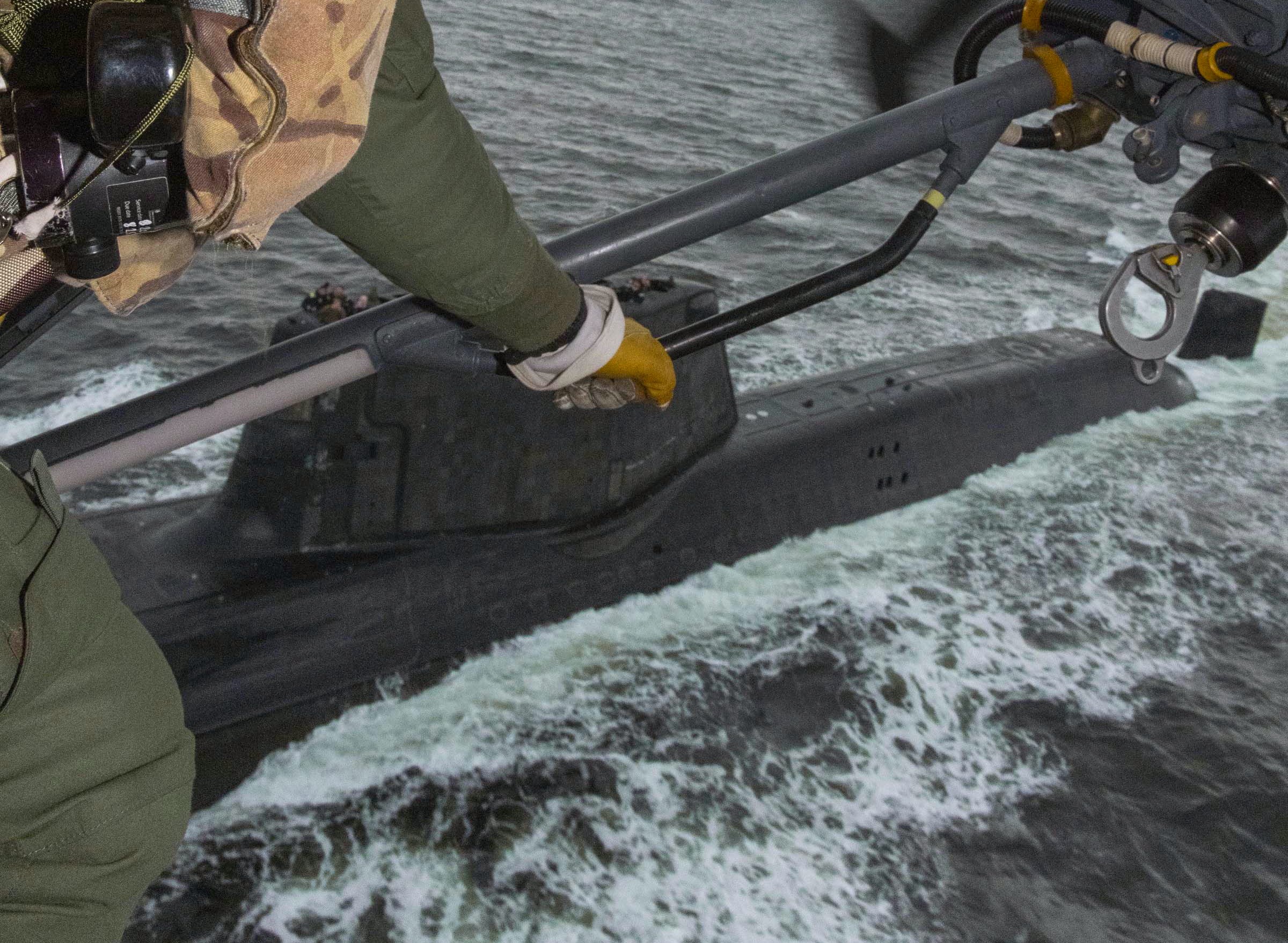
Britain and its allies are struggling to contain Russian submarines, the First Sea Lord has said, in an unusually direct assessment given in an interview for the Council on Geostrategy’s Defence Talks podcast.
General Sir Gwyn Jenkins, the first Royal Marine to lead the Royal Navy, was asked what threats concern him most in his own environment. He pointed to a real growth in Russian undersea capability, and then went further than the service normally does in public.
He said: “We are, if we’re really honest, as allies, we are struggling to contain very capable submarines, a very advanced so-called research programme, which is directly aimed at our critical underwater infrastructure.”
He was equally blunt about the organisation running that programme, which Moscow presents as a deep sea research directorate. He said: “Let’s not kid ourselves. It’s not a research agency. It is an independently funded arm of the Russian state, whose sole purpose is to pursue the destruction of critical underwater infrastructure, in particular in the event of a transition towards war, or just as an economic leverage for the Russian state.”
The context he set out is Britain’s dependence on the sea. The country relies on it for its data, virtually all of its trade and virtually all of its energy, with cables, pipelines and interconnectors running out from the coast in every direction and no practical means of guarding all of them at once.
The Main Directorate of Deep Sea Research, known by its Russian initials GUGI, operates a small fleet of specialist vessels and deep diving submarines, including the mother ship Belgorod and the Yantar, the survey vessel British ministers have previously described as designed to threaten underwater infrastructure and which the Ministry of Defence confirmed it was tracking in November 2025. The directorate reports separately from the Russian Navy proper, which is the arrangement the First Sea Lord’s reference to an independently funded arm of the state describes.
The answer he is pursuing is Atlantic Bastion, the layered effort to monitor the approaches and protect both undersea infrastructure and the patrol areas used by British nuclear submarines. Its surveillance element, Atlantic Net, is a network of autonomous sensors connected by data links, and the First Sea Lord said the Navy has down-selected to a preferred consortium, expects to be on contract later this year and should have the first sensors in the water by the end of it.
Britain’s own anti-submarine force rests on the Astute-class boats, the Type 23 frigates now being replaced by the Type 26, and the P-8A Poseidon fleet at RAF Lossiemouth, all of which are committed to protecting the deterrent and the carrier strike group alongside the wider North Atlantic task.
Listen to the full interview
The conversation runs a good deal wider than the extracts covered here. Over the course of the episode the First Sea Lord also discusses reforming officer selection and training, how the Navy intends to unleash innovation at the front line, the three strands of the Atlantic programme in Bastion, Strike and Shield, the relationship with industry that the hybrid fleet depends on, and his own reading of how the strategic picture has changed since he joined the military at the end of the Cold War. Interviews with a serving First Sea Lord at this length are rare, and anyone with an interest in where the Royal Navy is heading over the next decade will get considerably more from listening to it in full than from any write-up.
General Sir Gwyn Jenkins was interviewed by Viktorija Starych-Samueliene and Paul Mason. The episode is available on YouTube, Spotify and Apple Podcasts.
Defence Talks is produced by the Council on Geostrategy, a London-based think tank founded in 2021 which focuses on British foreign, defence and trade policy, the Indo-Pacific and the geopolitics of technology, and which publishes the journal Britain’s World alongside its research output. The series is delivered in partnership with ADS Group, the trade association representing the British aerospace, defence, security and space industries, and is sponsored by BAE Systems.






Just as well the type 31 possesses no sonar and barely any ASW capabilities. Have we not learned the lessons from the Falklands where shortcuts cost lives
Polish A140/T31 are getting Captas 2 towed array. The RAF has publicly stated it needs a minimum of 12 P-8. Now they have gone up to $328 m each, I sadly doubt HM Treasury will stump up for the extra 3.
The NATO MACHINE NEEDS T26 ADAP and when it finally turns up the performance will have to match the hype around it.
With just a Merlin for offensive action are t26s overhyped?Weaknesses – they can only be in 1 place at one time. What happens if it’s unavailable? Why are they not fitted with MTLS?
Correct me if I am wrong but currently still none of the Astutes are in service and only a few ageing type 23’s. No wonder we are struggling to monitor the Russians.
About 90 days since any Astute was at sea.
It’s import to note that not at sea is not the same as not in service.. we don’t know the readiness levels of the SSNs…
Trafalgar, like type 23 were getting on a bit, but, like everything else about the royal navy, the baby gets thrown out with the dishwasher. Whole classes of submarine have been retired before the dates it was estimated. Swiftsure, Churchill, valiant classes disappeared almost overnight.. my son was on the last of the Trafalgar boars triumph . Nth consensus of all on board was that the boat wes in good enough shape to have been retained in service. Crews from most of the class have repeatedly said that their boats whatever the gossip around certain systems wa saud were not sufficiently worrying to reduce their performance when ou doing its work. We have a litany of similar stories in the surface fleet. Type 22 disappointed overnight and wasn’t replaced with a t23 class for years. Not to mention the corruption stories behind the Romanian sales where millions were paid to anonymous ‘fixers’ who were never identified or the money 💰 an alleged million was never recovered theMETserious fraud squad have tried and failed to get to the bottom of the affair. Nark royal as retired 5 years early while the ship was actually at sea.
“the baby gets thrown out with the bath water”. Sounds more like it.😂
Probably true yet I’m not sure running them into the ground would have produced a better outcome which is where we are now with T23.
Obviously it takes time to build new ships. That said we need to focus on how we can generate new ships at a much faster pace.
I know this sounds ridiculous but it should be perfectly possible to have 2-3 T26 rolling of the production line every 6-12 months.
So it is allies that are struggling because RN have no ASW ships and submarines do no get out of port…
Not what it says.
Look at the title.
I wouldn’t be surprised if by now most of our undersea assets have charges laid next to them to cut us off in minutes.
Our governments have done an appalling job on defence and relaxed far too much post cold war, and with piss-poor planning to boot.
Agreed. Sorry didn’t see before I replied.
If anyone doesn’t think there’s not already detailed maps and probably even remotely controlled explosives tethered to cables around UK, Taiwan, Australia etc etc they’ve clearly not been paying attention.
Yes Craig, any how do the Russians communicate with these charges placed next to all of the cables at the bottom of the sea to set them off? How do these charges receive long term electrical power? How come despite us, several other NATO navies and a dozens very wealthy mega corporations all patrolling them on a regular basis has no one ever found a charge next to any cable?
For power, tidal flow generator, if not batteries. Trigger, how about a massive sonar ping, maybe with repeaters. As for not finding them, well do we have the assets? These things wouldn’t need to be very big.
The treasury have for many years had too much influence on the defence of the nation and is the direct result of weak governments with no Idea about to operate them. But at least we DID have a sailor and the first sea lord. Ships lost in 1982 were not replaced for nearly 15 years.
Not to Woory HEALEY to the Rescue…
Sadly a man that seems to have gone AWOL ..
Dare I say Taken us all for fools ..!
Ah, but he has a new job doesn’t he, now Starmer has been forced out. So defence??
It was always a possibility that Healey’s resignation was a tactical withdrawal to put pressure on Starmer. The lad’s done well out of it… Worked like a charm, back in the cabinet and with a promotion, as I’m sure was always the plan with his pal Andy looking out for him…
‘It was always a possibility etc., etc. ….’ – is the correct answer. Long in the planning and executed by an over promoted chameleon.
If we put on one side the instant criticism of Healey manufacured by the Telegraph and Mail, he is on the right path so far.
He pushed defence right up the agenda with his resignation and public support is high.
He will almost certainly hot second base by delivering the missing £5bn for the DIP, in his forthcoming budget, which Burnham has already tacitly agreed.
At next year’s spending review, HMG.l will lay out the path to get to 3.5% of GDP by 2035. Ii will apparently.most likely be by a linear progression in spending, so it rises by a bit over 0.1% of GDP per year up to the target figure. It will likely not hit ‘3% by 3030’, but HMG has never committed to that and Healey only set that out as an ideal. This is third base and one Healey has a fair chance of reaching.
To afford defence increase as well as everything else that has been neglected and needs fixed, like pronsa and social care and low-cost housing etc., there will inevitably have to be some reining-in of government/welfare spending and some selective back-door tax rises. The danger is that the extra funds get curtailed or squeezed out by other claims or global events. Defence funding accordingly needs a fall-back plan. Healey is well aware of the options here, because they have been widely debated inside and outside Parliament.
One is a government-backed loan scheme for defence investment, similar to the EU’s SAFE scheme, which is funding this current big batch of European defence orders. Canada has proposed a similar scheme for non-EU countries. Germany has excluded such loans from counting towards its national debt and the bond markets seem unperturbed. There are lots of other mechanisms on the table, such as requiring city funds to invest.a portion of their wealth in a defence fund, a national defence bond or just a penny in the pound hypothecated tax increase for defence.
The problem is that Treasury orthodoxy does not extend beyond tax-and-spend. This will be Healey’s biggest test as Chancellor, and he will need backing in the House and from the public, rather than columns of politically-motivated wobbling from the DT and Mail.
Doh what a lot of spelling mistakes I make on my mobile. Bring back the edit button !
Look forward to seeing all this Speculation in action
‘…data shows that global concern specifically regarding inter-state military conflict has risen significantly. For instance, nearby European neighbours like Poland saw concern over military conflict jump to 40%.’
But not in Britain, Germany or France: ‘Climate change 1st Place (or tied for 1st) in the UK, Canada, and Germany. Outpaced individual mentions of hostile state actors when framed as a “macro threat to global stability”.
Until that changes, and it won’t until it is too late, Britain’s armed forces will continue to ‘suck on the hind tit’
Without firm political leadership on defence of the realm (not happening before the next election, probably not even after that), we are fecked, well on the way to being comprehensively fecked…
Geez after events of this year so far I think underestimating the effects of climate change for us all in the future is rather foolish. It’s every bit as dangerous as potential conflicts we as a Country won’t have enough water without massive long term investment and not enough food (or frighteningly high prices, probably both) as just a few threats we face. While those conflict concerns have raised to equally red alert sadly mostly thanks to the orange moron in the White House destroying any real semblance of conflict prevention, especially where peer opponents are concerned. Failing to defeat a minor player like Iran, while eating through a large proportion of your high performing missile inventory, while showing your ships can’t cope all while blowing kisses at a laughing league of high threat tyrannical players in Russia, North Korea and China is hardly deterring the threat. Yes both are man made self destructive threats of the highest order that need urgent attention, simply ignoring one for the other in a stupid hyped Hobson’s Choice scenario is crass.
Everyone is entitled to their opinion.
I don’t get it.
Satellite data shows – worldwide, wildfire area is at the lowest for time of year since records began (Global wildfire information service 2026)
Paleo-Events: Radiocarbon and cosmogenic radionuclide (10Be) dating across the Himalayas, Karakoram, and Pamir ranges reveal dozens of massive Holocene rock-ice avalanches. Some of these historic slope failures involved volumes exceeding tens to hundreds of millions of cubic meters—orders of magnitude larger than recent events.
The summer of 2026 has recorded higher peak temperatures than 1976, but 1976 remains unmatched for its long, continuous duration and severe drought.
‘One of the most striking features of Earth’s climate history is its rhythmic natural structure. Throughout the Holocene, we observe:
multidecadal oscillations (~60 years),
centennial fluctuations,
millennial‑scale cycles such as the Eddy cycle,
and the Hallstatt–Bray cycle.
These patterns appear in ice cores, marine sediments, tree rings, and historical documents. They also correlate with solar and astronomical proxies. These cycles are not speculative; they are among the most robust features of paleoclimate research.
Yet current GCMs (General Circulation Model or Global Climate Model) do not reproduce these oscillations with the correct amplitude or timing.
This is not a minor detail. If models cannot capture the natural background variability of the climate system, then attribution regarding the global warming from 1850–1900 to the present becomes inherently uncertain’
AR6 Working Group 2 Chapter 16.2.3.5 (O’Neill et al. 2022) acknowledges that heat-related mortality risk is declining over time: Heat-attributable mortality fractions have declined over time in most countries…
Consequently, in many countries: ‘…widespread acknowledgement that RCP8.5 is an implausible emissions scenario. As a result, many news agencies have dropped or substantially reduced their climate desk, we don’t hear about climate change so much in the media (particularly as related to extreme weather events). Also, we can’t underestimate the impact of substantially reduced funding for climate-related NGOs, with USAID and other funds drying up.’
But not in Britain: ‘The UK has expensive electricity, higher than its developed nation peers. In 2024, Britain had the highest industrial electricity prices of International Energy Agency member countries…The UK’s expensive electricity is weighing on the nation. Rising bills are repressing the discretionary income of British households and high industrial electricity prices are discouraging inbound investment’
Meanwhile war rages on Continental Europe, hundreds of thousands dead, millions displaced. The Head of the CIA has to fly to Moscow to tell Putin not to attack either the Baltic States or Britain. The Head of the CIA also visited Moscow in 2022 to tell Putin not to invade Ukraine. On Friday 28 August 2026,Russia conducted a successful combat training launch of a mobile, solid-fuel intercontinental ballistic missile from the Plesetsk Cosmodrome in the northwestern Arkhangelsk region. The Strategic Missile Forces deployed a mobile launcher battery to a remote area before firing the missile across the country to the Kura test site on the Kamchatka Peninsula, located more than 6,700 kilometers (4,160 miles) to the east.
Russia has already killed a British citizen on British soil and badly injured, permanently, a police officer, deployed enough CBRN material in Britain to kill thousands.
I don’t get it.
The problem with the UK is that we have Jeremiah syndrome. It’s a good thing to make people aware of the ( environmental) ‘sins’ we ( the world) are committing and preaching ‘repentance’. But it’s a mistake to allow righteousness be incorporated into your identity as a kind of perpetual indignation for which you feel you must martyr yourself. God had to reproach Jeremiah and tell him not take things so personally. Otherwise you end up with a permanent victim psychology and screwing yourself. E.g. our escalation in ADHD, Autism, mental health crises, benefits culture, not building any reservoirs for 30 years etc; and irrational compensating behaviours like overspecced HS2
Yes…or Ostrich Syndrome
‘The Ostrich myth describes a human fallibility. You may figuratively close your mind and hide..This Ostrich syndrome has distinctive features: parasitic anxieties and fears, depression, frustration, and procrastination (A parasitic fear drains time and resources, offering nothing of real value in return.)
Psychology Today
Always good when Monro, Subnormal-in-Chief, informs us all that climate change is a-okay.
Boomers gonna Boomer.
‘The leaders of the climate alarmism movement have not conceded defeat but have done much whining, notably over… the RCP8.5 scenario…they have mostly stopped flogging the warming/extreme weather link, although there is a hardcore group that is committed to extreme event attribution as a mechanism to support litigation against fossil fuel companies. With the demise of the extreme weather link, the climate alarmists are now focused on climate “tipping points,” which simply doesn’t resonate with the public (extreme weather events were much more alarming).’
Judith Curry June 2026
“I have a condition that involves mental difficulties, primarily caused by inhaling lead for most of my life” – Monro, August 2026.
‘…widespread acknowledgement that RCP8.5 is an implausible emissions scenario. As a result, many news agencies have dropped or substantially reduced their climate desk, we don’t hear about climate change so much in the media (particularly as related to extreme weather events). Also, we can’t underestimate the impact of substantially reduced funding for climate-related NGOs, with USAID and other funds drying up.’
Unlucky
“Being born in the 60s means I have a higher concentration of lead in my brain, leading to long-term cognitive challenges” – Monro, August 2026.
Unlucky. It almost makes you feel bad for Boomers (not really, I hope you all keel over).
Bingo
Glad you confirmed.
Alzheimer’s gonna hit you hard, bro. Please get your family to post on your behalf once it kicks in.
‘Little Fido’s master had to go on a long journey,
So Fido followed her master, and ran cheerfully,
And often the master would speak kindly to the dog,
As along the road together they did jog.
Her master rode on a very beautiful steed,
And Fido followed behind at slow speed.’
McGonagall
Your climate change argument sounds great upon first reading, but lacks anything substantive in the form of trends and data sampled over time.
It relies on singular events to build a narrative, either ignoring that those singular events are likely outliers (1976) or exaggerating their significance (historical oscillations).
Meanwhile, the core of the climate change model is built around identifiable trends, the main one being that global average temperature has continued to climb since the beginning of the industrial revolution, in direct correlation to societal development.
The temperature is rising at a faster rate than ever recorded (without including major geological activity, e.g massive volcanic eruptions). Other periods of natural climate change did not occur this quickly.
The 1976 reference was in response to the comment ‘…after events of this year so far I think underestimating the effects of climate change for us all in the future is rather foolish.’
As the Global wildfire information service 2026 shows, worldwide, wildfire area is at the lowest for time of year since records began.
The observed warming of the deep ocean and land has led to observational estimates of climate sensitivity considerably lower, 1.5 to 1.8 deg., compared to the IPCC claims of a “high confidence” range of 2.5 to 4.0 deg. C.
From 1940 to 1980, when the human production of CO2 increased the most, global temperatures went down. After 1998 the global temperatures stopped increasing while CO2 levels continued to increase.
What else could explain the change the name of the global warming hypothesis from global warming to climate change?
In their seminal paper on the Vostok Ice Core, Petit et al (1999) note that CO2 lags temperature during the onset of glaciations by several thousand years.
Another problem with ‘temperature is rising at a faster rate’. How would you know? The WMO (World Meteorological Organisation) rates weather stations by the degree of nearby unnatural or natural temperature corruption. Classes 4 and 5 have possible corruptions of 2°C and 5°C respectively and these account for the vast majority of the Met Office sites. The WMO suggests that Class 5 should not be used to provide an accurate measurement of nearby air temperatures, yet nearly a third of the Met Office sites are classified in this super-junk category. Satellite datasets, by contrast, show 20–30% less warming since 1980, particularly over Northern Hemisphere land areas. Rural‑only station reconstructions also reveal weaker secular warming.
The Sun’s influence on climate is significant. A proper assessment requires addressing the long‑standing controversies surrounding solar variability on timescales longer than the 11‑year solar cycle — controversies that remain central to understanding the natural contribution to modern climate change.
So no-one really knows what is going on other than that the climate is changing, as it always has done. That is an extremely poor (if not dotty) basis for dramatic and expensive societal change (www.gov.uk, Net zero society: scenarios and pathways. How could societal changes affect the path to net zero? April 2023) to achieve net zero by 2050, leaving this country unable to respond to an immediate threat of foreign actor aggression.
But no-one wants to rock the boat. Since 1990 the U.S. Government has spent $120-$160 Billion on climate change research.
‘Public policy could itself become the captive of a scientific-technological elite’. Eisenhower 1961
We are well on the way to being comprehensively fecked.
Okay, let’s go one by one.
Using burned area is an inaccurate measure, because the type of environment that dominates the ‘burned area’, savannah and grasslands, have declined consistently as a category, due to agricultural expansion. Meanwhile, the actual number of wildfires globally and in the UK is increasing yearly. At the same time, fire intensity and the difficulty in stopping blazes once they begin has also been trending upwards of late.
Then, you’ve not used the full data range. Observational-only studies often give lower values, but paleoclimate, energy‑balance, and model‑based studies converge around 2.5–4°C. Then, you make another mistake; deep ocean warming does not imply lower sensitivity. It implies greater heat uptake, which can conceal surface warming temporarily, thus resulting in another misconception on your part. The IPCC range is based on multiple independent lines of evidence; you’re cherry-picking the data that you like, and ignoring the context.
The 1940-1980 ‘fall in temperatures’ was caused by aerosol production post-war, which concealed CO2 warming because of their artificial cooling effects. Once they were outlawed for a variety of reasons, aerosol levels in the atmosphere declined as human-produced CO2 levels increased continually, thus leading to warming. This is another example of a well-documented phenomenon being used for an argument without any actual scientific basis.
Global temperatures have continued to rise past 1998. This was a local spike due to a particularly extreme El Nino. Since then, the vast majority of data sets have shown that warming continues each year on average. This is just you choosing an outlier and attempting to anchor your argument upon it. It’s a basic statistical misstep.
Your point on glaciations is technically correct, but almost completely irrelevant to this conversation. The fact that CO₂ lagged temperature in ancient natural cycles does not imply it cannot lead temperature now. Pretty basic false analogy.
Class 4 and 5 are not automatically excluded, and are instead corrected using a variety of homogenisation algorithms. Anyhow, independent reconstructions still show strong warming, so the point is moot anyway. Because modern satellites record microwave emissions, they really need correcting for a whole bunch of factors before we can actually measure temperature directly. When you apply these corrections, which are required for fair comparison, the data complies with the established hypothesis.
Solar influence upon climate as a driving force behind warming makes little sense, when actual trends are analysed. If the Sun is driving warming, why is a) the Arctic warming more quickly than the Tropics, b) the night on average a period of greater warming than the day (in its respective bands over a 24 hour period, averaged), c) there stratospheric cooling, when, if your suggestion was correct, there out to be stratospheric warming.
You mistake uncertainty for ignorance. Scientists are uncertain about certain aspects of climate change, but the vast majority agree on the basics, and are alarmed by human impacts. Saying ‘nobody knows what’s really happening’ is a cheap and morally hollow way of worming your way out of an argument.
Nothing you have actually said explains why climate change action ought to be the sacrificial lamb to boost short-term military capability. After all, NATO itself acknowledges climate change as a driving risk factor for future conflicts.
Claims about US spending don’t actual mean anything. Just because money is spent does not imply that the results of the studies funded are majorly flawed in their outcomes.
You’ve butchered the actual meaning of that Eisenhower quote, by the way.
Thank you for your response.
Of course, there is very little that is wild about ‘wildfires’. ‘…most wildfires are started by human actions’ (www,gov.uk). Ground based data, where available, and satellite data both show that wildfires have declined in number and acreage lost over the past century, even as the Earth warmed slightly (data sets from both NASA and the European Space Agency (ESA)). Forestry management practices are also to blame: ‘The Cal Fire and California Legislative Analyst’s Office reports present a real world picture identifying that California’s government and regulatory agencies are responsible for the present terrible condition of California’s forests along with the resulting increased wildfire risks and occurrences.’
Studies do not converge. The Liu et al. (A global analysis of pollen-based reconstructions of land climate changes during Dansgaard–Oeschger events 2026) paper confirms: ’11 abrupt warming events between 57–29 ka (57,000 to 29,000 years ago), Greenland warming events of 10–16°C in a 50–200 years span, Global-scale expressions of these events, CO₂ levels around ~200 ppm during this period, These are not blog claims. They are peer-reviewed reconstructions.
The climate system has always been capable of dramatic, rapid changes. CO₂ is one influence among many, but paleoclimate evidence shows that abrupt warming is not exclusively tied to rising atmospheric carbon dioxide.
‘The 1940-1980 ‘fall in temperatures’ was caused by aerosol production post-war, which concealed CO2 warming because of their artificial cooling effects.’ Nope. ‘Reassessment of pre-industrial fire emissions strongly affects anthropogenic aerosol forcing, Hamilton et al’. Instead of aerosols increasing during the 20th century, it looks like they actually decreased by 30% over the 20th century.
‘The fact that CO₂ lagged temperature in ancient natural cycles does not imply it cannot lead temperature now.’
A comprehensive study (Stochastic assessment of temperature-CO2 causal relationship in climate etc 2024) details a stochastic assessment determination of the sequencing of CO2 variations versus temperature variations since the 1950s, over the last 2,000 years (the Common Era), and throughout the last 541 million years. It clearly shows the temperature changes lead and CO2 changes lag on yearly, decadal, and centennial/millennial scales.’
The fact remains that most of the Met. Office weather sites are junk, so their statements are, for the most part, modelled. ‘In the 2009 NIPCC report, Idso and Singer (2009) highlighted scores of studies demonstrating the impact of this phenomenon on temperatures and how population-growth-induced warming—spread across
the world—is often incorrectly construed to be CO2-induced global warming.’
Stratospheric cooling? Not this century: ‘…all investigated radiosonde data sets suggest a change from late twentieth century cooling to early 21st century warming in the lower stratosphere. Santer et al. (2023) use updated data to show that a cooling trend has not re-emerged in the lower stratosphere. A combination of tropospheric warming and stratospheric cooling is a commonly cited “fingerprint” of anthropogenic climate change. Stratospheric warming since 2000 coincides with continued surface and tropospheric warming, a pattern that is not found in climate model simulations and is not apparently consistent with the anthropogenic fingerprint.’
The IPCC and NASA are convinced that changes in the Sun have very little effect on climate. But Holocene climate changes could not have been caused by changes in CO₂. They must have been caused by something else: ‘…the four grand Spörer-type Holocene minima coincide exactly with the four major climatic events on the graph we saw earlier. We know that during each of these grand solar minima, when the Sun’s activity dropped for 150 years, the climate experienced a tremendous cooling that had a major effect on climate proxies around the globe.’
Furthermore: ‘…multiple boreholes from around the world agree with each other on the scale of the last millennium, which shows borehole-derived temperatures are a valid and consistent representation of reality. compared the solar indices of the past millennium with the borehole temperature reconstructions, demonstrating the borehole data and solar indices agree on the long-term temperature pattern of the past thousand years. Thus the two parameters imply the existence of a solar induced Medieval Warm Period (MWP) around AD 1000 to 1300 and a Little Ice Age (LIA) in the 1600s to 1700s. Their study confirms the existence of a global MWP and demonstrates the link between the MWP-LIA oscillation and solar activity. In addition, it indicates the MWP was roughly as warm as—or warmer than—it has been to date during the Current Warm Period.’
The key stat. is that the risk and absolute number of deaths from weather and natural hazards have fallen dramatically since their peak in the 1920s, even as the global population has multiplied (International Disaster Database EM-DAT). There are many reasons for that but the salient point is that the sky is clearly not falling.
‘The prospect of domination of the nation’s scholars by Federal employment, project allocation, and the power of money is ever present and is gravely to be regarded.’ Eisenhower 1961
So, if the sky is clearly not falling but, on the other hand, Russia is still on the offensive, thousands are dying every week and Britain is quite clearly not safe…
You know the rest…
‘Physical science is based on physical evidence and the physical science of climate change science is anything but settled. A brief list of what we do not know includes the following:
• We do not understand the changing sun, which dominates Earth’s climate.
• We do not understand Dansgaard-Oeschger (D-O) events, periods of rapid warming followed by slow cooling. It has been suggested that they are volcanic, but the intervals seem too regular. Are they connected to the Bray Cycles and the Eddy Cycles that indicate changes in solar influence?
• We do not understand turbulence of fluids in the atmosphere and oceans – giving rise to Chaos Theory. Turbulence in the atmosphere limits the horizontal dimensions of grid boxes describing weather to about 100 km, or 60 miles. They cannot be smaller. Turbulence limits the vertical dimension to 1km or a few thousand feet.
• We do not understand the formation and dissipation of clouds in the atmosphere. They have a greater influence on climate than CO2.
• We do not understand plate tectonics, to include changes in volcanic activity. Changing plate tectonics changes with location of land masses which, in turn, changes the ocean currents. And the oceans are the vast storehouse of solar energy on Earth. Changes in underseas volcanos can cause significant local ocean warming.
Further, global climate models attribute to carbon dioxide a far greater influence on temperatures than what can be attributed when considering all the physical evidence. Often, the “settled science” is based on the omission of contradicting evidence such as the conclusions of the Westerhold et al. study published in Science (2020). When all the evidence is revealed, Earth had periods of millions of years when atmospheric carbon dioxide varied widely but temperatures were roughly stable.
The UN Intergovernmental Panel on Climate Change (IPCC) has misled the public by limiting climate change to only since 1850 and only to human influence, ignoring massive natural changes. Earth’s history did not begin in 1850 and climate change began long before humanity existed. The greatest threat to civilization is another cold period, be it a D-O event or the onset of a major glaciation.’
Ken Haapala March 2026
“If the man doesn’t believe as we do, we say he is a crank, and that settles it. I mean, it does nowadays, because now we can’t burn him..”— Mark Twain, Following the Equator: A Journey Around the World (1898)
‘…sudies converge around 2.5–4°C.’
Nope
‘This large difference between analysis groups is sometimes described as the “structural uncertainty” in the estimate of long-term temperature change, and limits humanity’s ability to say for sure how much warming has occurred.’ Berkeley Earth 2026
Here we go again.
I have already rebutted your climate misinformation (disinformation) multiple times on this platform.
You are wrong. The IPCC predictions are proving themselves to be accurate, while those of people trying to convince themselves and others that it is not real are shown to be incorrect.
You also use argument “techniques” designed to obfuscate, confuse, or drown people in plausible-sounding (but almost universally incorrect, inaccurate or out-of-context) factoids.
Until you can produce evidence of comparable scientific rigour to an IPCC report, there is no reason that anybody should believe you.
‘Scientific consensus is the last refuge of frauds’
IPCC?
“In my more than 60 years as a member of the American scientific community, including service as president of both the National Academy of Sciences and the American Physical Society, I have never witnessed a more disturbing corruption of the peer-review process than the events that led to this IPCC report.”
Frederick Seitz, the 17th president of the United States National Academy of Sciences
The first IPCC Physical Science Basis report is called “FAR” and was first published in 1990. An updated 1992 version of the report contains this statement:
“…global-mean surface air temperature has increased by 0.3°C to 0.6°C over the last 100 years … The size of this warming is broadly consistent with predictions of climate models, but it is also of the same magnitude as natural climate variability. … The unequivocal detection of the enhanced greenhouse effect from observations is not likely for a decade or more.”
(IPCC, 1992, p. 6).
‘This was an accurate statement at the time, and it is mostly accurate to this day. In the past century (since 1920) temperatures have increased about one degree and I’m not sure we will be able to detect a human enhanced greenhouse effect in ten years, or ever, but otherwise the quote is still accurate. One degree of global warming in a century is well within natural climate variability according to historical records and records of glacier advances and retreats (Vinós, 2022, pp. 89-107).’
‘…the bottom line is that AR6 is the worst and most biased IPCC Physical Science Basis report ever. SAR through AR5 were bad, but AR6 is beyond help.’
The General Public are not fools. ‘It is very clear that the IPCC is losing the public, polls repeatedly show the world population does not believe global warming is a priority…60% of U.S voters believe that climate change has become a religion…Billions of dollars, six major reports that total 6,543 pages (2,391, or nearly half of them are in AR6) and a total of 47 reports of all kinds, and the public has not been convinced that climate change is important. It’s time for the IPCC to reform or give up’.
What kind of country do you want to live in? This one:
‘Constructive criticism and debates are at the heart of scientific discovery and should continue as the framework for scientific progress. Scientists do not have all the answers…When the Iranian Revolution started, I was about 12 years old. I witnessed many atrocities–individuals hanging dead on trees and light poles because they disagreed with the government. I saw my friends’ fathers in pictures on the back of the daily newspapers, with bullet holes in their foreheads, because they said or believed something that disagreed with the government…’
Or this one?
‘At 14, I was lucky enough to leave Iran for Istanbul and at 16 I received a visa to come to the U. S. to learn English. During my early years in the U.S., I was amazed by how individuals with different beliefs and opinions engaged in respectful debates to try to present their cases to each other…’
Ali Shilatifard
Precisely the level of reply I would expect of you. You claim scientific consensus is fraudulent, but defer to the great wisdom of 60% of American voters? Forgive me if I am less than convinced. You could at least use the population of this country… but oh no! That would not fit with the script.
Your two cited works only serve to indicate that the IPCC made a prediction and it is proving to be accurate (with a bit of unjustified skeptical opinion thrown in).
I am unclear what the last few paragraphs do for you, other than serving to pad out your spiel in line with your standard gish-galloping strategy. Perhaps they could serve as a point of reflection? Constructive criticism involves providing reliable information, presented in a concise and helpful manner. It also involves listening and learning from feedback, rather than continuing to grasp at straws after being roundly debunked.
Our present government was voted in by 33.7% of voters.
‘…widespread acknowledgement that RCP8.5 is an implausible emissions scenario. As a result, many news agencies have dropped or substantially reduced their climate desk, we don’t hear about climate change so much in the media (particularly as related to extreme weather events). Also, we can’t underestimate the impact of substantially reduced funding for climate-related NGOs, with USAID and other funds drying up.’
The boondoggle is over. Britain’s public sector just hasn’t realised it yet.
And that is imperilling this country’s safety, security.
1st paragraph: Irrelevant
2nd: We’ve been over this before. RCP 8.5 is implausible because it was the “business as usual” scenario where the world did nothing to curb emissions. We have done something to curb emissions, so it is now implausible. Similarly, scenarios assuming that more was done to curb emissions than actually occurred are also now implausible.
3rd: what countries choose to do is not a good representation of scientific consensus. A report published by hundreds of leading scientists in the field is.
IPCC official Ottmar Edenhofer: “One has to free oneself from the illusion that international climate policy is environmental policy. It is not. It is actually about how we redistribute de facto the world’s wealth”.
The idea that ‘we have done something to curb emissions’ does not stand up.
‘Climate TRACE’s preliminary estimate of January 2026 emissions in China, the world’s top emitting country, is 1.5 billion tonnes CO₂e, an increase of 4.1 million tonnes of CO₂e, or 0.3% vs. January 2025. India emissions increased by 1.6 million tonnes CO₂e, or 0.4% year over year;
In the EU, which as a bloc would be the fourth largest source of emissions in January 2026, emissions increased by 10.5 million tonnes CO₂e compared to January 2025, or 3.2%.’
It is quite clear that there is no scientific consensus regarding the extent of climate change, and for good reason:
‘Estimating global mean temperature in the late 19th century is always going to be more challenging than during the recent period due to less data and the less reliable nature of the data that does exist. Much of the disagreement between analysis groups derives from the choice of ocean dataset employed. NASA and NOAA rely on NOAA’s ERSST data product, while Berkeley Earth and HadCRUT use the HadSST data set. These two data products are the most widely used instrumental reconstructions of the long-term changes in the ocean and they disagree to an appreciable degree…Early ocean temperature observations relied on hauling buckets of water onto the ship’s deck in order to be measured…These methodological differences make understanding of the changes since the pre-industrial period more difficult. Different research groups disagree on the amount of warming that has occurred since the pre-industrial…This large difference between analysis groups is sometimes described as the “structural uncertainty” in the estimate of long-term temperature change, and limits humanity’s ability to say for sure how much warming has occurred.’
Berkeley Earth 2026
The boondoggle is over.
Meanwhile, in the real world, Britain is not safe, not secure. Weak, we think we can rely on Ukraine to keep us safe. They cannot.
So, do we feel lucky?
We clearly have curbed emissions. They simply rise less quickly than they otherwise would have. Unless you think that all the world’s wind turbines and solar panels are fakes with little gas generators hidden in them?
We also have extremely clear measurements of the earth’s average surface temperature, regardless of the out-of-context mish-mash of quotes you have provided. One can simply go on NASA or the Met office’s sites to see them.
We most certainly have not reduced emissions. Emissions increased 0.50% by 303.19 Mt CO2e last year, reaching a new high of 60.63 Bt CO₂e. Despite a small decline in power sector emissions, fossil fuel operations, transportation, manufacturing, and buildings all nudged emissions higher. The biggest movers in the power sector were China, India, and the US. (Climate TRACE 2026). Britain’s emissions are down by a rounding error year on year and represent only 0.81% of global emissions.
What kind of power do you think is used to produce all those wind turbines and solar panels? New and reactivated coal power project proposals in China surged to 161 gigawatts (GW) in 2025, a record high. 2025 also saw China commission 78 GW of new coal power capacity, which is more than India’s net coal power additions over a ten-year period from 2015 to 2024, even though India operates the world’s second-largest coal power fleet CREA 2026).
We may or may not have ‘clear measurements’ of global average surface temperature (We don’t. The percentage of missing station data that is “fabricated” has been rising in recent years). More importantly, an analysis of vertically resolved radiosonde measurements from 60 stations shows an increase of lower stratospheric temperature since the turn of the century at altitudes between 15 and 30 km and over most continents. Updated data shows that a cooling trend has not re-emerged in the lower stratosphere. A combination of tropospheric warming and stratospheric cooling is a commonly cited “fingerprint” of anthropogenic climate change. Stratospheric warming since 2000 coincides with continued surface and tropospheric warming, a pattern that is not found in climate model simulations and is not consistent with the anthropogenic fingerprint. (Santer et al. 2023)
Meanwhile Andrei Fedorov, a former Russian deputy foreign minister who advises the Kremlin…said: “For example, something might happen with enterprises, with (UK) factories which are producing drones for Ukraine…
We are not safe in Britain and we will not be safe until the defence budget is dramatically increased.
IPCC official Ottmar Edenhofer: “One has to free oneself from the illusion that international climate policy is environmental policy. It is not. It is actually about how we redistribute de facto the world’s wealth” but now that boondoggle is over. The dotty idea of ‘net zero by 2050’, never put in a manifesto, must go forthwith.
“Meanwhile, the core of the climate change model is built around identifiable trends, the main one being that global average temperature has continued to climb since the beginning of the industrial revolution, in direct correlation to societal development.”
You know that correlation is not causation? Care to elaborate on precision, reliability, site quality, site change, margin of error of temperature instrumentation for 0.X Cº supposed variation we are talking about ?
Care to elaborate what was the cloud cover from the start of Industrial Revolution” to today?
Care to elaborate what was the Sun energy value that reach Earth from the start of Industrial Revolution” to today?
And its variation at various altitudes in Earth atmosphere?
You know the minimum necessary to even reach an energy budget – other part of energy budget like volcanoes – above and under water , thermal vents not included?
Care to elaborate on temperature variation in Point Nemo since the start of Industrial Revolution”? The point on earth more distant from civilization?
And finally how do you even distinguish between pre industrial climate change that had huge variation but CO2 remained relatively stable compared to today?
Climate Sciences have been corrupted by incentives being made by media which are nothing more than activists disguised as journalists.
Climate Sciences are corrupted by some of its own scientist that like in anthropology need to give meaning(and a culprit) to everything.
And obviously you don’t get funding if what you say to a politician is we don’t know and have no way to know.
That is not useful to a political world You need to be useful to political world to get funding. A problem is very useful a bigger one is even more. After building roads, sanitation, etc, the political world needs new problems to show its usefulness, the investment of a society in politics needs to be maintained.
I have addressed most of these points above in my answer to this other guy. Go through your answer, and recomment anything I’ve not explicitly addressed.
But whilst you’re doing, please, please, please, make sure you haven’t made any basic statistical and analytical blunders like the other guy did. No leaps in logic, no jumping to conclusions, no cherry-picking data or crafting arguments on outliers (as I can already see from a quick scan through).
Argue with some integrity, or don’t expect a response.
‘Scientific measurements are never perfect, but different teams studying the same phenomena can often produce widely different results. These “outlier” values are the cause of much consternation – but they may also be a sign of healthy scientific progress’ David Bailey
‘Scientific consensus is the last refuge of frauds…the first pronouncements on global warming argued strong limits on what could be determined with certainty about climate change. The 1995 IPCC draft report said, “Any claims of positive detection of significant climate change are likely to remain controversial until uncertainties in the total natural variability of the climate system are reduced.” It also said, “No study to date has positively attributed all or part of observed climate changes to anthropogenic causes.” Those statements were removed, and in their place appeared: “The balance of evidence suggests a discernible human influence on climate.” Michael Crichton
‘Scientists best serve public policy by living within the ethics of science, not those of politics. If the scientific community will not unfrock the charlatans, the public will not discern the difference—science and the nation will suffer.’ Philip Handler
You don’t address my points so stop trying to bring ” the other guy”.
How do you distinguish climate change by CO2 and not by CO2?
This “1473 heat and drought in Europe”
This “The year-round heat and drought of 1540 in Europe”
If those occurred today you would be subject to a never seen indoctrinated panic campaign by your activist media including the major culprits: The BBC, The Guardian .. and you will be here screaming…
So what kind of science is that when a giant year long heatwave, drought in XVI Century is “natural” but if in XXI Century would turn by magic into “CO2 fault”?
One of worse things that modern Academia does is selling the pretention of certainty. The almost cargo cult level presumption that if you study something you get all necessary answers…
‘If we take the Russia threat seriously, continue to invest in our defence, maintain a credible deterrence posture and have credible resourced defence plans, then we are able to deter Russia, yes,” he says.
But he enters a vital caveat. “If we ourselves in the West somehow screw it up, then this would create a new situation for Russia to recalculate, perhaps,” adds Rosin. “So it heavily depends on our activities, our investments and our seriousness.”
Daily Telegraph: Estonian Head of Intelligence 28 August 2026
Well they best get a move on and order more Type 26’s so make up for the ones allocated to Norway.
Having all our Astutes alongside really isn’t helping, plus the shortage of P8s and Type 23s. Has the sonar fitted to the Type 45s been re-activated? Plus of course the Tupe 31s have no anti-sub capability…..it seems our governments continue to forget we’re an Island. . surrounded by water…
One of the main culprits is the RN itself. It lashed out the equivalent of 4 years of its entire ship procurement budget on two carriers, (the value and vulerability of which are now rather questionable in a north Atlantic ASW scenario).and the rest of the surface fleet suffered as a result.
That £6.5 bn could have paid for 6 T26 frigates, or 16 T31s, or countless replacements for the River 1s, MCMVs, Bay LSDs etc. And they would have been in service by now. Instead, it left a massive hole in the procurement budget, which resulted in not one new escort bring built for what will be 14 years and gaps across the rest of the fleet. No wonder we are weak in the ASW stakes and just about everything else.
With hindsight, this was a folly. The idea that Britain could continue to project serious naval power around the globe, like in the old days, was and is completely incompatible with the financial means at the RN’s disposal. With only £1.8bn a year in the navy’s procurement budget, out of which has to come PIP and LIFEX and refits and whatever else, I doubt we can afford to build one T26 a year, let alone other escorts, minor warships and RFAs. If we wanted to be able to project naval power worldwide, we’d need to be spending double what we are on defence, upwards of 5% of GDP.
There was never any prospect of doing so when the carriers were conceived, so one must question severely the Sea Lords of the day on what they thought the knock-on effects of the carrier decision would be on the surface fleet in ten years time, which is today. They must have known that it would knock a giant hole in the fleet, as has duly happened. Now we cannot even provide the escorts or a replenishment ship for this cherished carrier strike group, let alone put some ASW frigates in the North Atlantic.
Will they ever learn to adjust their ambitions to the financial realities of a small middleweight power?
That
They adjusted their ambitions to reflect views expressed in the strategic defence review by the government of the time. SDR 2025 is yet another iteration meeting the same fate.
Willing the mission but not the means…
Perhaps you could ask Lord West who still sits in the House of Lords?
@Cripes
Not really! The RN’s budget was continued to be cut, evan after the decision to build the carriers. Result, late ordering of ASW frigate replacements! And a new build hall for two being built, at a time, in 2010.
We can but hope that the delays to T31 arise from their being fitted with the Remote Operations Centre for ASW data collected from T92 and T93….which I am sure are just round the corner, along with the order for more Merlins.
When does the RN expect to have 2 Astutes on operations at the same time?
When do they expect to have ONE available?!!
If anyone doesn’t think there’s not already detailed maps and probably even remotely controlled explosives tethered to cables around UK, Taiwan, Australia etc etc they’ve clearly not been paying attention.
At the out break of war its going to be so easy to sever these various interconnectors. Im not sure what can be done to counter it. These cables flow in all directions for gods sake. It used to be said that living on an island was a benefit, not sure about that anymore. We are becoming more reliant on energy transfer not less aswell. All at the time our navy is tiny and not growing. Grim.
There are multi terabit links which flow through the channel tunnel to link us to mainland Europe. These give us some resilience in the event of transatlantic cables being severed. Although we have never had to ‘ration’ bandwidth as a nation I would expect there is a plan to limit bandwidth dedicated to entertainment so that essential traffic can flow properly. Hopefully one of the main network arteries that is present near the new Chinese embassy is being re-routed soon.
I didn’t know that, thanks.
Microwave links provide high bandwidth fall back for optical fibre links and are fully capable to bridge from south east UK to Netherlands, Belgium and France.
Thats good. The worry of course is the power interconnectors too.
Indeed, however the Channel Tunnel has railway traction power, about 22 kv so presumably it’s no problem to carry contingency power interconnect in there as well. The railway industry has long standing relationship with the energy grid since London Underground has been electrical powered for a long time. So there are sub stations on both sides of London for a resilient power supply.
Railway electrification above ground is also of long standing, including the Elizabeth Line that shares 22 kv traction power so there’s one common system above and below ground.
Critical infrastructure at work..
We are open to attack on all fronts and that includes America not rocking up with food supplies, let alone military aid.
Offshore wind is subject to sabotage leaving only on-shore and solar. Hydro would be sabotaged as well.
Q. Do we start coal mining again? Stockpile bio-mass?
Q. What food and water stocks do we have, how long would they last?
Q. Should Burnham be sincere he would nationallise energy, stop the export and re-import at exaggerated prices and deliver price cuts to the UK economy – warship building would become cheaper!
T31 – order 11 more, with ASW.
T26 – order 4 more with improved AAW.
AND pigs will fly.
Coal mining would require a mining industry having invested in miners so that goes the same way as ship building.
Might find uses for the tunnel boring machines other than HS2 if we need subterranean food storage or shelters etc
Can’t see more than 2-3 or either T26 or T31 in the current (or ASW) design ordered anytime soon.
100% unfortunately!
A point on the TBMs is we keep buying new ones – why?
There are numerous projects both rail, road and national resilience where these machines could be employed.
TBMs probably get disassembled and donated to Ukraine after use would be my guess.
There are so many potential projects in the Highlands that could replace exposed routes.
Even the recent talk of the linking of the Shetland Isles has strategic value in transportation of space tech by road rather than local ferries that are worn out and unreliable in heavy winter weather.
“T26 – order 4 more with improved AAW.” Norway has already brought 5 T26s of our industrial capacity to produce them. The RN may need to lease -back some Norwegian T26’s built, until RN orders are fulfilled?
I’ve read nothing of how both the Norgie and British orders are going to be fulfilled so I am little bit sceptical that all 8 British frigates will be built.
Adding them to the end of the Norwegian order would save big money for the budget and the hopes of the current Govt that things can only get better for public finances – and should things not improve, sucks lips deeply, we’ll cancel the final three.
There is no hope of this Govt improving the public finances as there is no hope of them gripping benefit payments – all those newbie MPs and nicely ensconced in Parliament now and very happy they are too, let’s hand out the quids and try and keep our jobs; fiddle while Rome burns comes to mind.
Offshore wind would seem challenging to sabotage on a large scale. Unlike with deep underwater cables etc, russian movements around the surface near a wind farm would be very visible.
Hit their land based connectors.
No HSF anymore.
That would not be deniable in aggregate and we have nukes & article 5. Yes they can take out one or two but so what, submarine cables can be fixed in a few weeks.
Sonik, there are more than a few land based connectors and they could all be hit at the same time – that would disrupt the world in terms of communication, electricity and gas. The UK would be paralysed after that and without a Home Service Force, there is no one protecting those connectors. Article 5 doesn’t come into it, nukes don’t come in to it; we’d be fcuked.
Labour can’t be happy but it is falling on Labour to address social spending, the triple lock and the huge deficit to fix Britain’s finances under a ‘Yes’ Prime Minister who is not up for the job of saying NO!
We are in a world of pain.
Face facts Burnham is no more going to spend big on defence than Starmer. If he and the delusional part of Joe Public wants to nationalise water companies and more, he either has to steal them from their shareholders or find hundreds and hundreds of billions of pounds to buy them and then the taxpayer inherits all the liabilities so defence cuts on a monumental scale would follow. The best we can hope for is a slow incremental increase in spending and pray crazy Vlad fails in Ukraine, is ice-picked and that his replacement isn’t a bigger psychopath. I tell you that is Burnham’s nightly prayer to the man in Moon before bedtime. Burnham must hope the second Emperor of USA is not more insane than this one because if we don’r spend more on defence he will be a bigger danger than Ivan.
The Peace Dividend delusion is over and we are not safe.
Time to pay the insurance premium for freedom or learn ruzzian [ CDS ]
The Peace Dividend delusion has allowed politicians to safeguard their electoral prospects by shifting Defence spending to social provision and even war in Europe hasn’t enabled them to pivot back to Defence.
The UK Defence Investors’ Advisory Group (DIAG) is a logical step having realised that public funding can’t cover the Defence Investment Plan so private investment is required.
Welfare or Warfare is the wrong discussion, assuming that only taxes are available.
We bailed out the bankers in 2008 and now its their turn to invest in Defence since their business depends on peace and stability. Lower risk means lower cost for Defence Investment Bonds than standard Gilts.
Thus the 3.5% GDP Defence spending target for 2030, and 2.7% GDP for 2027 are affordable without tax increases.
A long term investment plan for national security. A requirement for a banking licence, a duty in law.
Ethical investment means defending people that you expect to profit from.
Over to UK & European Finance Ministers to make it happen. Banks must do their Duty or face Windfall Taxes.
How can water company shares be worth hundreds of billions if they are chock full of liabilities? The value of the company would be reflected in the stock price. If it can’t return a profit over the medium/long term enough to repay the purchase price, that price was too high. The asset price (RCV) will be discounted if the business is being run badly and the level of debt subtracted to get a valuation. What’s paid for a worthless company at the end of the day, such as Thames Water, would be nothing. Its shareholders have already written off the share value. That isn’t theft..
If they don’t want to sell it is.
How do you “contain” submarines if you can’t actually sink them? Obviously in time of war they would be found and attacked! That’s containment.
@Paul.P
Hybrid-Navy Concept, T92, T93, Not going to happen anytime soon!
A return to the t83 appears inevitable.
Only really cancelled on cost grounds by Starmer and his side kick Rachel in no11..!
Our QECs Need a Air Defence vessels for ops East of Gibraltar..T9# generation will take some time to Perfect even close to home let alone on multi months Deployment in the hot far east..And the t31s woeful Anti submarine capabilities make them unsuitable..
I would have thought that the reverse is also true. Russian subs must be struggling to be quite so annoying.