

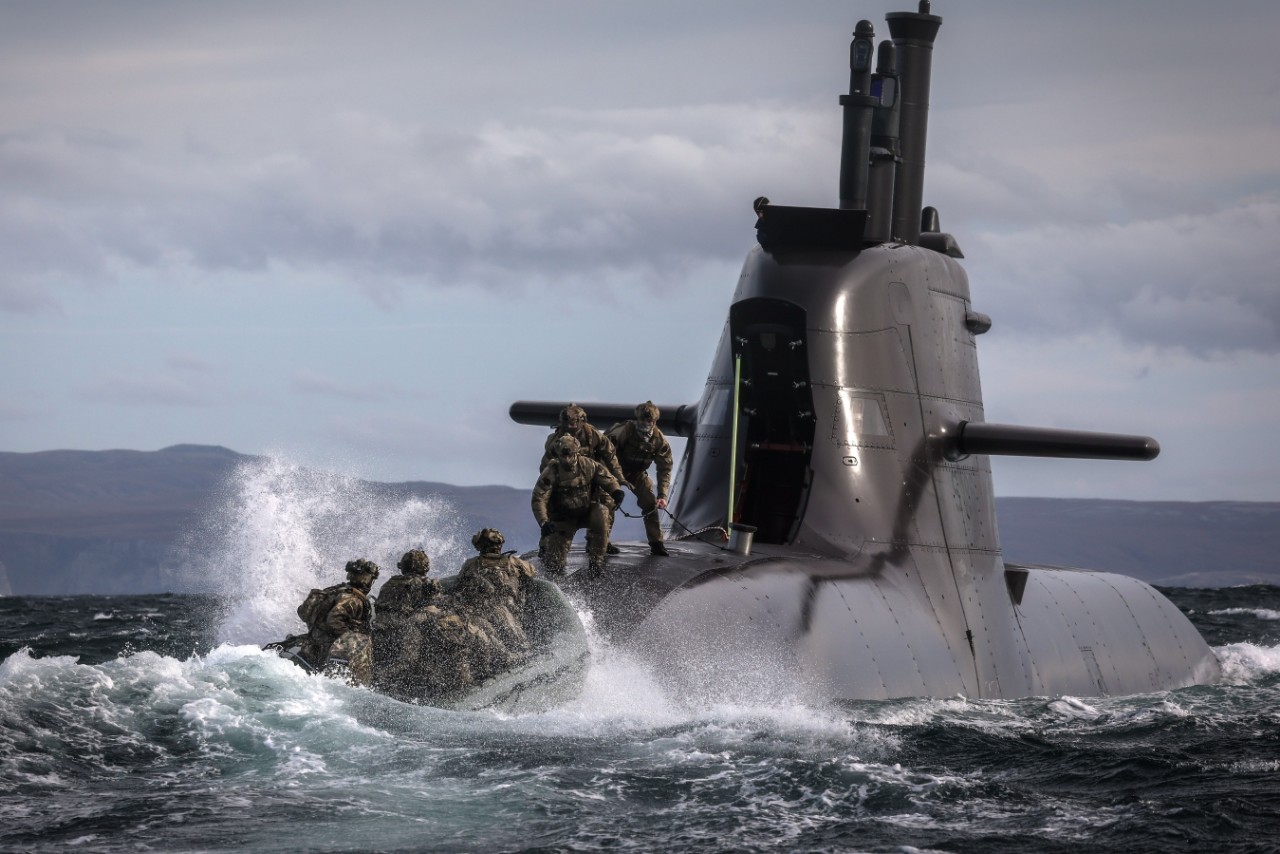
British commandos have come ashore at Cape Wrath from a German attack submarine and directed the guns of a Portuguese frigate onto targets inland, during the largest test of every part of the UK Commando Force in fifteen years, according to the Royal Navy.
The landing took place during Exercise Strike Warrior, which the service describes as the first occasion since the war in Afghanistan on which all the specialist elements of the formation have worked together. More than 2,000 personnel from six nations are taking part, drawn from the United Kingdom, the Netherlands, Canada, Germany, Norway and the United States, and deployed across the Western Isles, the North-West Approaches, Galloway, the Borders and the North Sea.
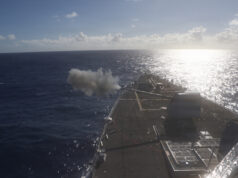
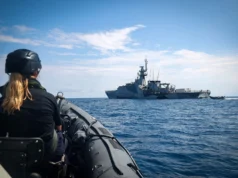
Navy and Army commandos from 148 Battery Commando Forward Observation Battery, the unit trained to carry out reconnaissance and call down naval gunfire from behind enemy lines, left the submarine in inflatable raiding boats and established an observation post on the cliffs at the most north-westerly point of mainland Britain. From there they directed the guns of the Portuguese warship NRP Dom Francisco de Almeida onto positions ashore.
The battery’s operations officer, who cannot be named for operational reasons, said: “This level of complexity and coordination of live assets has not been achieved by 148 Battery for nearly 30 years.
“We wanted to demonstrate to our partners across the United Kingdom Commando Force, wider UK Defence and NATO Special Operations Force community the type of missions we are prepared to execute against future threats.
“Warfighting is our focus, and we are prepared to employ specialist assets to deliver Multi-Domain Fires and Targeting.”
Three navies were involved in the single sequence at Cape Wrath. The German submarine found the targets, the commandos put themselves ashore without being seen, and the Portuguese ship supplied the firepower. The Royal Navy has not identified the submarine.
Earlier in the exercise the same battery controlled the naval gunfire of ships from Standing NATO Maritime Group One, the alliance’s standing task group in northern European waters. The Dutch frigate HNLMS Van Amstel and the Royal Canadian Navy frigate HMCS St John’s both worked with commandos in observation posts to bring their guns onto targets.
Eight warships and 19 aircraft are taking part in Strike Warrior, which began on 28 September and finishes on Friday. Alongside the gunnery serials, the exercise has covered amphibious landings, boarding operations, intelligence and surveillance missions, logistics and sustainment, maritime security and anti-submarine warfare. Commandos have flown drone missions including strikes and resupply to troops in contact, and have built underground medical facilities.
Cape Wrath matters to this kind of training because it is the only place in Britain, and one of very few in Europe, where warships can fire live rounds at a land target. The range takes in Garvie Island off the headland, and the combination of the cliffs behind and the open Atlantic in front is what allows observation parties to work close to live naval gunfire.
The participation of a German boat and a Portuguese frigate alongside Dutch and Canadian ships reflects how the Commando Force now expects to operate, which is as the land element of a NATO maritime group rather than as a national force working alone. Norway and the United States also have personnel committed, and the stated purpose of the exercise is rehearsing allied crisis response in the High North and the North Atlantic.




“reflects how the Commando Force now expects to operate, which is as the land element of a NATO maritime group rather than as a national force working alone.”
So in other words, admitting how far the RM has fallen? The Brigade of RM worked as a “land element” of NATO forces quite happily when it was assigned to Norway. No difference. Now it cannot as it no longer exists, neither do many of the ships that supported its deployment.
Working with allies is fine, until the UK needs the capability to act alone, potentially outside the NATO European theatre. And ironically, 42 Commando did so the other month when stopping the Russian tanker, because it needed to. And oh boy how HMG reaped the dividend and shouted its mouth off then.
And if the wider Corps of RM cannot act alone if needed, or one says “it does not need to as we are in NATO” then that again is yet another admittance of how far we have fallen. A nation unable to act alone in the maritime domain….and we are an Island.
This exercise as an example. The RN had Chalfont DDS, and its predecessor, used by the SBS for donkeys years. Does that capability still exist, given the lack of operational SSN?
The RN of course also had SSK and also used SSN to place forces into RIBs for insertion ashore. The SSK as we know are long gone, so have we lost that capability as well?
Sorry for the negativity, this is all fine and dandy, but I see through the spin that comes out of every pore from HMG and the MoD to deflect from how far we have fallen.
And I’m not afraid to point it out, sorry.
Good piece, well critiqued and well said. I too would like to be critical however, a part of me thinks the UK gov couldnt give a fig, other than the woopie and yahoo ‘soundbites’ about a few blokes landing on an island from someone else’s submarine… as ours is in dry-dock, or waiting a refit, or awaiting some parts from Temu.
Like many on here I’m tired of the spin, the barefaced lies, the ineptitude of whatever gov that happens to be running the shit show at the time.
Two comments, displaying the attitude our enemies want to see. British government bad. Everyone else good 👍 Well done lads.
Dry up and blow away! Our ‘enemies’ couldnt give a fig what’s written here, or the dozens of other sites across the internet! I did my time, and without doubt the armed forces are a shitshow compared to what they used to be. That’s not an ‘attitude’, it’s a statement of fact dude!
I’m a veteran too. And I’m very aware of the cuts over the last 30 years and also were we are far more capable in many area’s. People just obseess over numbers like its still the 1980s
The one thing the Ukraine/Russia war has clearly demonstrated to everyone, is that numbers are essential in starting, prosecuting and finishing a conflict.
That fact has been completely missed by bean counters, politicians and the uneducated, as well as all those looking to push automatous warfare. Quite frankly, everyone has taken their eye off the ball, with too much focus on automation and Drone warfare.
You will always need boots on the ground, to take and hold the ground, and capture other ground to win.
Personally I believe Drones and automation have allowed politicians to reduce numbers in personnel, kit, equipment as well as the ‘big stuff’ (ships-aircraft etc) to a critical level.
Drones do not (yet) mean, 5000 drones = ditch an infantry regiment, or 3 Typhoons, or a Frigate, however my fear is that the idiot element see it that way.
I don’t think it has been missed by the bean counters. So what is enough?. 90 thousand, 100k, 150K or 500K. A UK/NATO led war against Russia wouldn’t look like the Ukraine war. Major troops number wouldn’t be committed until air superiority has been achieved and the complete destruction of Russian air defence systems and long range strike. Whatever any war looks like, drones are going to play a massive part of it, they will be a large part of our mass, especially for the Navy and the RAF. It’s also an acknowledgement that if we did want to increase the size of the Army by say 20k, recruitment is difficult. Its not like WW2, national mobilisation, 3 weeks traning and off you go son. Where they have been wrong is the technical branches, pilots, technicians, marine engineers, nuclear engineers. Trades that takes years to learn. That’s what we need more of. But with hybrid warefare we need different capabilitys. Cyber, space, intelligence services, countering disinformation. The kind of threats Frigates and tanks can’t defend us against. We can’t undo 30 years of cuts in just a few years. And the cost of new big ticket equipment is vastly more than before.
With respect mate, absolute nonsense.
I’ve talked on Defence sites like that since before 2010 on the gradual erosion of our military, wY before Russia became a thing again, and I’m not stopping. It’s got sod all to do with Russia and everything to do with what HMG provide, and more importantly what they don’t.
Conversely, singing oh what a beautiful morning and saying we should all keep schtum to not embolden our enemies by excusing every cut, like you did on the Atlas article the other day, in which the RAF ATS, by the words of one of it’s own ex Group Captains, lost 25% of it’s strength yet we should all sing along and support that because somehow an asset that’s more capable cannot magically be in 3 places at once?
It’s good to be positive about our cutting edge capabilities, and it’s also detrimental to pull the wool over the eyes and be so positive, as you are at all times on all things, that in itself is doing a disservice to not only the military, but the wider public and also the political class, that all is well
All is not well.
We have no submarine to practice a skill we once did as commonplace.
If you think that’s helping out enemies, well, good luck to you, the actions or inaction of HMG to leave things in such a condition to me is all the encouragement our enemies need.
Deterence? Speak softly with a big stick?
It’s bluster in many cases and lamenting on a public forum on Defence won’t make a blind bit of difference.
You want positive.
Our SF are world class, our Light Infantry are world class, our logistics are world class, our PJOBs are an asset not available for most, our intelligence community and underpinning ISTAR are world class, many of our assets are world class.
The negatives.
THEY ARE TOO SMALL, TOO FEW, and in several areas shrunk to insignificance, no matter how capable.
Our GBAD next to non existent, we have 14 SPG, and after spending tens of BILLIONS we have no SSN for tasking
Such as here, we have no submarine of our own to practice a skill once commonplace.
I won’t be silent, sorry.
And ranting about 30 years of cuts isn’t going to make any difference either. Everyone across NATO has made cuts. It can’t all be undone in a handful of years. Countless times our allies like Germany have used British assets in exercises. But people aren’t interested in that are they, just want to moan about what we can’t do. A 6th Astute arrived at Faslane just the other day. Hardly got any comments. No nation in NATO has the kit and numbers of 20 odd years ago. Lots of money is being spent, the defence budget is going up and will continue to go up over the next 9+ years. Now that money might not result in 10 more Atlas being ordered or the Navy getting Escorts back up to 30. You know what the money is going to be spent on as its in Defence Equipment Plan. Capabilitys that are very expensive. To get to 3.5% the government needs to find an extra 40bn a year. Serious money. And you know how little wriggle room they have with the economy in the situation its in. Especially the debt. But the money will be found one way or another. Money for kit and capability we actually need for the next decade and beyond. Not what we should have had 5 or 10 years ago. There is so much going on in defence right now people forget, then over react because one exercise didn’t involve 800 RMs and Albion class LPDs. I’m sick of the British bashing, If we are so weak why isn’t Russia having a pop at us now? Why wait 5 years. Why aren’t those Bear bombers heading over the north sea. Oh wait, many of them have been blown up. People just think the government isn’t doing anything because they haven’t announced to expand the Army by 30 thousand, or ordered 50 more Typhoons. You know what the money is going to be spent on Daniele. I don’t need to repeat it
To be fair mate the DIP is unfunded in the most part, cash is tight but the DIP was more about bluff and bluster, with an expectation of the DIP being fulfilled by 2035. I’m the same don’t like Brit bashing but we (and Europe) need to be both realistic and understand our weakness (and know our strengths) as over estimating capabilities ensures we overreach over plan. As I keep griping about, continued cut in capabilities and numbers limits our options, which consequently makes an option you may not have wanted to consider previously, the only option. Yes the defence budget is increasing, we have to agree to that and anything is better than nothing but its certainly not a priority for HMG and it should be. Cheers.
Hi pal. I think the missing 5bn or whatever it was for the full DIP funding will be addressed in the upcoming budget, and the roadmap to 3.5% likely in the spring spending round. I feel like the DIP was the starting point, rather than the full finished product for the next 10+ years. Technology is moving so fast now. Labour have dithered, but at least defence is much higher up the political agenda than it used to be. And some serious cash is heading the MODs way. I think a lot of the reluctance from the Treasury comes for the very long list of failed or very delayed procurement projects over the years, and general miss management. And for that I don’t blame the Treasury for wanting to see much more concrete plans that any new money is going to be well spent.
Agreed that the treasury aren’t 100% sure the MOD won’t staff away billions with their incompetence and agree the DIP starting point but the plan was to map out the next 10 years, all the new tech, plans, formations and deliver. But it turned out it was not funded, many things pushed to the right, and that’s more to do with the current HMG desperate need to keep its voting pool onside and sad to say the vast majority of those don’t give a hoot for defence. I think the RN is going the correct way for sure, as is the slow (ramping up) progress with the drones at pretty much every level in the Army! Think the RAF will struggle with the loyal wingman type program, but with the right intent and finance nothing is unsurmountable. Cheers.
Staff should read spaff, but you knew that anyway 😂👍
I think the CCA project for the RAF and other drone project are at a much more advanced stage than we all are aware of. 👍
No matter how negative we can be, I think we do all hope for the best and I’ve no doubt as you allude to there’s much going on, with success, we are not aware of! 👍
Robert, you think patriotism is trying to defend the British state come what may. Real patriotism is actually not pretending things are ok when they clearly aren’t. Our armed forces are a shadow of their former selves, pretending otherwise helps nobody. Because guess what, our potential enemies already know everything about our capabilities. Im a combat veteran myself so don’t try any of your nonesense with me either.
Good post and well said that man 👍
Indeed we need a larger, properly resourced RM. At least half a dozen modern SSKs to relieve the Astutes of the burden on a tiny number of SSNs, proper amphibious landing ships & an assault carrier. It doesn’t matter how “agile” you are if you are weak & major enablers have been thrown away. The modern battlefield is scarier than ever, all the lethality of C20th plus practically terminator UAVs/drones.
Talking of Landing Ships, 1SL met his Dutch counterpart today and was holding a small model of the ATS that we’re getting, 4 per navy.
The reaction on SM is mixed to say the least.
I remember when we had 13 Oberon’s in the fleet as well as 12-13 ssn .the Oberon’s and the type 2400 were excellent boats ..much cheaper than the SSN . I remember them well. We could do with half a dozen or so new boats to leave the nukes to go global .. excellent for training as well and RM inserting.