

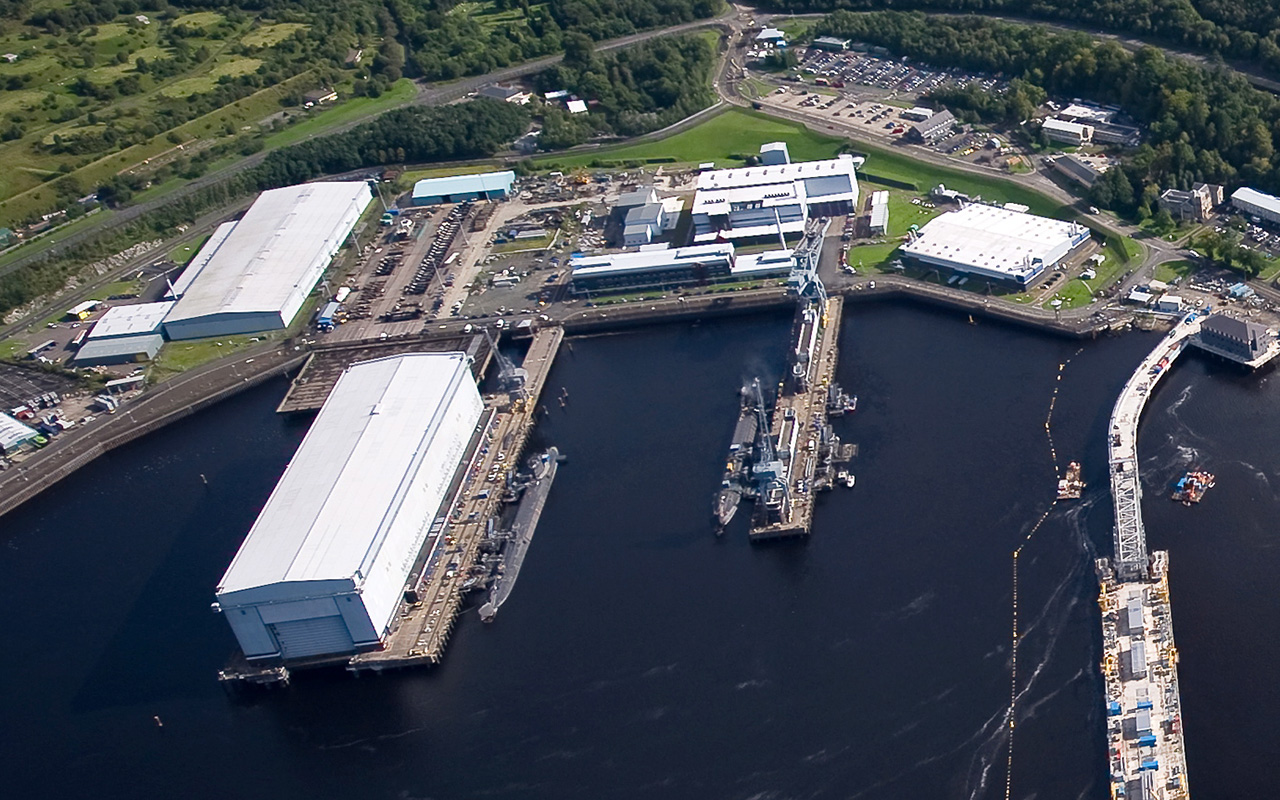
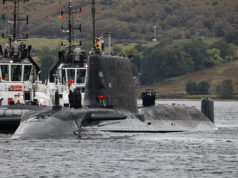
Two nuclear-powered attack submarines came in to HM Naval Base Clyde on Friday, a United States Navy Virginia-class boat arriving in the morning and the Royal Navy’s newest hunter-killer, HMS Agamemnon, following later in the day.
Neither navy has identified the American submarine, and visits of this kind are not usually announced in advance for reasons that need little explaining. American submarines call at Faslane regularly to take on stores, change crew members and rest their people, often after periods working in the North Atlantic and the waters north of Scotland.
The Virginia class is the current American attack submarine, displacing around 7,800 tonnes dived and armed with Mk 48 heavyweight torpedoes and Tomahawk cruise missiles, with the later blocks carrying additional vertical launch tubes. The United States Navy has more than twenty in commission and is building more at Groton in Connecticut and Newport News in Virginia, and the type is the same one Australia is due to buy under the first phase of the AUKUS agreement.
Agamemnon’s arrival was her first at the base that will be her home. The sixth Astute-class boat sailed from the BAE Systems yard at Barrow-in-Furness on 25 September for contractor sea trials, thirteen years after her keel was laid, and she completed the passage north over the following week.
Announcing the start of those trials, the First Sea Lord, General Sir Gwyn Jenkins, said: “In an increasingly dangerous world, sea power remains fundamental to keeping our country and people safe. Our submarine fleet is essential to that effort, which is why I am delighted that HMS Agamemnon, the sixth of our Astute-class submarines, has now begun sea trials.
“She embodies the best of British engineering and the professionalism of our submariners and will be one of the most advanced submarines ever operated by the Royal Navy. As we continue to strengthen our warfighting readiness, HMS Agamemnon will play a central role in keeping the United Kingdom safe, contributing to NATO’s collective defence and ensuring we are ready to lead, fight and win.”
The two boats are not far apart in size or in what they are asked to do. Both are built to escort ballistic missile submarines, hunt other submarines and surface ships, put special forces ashore, gather intelligence and strike inland with cruise missiles, and British and American attack boats have operated closely together in the North Atlantic for decades.
That relationship is also being built into the next generation of hardware as the Barrow yard is constructing the four Dreadnought-class ballistic missile submarines using a missile compartment designed jointly with the United States for its own Columbia class, and SSN-AUKUS, the British design that will replace the Astutes, is to be built with American technology and sold to Australia as well. Faslane, meanwhile, is in the middle of a long programme of work under the Clyde Transformation Programme, including three new floating docks that the Treasury confirmed last week will be competed among British yards only.



[ AUKUS, the British design that will replace the Astute, is to be built with American technology ]
is this American technology being used in our subs. if so will they have any hold or restrictions over its use.
just asking . I thought we used mostly our technology. as in use of missiles.
or do I have it wrong , i would be interested to know
thank chaps..
The American “technology” the Australian media constantly drivels on about is the combat system, it doesn’t really give the US any hold over our boats as it’s much more of an overlay system that British systems can plug and play with. It’s very different to the F35 source code that requires updating before every mission.
Beyond that the AUKUS subs are using the US VLS system and the Common Weapon Launcher.
The reactor is British (influenced by US research and designs) and most importantly the sonar and sensors are British.
US submarines also have significant British components as well and we are now manufacturing large parts of US submarines at Rosyth.
The entire “US technology” tag was largely an invention at the start of AUKUS to make it look like the US was getting more from the program than it actually was. AUKUS was originally started by the UK and Australia that had to convince the Biden administration to let it go ahead as well as provide the backstop of 3 Virginia class.
“It’s very different to the F35 source code that requires updating before every mission.”
I think you mean mission code?
No it’s actually the mission data files I’m referring to, they are primarily update of the EW and Air Defence picture. My reference to the source code is more akin to the wider F35 computer issue but agree it was lazy vernacular on my part.
I think the reactor is probably closer to S9G than it is to being a independent British design, though given all UK submarine reactors are tied to US permissions whether indigenous or not, it’s really a moot point.
We know they use the Virginia VLS, an American design, but some of this build for the Virginia class has been outsourced to Babcock in Rosyth, who also do VLS structures for the Columbias and the Dreadnoughts. We are entangled in each other’s build. We currently have no VLS on our attack subs, so that will be all new, but our attack missiles are US Tomahawks even on the Astutes. The combat control systems (tactical control, payload control and information assurance) will be General Dynamics, although not the same division as gave us Ajax and Morpheus, thank heavens. So for land attack it’s pretty much all American. I also read an article that said we’ll abandon our heavy Spearfish torpedoes in favour of American Mk 48s, but I’ve heard nothing official. That would be a shame. The systems should really be torpedo agnostic.
The reference to UK torpedoes not being on AUKUS came from some twat deputy Secretary to the navy project office that was shooting his mouth off in a conference and had no idea what he was talking about.
The RN has no plans to replace spearfish and has just updated it and the system in SSN AUKUS will be torpedo agnostic.
Thank you. I had totally forgotten about that bit of grandstanding.
Spearfish is a far superior weapon. Even USS Chicago wanted to buy some back in Red Storm Rising!
Good reference mate, I forgot that one 💪🇬🇧
It’s I far bigger weapon as well, you wonder if a US subs bomb room would have the scope to even take a spearfish.
Wonder if the Relvant people will take a look inside their Counterparts Vessels…?
Understand past Americans have been impressed with the Astutes Extra Room the beam gives..!!
Sure, though it wouldn’t be that significant a loss of capability IMO. Better that the UK introduces and trains with both to maximise store availability during wartime.
The American Vessels are much longer..So I’d Assume thr Extra beam gives the interior a more Spacious feel..but that’s just my Guess..!
American technology is used extensively in our boats. British technology is used extensively in American boats. The nature of the platform is such that it needs the best available tech regardless of origin.
Wonder if she’s there to assist in Agamemnon’s trials?