

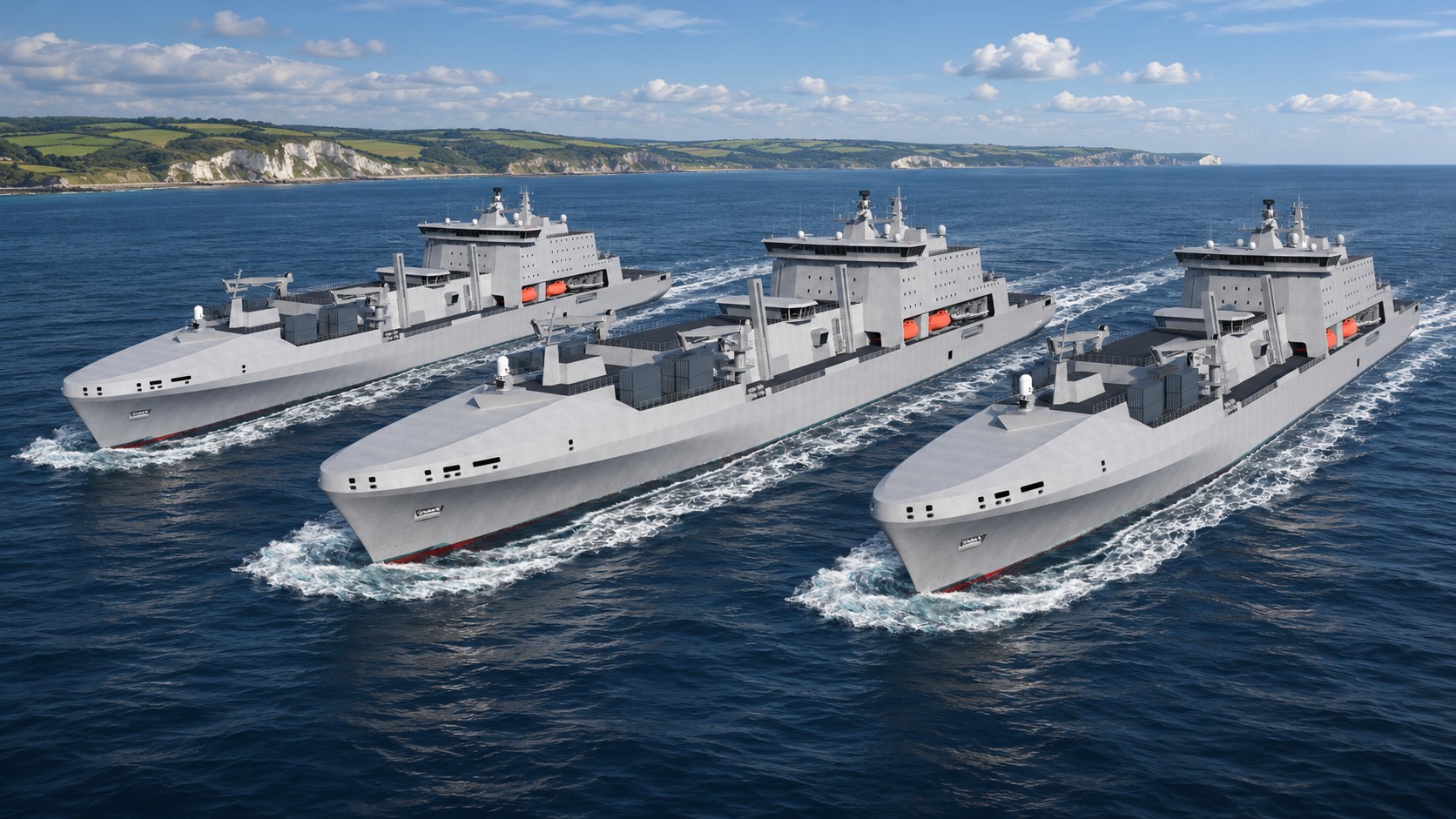
Work on the Royal Fleet Auxiliary’s three new Fleet Solid Support ships is progressing on schedule and within budget, with all three due to enter service in the early 2030s, according to the Ministry of Defence.
The department gave the update as Navantia UK opened Resurgent Hall in Belfast, adding 5,000 square metres of fabrication space with new cranes, robotic plasma cutting and a mechanised panel line. It said “Work is progressing on schedule and within budget” on RFA Resurgent, Reliant and Resourceful, backed by £1.6 billion of funding, and that Navantia UK is leading on fabrication and final assembly as prime contractor. The ships will replenish Royal Navy task groups at sea.
Luke Pollard, Minister for Defence Readiness and Industry, said: “Few sights in the UK are more evocative of our industrial heritage than the Samson and Goliath cranes, and it’s fitting that this new hall sits on the shoulders of these iconic giants. Belfast continues with its proud shipbuilding history by building the modern shipbuilding capability the country needs today, with this new fabrication hall at the heart of it. Navantia’s £157 million investment across its UK yards shows what sustained investment in shipbuilding delivers: good jobs, growing skills, and the support ships our Navy needs.”
Keith Bethell, the National Armaments Director Group’s Maritime Director, said: “The opening of the Resurgent Fabrication Hall is a clear sign that growth in UK shipbuilding is happening right now, in Belfast. This investment is renewing our industrial capability, creating skilled jobs and apprenticeships, and strengthening the supply chains that underpin our national resilience. It gives us the modern capability we need to deliver the Fleet Solid Support ships for the Royal Fleet Auxiliary and lays the foundations for Belfast to compete for future UK naval and maritime programmes.”
Maria Eagle, then a defence minister, said in March 2025 that the first ship was expected in service by 2031, while the effect of Navantia UK’s takeover of Harland & Wolff was still being assessed. Pollard said that September that the impact on approved cost and in-service dates was still being assessed and would be mitigated as far as possible.
Part of the first ship’s fabrication later moved to Spain to avoid schedule slippage, with more UK work on the second and third ships in return, Pollard told the Defence Committee in November 2025, and he said the contract is fixed-price. Steel cutting began at Appledore in December 2025 and the keel of RFA Resurgent was laid in September.





Very welcome news.
The early 2030’s is going to be a very happy time for the RN. With 3 FSS, 4 SSBN, 13 Frigates and dozens of drones all arriving at the same time.
That’s fine but there should be some law introduced that would prevent future governments making same mistakes.
That could be minimum fleet numbers, tonnage.
Or a minimum defence budget. It should never drop below 2.5%.
I agree with that David.
A percentage budget can always be circumnavigation with Add ons as we’ve Seen over the Past…!
Or a minimum order number.. minimum fleet numbers could simply see a party keep on kicking the problem down the road until all the ships fall apart and then point the finger at the encumberant government and say look they let the numbers slip…
In reality who do you blame for the present frigate crisis.. every PM from Blair to Johnson could have put mitigations in place to elevate this problem.. but you cannot say Blair or brown caused it, because they can rightly say there was time to sort it.. Cameron would say but why didn’t brown place the order, May can say everyone before was an idiot and Johnson could say…but what could I do… ( even though he could have pushed money into the new BAE facility to speed up the Type 26s..
Cameron would have cancelled or postponed it
Evening Jonathan, a bit like the car that hits the breaks on the motorway,that causes a tailback 3 miles behind, the answer is very clearly Blair.
Everything that wasn’t directly involved with his Sandbox wars ( or supporting that effect) was postponed, withdrawn or cancelled…
That was massively compounded by Cameron and his utterly reckless defence cuts in 2010.
Those two idiots are responsible for the mess we find ourselves in today. That said, despite the utter mess defence is in and Labour howling about in opposition, they have proceeded to do the square route of fu#k all about it, they won’t even guarantee 3% by 2030!
It should be 3.5% by 2030, but they are so busy shoveling extra billions into the already bloated welfare budget, it simply won’t happen.
Yep the two big boys on the crew were Blair and Cameron.. not sure how I would allocate a percentage between the two.. other than Blair fucked the destroyer fleet and undermined the frigate fleet and Cameron fucked the frigate fleet and undermined the auxiliary fleet.
Between them they caused catastrophic damage to the armed forces mate.
That will take a decade and serious and sustained spending above 3% to fix.
The trouble is, Labour won’t fire that starting gun, they have an aspiration to consider firing it, maybe, perhaps, one day.
Someone has to step up and start really spending significant money.
John, someone has to step up and be the guy (or girl) to make the unpopular decisions across a range of political areas. We’ve had an array of utter sh1tebags of PM’s who are basically cos-playing at being a PM looking for ways to spend OUR money on THEIR legacy. Thank gawd for the resolute and steely eyed Andy who takes no crap off nobody and will silence critics with a cold hard stare…..
😂😂😂😂👍
Hi Jonathan, I actually think the time has come for us to just admit that our system just doesn’t work, it’s outdated and not fit for purpose. With an unelected 2nd house which has zero override on the commons any party with a majority can do what it wants, even if we had a Naval Act like France that sets the force structure and commits to fund any new Government can just ditch it.
So IMHO we should have a 5 year fixed term commons elected on the current 1st past the post system and a smaller second chamber elected at the mid term but on the PR model.
Then we can set out an agreed 10 year plan, which is debated and turned into Law, then repeat just like France and Italy. It gives stability and certainty of workload to industry and is probably one of the treasons they actually get better value for money than we do.
Yes agreed but I would actually depoliticise the second chamber and only allow people to stand for one term. I would make the second chamber a chamber of knowledge and experience, essentially seats would be based around areas of knowledge with each region having a selection of seats based on knowledge and experience.
So split you county up into 10-12 regional areas each of about 5 million people and each region get 1 person in each area of expertise or experience and you would have say
1) millitary
2) power
3) water
4) transport
5) health
6) industry
7) finance
8) religion
9) cultural
10) food production
11) retail
12) IT/AI industry
13) environmental
14) law and order
There may be more.. but you get essentially 12 regional groups who are looking out for their regional needs as well as groupings of expertise who will act as an advisory body to the who house on a piece of legislation.
The house of experts will act in a none partisan way, members of this house could not have been MPs or held office for a party, they would have to give up parry membership and could take no funds from parties. They can only sit for one term and the term is 2.5 years. They get an allowance only and will not sit full time, they will be allowed to participate online part of the time if they wish. They would be expected to have a significant history in their particular area of expertise and will probably be retired or on a sabbatical. If an individual wished to stand they would get a small allowance for advertising.
They decide any changes required to proposed primary legislation, and have the ability to advise a veto if they consider the primary legislation to be damaging to the national interest.
I would then make a third virtual ( house of the public) using modern IT to completely revamp how our democracy works. This 3rd house would be essentially created via a draw process from the voting registries in each seat, the drawn people would be required to sit for a year. It would be a large body, the draws would be from demographic groups to ensure a good mix.. ( so many men of specific age groups, so many women of specific age groups etc ), you can opt out if you wish and someone else will be drawn, this group would only be expected to work a few hours a week virtually, they would get information on the primary legislation proposed and they would get the recommendation from the House of experts.. they would then get to vote virtually 1) agree the firsts houses draft 2) agree the house of experts draft 3) veto.
When 2 houses agree that thing happens… if the virtual house agrees the first houses proposed legislation.. it’s passed. If the house of experts and virtual house agree a change or veto that is passed. If the first and experts agree a suggested change from the expert house it’s agreed.
The house of experts will be allowed a vote of no confidence in the government.. if a super majority agree it will be taken to the virtual house.
Thats what you call a democracy… essentially the party in power in the main house have to either get an Apolitical house of experts to agree or a house of the public.. and those two houses together can force a change.
Cameron also delayed the Dreadnought SSBN program by 4yrs, straining the Vanguard class. He would have cancelled HMS QE & POW, but the contracts signed didn’t make it possible without massive compensation to the shipyards. But the worst is this government. I quite liked John Healey when he resigned as Defence Minister on principle that defence was being compromised in favour of welfare. But now as “Welfare Chancellor” he’s a joke.
The term “Lions lead by Donkeys” has never been more appropriate.
I’m giving them 1 chance, if they come up with a proper path to the 3% target for 2030 that includes 2.8% in 2.8% and 2.9% in 2029 with what that buys it 2030 and then a wider strategy of what 3.5% in 3035 looks like and what strategically that will buy.. then will be happy.. if not its letter writing time.
I think it’s pretty easy to lay the entire frigate crisis at the Cameron government.
Both responsible Jim, couple of bloody idiots…..
There is a.third candidate for blame – the Sea Lords themselves. They agitated, lobbied and campaigned endlessly – and bamboozled politicians and goverments, to get back into the carrier game. They believed this would restore the RN’s prestige and status in the world’s eyes.
The problem was there was never enough money in the naval budget of the time to do so. Not.on Brown’s defence budget of 2.5% of GDP, certainly not with the reduced budgets of the following 14 years. Even with a slimmed-down carrier minus CATOBAR and nuclear propulsion, it could only come at the expense of something else.
That something else was the ageing frigate force. The £6.5.bn snaffled fron the naval budget to fund the carriers should have paid for 8-10 new frigates, at a build rate of one per 18 months. Instead, NOT ONE frigate has been or will be commissioned for 16 years in a row.
The RN and the naval lobby are naturally delighted to be back in the carrier game, we can rule the waves again!
The rest of the defence community is less impressed.
Our ridiculously small, ancient frigate force is viewed with pity or despair by our allies, because we can barely put one ship in the North Atlantic.
Our yards suffered the permanent loss of skilled workers, because we gapped warship building for do long.
And the carriers themselves receive lukewarm enthusiasm among defence circles, on both objective and practical grounds.
With the naval emphasis belatedly switched to the North Atlantic, the need for carriers is less evident, particularly when they require half a dozen other ships to protect them, which we don’t have, and can only contribute a limited strike capability, due to the short-range, low weapons load of the F-35B. Instead of being a dominant naval asset, they look like a rather large target.
When we start swarming over which politicians to blame for everything, we need to remember that politicians and governments are not experts in every or indeed any aspect of policy, they rely on the professional advice of the departmental civil servants – in this case , the Chiefs of Staff Committee’s recommendations to the Defence Committee, via the hapless MOD senior civil servants.
If the advice is ignored, or undermined by one self-serving service lobbying behind the arrass, or pliant MOD senior civvie doing the easy thing, no amount of 10-year defence acts passed by Parliament will prevent highly questionable strategic choices messing up our defence readiness.
Morning Cripes, you make a very valid point, my counterpoint would be that such was the pressure of the sandbox wars, I believe that had the Carriers been cancelled, they wouldn’t have ordered any frigates either, Frigates were regarded as irrelevant in their perception, as they thought the future was going to be decades of counter insurgency, anti terrorism actions.
We would have been precisely where we are now, but with no Carriers.
If, as you say, frigates had come to be regarded as irrelevant in an imagined future world of insurgencies and terrorism (and now grey zone warfare), then the Sea Lords would be guilty of another crass strategic error.
I doubt that was the case at all. There eould be no point lobbying for carriers if there weren’t the ASW frigates to protect them! No point banging on about protecting sea lanes worldwide because-we-are-an-island-etc, if there were no frigates to do so!
I am accordingly extremely sceptical about your hypothesis.
I think that the Sea Lords obsessed about a return to carriers, because these would be a symbol of status and prestige, and so took a gamble on the rest of the warship fleet.
The gamble was, if we switch the frigate budget into paying for the carriers, we will inevitably get to the point where we have virtually no operational frigates. As that would turn into a national scandal, HMG would be forced to cough up a shedload of additional funding. The fact that, short of increasing the defence budget towards 3.5 or 4 % of GDP, which wasn’t at all on the cards at the time, it could only come from cutting the RAF and Army budgets. It is a card that the RN has played repeatedly and is indeed doing again with the submarine budget.
It was a strategic gamble, which relied on the RN’s proven ability to lobby, campaign and manoeuvre through the corridors of power. Trusting in hoodwinking the dozy senior civvies at the MOD, whose grasp of military strategy and resulting procurement priorities, looks to be about zero.
There was never really any point where the RN seriously thought of abandoning frigates!
We will have to agree to disagree Cripes, my opinion ( based on decades of jaded defence sector observation), informs me that we would be in precisely the same position, but without carriers.
The old ‘ gruel today, for jam tomorrow’ bollox we have been drip fed for years. They would simply have deferred ordering T23 replacement, based on it’s perceived low priority, carriers, or no Carriers.
Wars in the Sandbox soaked up everything at the time.
Absolute rubbish – total fiction
Which bits please?
You do seem to post these sweeping statements, generally bereft of any cognitive analysis or particular knowledge.
Not possible, we have a convention that no government can pass a law that the next can’t unwind. So no government could pass a law requiring a future government to do something. Democracy in action for better or worse.
Firstly ship numbers is irrelevant. It is lethality which is important and if that can be done unmanned then that is what we should have.
Secondly parliament is sovereign and can undo any previous law.
The law is that we elect a new government every five years maximum. In 2010 we gave a Coalition the power to defang the country. No subsequent government until this present decade saw fit to wake up to its primary responsibility to defend the country. Personally, I believe the urgent threat is here amongst us now.
…which gets us back to an absolute bear minimum and nothing more.
Good news, but all the chickens have come home to roost for the RN. Who would have thought delaying the new frigate program and not investing in sub maintenance facilities would have been a bad idea.
Nice looking ships. Can anyone tell me what is the function of those two vertical pylons on the port side?
They are the Replenishment At Sea rigs which are how the ship transfers supplies to escorts and the aircraft carriers.
Part of the RAS equipment i guess. They always RAS from the port side
There’s another 1 on the starboard as well.
Lifts for supplies, move equipment about the ship up and down decks.
Thank you T, R and J – I stand enlightened!
Excellent news. Well done Navantia. Keep it up.
We all know they won’t. Every order seems to start with the positive stories and the as they come close to delivery all the delays and over runs come to light, so avoiding any blame of the people involved in the placement
Sadly Steve experience suggests you’re probably right.
Blair & Cameron , two sides of the same coin- both disigenious wankers.I cant stand either but Blair trumps it for me , not least because , post Chillcot,hes resurfaced around pushng his subversive diatride.
I don’t know what they did in their spare time 🤔, but yes Chilcott. Yuck.
Once the 3 fleet support ships are built, could you use the hull design for a cheap & cheerful Helicopter carrier? Thinking of those WW2 Escort carriers built on merchant hulls.
That was previously the idea for ELIDA strike from BMT and Navantia. But we went with the Dutch AST program instead.
No chance. Nothing ever gets delivered on schedule and in budget.
And manning?
Ships – a start … but crew?
Great news from America!
And Man Utd beat Roma. Obviously this is a turning point.
But we must also ensure we have the crews to man them as the RFA currently is very much struggling. A Major boost to recruiting for the RFA needed and with the rewards they truly warrant. Also will the weapons fit change? The 40mm MK4 would be a better all round fit with 4 fitted as standard. They also need a dedicated Helo for Vertrip use rather than the Merlins, plenty out there that would be capable and cheaper too.
Yeah, yeah.
That was a reply to the Grinch.
Wonder if these vessels are Ice classed.?
This is good news so far from Navantia. They sensibly put in the investment at the outset to modernise the yard and production facilities. They sensibly switched work on the main part of the first of class to Spain, while the Belfast yard is gearing up. They have a successful track record of building warships and auxiliaries, so the omens look pretty good.
Of course, gremlins may emerge with the design or build process, but it’s not inevitable.
It is equally likely that the main risks come from the MOD and RN fiddling with the specs or slowing down production to fit the budget, which looks to be happening on both T26 and T31 production.
The budget problem is that there is nowhere near enough money in the kitty to simultaneously fund 4 new vessel classes, 6 new classes of unmanned ships, helicopters and naval UAVs, 2 classes of submarines plus replacement for Scott and Protector. That lit can only work on paper if the acquisition rate is spread over 10-15 years. Which means that nothing can really proceed at pace and the money available to each has to be continually switched about to keep some minimalist rate of building.
Basically, we are trying to do far more than the RN budget can possibly support. What we should really have, set out in a naval ( and similarly Army and RAF) bill requiring Parliamentary approval, is a real-world estimate of building and major refit costs of the fleet envisaged, class by class. I.e. submarines, escorts, minor warships, RFA vessels, major weapons and rotary. Each should have a ring-fenced budget, whether large enough for the task or reduced to fit the money available. That way, each element can be planned and committed to on a calendar that recognises ship lifespan.
For instance, the ringfenced RFA programme would allow for the cost and timescales to produce the three Resurgence ships, followed by the four Bay replacement ATS and possibly a further Proteus or two. There would be one senior uniform in charge, one senior bod from the new armaments side and one ten-year budget. Any proposed deviation from plan by a future government would then be open to scrutiny and informed debate.
That is how most other western nations proceed and they generally do so far more successfully than our MOD senior civil servants manage to achieve. We are reduced to putting written questions to the Parliamentary defence team to get even a partial idea of what the MOD mandarins are planning and deciding. We have got to get away from our MOD pattern of odd decisions behind closed doors, many from non-expert civvies, a lack of any coherent overall plan, endless reshuffling of procurement budgets and timescales, all covered by a stream of half truthful, exaggerated PR wuffle from the MOD’s army of civvie PROs.
A logical way of proceeding seems to work everywhere else, our funny way of operating most certainly does not!
.
The last time a Labour Government ordered a frigate was April 1979, a batch 2 Type 22.
Since then the Tories have ordered 37no….. please can we stick to the facts…..
I should use the term ‘Escort’, meaning destroyers and frigates, to avoid nit-picking.
The last escort commissioned to the fleet was the last of the T45 destroyers in 2012. Not one single escort has been completed since then. It will be a 16-year gap if we’re lucky, before the first new frigate is finally commissioned. Who cares how many frigates were built under Conservative governments umpty years ago? What relevance does that have today? Our current problem of being down to just 1 or 2 operational frigates and one alongside, is entirely down to 14 years of Conservative governments failing to build any frigates. In fairness, they didn’t have much choice, as the Sea Lords had swiped the entire escort budget, and what was left in the Army’s FRES budget, to pay for the vaunted carriers.
Which of these facts do you dispute?
The T26 long lead time items were placed in 2015, and the contract awarded to BAE Systems in 2017, so 5 or 7 years, still too long I agree. The Tories did huge damage, most notably by absorbing the nuclear budget into the main MOD one, previously separate. Some think was this was as much as 0.5%, I heard even 0.7% mentioned – please advise ??
With regard the 45’s, they were supposed to be 12, then 8 – then 6….. with engines that didn’t work and hugely under-armed under Labour – because once again they ran out of money….(standard).
But since 2015 or 2017, the Tories did order 13 frigates…. of course could and should have been earlier. But Boris did mention the 32s, that the CDS did suggest could be a T31 B2 – but the never funded pie in the sky DIP then cancelled….
Interestingly, next year 2027, it will have been 30 years since Blair was elected…. and of those years since, 16 were under Labour and 14 the Tories…. seeing who ordered what wont reflect well on either major party, partly the reason why we are in the position we are now…. but a closer look will reveal how Labour short changes defence full stop, took us into two losing Wars, refused to properly fund either and left our boys to die and be injured by the hundreds ill equipped without adequate body armour, 50 year old APCs, land-rover coffins and a huge shortage of helicopters for medevac.
But, whilst were on FSS and the Navantia build at H&W…. I’d be inclined to add a 4th ship, so that we could deploy 2 for major ops, and help rebuild a capability which is in production now.
I mean on time and on budget is a relative thing given the delays that existed before those contracts were signed. These shoukd have been in the water at the same time as the carriers.
Fortunately it seems that at least in Spain Nvatia can build ships. Hopefully they’ll be able to continue the efficiency in Belfast although I do wonder…