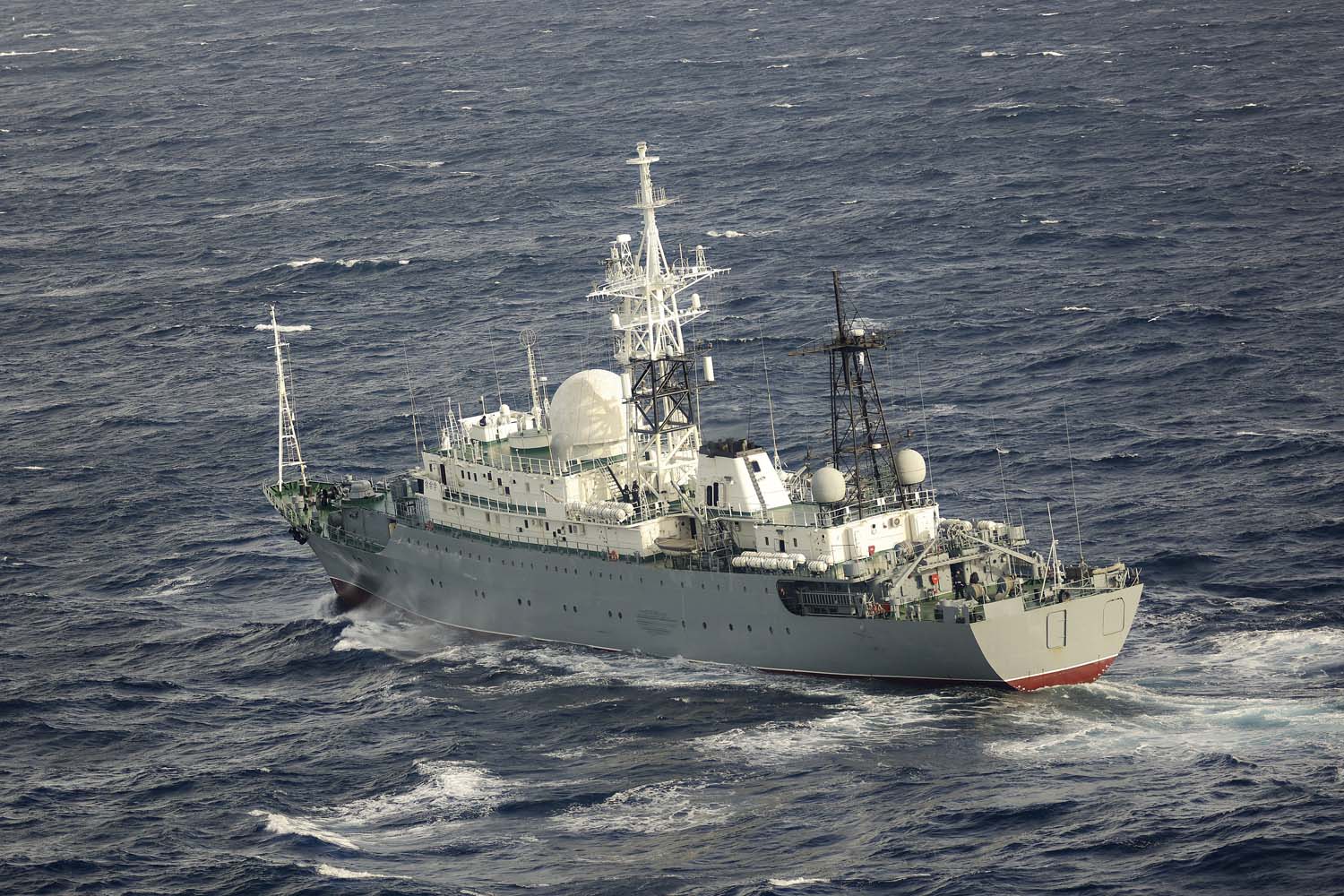
Royal Navy Merlin helicopters sent at short notice from Cornwall to Scotland tracked the Russian intelligence-gathering ship Viktor Leonov off the Outer Hebrides as it watched NATO warships on Exercise Strike Warrior, according to the Royal Navy.
The Merlins deployed from Royal Naval Air Station Culdrose to Glasgow Prestwick Airport to conduct Operation Iceblast and kept track of the Vishnya-class ship from 29 September until 8 October. The Royal Navy said the Russian ship was “closely monitoring NATO warships” during Exercise Strike Warrior, off the coast of Scotland, which involved more than 2,000 personnel from six nations.
The tasking formed part of three focused operations across 17 days, in which HMS Tyne, HMS Dauntless and Wildcat and Merlin helicopters were dispatched to report on Russian movements in UK waters during the final days of September and the opening two weeks of October.
Captain James Hall, the commanding officer of RNAS Culdrose, said: “I am immensely proud of the efforts of our people, who have once again demonstrated that the UK is prepared to respond to immediate operational requirements. This tasking was part of a wider series of operations, known collectively as Operation Iceblast, which was designed to test the ability of Merlin Helicopter Force to deploy away from its home base of RNAS Culdrose in force and at short notice. This operation has been a critical means for demonstrating to ourselves, our adversaries and the nation that we are willing and capable of securing the homeland 24/7. The Merlin Helicopter Force stands ready to answer the call at a moment’s notice.”
Type 45 destroyer Dauntless and patrol ship Tyne were tasked from 1 to 14 October to report on the movements of the Russian frigate RFN Neustrashimy as she escorted sanctioned cargo ships through the English Channel. The Royal Navy said the Russians have been “forced to deploy the warship over the last three months to protect their illegal shipments”, and that the UK has sanctioned more than 500 shadow fleet vessels and seized the tanker Smyrtos in June.
Commander Neil Skinner, HMS Dauntless’ commanding officer, said: “The Royal Navy’s ability to monitor and respond to activity around the United Kingdom is fundamental to our role in protecting the nation’s interests at sea. HMS Dauntless maintained the close and proficient monitoring of the Russian warship Neustrashimy during her operations within the English Channel, providing reassurance to the UK and our allies whilst contributing to a comprehensive understanding of the maritime environment that surrounds us. I am immensely proud of the professionalism, dedication and operational readiness displayed by every member of HMS Dauntless throughout this tasking.”
After handing Neustrashimy over to Dauntless, Tyne was tasked to intercept RFN Aleksandr Shabalin between 11 and 14 October as the Ropucha-class landing ship escorted cargo ship MV Energy-2, accompanied by tugboat Proton. Tyne was activated from North Shields to watch the group sail through the English Channel en route to the Baltic region, and was accompanied by a Wildcat helicopter from 815 Naval Air Squadron.
Lieutenant Commander Sam Fields, HMS Tyne’s commanding officer, said: “Operating from the North East to the English Channel in quick succession, HMS Tyne’s recent activations demonstrate the flexibility and enduring utility of our patrol ships. Maintaining a persistent presence around the UK and beyond, we stand ready to respond at a moment’s notice to protect our nation’s interests. I am proud of my ship’s company for their unwavering professionalism and adaptability.”
The Royal Navy said the UK continues to work with international partners to target the revenues that fund Russia’s war in Ukraine while reducing Moscow’s ability to threaten European and global security.
HMS Tyne closed to five nautical miles of Neustrashimy in July as the frigate carried out gunnery firings outside UK and French territorial waters. The Royal Navy said in August that activations to monitor Russian activity were up 25 per cent across the first eight months of the year compared with 2025.
The RAF’s Protector RG1 also flew more than 10 hours of surveillance in support of national maritime tasking during the same period, its first operational sorties in UK airspace, the Ministry of Defence said on 31 October. Defence Secretary Wes Streeting said: “For the first time, Protector has joined Royal Navy warships and helicopters monitoring activity around our shores, demonstrating how we are constantly innovating to monitor and deter threats and irresponsible provocation.”