

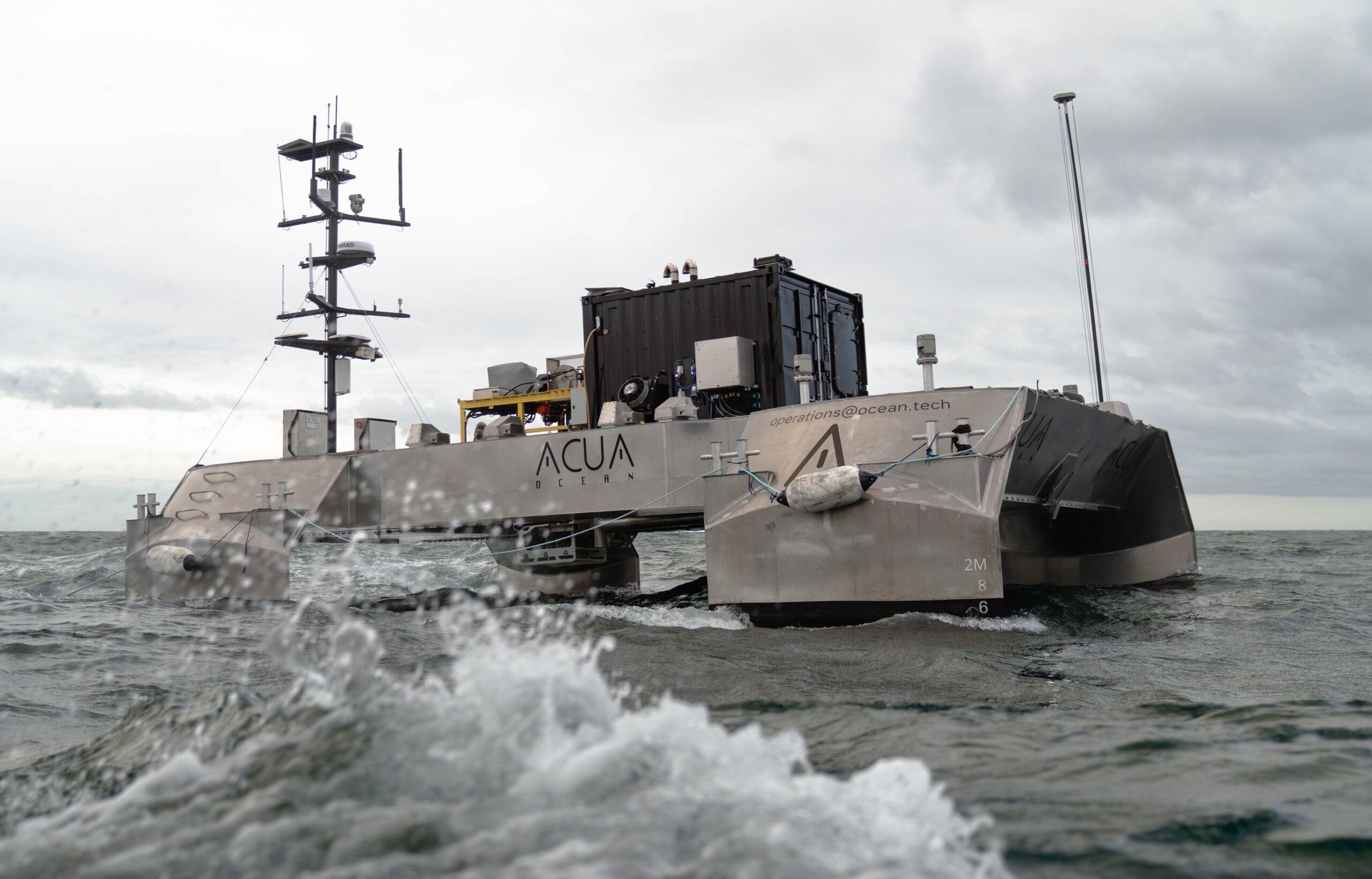
ACUA Ocean and Forssea Robotics have completed a three-week trial in Plymouth integrating a remotely operated underwater vehicle with an uncrewed surface vessel, demonstrating more than 40 remotely controlled deployments from shore, according to the companies.
The trials paired Forssea Robotics’ 170kg ARGOS remotely operated vehicle, or ROV, with ACUA Ocean’s USV Pioneer, using a Sonardyne Mini-Ranger 2 ultra-short baseline positioning system to track the underwater vehicle.
All launches, dives and recoveries were commanded remotely from shore, with the combined system controlled from ACUA Ocean’s Remote Operations Centre at Turnchapel Wharf in Plymouth. Forssea personnel simultaneously supervised operations from the company’s headquarters in Sète, France.
The programme was carried out under a contract with the European Space Agency and was intended to test whether inspection, survey and light-intervention tasks normally supported by crewed vessels could instead be conducted using an uncrewed surface platform.
More than 40 ROV deployments were completed during the programme, including eight launch-and-recovery cycles during a single day. The companies said ARGOS reached and inspected the seabed in water deeper than 20 metres while operating with up to 35 metres of tether.
Trials also included inspection work on the wreck of the Poulmic, a seabed feature and a concrete target block in Cawsand Bay, with the ROV locating and filming the targets.
ACUA and Forssea said operations were conducted in one-metre waves with winds averaging 18 knots and gusting between 20 and 30 knots. The companies also reported an operation south of Plymouth Breakwater in waves reaching around two metres, which they said had no effect on the ROV.
The positioning arrangement used a Sonardyne Mini-Ranger 2 USBL system mounted aboard Pioneer to track a WSM6+ transponder carried by ARGOS. Both manual station keeping and dynamic positioning were used to keep the surface vessel and ROV in position during the trials.
A live ROV dive was also streamed to Eckernförde in Germany for the Cyber Innovation Hub of the Bundeswehr, demonstrating how the underwater system could be monitored remotely from another country while being operated from the UK.
According to a joint news update from ACUA Ocean and Forssea Robotics, ACUA Ocean CEO Neil Tinmouth said: “These trials prove we can open a weather window that conventional crewed vessels cannot work in, giving operators a wider weather window for inspection campaigns. Just as importantly, running inspection campaigns from an uncrewed surface vessel takes significant cost out of the work – fewer support vessels, fewer people offshore and far less weather-related downtime.”
The companies are targeting offshore energy operators, subsea inspection and maintenance providers, critical infrastructure operators and survey organisations with the combined system.
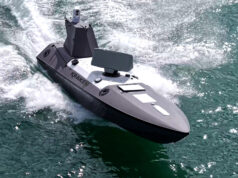
ACUA Ocean describes Pioneer as an uncrewed surface vessel designed to provide endurance and seakeeping for remote maritime operations, while Forssea’s ARGOS is a compact ROV intended for inspection, survey and light-intervention work. Forssea supplied the underwater vehicle with a dedicated integration kit for use aboard the USV, allowing the two systems to operate as a single remotely supervised package. The ROV can also carry different payloads depending on the inspection or survey task being undertaken.
Gautier Dreyfus, CEO of Forssea Robotics, said: “All of us at Forssea are hugely proud of this milestone and impressed by Pioneer’s sea-state capabilities. Seeing how smoothly the ROV integration and the multiple launch-and-recovery sequences went over the past few weeks was hugely satisfying. My congratulations to the ACUA engineering teams – we are excited to see what comes next.”
The work forms part of a wider industry effort to reduce the requirement for large crewed support vessels during routine subsea inspection and monitoring. Uncrewed surface vessels can carry sensors or deploy underwater systems while operators remain ashore, reducing the number of personnel required at sea.
ACUA and Forssea said the configuration is intended for work around offshore wind farms, pipelines and other subsea infrastructure, where repeat inspection and monitoring missions can require vessels to remain on station for extended periods.
During the Plymouth programme, the partners focused on proving repeated launch and recovery of the ROV, maintaining communications and positioning between the two platforms, and controlling the combined system remotely during operations in coastal waters.


This seems to have been a fantastic test. They have developed a real, useful capability. Congratulations to all involved. Hopefully moving forward ACUA can commercialise this capability as there is a huge amount of use in the civilian world as well as the defence sector.