

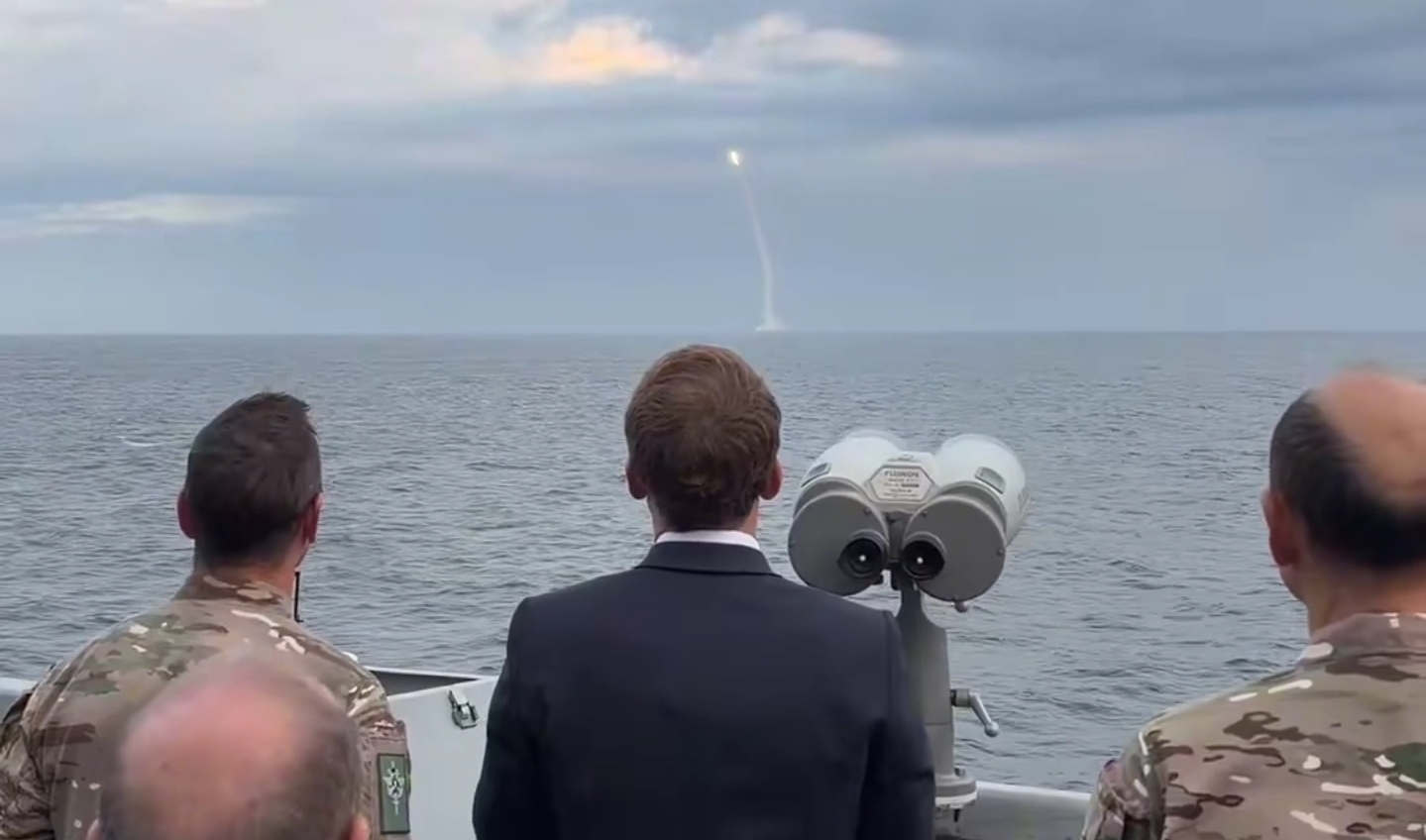
France has fired its latest submarine-launched ballistic missile for the first time from the boat Le Vigilant, with President Emmanuel Macron watching from the deck of a frigate, the president stated in a post published after the launch.
Writing in French from aboard the multi-mission frigate Auvergne, Mr Macron said: “Aboard the multi-mission frigate Auvergne, I witnessed the first firing of the new M51.3 ballistic missile from the nuclear-powered ballistic missile submarine Le Vigilant. Very few nations possess such expertise.”
He thanked the defence procurement agency DGA, the Atomic Energy Commission, ArianeGroup, Naval Group and the French Navy, and said: “This technical success is a new demonstration of the credibility of our deterrence, whose sustainability is assured. To be free, one must be feared. And to be feared, one must be powerful.”
The missile was launched off Finistère in western Brittany without a nuclear warhead fitted, and flew to a designated impact area in the North Atlantic several hundred kilometres from any coastline. France has described the trial as validating the operational capability of Le Vigilant’s strategic weapon system after a long refit, and the boat has recently emerged from the major overhaul the French call an IPER before returning to the deterrent patrol cycle.
The M51.3 is the third operational version of the missile, which was declared in service last October with improved range, accuracy and penetration performance over the preceding M51.2, and carrying the newer TNO warhead. ArianeGroup builds the family, which entered service in 2010, and the missiles arm the four boats of the Triomphant class. A further version, the M51.4, was contracted to the same company in August last year and is expected during the next decade, alongside the third-generation submarines that will replace the current fleet.
Published range figures for the M51 run to somewhere between 8,000 and 10,000 kilometres, though France does not confirm them and the real figure is classified.
Mr Macron set the firing against his own record on defence spending, saying he had launched the renewal of French capabilities in 2017 and that the armed forces budget will have doubled over ten years. He added that the programme for hypersonic and manoeuvring strategic missiles that will arm the airborne component of the deterrent was launched this year, a reference to the weapon intended to succeed the ASMP-A carried by Rafale squadrons.
France designs, builds and owns every element of its deterrent, from the warhead through the missile to the boat, whereas the Royal Navy draws its Trident II D5 missiles from a common pool held at King’s Bay in Georgia.
The two countries are also closer on nuclear matters than they have been at any point since the war. Under the Northwood Declaration signed last year, Britain and France agreed to coordinate their deterrents and stated that there is no extreme threat to Europe that would not prompt a response by both, which was the first time either had said so in those terms.
Mr Macron closed by saying that French nuclear deterrence “protects us and will continue to protect us”.





It’s still an interesting question whether we should be leaning on the US or French for out SLBMs, or even developing our own. Realistically, to the US we’re a customer of a, to the French we’d be a peer potentially wanting more control, and to ourselves we’d be spending an unholy amount of money but it would be cycling through our own economy.
Yeah but one has had more successful launches than the other
You can’t trade one master for another. The French would probably be open to selling the missile but they would never transfer the core technology. One day the UK will simply have to stomach the cost and difficulty to develop its own SLBMs without relying on anyone.
Agree the UK needs a IRBM programme.
The entire cost of developing and producing the M51 for France was €8.5 billion. About the same as we spent on Ajax.
We need to stop pretending that there is anything particular difficult or expensive about building our own SLBM’s.
Given the £100 billion cost of the successor program we might as well spend 10% more and get our own SLBM’s. We can even share R&D with France who I am sure would be delighted to have a partner sharing the cost.
We need complete operational independence from the USA as they will seek to exploit any dependence. If that means accepting cuts in other areas so be it. Our submarine launched nuclear weapons are the most important capability we can provide for both ourselves and NATO. Everything else should be seen as secondary.
“The entire cost of developing and producing the M51 for France was €8.5 billion. About the same as we spent on Ajax.” If that isn’t a sobering thought I don’t know what is. The question is, do we still have the will to sort out our problems?
We would be Starting from Scratch .
That’s Not the case in France ..
You can Easily Double that figure and more by the time we set up the Facilities and Develope the Missile..getting Experienced people and multiple tests
x4 the figure – and it’s still a responsible use of resources given the threat, and given the direction of travel of the USA. I’d go a step further and suggest that the full doctrine needs serious revision. We ought to have already invested in nuclear-tipped Stratus Lo development by now, and should already have plans for a significant arsenal of said weapons.
These are turbulent times, and the UK is presenting an image of weakness throughout it’s posture – from the tiny size of it’s deployable forces, all the way up to the relative non-availability of it’s American serviced nuclear deterrence.
Weakness invites war. It’s about time we took this defence business seriously, before our impossibly obvious bluff is called, and we are making the call to 16 Regt RA, with a quite serious face, to defend hundreds of key strategic assets with their 3 deployable Sky Sabre launchers.
Don’t worry that would be £24-40Bn by the time it was done in the UK.
Nobody believes me when I continually say that every project I come into contact with in the UK is 3-5x continental costs.
Our perfectionist tendencies and the inability to accept risk comes very, very expensive.
You may well be right but, as I heard someone say yesterday: if safety is expensive, try having an accident. In this world there’s no coming second. Maybe there is wisdom in perfection and minimising risk. But then I’ve always been risk averse, not least when I did a bit of flying some years ago!
Obviously because the UK is shit at everything and France is amazing which is why all the schools in London and not Paris are rioting and beating up their teachers 🤔
I wouldn’t agree we are shit.
We are very, very, very good at the necessary engineering.
As a country we have a total aversion to risk – either financial or otherwise….that comes at a huge cost…..
Nobody says that (uk has a much better pisa ranking); it’s simply a question of choice. The cost of France’s nuclear military capabilities has been around 150 billion euros since the program was launched. This cost explains why France lacked certain capabilities at times (for example, deploying only 16,000 men in the First Gulf War). However, these costs could be lowered thanks to R&D and the civil nuclear industry. For instance, the cost of the M51—the latest iteration of the program—is low because ArianeGroup could leverage civilian capabilities. So, the UK can definitely do it, but it remains a generational choice.
you’d do well to riot from time to time instead of accepting what your government throws at you
I can’t dig too deep into this, but I tend to agree with you. Everyone with half a brain is saying that the evil that is now permeating the US ruling classes isn’t simply going to go away the tech bros with their enormous funds and their fellow stalkers and as we have seen a totally compliant Republican Party with few with the gumption to resist are out to control events there one way or another and sooner or later as the leadership if the forces are further purged we simply won’t be able to rely on them. I don’t think almost anyone here knows or if they do want to express that near inevitable reality. Even the Democrats who were historically the more anti British Party will take on some of the Republican memes just to try to regain or maintain just as the Tories are doing with Reform proposals. The idiocracy is at best next month and in two years postponed so time is previous for the next mad President almost certainly have any even if warped like the present one, love of Britain. Time is not on our side.
The technology is attainable if we wish it after all any number of private companies including of course a very impressive New Zealand one are able to produce successful launch systems that once even the US Govt struggled to fund. With or without France and other European Countries might well be interested in cooperation too (despite political complexities) at some point we may well have to work on a non American solution whatever form that takes. Best to at least to start thinking about it well before hand because a decision out of our hands could pretty much cripple our ability to exercise our own independent deterrent or threaten in in ways that just might tempt Putin or a successor to try their luck.
I think we hope for the best with the US and plan for the worst. Either way having our own SLBM just makes sense in this environment.
The UK has never had an independent nuclear force. The US has always gifted it to you for the love of God. Just see what it is
I could not agree more.
I might push even further and suggest that one day, in the not too distant future, we may well require a big stick that even the USA is obliged to respect the integrity of.
I think any SLBM form of sharing with the UK is a good move for France for you allready have the equivalent.
And these are things that can be discussed without passionate debates. It is needed for both countries.
You greatly underestimate the cost and complexity of such a program. No it would not cost the UK this “little” to develop sovereign SLBMs. Simply because the UK is completely starting from scratch while France has been continuously developing ballistic missiles for land and submarines since the 60s. The result is that France has the largest aerospace industry in Europe today, by far, followed by Germany and Italy, the UK is far behind. France was smart and created synergies between the Ariane rockets and SLBMs (the missile engine is derived from Ariane 5 boosters) and between civilian nuclear and military nuclear industries. That’s how they manage to have a large pool of engineers, skilled workers and specialized SMEs in both fields, making their deterrence “sustainable” despite having a lower defense budget than the UK.
The UK has none of this because of the over reliance on the US. Who would develop this SLBM in the UK? I can’t name a single company with the required skill set to be the prime contractor. MBDA doesn’t develop ballistic missiles, Rolls-Royce does not make solid rocket engines or boosters, Thales is French, Leonardo is Italian, BAE is 40% owned in the US (against 27% in the UK, same for Babcock), General Dynamics is American…
With their successful Vega launchers built by Avio, Italy is actually closer to developing an SRBM/IRBM than the UK is. Where are the suitable testing facilities in the UK? A missile tracking ship like the French Monge? A proper space program? Domestic rockets?
Make no mistake I’m not diminishing the British engineers, they will absolutely succeed if needed… But it will be incredibly costly and risky. You won’t develop an M51 for €8B without having first developed an M1, an M2, an M20, an M4 and an M45. That is the cost (and not the full cost since France doesn’t want others to know how much it spends on deterrence) for a country with uninterrupted generational know-how.
If Trident could be test-launched from land like the French are doing, it would reduce the launch failures from the submarines. Proper infrastructures alone will cost you billions before you even start developing anything.
It’s much more complex than just saying “it costs the French this much, so we should just do it”, there are structural differences that mean that it would cost the UK 3x that amount to achieve the same thing. Should it be done regardless? Absolutely! The UK must become independent.
What then, do you propose is the alternative?
For me, you could 6 x the figure, and I’d still consider it a prudent use of resources. The maths is quite simple, in that I view the US as not just unreliable, but as outright dangerous to the UK and her allies.
I suppose that viewpoint, while controversial for now, does go some way in validating the potential cost of such a program.
I did say that regardless of the cost, the UK should still do it since over reliance on the US is too dangerous.
It would take at least 15-20 years to deploy a working missile with satisfying performance but it should be done.
My earlier comment was just highlighting that it will be costlier and harder than some think. It’s not the same as developing a small cruise missile.
I still wish the UK would go back to Polaris status for Trident. I.E. UK to own its missiles, be able to load/unload them in the UK & do basic servicing & upgrades in the UK. My back of envelope guess, is that would add $6 to 7 billion, but give the UK much more independence.
We do own the missiles. The difference is that they aren’t serviced here and when one is taken to King’s Bay for service, rather than waiting for that one to be serviced, we just draw one from a pool of missiles that have already been serviced, as do US SSBNs. I completely agree though that it would be much better to have the servicing and upgrades done in the UK, partly to avoid the irritation of people claiming they are just rented.
I agree it’s a good interim solution, however we would need to get the US to agree to it and you wouldn’t even want to ask the question unless you already have another solution.
To be fair, that’s precisely what you do with Germany. The ground to grounds missile 2000km range is a redevelopment of capabilities.
M51 is undersea launched and is special to avoid enemy means of protection. Though UK seems to be on a good trajectory.
“To be free, one must be feared. And to be feared, one must be powerful.”
Can anyone imagine Andy Burnham saying this? France have a much healthier attitude to their deterrence than we do.
In fairness I don’t think that’s a Burnham thing, I think that’s probably the near dozen PMs we’ve had since Blair and Brown. And I think it is more a reflection of the feelings of parts of the country (who are very vocal), for whom Britain’s possession of nuclear weapons, our P5/G7/5Eyes membership, all weigh rather heavily, and thus would react rather badly if a PM started talking about instilling fear in other countries!
Have you ever listened to the French national anthem.. it’s like some chant of a bloody death cult.. it’s got blood, death, armies watering fields of blood in every line. I’m surprised the French can even get out bed in the morning without butchering some random nation..
At least our anthem is just a basic rendition of we are better than you.. vs the French “ we are going to slit your throat and murder your mother”
This one is a bit more subtle than it may look like:
An impure blood shoul fill our Fields:
The real question is: what was by then a pure blood and an inpure blood?
The pure blood was the one of nobles, first in ranks for war. The impure blood was the one of paysant, merchant, workers.
This only meant that titles of nobility were no longer enough to run French armies.
The French anthem is banging, it’s great fun.
Burnham “to be free, one must be on benefits, and to be on benefits one must vote Labour”…..
The nuclear deterrent really has only one purpose- to make a nuclear attack too costly to contemplate. Polaris didn’t deter Argentina from attacking the Falklands; the Israeli nuclear capability didn’t deter frequent attacks from Gaza, Hezbollah in Lebanon or Iran.
A better use of defence funds would be to acquire more long range non nuclear missiles to deter conventional attacks.
It’s all about balance: nuclear weapons to deter nuclear aggression, well-equipped conventional forces to deter a conventional attack. But as a nation we forgot about the latter, and close our eyes and pretend we don’t have the former!
Nobody is going to nuke an enemy out of existence(& possibly end the whole world) just because someone has invaded somewhere peripheral. Any nuclear response to Argentina invading the Falklands would be way out of proportion to the situation.
It’s a Nuclear Deterrence not a Conventional Deterrence… That’s were countless Goverments here have gone Wrong in the Past… What do you do if your Attackt by a Conventional force who either don’t have or Don’t use their Nuclear Capability..??
Remember Suez 1954.
You grossly miscalculate the ambition of Russia, and their genuine, deep seated hatred of the UK.
Do not for a second allow yourself to believe, that were Trident to dissapear tomorrow – that a nuclear strike on the UK would not be firmly on the table for Russian war planners.
Ask yourself this. A Russian nuclear weapon destroys London, the world is shocked. What happens next? Does France retaliate on our behalf and guarantee the same fate for Paris? Does the USA risk ww3? No. A far more likely end result is an extremely tense few months with lots of harsh words spoken, followed by humanitarian efforts, followed by constructive conversation around avoiding further use of nuclear weapons.
Your point of view is dangerous.
That is what independence and sovereign capability looks like.
French doing well and they have continued with nuclear civilian power generation
It’s a rather sobering thought that one conventional attack on faslane and were the remain patrol endurance of the V boat at sea from losing our nuclear deterrent.
It’s easier than ever to take out a single base.
I personally think we shouldn’t get too obsessed with an independent trident but rather should have some air launched and silo’d capability.
I’ve got very little confidence that a disabling attack on a uk base from Russia would be met by a similar response.
Sure NATO exists and an attack on one is an attack on all but let’s say it’s a drone attack launched from the UK and Russia denies it and threatens a nuclear response to any attack made against it.
I have questionable confidence for the will to bomb Russia in that situation.
Meanwhile France is burning from the inside
Just a moment, the french missile appears to have left their boat and flown, that’s cheating! Ours seems to manage to leave the boat and fall back on it which is obviously far more if a deterrent. We should stop buying American crap and make some ourselves