

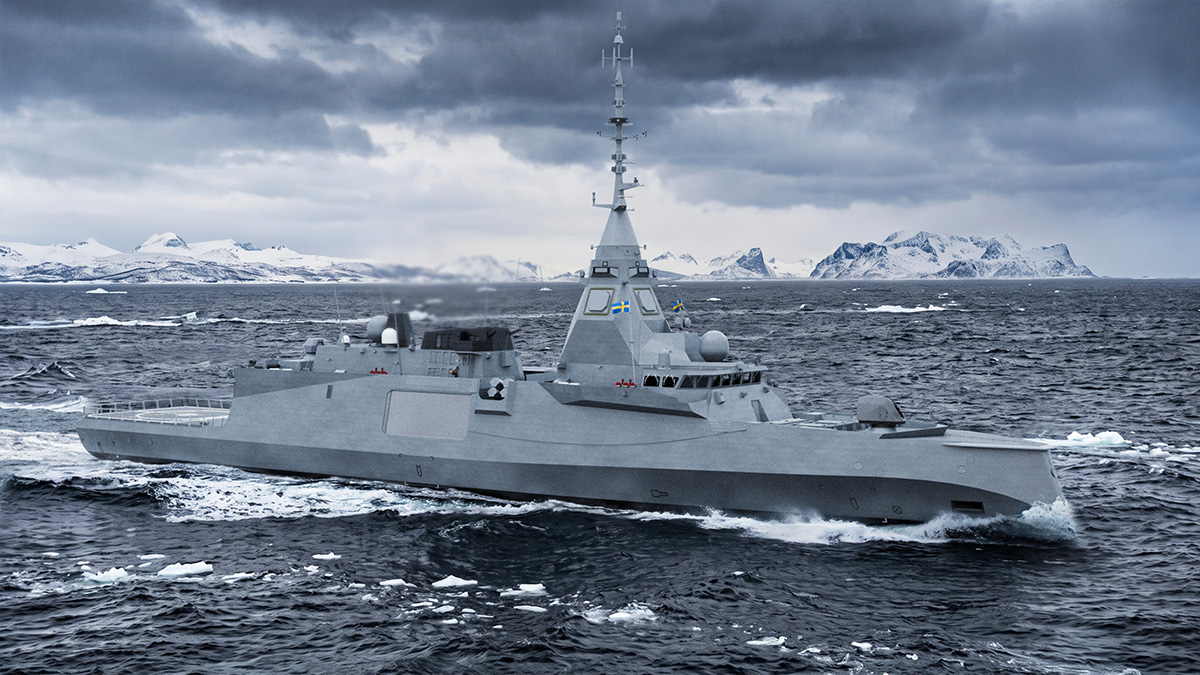
Sweden has signed a contract with France’s Naval Group for four FDI-based air defence frigates, completing a competition that also included British-Swedish and Spanish proposals, the UK Defence Journal understands.
The Swedish Defence Materiel Administration signed the procurement contract on 31 August during a visit to Stockholm by French President Emmanuel Macron, with the ships to enter Swedish service as the Luleå class.
The first frigate is planned for delivery in 2030, with the remaining three following successively. Sweden had selected Naval Group’s Frégate de Défense et d’Intervention design in May and subsequently entered negotiations with France over the purchase.
The Swedish Government said construction of the vessels and training of Swedish Armed Forces personnel can now begin following signature of the agreement.
Swedish Defence Minister Pål Jonson said: “This is a strategically important investment that strengthens Sweden’s defence capability and security in light of a deteriorated international situation. The four frigates will triple Sweden’s current air defence capability. This is essential to Sweden’s security and NATO’s capability.”
The Luleå-class vessels will be based on Naval Group’s FDI design but configured for Swedish requirements. The Swedish Government has previously confirmed that the ships will incorporate a number of domestically produced systems.
These are expected to include Saab’s RBS 15 anti-ship missile, lightweight torpedo, Giraffe 1X radar and Trackfire remote weapon station, together with 57mm and 40mm naval guns from BAE Systems Bofors.
The ships will also be equipped for area air defence. The Swedish Government said in May that advanced air defence was a central requirement for the programme and that the new frigates would contribute to NATO’s integrated air and missile defence capability.
Naval Group Chairman and Chief Executive Pierre Éric Pommellet said when the design was selected in May: “We are extremely honoured to have been selected by the Swedish Ministry of Defence. We are now eager to engage with the Swedish authorities and partners in the execution of this strategic project.”
He added: “The FDI will provide the Royal Swedish Navy with a latest-generation frigate and extended capabilities in all warfare domains with rapid delivery timeline, to meet the operational needs expressed by the Ministry of Defence.”
Naval Group faced two other proposals during the Swedish evaluation. Babcock, working with Swedish defence company Saab, offered the Arrowhead 120, a smaller derivative of the Arrowhead family that also includes the 140-metre design forming the basis of the Royal Navy’s Type 31 frigates.
The Arrowhead 120 proposed for Sweden is approximately 124 metres long and displaces around 4,650 tonnes. Babcock’s proposed configuration included the Saab 9LV combat management system, Sea Giraffe 4A fixed-face radar, Sea Giraffe 1X, RBS 15 anti-ship missiles, Saab lightweight torpedoes and Bofors guns.
Babcock and Saab had already been working on the Luleå programme before Sweden moved towards purchasing an existing foreign design. Saab had been contracted by the Swedish Defence Materiel Administration to undertake basic design work, with Babcock providing engineering support including structural design and auxiliary systems.
The third contender was Navantia’s ALFA 4000. The Spanish shipbuilder offered a 120-metre, approximately 4,300-tonne frigate and had proposed delivering the first two vessels in 2030 and the remaining pair in 2031.
Navantia’s proposed Swedish configuration also incorporated Swedish equipment, including the RBS 15, Bofors 57mm and 40mm guns and Saab Trackfire weapon stations. The company proposed air-defence, anti-submarine and surface-warfare capabilities alongside a hangar and flight deck suitable for helicopters.
Swedish officials said during the competition that the three proposals were assessed against time, capability and price. The government had also stipulated that the programme should concentrate on a mature vessel already in production in order to reduce delivery times.
The FDI is already in production for France and Greece. Naval Group pointed to the maturity of the production line and existing deliveries when making its Swedish proposal. The Swedish Government initially authorised negotiations with France in May for four ships expected to be delivered between 2030 and 2034. At the time, it said the procurement was the first stage of the process and that an order could be placed once negotiations were complete.
That process concluded with the contract signed on 31 August between the Swedish Defence Materiel Administration and Naval Group. Sweden and France also signed a separate framework agreement covering defence cooperation during Macron’s visit, including operational matters, defence equipment and industrial development.





Aster30+CAMM-ER
Fair choice by Sweden, but Norway made the right decision with T26 and it looks like Denmark have chosen a Babcock T31 based architecture. Up tp the Kiwis of course but I’d also say that T31 is a better choice for NZ requirements – large EEZ – they could afford 3 for the price of 2 Mogamis.
Even with the smaller crew for the 31’s compared to the current ANZAC’s would New Zealand actually have the manpower for a 3 ship frigate force?
NZ might well want to replace the two frigates and 2 Opvs (1 actice) they’ve got with 3 vessels. Can’t believe that they can’t find enough crew, if there’s an unemployment queue give them a chance, same for the UK and here in Aus. Might also want to look a selling a ATS to replace Canterbury or offer an AH140 dervative for that too.
hey Mate -their is some noise in the government to do what you outlined- 3 frigates -no opvs. The smart money is on the Mogamis, tagged onto the Aussie order. Just the matter of national election to get though first n a November.
They may do that, but there are always tastings for something below a frigate, dropping all the OPVs for just 3 frigates means either using them for tastings they aren’t needed for or gapping them. As for people, the RNZN is struggling just as many Western nations are, hence why they flogged off two Lakes to Ireland.
Taskings, not tastings, ducking autocorrect.
To be honest, Mark I don’t know. Am playing devil’s advocate to a degree. Mogami is the ‘no thinking’ option. As they used to say ‘no one ever got fired for buying IBM’. New Zealand is a GB sized island in a very big, dangerous ocean. New Zealand’s future fleet will probably focus for the next decades on surveillance, patrol, interdiction, search and rescue, Humanitarian Assistance and Disaster Relief – both domestically and regionally plus augmenting regional resilience and security operations and support to other government agencies. T31 is a large, tough ship with long legs, simple maintenance and an adaptable hull. It can come in several flavours. I’ll bet Babcock could get the patrol frigate crew ( say HMS Venturer with 24 CAMM) ) down to 100 and it could do all of the above pretty well: big flight deck, boat bays, 6 container mission bay, big helicopter, up to 50 troops is a very flexible asset. Future NSM option and ASW drone if the balloon goes up but you don’t have to equip all 3 to a ‘combat’ level on day one.
Let’s hope France can be there for Sweden if it kicks off with Russia. The UK needs to learn to be more mercurial in its defence relationships just like France and the USA. I can’t think of any major system Sweden buys off us yet it looks to the UK as lead security provider in the region via JEF.
Buying Global Eye wouldn’t have hurt Frances chances . They also may offer a new version of Scalp naval to Sweden?
France gets on and builds the package and offers it for export. We seem to be in numerous collaborations and aspirations.
Yes no doubt but the UK buys significantly more from Sweden than France does.
Hard not to see this is a slap in the face, Sweden is not the kind of ally we need. Norway and the Netherlands are a much better example. Hopefully Denmark follows their example.
Sweden needs to learn that alliances are suppose to be about mutual benefit, I see the UK providing great benefit to Sweden but getting nothing in return.
Ok, Sweden wanted/wants the first hull in service by 2030, France has an active FDI line with hulls already in active service, the RN has ships still fitting out and not even ship builders trials yet. So, which RN slot/hull do you want to give up to make that 2030 timeline?
Nothing from sweden? Uk has the assistance of a powerful army, air force and no doubt those fdi Will be useful to defend northern flank of nato.
Sweden has a powerful army guarding Sweden, how’s that a help to the UK?
Sweden does not protect sweden only; the quasi merger of a the nordic air forces show it. Sweden provides strategic depth in high north and baltic, training capacities for cold temperature, they also conduct underwater surveillance to protect infrastructures critical to uk, and obviously, they can gather unvaluable Intel with regards to russia (we all need their FRA).
The 1st Swedish Division literally is being aligned to advance into Finland if the Russians invade.
That’s my view as well. If things do kick off with Russia, likely just a matter of time under current trajectory, then Sweden should be reminded to ask for French troops, helicopters, ships, subs, aircraft, drones, artillery, air defence.
Sweden is NOT our ally. As a reminder they have been neutrals for the last 60 years and before that we’re actively supporting Germanys WW2 efforts via direct exports of coal and steel.
The French seem far more joined up. Aster 30 on most of their surface fleet and 10 batteries of SAMP/T for land defence, not to mention more TAS numbers across a couple of Captas variants.
Probably a good choice for the Swedes. Babcock might sell more Arrowhead if it’s leads operator got a move on and up armed them.
I’d say Babcock might sell more if they got a hull out for sea trials. The French are saying they can manage a two hulls a year production rate and already have active examples in the water to show off to potential buyers.
That’s very true..
Its going to be interesting to see which way NZ goes considering Mr Pollard’s visit to there recently and all the efforts going into the Denmark frigate bid. Good luck Babcock for both!
I think we need our own SAM/T variant but with CAMM MR. A naval version that we integrate into naval air defence. Would give us good home grown AA capability. If integrated into Type 26 and Type 31 it would be a good selling point.
Makes you wonder with the spending on the capability insert upgrade for the T31s what could have been if they’d gone with the NS200 radar? Not sure of the price or performance diffential compared to the NS110 but its got to be more useful.
Though if the CCV is based on the AH 140 andvordered in a decent number that could well make for it! Lol. I still think 1-3 more T31s would help sustain and spread patrol “middle tier” presence for the RN in around the UK, Med, Indo Pacific and South Atlantic and especially if the B1 Rivers are replaced.
Is the UK actually looking into CAMM-ER and CAMM-MR forcsea and or land or are we the only ones enthusiastic about it here on ukdj? Hoping so, because if they aren’t other will with there systems and then we’ll complain about buying from others. .
I had to laugh at your comment QuentinD63!
I have no idea if we are looking at it, but we absolutely should be! Poland are developing CAMM ER with us and intend to equip ‘up to 23 batteries’. I think it would work well as part of a layered defence for GBAD. But as you say, is the UK looking at it seriously or is it a UKDJ CAMM fan club?
No, CAMM-ER was developed by Italy and it is in service, CAMM-MR has been in limbo with no recent news and MBDA is not promoting it.
Thats a shame, I wonder if that has died a death since Poland is currently negotiating with the USA for Polish made patriots? Why develop a new weapon when you can make a top of the range missile in your own country thats already tried and tested and no R&D costs?
The main point here is that Sweden were looking for an AAW frigate, and we don’t have any to offer, whereas the French do.
Geoff, the main point is that the Govt and Industry have done zero scoping of future export requirements, our Defence Attaches have not been listened to OR just sat on their arses until their pensions become available, and we have not delivered product that is tangible and lost more sales to the fffRrench.
I have no idea about Defence Attaches but someone needs to critique their input into defence sales, they then need to critique the UK MoD and finally industry. We are failing at this because of our marketing and UK Defence Attaches are pants at marketing. Time to retire a lot of braid without pensions and replace them with motivated people.
Hopefully if Denmark is doing the same the UK doesn’t miss this new opportunity. And what might be good for Denmark would be good for others and even the RN?
Another embarrassment for UK defence and manufacturing. But hey oh least we can feel better about sending an extra 13 billion a year in international aid instead of using it to undercut our rivals to win ship building contracts and lower energy prices for manufacturing industries.
I think you will find France and Sweden both give far more in overseas aid than we do.
Our cash flow problems come from our high number of benefit scroungers but with the current attitudes of Reform and Labour the next election will be decided by them.
Do you have access to reading materials from the last decade obelisk, suggest you review the UK foreign aid budget because it’s no where near £13 billion anymore bd hasn’t been for a long time and almost all of it goes on Ukraine or UK based asylum hotels.
Actually, UK was the third biggest donor in 2025, behind Germany and USA. Spending was over £13b. Whilst some goes on migrant costs and Ukraine, most doesn’t. Most assistance to Ukraine comes out of other budgets, including defence.
The government need to back the type 31 frigate programme and order some more. God knows we need them. 3 more would be ideal and just what the navy needs to maintain persistent presence.
Could we crew 3 more?
Sure we could. Just about political priorities and choices.
The Amiral Ronarc’h frigate is small by modern standards but is heavily armed. For relatively short deployments in the Baltic, it seems an ideal choice. It also has the advantage of being in service, unlike T31.
I don’t get why we are beating ourselves up over a ship contract.
The UK sells plenty abroad, and has done well of late ship sale wise.
Sweden chose what it wanted, so be it. They’ll help Sweden and NATO, wish we were trying to expand like others instead of just talking.