

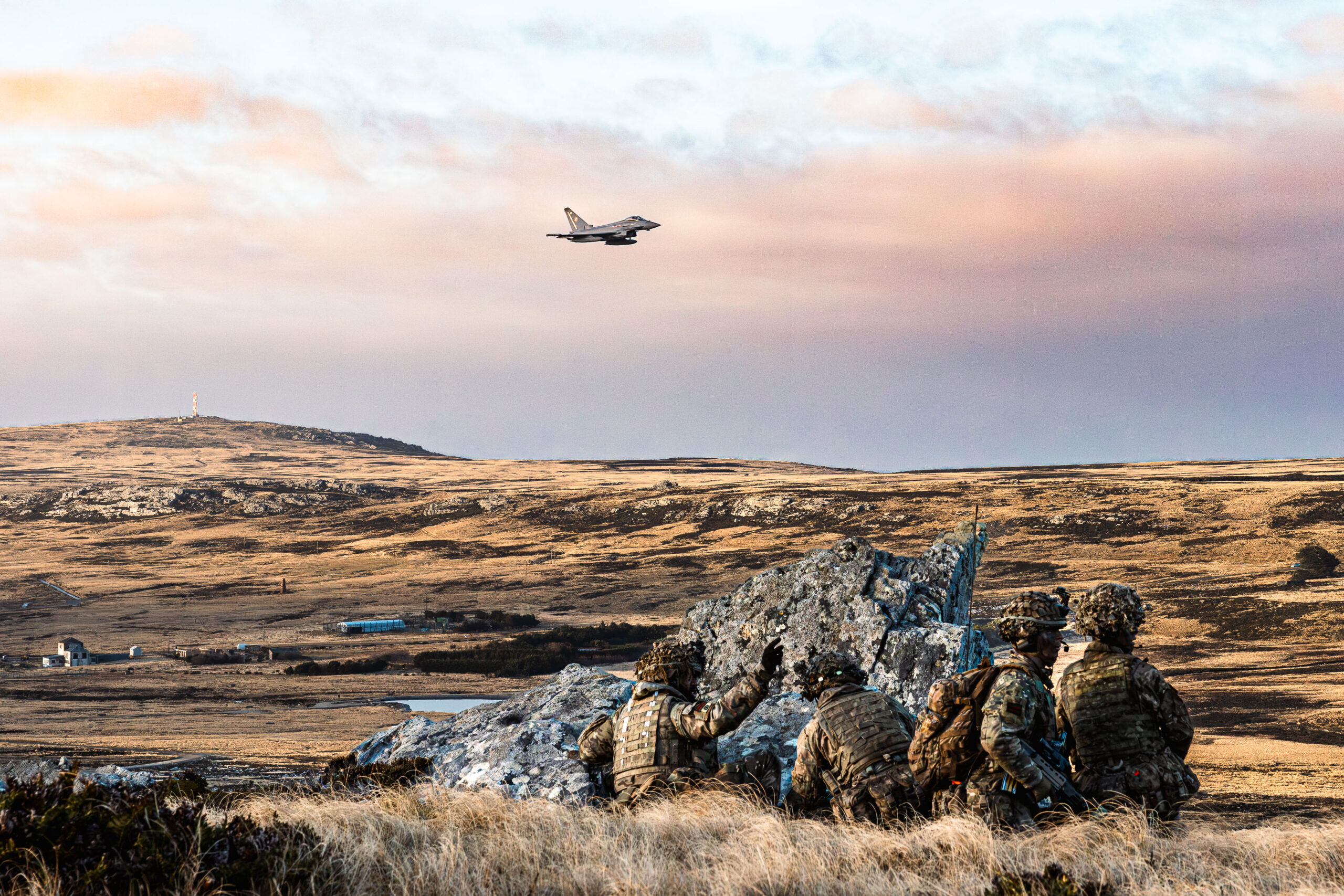
Britain’s military presence in the South Atlantic is at the appropriate level for the defence of the Falkland Islands, and the absence of an ice patrol ship does not change that, according to an answer given in Parliament.
Ben Obese-Jecty, the Conservative member for Huntingdon, asked what assessment has been made of the potential impact on Argentine posture in the region of having no ice patrol ship available.
Louise Sandher-Jones, the Minister for the Armed Forces, said: “The Ministry of Defence is committed to maintaining a defensive military presence in the South Atlantic to ensure the protection of the Falkland Islands and South Atlantic Islands. Our defences in the South Atlantic are robust, consisting of air, land, and maritime forces with a strong permanent presence on the Falkland Islands. I am confident that our military presence is at the appropriate level for the defence of the Islands, and we keep this under constant review.”
British forces in the South Atlantic are based around Mount Pleasant Complex on East Falkland, where Typhoons of 1435 Flight hold quick reaction alert, supported by a Voyager tanker, an A400M and Sky Sabre ground based air defence. A River class offshore patrol vessel is forward deployed to the region and the islands are garrisoned by a roulement infantry company.
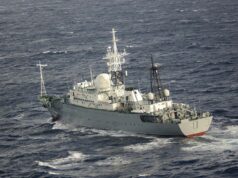
HMS Protector carries out survey and inspection work under the Antarctic Treaty and has no combat role, though her presence has long been part of the pattern of British activity in the South Atlantic. She last deployed south in the 2024-25 season and will miss a second consecutive Antarctic season this year.





I seem to remember someone said that once before?
The issue is as Argentina slowly ramps up its military, it will become impossible to defend without sending a sizeable portion of the military which would be disproportionate, especially considering the Falklands isn’t strategic for the UK economy.
For example Argentina now have 20 odd f16s, all they need now is air to air refueling to give them more time on target and if they could win the air war the land one would be a lot easier. The number of jets will likely grow and it means the 3 typhoons there are out numbered. Yes in theory we could match with 20 typhoons, but that is a 5th of the fleet, and would signficantly diminish ability to respond to other needs, so not practical in reality plus troops don’t want to spend long stints in the middle of no where.
However right now Argentina isn’t a threat, it neither has the money or the political will to launch an offensive, but should that change it would be a challenge.
Steve , I believe Argentina has a pair of KC130 for air to air refuelling.
I didn’t think they were air worthy as they had been looking to buy replacements from the US stock.
cheers Steve- thanks
This is clearly nonsense, obviously what stops Argentina invading is not the four Typhoon jets or the CAMM air defence system, it’s not the company of soldiers armed with Javelin missiles or the massive modern airbase able to rapidly reinforce the Falklands.
No it’s the barley armed ice survey ship that spends most of if its time either thousands of miles south in Antarctica or thousands of miles to the north in the UK 😂
I think this is an institutional memory of how the plannred withdrawal of Endurance in 82 emboldened the Junta.
This time there isn’t such a government in Argentina.
The loss of Protector has greater impact on our Antarctic territories work.
I agree but it’s also worth mentioning that we have the RRS Sir David Attenborough down there too performing many of the same roles. It’s not a navy ship but it is owned and operated by HMG.
Yes, point accepted mate.
Yep all you really need to do is stick a marine contingent and a rotor on the SDA and you have essentially covered the role.
I’d rather be in a Typhoon than an F16, but in the Falklands War the USA offered a ton of behind the scenes support to the UK; it remains to be seen what happens with Donald Fart in charge. Knowing him, with his inability to get anything right and unerring skill at making things worse, he’d support the Argies or threaten the UK or something.
So my layman’s opinion is, don’t watch what the Argies are doing, worry about what Donald Fart will do.
I take offence at the narrative of the “support” the US gave in the Falklands. It’s another example of everything we see on D Day and every where else.
Fact is the US did with hold SIGNIT intelligence satellite capability because they wanted it for themselves.
The allowed us to use some fuel reserves on Ascension.
The allowed us to use Sidwinder L missiles, however they did not magically give us these missiles, they were part of a common store.
Beyond that I find it difficult to see what else the US did to support us in the Falklands.
Much the same of the America did D day, despite most if the soldiers, planes and ships all being British and Commonwealth.
‘Fuel. As part of a routine agreement, the U.S. sent 1.5 million gal. of aviation fuel to the joint U.S.-British airbase at Ascension Island. It also made KC-135 aerial tankers available to Britain, but these were never sent to the South Atlantic. Instead, the Royal Air Force used its own KC-135s for midair refueling of Vulcan bombers making the 3,800-mile trip from Ascension to the Falklands, while U.S. planes in Europe were reassigned to British NATO duties.
Ammunition. The U.S. sold Britain an unspecified quantity of 20-mm shells and supplied sonar-equipped buoys for use in antisubmarine warfare. Washington officials will not say if any of this equipment was ever used on the islands.
Missiles. The U.S. sold Britain about 100 AIM-9L Sidewinder missiles (for $48,000 apiece). Of 27 Sidewinders fired by Harriers during the war, 23 scored hits. These, however, were most probably British missiles; the U.S.-supplied Sidewinders were apparently used only to replenish inventories in Britain. Also supplied were highly effective laser target indicators for British ground forces and a radar system for the Royal Navy’s Sea wolf surface-to-air missiles.
Intelligence and Communications. As a NATO ally, Britain always had regular access to the U.S.-built Defense Satellite Communications System, which relays encrypted messages around the world. Routine information from U.S. meteorological satellites was also available, although their effectiveness was severely limited by bad weather over the South Atlantic.’
But, apart from that, what did the U.S. of A. ever do for us…
The Royal Air force used Victor tankers for Refuelling . 👍 🇬🇧
Spot on. Apologies. No edit function.
Excerpt quoted above, in inverted commas, is from Time magazine 1982.
I remain baffled as to why we no longer possess the defence capabilities, binder twine secured as they may have been, that we had then. They deterred until we withdrew part of the binder twine. The rest is history. Deterrence is bluff, but bluff works and is cheap compared to the alternative.
Per ardua ad astra
🇬🇧 🇺🇲
Yep and they were really great aircraft made by Hanley Page and ALL British no US crap in them. They were also the only aircraft during the first Gulf war to successfully complete all missions during this conflict without a failure.
Cheers 🍺
I understand some of NSAs / NROs satellites were also retasked as part of UKUSA to assist GCHQ with coverage.
I also read a tantalising report once, which I doubt, that an SR71 made an overflight of the Falklands.
I doubt this one myself.
Type 967/968 surveillance radar and Type 910 radar for tracking was the systems used for Sea Wolve!
All UK sourced.
What American radar supported the GWS25 Mod 0 (CLSW) system
Well said Jacko?
I can only think that Time Magazine, quoted by me, above, ‘Just How Much Did the U.S. Help?’ 28 June 1982, was referring to components. To build high-speed processors and advanced ADAWS (Automated Data Handling and Weapon Assignment System) combat data networks, British defence contractors imported standardised, military-grade integrated circuits from the United States.
U.S. support, often relatively informal between colleagues and friends, was extremely useful. I believe General Sir Michael Rose used ‘borrowed’ U.S. supplied early satellite telephones to talk direct to Downing Street at various times during the campaign.
‘…the Americans made available any weapons that the Royal Navy required, essentially opening up the armories and allowing the British to take whatever they needed with the proviso that they would eventually reimburse the United States. What has remained still classified to this day is the intelligence sharing that took place between the United States and Britain.
The National Security Agency, GCHQ’s U.S. counterpart, had not achieved global coverage with its sigint satellites by 1982. The craft which was in a position to help Britain monitor Argentine communications was being used by the Reagan administration to eavesdrop on central America, principally El Salvador. One of the GCHQ officers who liaised with NSA recalls, “We had to negotiate very hard to get it moved, and then only for limited periods.” During these spells of a few hours each, the satellite’s listening dish was reorientated towards the south Atlantic in order to help Cheltenham…’
The Lion and the Vortex, Dwayne Day, March 11, 2013
And let’s not forget the flip side… what did Russia ever do for Argentina
Satellite Imagery: Moscow repositioned military and reconnaissance satellites over the South Atlantic to track the movements of the British Royal Navy task force.
Location and Coordinate Data: The Soviets analyzed electronic signals and shared tracking data and coordinates of British ships with the Argentine military, which assisted in targeting operations.
SIGINT Ships: The Soviet oceanographic/intelligence-gathering ship Akademik Knipovich operated near Tierra del Fuego and Ushuaia to monitor British and regional electronic communications.
Loggistic flights from Brazil, which included weapons and spares..
Every day Kosmos-1365 would fly over the Falklands.. it was launched specifically to provide intel on the UK fleet to Argentina. As well as Kosmos-1455 and Kosmos 1372 provided vital information about events on the islands and their surroundings and kept Argentina aware of where all the RNs ships were..
The Russians attributed the loss of HMS Coventry to its intel as well as probably the Atlantic conveyer to its satellite intelligence.
Almost as if someone (Munro) copied and pasted an article without doing some basic fact checking isn’t it?
Having been in the RN at this time and knew several of the crew I ‘m not sure what you have said has ever been proved! Coventry was lost because the Type 22 unfortunately was not quick enough to get into a position to use Seawolf after Coventry had a Sea-Dart failure.
This was statements from the other side of the wall so to speak from Russia officials who probably know..
Mike, I saw a doco, some years ago on the loss of HMS Coventry. I seem to recall she turned across the Type 22’s bow and unintentionally broke the Sea Wolf missile system lock (or target acquisition) … the fog of war.
I seem to remember Coventry had taken out two aircraft before there was an issue with the Seadart system? There was also lots of discussion about the 22 either in the way or not close enough to protect Coventry? It was 44 years ago and I’m getting old!!!!My main reason for the post was I don’t think we can blame the Russian and I don’t think there is open source proof to say they were supporting Argentina!
thank you Mike – agreed re. your point on Russia!
“Much the same of the America did D day, despite most if the soldiers, planes and ships all being British and Commonwealth”…
Now, I’m no US sycophant , but even a cursory look at wiki provides the following breakdown of the 160,000 soldiers that took part in the D-DAY invasion as follows:
73,000 US Soldiers ,
73000 UK Soldiers,
21,400 Canadian Soldiers ,
15,000 ‘other nation’ soldiers
so ‘roughly’ 2/5 US, 3/5 NON US.
As for equipment, its is quite simply ridiculous that you are ignoring the manufacturing might that the US bought to WW2.
So the word ‘most’ is doing some heavy lifting in your statement there.
It seems your anti-Trump rhetoric is clouding your judgement somewhat.
Anyone who has served there and who knows what is there now will tell you otherwise.
Would it be an option of leasing a Protector class AOPV from NZ for the FI if its available? I believe its HMNZ Wellington but it might need to be regenerated like its sister ship HMNZ Otago was done by Babcock NZ. Or, even lease/buy a Harry Dewolf AOPV from Canada?
The word complacent comes to mind. That HMG doesnt take UK defence seriously makes the use of the word ‘robust’ rings hollow.
Support for the Falklands should be removed until the body of the murdered Royal Marine is returned to his family, and the perpetrator held to account.
Greg, what are the bare bones of that story?
Alan Addis went missing. believed murdered in August 1980
How are they re-supplying the station at Halley Bay?