

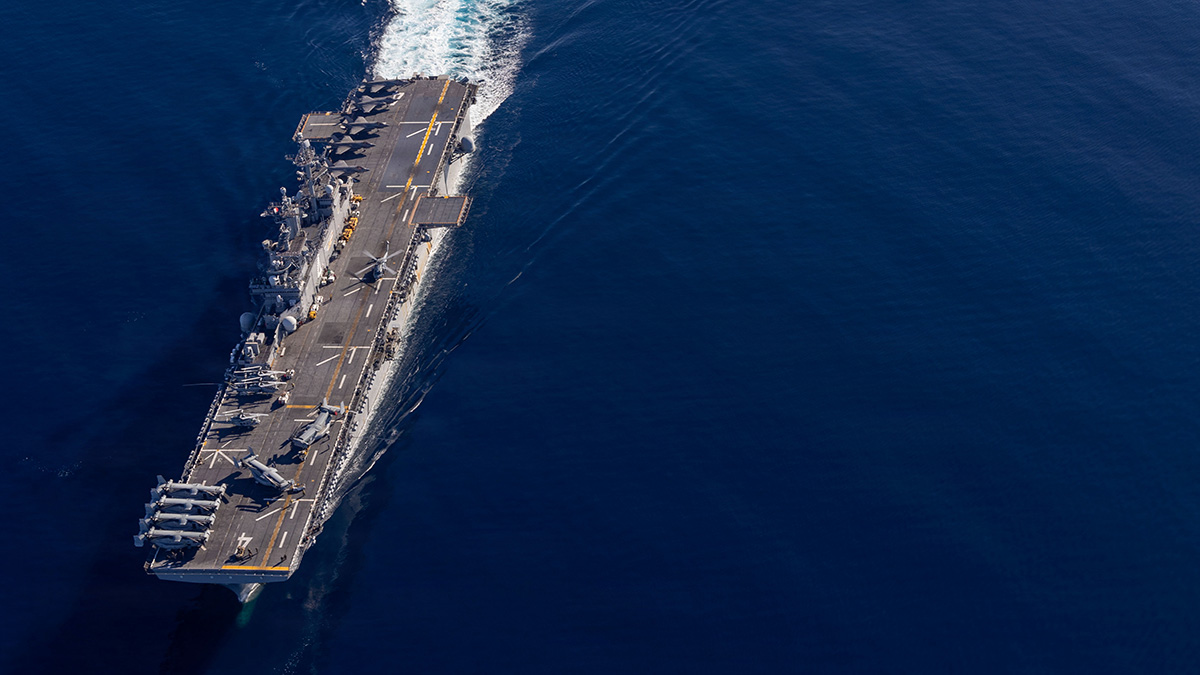
BAE Systems has received a $149.8 million contract from the US Navy to carry out maintenance and modernisation work on the Wasp-class amphibious assault ship USS Boxer, according to the company.
The firm-fixed-price contract announced on 26 August covers a Selected Restricted Availability for the ship at Naval Base San Diego, with the overall value potentially rising to $180 million if all available options are exercised. BAE Systems said the work will include a combination of modernisation, maintenance and repair activity on the 40,000-tonne amphibious assault ship.
Eric Icke, vice president and general manager of BAE Systems Maritime Solutions San Diego, said: “Critical maintenance of the USS Boxer will support the U.S. Navy’s vital mission to continue defending our nation.” He added: “I look forward to our highly skilled team delivering unmatched capacity, precision, and performance for our customer.”
USS Boxer, hull number LHD 4, is the fourth member of the US Navy’s Wasp class of large-deck amphibious assault ships. The vessels are designed to embark Marines, landing craft, helicopters and fixed-wing aircraft in support of amphibious operations.
The class can operate a mix of aircraft from its full-length flight deck, while a floodable well deck provides space for landing craft and other amphibious vehicles. Wasp-class ships have also operated AV-8B Harriers, MV-22B Ospreys and other aircraft during US Navy and Marine Corps deployments. The Selected Restricted Availability will be carried out at Naval Base San Diego, where Boxer is homeported. Such availabilities are scheduled maintenance periods used by the US Navy to conduct repairs, upgrades and alterations while returning ships to the material condition required for further operational service.
BAE Systems operates a ship repair facility in San Diego alongside its other American shipyard operations in Florida and Virginia. The company provides ship repair, maintenance, conversion, overhaul and modernisation services for the US Navy and other government customers. Its San Diego operation supports ships assigned to the Pacific Fleet and has previously undertaken maintenance periods on amphibious ships, destroyers and other surface vessels based on the US West Coast.
USS Boxer entered service in 1995 and has subsequently deployed in support of US military operations in the Pacific, Middle East and other regions. The ship is designed around an amphibious task force role and can carry a Marine Expeditionary Unit together with aviation, landing craft, vehicles and supporting equipment.
At more than 250 metres long, the ship has a flight deck extending across most of its length and an internal hangar for embarked aircraft. Its well deck allows landing craft to enter and depart through the stern while the vessel is at sea. The $149.8 million award is firm-fixed-price at its initial value, with BAE Systems saying additional contract options could increase the total to approximately $180 million.
The work will be undertaken by the company’s Maritime Solutions operation in San Diego as USS Boxer enters its scheduled maintenance and modernisation period at Naval Base San Diego.







Three of these would have been ideal replacements for the Invincibles, make it six and the assault ships could have been sold to Brazil without any remorse.
Imagine the benefits of that scale and availability!
I like your thinking DIMWIT, but the uniparty would never let our forces have anything this good.
Power it with gas turbines (like the last one in the class), replace the forward sea sparrow launcher with Cam. Keep the Ram and Phalanx. Possibly fit more Cam starboard aft, after moving the position of the Phalanx that was in that position.
We would have a very capable ship that actually had the means to defend itself.
Able to defend themselves and deliver offensive capability across the board – and at a cost of £2Bn, three would have come in under the cost envelope of the QECs…
The America class would have been just the ticket for you, then. Gas Turbine/Electric propulsion with expanded hangar facilities for aircraft handling (no well deck). I’m sure US would’ve been happy to provide the plans through some kind of teaming or partnership arrangement. Given actual numbers of F-35s UK is currently operating, this would probably have been a better bet than buying a full-sized super-carrier and only operating two squadrons off her.
That’s the point about the Makin Island – it changed the propulsion system but kept the other features of the Wasp Class including the well deck.
Given our F35 generation rate, these would have come in faster, allowed Harrier transition and given us superb Atlantic / North Sea reach.
My only concern with that approach is that it becomes too easy for your ‘carrier’ to get repurposed into an assault ship instead (there have been numerous attempts to repurpose USS America into a ‘light carrier’, since she has no well deck), but I see your point. When dealing with the penny-pinchers, it’s best to get procurements done fast. I have repeatedly said that the UK would’ve been better off continuing the Harriers as a high/low platform with the F-35B the way the USN did with the F-18s and F-35Cs.
Have a lovely day.
You too, but before I leave consider my point about buying six of them and that would have given us the capability to release our assets to countries like Brazil and give us the ability to re-role those decks for amphib or strike. We missed a trick and spent big on two assets that we can not hope to sustain or replace.
So a different sort of ‘multirole strike ship’. Got it. I like it.
Keeping the Harriers would have meant retiring the Tornado force, and given the actions we where involved in the 2010’s the Tornados where worth every bit of that decision.
Things always circle back to the undercapitalization of the British military. It should never have come down to Harrier vs. Tornado as they were doing different things. This ‘zero-sum’ mentality is why the RN is the wreck that it is right now.
It’s almost as if there had been a massive financial crash….
Eh. We went through the same financial crash. We didn’t suddenly decide to just scrap chunks of military capability.
Actually the US military budget was cut by about 100billion USD per annum in the first half of the 2010’s.
Yes the US has changed its mind a few times on the detail design and purpose/role of the Americas as they replace this class. For us the mini carrier concept would certainly be more focused with a class like this than the choices have been for the US which decided a well deck was no longer relevant on operational considerations but then wasn’t sure if that was the right choice after all. Not sure what their latest thinking has been but while the Wasps exist I guess they have the options covered.
I’d argue the way western hegemony was set up after the world with the US taking over Britains spot – America does not have want another power that they can’t heavily influence
I say that knowing full well that all of our governments have failed on defence or have used it for political point scoring
The latter is talked about ALOT on here, I never hear the former and how that influences what politicians are likely to prioritise
We should be cognizant of how we define allyship vs say America (or anyone else really)
Other than that, rant away mate
‘Western Hegemony’ as you put it was set up by the British and other European powers to do basically what NATO has done all this time: Use American money and firepower to preserve the European way of life without paying for it. In the immortal words of Winston Churchill: NATO is designed to keep the Germans down, the Russians out, and the Americans in.
Where things have gone sideways is that America got tired of the continued finger-wagging when we were paying the bills. Sorry, not sorry.
Your not paying the bills. Throughout the Cold War the vast majority of NATO ground forces where provided by European Powers, not the US. Current US defence spending is geared towards middle east adventures and preserving US hegemony in South America, not NATO defence, especially after the end of the Cold War, as in the 90’s and 2000’s Europe really didn’t need defending.
The whole “We’re paying the bills” BS is for US home consumption and creating a boogey man to rile up voters with, and little to do with reality.
Uhm… When you guys are literally spending less than 1% in some cases and you have some of your militaries literally shredding your entire armored force, you can miss me with the ‘we provide all the troops’ argument. Troops with no artillery, no guns, no missiles, and no tanks are… cannon fodder. And a lot of the ‘troops’ that non-US NATO is providing come from the Greeks and Turks, not France, Germany, and the UK.
You want to point to recent actions in the Carribean (now finished) and try to argue that all our money is going there. Baloney. Literally a few months of activity. The business with the Middle East was going on since the sixties and never stopped the US from supporting NATO actions. Again, you’re trying to pretend that all our money and resources are going there, and that’s baloney too.
NATO countries have been refusing to spend on defense since Bush junior was in the oval office. The reality is that every president since Bill Clinton has asked Europe to up its game. You just don’t like the fact that the most recent occupant has called you out in public.
Wow, so there’s a lot to unpick here.
Let’s start with % of GDP, which is a terrible figure when you remove it from threat analysis. Spain for example, largely surrounded by friendly powers, far from any conflict, only likely to be involved in any major war if it gets pulled in by Article 5. Yes they spend very little, but that’s not the US picking up Spains security tab, that’s spain being in a secure position by being surrounded by friends. The same went for Germany in the 90’s.
Next point: it helps if you read (I know American education is a problem so this might be difficult): I said in the Cold War Europe provided the majority of ground forces. I suggest you read the words Cold War. Which was when Europe was under considerable threat. During the 90’s this was cut (as where the US forces too btw), but again the threat wasn’t there. There is a threat returning now so force numbers are going up again.
Next the canon fodder argument: This is just stupid. For starters the US fields about 2,000 Abrams (after cutting the Marine Corps Abrams), while ENATO has about 3,000 MBT’s.
I’m not pointing to “Now finished” actions in the carribean, I’m talking about longstanding US doctrine about South and Central America that features regular interventions going back well before the 90’s and to continue into the future for as long as the US treats those regions as it’s colonial playground. I never said that US interventions in the Middle East stopped the US from supporting NATO actions (again that reading comprehension needs to be taught in the US): I’m pointing out that the US defence budget is the size that it is largely to fund military adventurism and operating bases in the Middle East, not for NATO defence.
That whole last Paragraph is another demonstration that you don’t understand that defence spending can be proportioned to threats. US defence spending from 1988 to 2001 as a % of GDP *halved* and the only reason it climbed again was because of Afghan and Iraq. For European powers, whose only prospect of war was being dragged into the middle east by the US there was no need for massive military spending lifts. Again: Not the US footing the bill to protect Europe.
And as for the calls by US presidents: Don’t make me laugh. As I said, that is for domestic voter consumption, to rile people up and get them voting for whatever party screams about NATO the loudest. Because here’s the thing: If the defence of Europe was actually what the US was worried about, it would care about capabilities. Not Budgets. And every time Europe has moved to create any sort of United Command that would allow Europe to get more bang out of it’s militaries for it’s buck spent, US administrations have shat themselves and said “under no circumstances.”
Jomo. I can see you had an American education infused with the rewriting of history, so I doubt that actual intelligent debate is worth indulging in to question your thinking. I will therefore save it for those worth the effort.
The statement:NATO is designed to keep the Germans down, the Russians out, and the Americans in. come from the General Hastings Ismay the first NATO Secretary General. not Churchill
Steve, Read that twice and still not sure what the actual point was, seemed a little nebulous. So can’t really reply.
I am pretty sure that UKDJ itself did an article on why you can’t just say 2x60Ktonnes = 120 Ktonnes, so we could / should have 3x40ktonnes. It was quite an interesting read and there should probably be a link posted every time (i.e. too frequently) someone says it.
You’d have ended up with 2 of them. They cost 3.4billion USD each, so about the same as a Queen Elizabeth, for half the displacement.
Dern, I quoted USS Maklin Island and that was delivered at $2.2 which in £ terms was affordable.
The displacement is just white knighting – if they can not be deployed then they are drone targets in port – and how often are they drone targets in port… Answers on a postcard to the FSB
2.2 is an unmodified Wasp class, but sure, a even less capable platform. Point being you’d have still only gotten two hulls, and they’d be smaller and less capable than what we ended up getting. The displacement is not white knighting (I don’t think you know what that means) it’s a pretty relevant point when looking at what we get for our money.
As for drone targets in port, the fact you use those words is pretty telling of a bias. The QE’s seem to be getting pretty good time at sea all things considered… tell me, how many Queen Elizabeth class carriers have been reduced to burning hulks and had to be scrapped with zero enemy action, and in a friendly port?
The America class LHD cost £$3.4 billion each in 2015. Crew around 1200 and a max of just over 20 aircraft. Today’s cost is gonna be much more. The four LHD we are buying with another 4 for the Dutch will cost us £1.2 billion, so around £7 billion and crewing of 3,000. Against $20 billion in 2015 prices and a total crew of 7,200.
As I wrote to JOMO, I was writing about USS Makin Island – if we had taken that approach we could have taken an initial three and added three more to replace our Amphib capability; your comment about crewing doesn’t hold water because the USN are notorious for one person/one role; the RN are able to multi-task and reduce headcount.
So, we are writing about apples and pears.
You are correct. While doctrinally the USN favors large crews, they are not necessarily needed to run the boat. A colleague of mine told me that he could literally get his old nuclear sub (bomber in UK parlance) away from the pier and out to sea with a handful of people. Crewing levels are more of a choice than people think.
Was that using a tug? Not sure crew size is dictated by such matters.
IF only we had ships with this capability 🤔
Trouble is the Americans when deciding to replace them didn’t think their focused capabilities were any longer practical against a pier to pier enemy which is why they changed it for the class that replaced them then altered that too after the first two. It’s difficult to be fair to know exactly what exact role the Wasp Class now has outside of beating up minor opponents.