

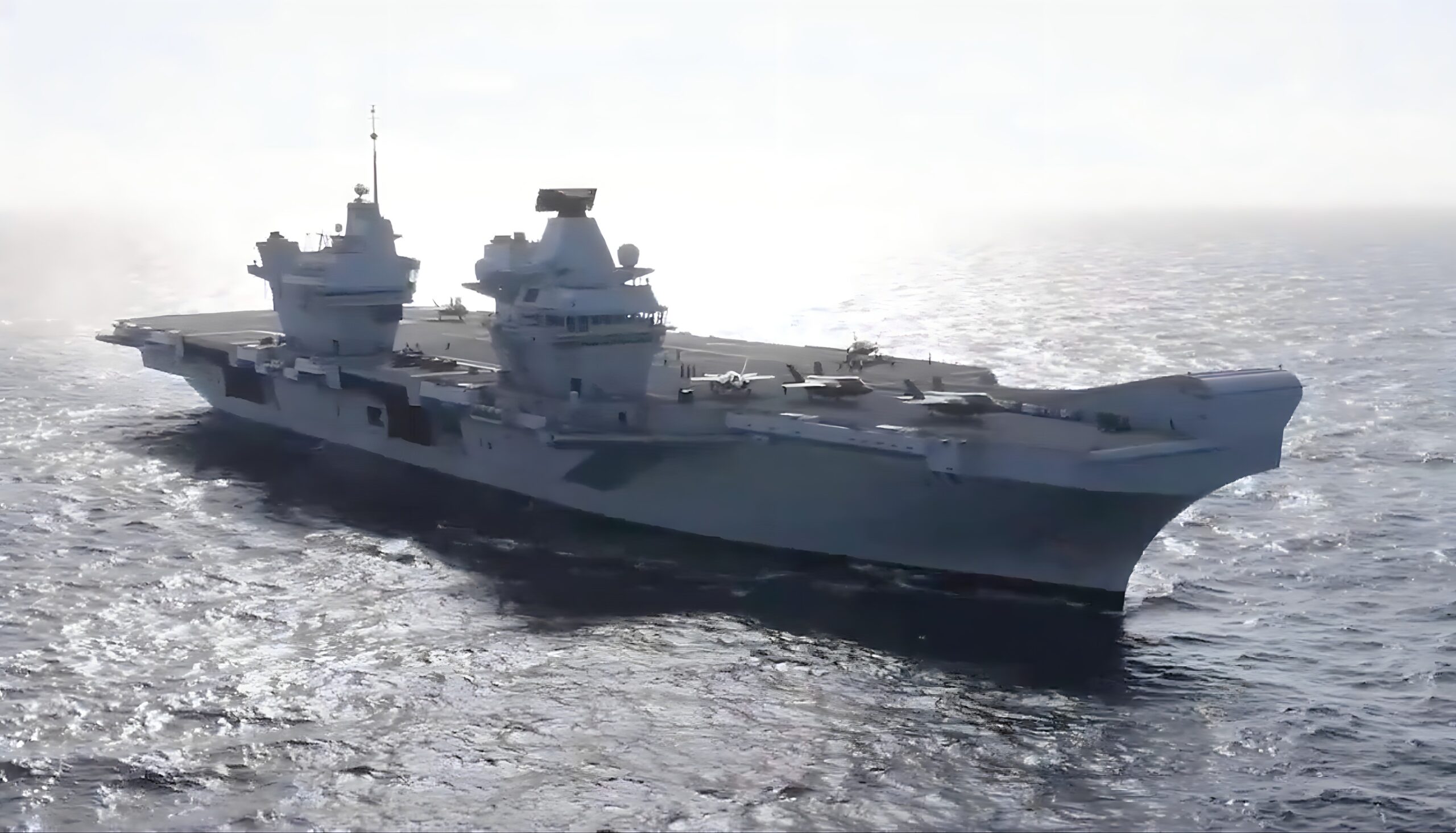
HMS Prince of Wales has arrived in Stavanger, Norway, following the completion of Exercise Tamber Shield, the carrier announced via social media.
The port call marks a pause in what has been an active deployment to Nordic waters for the carrier strike group, which departed Scotland earlier this month. The group, which includes Type 45 destroyer HMS Duncan and tanker RFA Tidespring, is operating under the staff of Commander UK Carrier Strike Group and is expected to continue into the High North for further NATO tasking including Dynamic Mongoose, the alliance’s primary anti-submarine warfare exercise in Northern Europe.
The UK’s Flagship, HMS Prince of Wales has arrived in Stavanger following Exercise TAMBER SHIELD. Working with partners and allies, she remains ready to continue operations in the North Atlantic and High North. @RoyalNavy pic.twitter.com/lw7lF2ekco
— HMS Prince of Wales (@HMSPWLS) May 14, 2026
Exercise Tamber Shield, conducted in the fjords near Bergen, focused on defending high-value assets against swarm attacks from small, fast-manoeuvrable threats in confined waters. The drills involved Wildcat helicopters of 815 Naval Air Squadron, P2000 patrol boats, and Norwegian missile craft operating alongside the carrier group.
The exercise is designed to replicate the kind of threat environment that a carrier strike group could face in the confined and contested waters of the Norwegian fjords, where geography limits manoeuvre and places a premium on layered close-in defence. Developing the tactics, techniques, and procedures to defeat coordinated small-boat and aerial swarm attacks in such terrain is a growing priority for NATO navies, informed in part by the proliferation of cheap uncrewed platforms observed in recent conflicts.
HMS Prince of Wales is the second of the Royal Navy’s two Queen Elizabeth-class aircraft carriers, displacing around 65,000 tonnes and stretching 280 metres in length. The ship can embark up to 36 F-35B Lightning II aircraft alongside a complement of Merlin and Wildcat helicopters.
The carrier is propelled by two Rolls-Royce MT30 gas turbines and four diesel generators feeding an integrated electric propulsion system, giving a top speed of 25 knots. With a ship’s company of around 700 and the ability to accommodate a total complement of up to 1,600 including an embarked air group and staff, the Queen Elizabeth class represents the largest warships ever operated by the Royal Navy.
Stavanger has historical significance for the Royal Navy, having served as a base for allied operations during the Second World War and remaining one of Norway’s principal naval ports.


Really, another deployment without any air group.
Exactly what is the point of a Carrier without ac? Answers please to the First Sea Lord!
It has an air group, just not comprised of F35s which don’t have an anti submarine capability last time I checked…🤡
It is not a helo carrier, it is an aircraft carrier with no jets.
Strictly speaking are helicopters not aircraft?
I’ve gained $17,240 only within four weeks by comfortably working part-time from home. Immediately when I had lost my last business, I was very troubled and thankfully I’ve located this project now in this way I’m in a position to receive thousand USD directly from home. Each individual certainly can do this easy work & make more greenbacks online by visiting
following website—.,.,.,.,.—>>> JobatHome1.Com
Then it’s useless to use a 70000 tonnes platform for this exercise. This is why selling HMS Ocean and not replacing it was not a good idea. The Royal Navy is already strapped for money and deploying a carrier is not cheap, especially since a smaller helicopter carrier could’ve done the same job apparently.
Using an aircraft carrier as a helicopter is a waste of money and manpower!
It’s always a great idea to send a fleet carrier with a virtually non-existent air group and inadequate escorts to go look for submarines. # HMS Courageous
Great post. It is a white elephant.
At best a helicopter carrier with few escorts and I bet no sub as only operational astute is off Gib.
What would you know about it ? Has Iran surrendered yet ?
Jonty, we deployed CSG25 last year and the carrier had up to 24 fifth gen stealth aircraft embarked – that is an Air Group. It is only the very ill-informed ‘man in the street’, rather then commentators on UKDJ, who keeps shouting ‘Wot, no planes!’. The UK has 47 F-35Bs.
Our carriers have 4 roles, not all of which require a sizable F-35B Air Wing embarked. Our carriers also carry out specific exercises and evolutions for which jets are not required.
This exercise is ‘focused on defending high-value assets against swarm attacks from small, fast-manoeuvrable threats in confined waters’ and ‘to defeat coordinated small-boat and aerial swarm attacks in such terrain (fjord terrain).
It has been deemed by those rather more expert than you that the deterrence and defeat tasks are best met by a T45, Wildcat helicopters of 815 Naval Air Squadron, P2000 patrol boats, and Norwegian missile craft. Clearly in this exercise we don’t need 24 F-35Bs to simulate attacking small-boats and aerial swarms.
Just for a brief moment, I thought It said Exercise “Timber Shed”.
silly me.
You need to be taken to the woodshed sometimes.
Thanks ! 😁
I saw something nasty in the timber shed, a mirror.
Nice move on Norway’s national day.
Absolute sublime piece of role enactment for a modern ac Carrier acting as as a bullet magnet while no pkanes on-board!
Why all the hate?
Now that this tactic has been tried and tested we can forward her to the Gulf with minimal crew and get her to engage Iranian craft for which the US will be eternally grateful for a nano-second and we will sink a huge piece of budget.
What a great plan!
All those Admirals with no ships doing foxtrot alpha and they have this planned.