

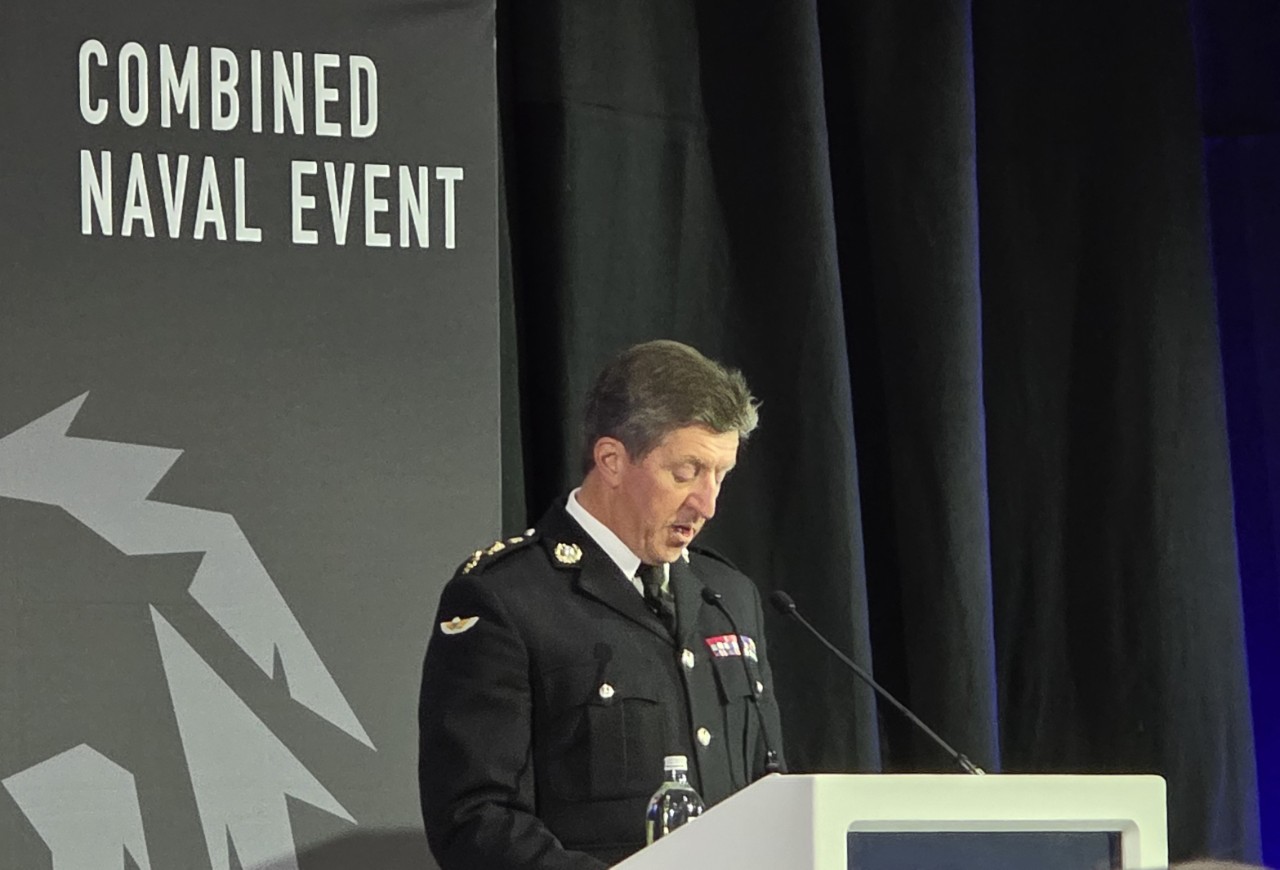
General Sir Gwyn Jenkins, First Sea Lord and Chief of the Naval Staff, spoke today at the Combined Naval Event in Farnborough to set out three priorities for the Royal Navy: building a hybrid fleet capable of warfighting, deepening the partnership with industry to deliver it, and forging a persistent multinational maritime force with Joint Expeditionary Force partners in the High North and North Atlantic.
Jenkins, who took up the role one year ago as the first Royal Marine to serve as First Sea Lord, described the geopolitical environment as more volatile and dangerous than at any point in his career. He pointed to Russian activity in the North Atlantic, the ongoing war in Ukraine, and the lessons emerging from the Middle East as drivers of urgency. “The capable status quo is not good enough, not anymore,” he said. “Freedom is not free.”
Jenkins was blunt about what the evidence from recent conflicts had demonstrated. “Drones and autonomy have rapidly become the dominant and decisive factor in the modern battlefield,” he said, adding that anyone who had watched Russia massively increase its drone capability and production over four years would understand how much things had changed. He said the Royal Navy had no time to pander to hybrid sceptics. “We have no time to pander to cynicism or traditionalists, because autonomy is already demonstrably changing the nature of warfare, as evidenced in Ukraine and in the Middle East.”
His vision for the hybrid fleet was summed up simply. “Crewed where necessary, uncrewed wherever possible, and integrated always.” War games had demonstrated that the hybrid model delivered a substantial uplift in combat mass, additional tactical flexibility, and a threefold increase in missile capacity compared to the current fleet. “The case for hybrid is clear. The task is now to get on and deliver it.”
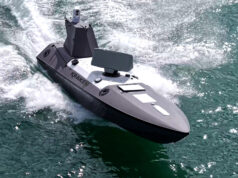
Jenkins confirmed that the first 20 Beehive autonomous boats from Kraken had been delivered, with the first ten arriving in just six days, and that the system would reach full operating capability within 12 to 14 weeks of contract signature. “This is the definition of an agile partnership,” he said, adding that Beehive would be among the first hybrid systems deploying to the Gulf as part of the multinational Strait of Hormuz mission. He described the ability to deploy autonomous sensors and effectors at scale in a congested chokepoint as conferring a clear operational advantage.
Turning to industry, Jenkins called for a fundamental change in how procurement is done, moving from multi-year acquisition models to iterative spiral development, enabling commercial and classified technologies to develop side by side, and allowing talent to flow more freely between the Navy, industry, and academia. He said current regulation was not fit for purpose and expressed hope that the Regulation for Growth Bill announced in the King’s Speech would provide the means to change it. “The navy of the 2030s cannot be created using processes from a bygone age,” he said.
Jenkins also addressed the ongoing Russian threat directly, warning that Moscow was seeking to exploit the current focus on the Gulf. “We must not lose our long-term focus on the North, on our backyard, because it is here that Russian surface and subsurface activity continues to pose the most acute and persistent threat every single day to our critical national infrastructure and the continuous at sea deterrent.” He said the Royal Navy had been expending significant resources with allies to disrupt and deter Russian submarine activity in recent weeks.
His ambition for the JEF was to move beyond episodic exercises toward a persistent integrated multinational maritime force with real capabilities, real war plans, and real integration. Jenkins confirmed that JEF chiefs of navies would meet in the coming weeks to convert a statement of intent into a concrete proposition, with a full formed plan ready for implementation by autumn. “By the autumn, it is our firm intention that a full formed plan is ready for implementation. That sounds like we’re moving fast. It’s because we are, and it’s because we must.”




This is nonsense, everyone knows that since the battle of Jutland that the Royal navy should have 36 “escorts” any talk of drones at the expense of frigates is just another labour government cut 😀
Let It go now Jim, let It go. 😁
I’ve gained $17,240 only within four weeks by comfortably working part-time from home. Immediately when I had lost my last business, I was very troubled and thankfully I’ve located this project now in this way I’m in a position to receive thousand USD directly from home. Each individual certainly can do this easy work & make more greenbacks online by visiting
following website—.,.,.,.,.—>>> JobatHome1.Com
Fuck off
It’s not a cut, as the cuts already happened and the convenience of Drone tech arriving gives HMG and 1SL a figleaf to hide behind and concentrate on.
Going forward, I’m keen to know how these autonomous ships deploy, alone, to say the South Atlantic in such a scenario. Will they have the several thousands of miles range of conventional types? If not, what’s the solution?
One assumes that they will still need the RFA, and Carriers, to give air cover, and crewed vessels in the mix as well.
So 8 T26 and 5 T31 it is, the 6 T45 will I guess be replaced by fewer manned hulls with the autonomous alongside.
Having read on NL what he says I’m dubious that T83 and MRSS will ever happen, a nice saving for HMG.
Agree with more cheaper mass though, I’ve suggested differing tiers for years as the only way to balance quality and quantity.
But alongside, not instead of, and that’s where I forsee problems ahead.
Send him an Email Dan,
Go on, I dare you 😁
Don’t need to, sites like this give one a chance to state an opinion and gauge others views. Which is just that, an opinion, from a nobody.
Nothing more.
I’m still hoping all these smaller assets give a chance for the admiralty naming committee to resurrect some names.
Nah.
Sites like this are for people like us to have a soapbox of our own.
Nobody takes any of the comments seriously.
I keep telling people this but they don’t get it.
Do you really thing anyone takes anything said on here seriously ?
Email your MP, that’s what I do when I’m frustrated at certain events. After all, that’s their job to represent us Halfwits.
Nothing personal, just obvious observation that I have mentioned many times before and why I just don’t take this comments section, seriously. It’s pointless getting all serious mate.
Go on. I’ll bite. How can I take your comment seriously, Halfwit?
You’re really not meant to.
That’s why I write such drivel, nobody cares. 😁
As people on site might have not, I’m not a big fan of all the drone stuff that is cons peddled out. But having said that, I’m interested in the concept of force multiplying designs in particular the submarine aspects I m not sure how quickly drones like the XLUv Excalibur can be produced. Weaponised versions forward deployed in great numbers around the world a very big fleet of these makes good sense cand reduces the need TO RUSH INTO A rush a new type of SSN.. HOW FAST DO THEY GO? HOW LONG TO BUILD ONE? Something that will fit into a container is small enough to be churned out at a goody rate.
A priority might be best to make one that’s actually hard to shoot down
The reality is blue water drones are not a proven as yet. There are issues that need resolving.
1) maintenance and repair, the sea will kill a ship if it’s power/ propulsion fails and this does happen. Now that’s fine if it’s a cheap as chips 12 meter drone, but a 80-90 meter blue water drone, with high end sensors and very expensive effectors.. your not going to want to loose what is probably 200 millions worth of gear because it lost propulsion.
2) sub kinetic conflict.. our enemies will play games with autonomous vessels.. accidentally ramming them etc etc and unless we are at war and going kinetic what are you going to do.
If airborne drones are anything to go by a blue water drone won’t last five minutes
As most drones at the moment are one way attack drones they are not likely to last long are they?
Is it just me or ls too much being placed into the wrong areas of defence? I am utterly sick and tired of the word drone, autonomous, unmanned?
Plenty more descriptors out there: uncrewed, crewless, remotely operated, remote controlled, robotic, automated.
Probably because it isn’t 1975 anymore.
Ask Russia
Ditto. Cant help but look at the majority of states using these weapons and shudder at the thought of being like them
The US airforce experimented with drone bombers in the Second World War. It’s nothing new, just that multiple technologies have converged to create a huge leap in capability. I think the naval drones being talked about for the near future are supposed to supplement crewed ships not replace them.
I think you have it the wrong way around. Not enough money is going into what you would call the right areas. Hybrid is not a bad idea, but we can’t fight with it in 2029. Not because we can’t get the drones, but because we aren’t spending enough on the blue water platforms that will be needed to partner them and more importantly their crews. Lean crewed is one thing. Not being able to run a Navy because of a lack of crew, quite another. For the last decade, we’ve had neither the crews nor the maintenance infrastructure, and that hasn’t changed. Get the RN and the RFA sorted in terms of people, and we’d be far stronger.
I’m very sceptical about the feasibility of large autonomous vessels.
An oil tanker may operate with 25 crew, yet a QE needs @ 700 people to sail and maintain it, assuming no air wing is embarked. Given the paucity of on board weapons, what are they all doing?
One of the advantages of UCAVs is persistence – allowing ground crews to rotate during a long mission. If a large autonomous vessel is expected to deliver similar levels of persistence, it will have to be built to high standards of robustness, have long range since RAS would be impossible, and a level of mechanical reliability rarely if ever achieved in manned warships. If it also has a full suite of sensors and a sizable load of effectors, the costs are likely to be close to those of manned warships.
The RN has been appalling at keeping ships and submarines at sea. Why would they do better in sustaining autonomous vessels that have no on board running repairs?
An arsenal ship, with targeting data supplied by a conventional warship, could operate much like a lightly manned oil tanker does now. But the naval equivalent of a loyal wingman isn’t credible.
This is the peril of getting a Royal Marine as 1SL. He is too niche.
The worst parts are he does not specify what kind of drones and where he will make the cuts to pay them…
In all fairness this is just a snippet of a speech, not the actual plan. I think he’s realised nothing major will change from government and in the spirit of ‘you can only p*$$ with dick you’ve got” has been trying to find a way to regenerate sufficient mass to do something.
That’s far better than burying your head in the sand and hoping things will improve.
Maybe. But then what. A River class drone size is probably the minimum for some oceanic capability but then don’t even have the speed to escort major combatants. Maybe most human stores and space can be traded for more powerful engines, but will have margin for sensors, missiles, and also fuel? if it do not have refueling at the sea capability needs to have a big range. It will always need a helo platform for support reasons at the least- i dont expect “humanized” robots to be at the sea for 30 years. And the price for all this will be in xxx millions. So instead of 5 T31 8-10 of this depending on sensor, missile expense…?
Ultimately and it has been stated on countless occasions, the UK is a financial basket case and cannot afford to parade around like it was still important in the world. Reality is now hitting home.
The UK is stoney broke. It can’t afford to fritter money on vanity projects. Best keep the country’s noses out of other country’s business.
Uh? UK is not broke… it is just a social democratic addicted country that just spends too much money…
As opposed to the non democratic countries that spend too much money
Show me a country that doesn’t spend too much money
The UK has one of the lowest government debt levels in the G7 and it’s far far less than China
I hate to be called ‘a slow thinking cavalry person as the tank appeared on the battlefield’ but I genuinely feel the ‘Hybrid Navy’ is not going to happen as described, at least not with large vessels carrying effective numbers of real effectors, sorry.
1st Sea Lords tone suggests no more high end/costly bits of kit, I wonder if they’ll be tempted to reduce type 26 buy (well you know Norway will be out there eventually with type 26!!)
Of concern is the possibility of no more orders for Babcock….they haven’t enhanced their reputation as a reliable/competent ship builder by having to own up to building the first 2 type 31’s out of sequence and having to re do earlier construction. Would HMG be willing to trust them to build more ships??
The Danes who want frigates will also be aware of that and may take fright and opt for other builders.
Babcock pull your finger out and get a ship completed and out on sea trials.
I’d like to know if this influenced Sweden’s decision in private…
We are the 5th richest nation in the world(just overtook India) and this guy 1st Sea Lord comes up with this Sh*t statement , I will vote for any party that will increase military spending thats needed and get rid of this guy.
“Freedom is not free”. I hear there’s a hefty fee.
I despair that this bootneck is the First Sea Lord, and the general obsession with technology and saving on personnel in the MoD and UK Armed Forces.
Still need “real ships” for “real presence” and at least as “motherships” so hopefully a right level of mix of both ships, drones and subs. Other countries will do the same, it’ll still be a bunfight, lots of screen time but need to watch out for all the “non-drone” stuff that could happen.