

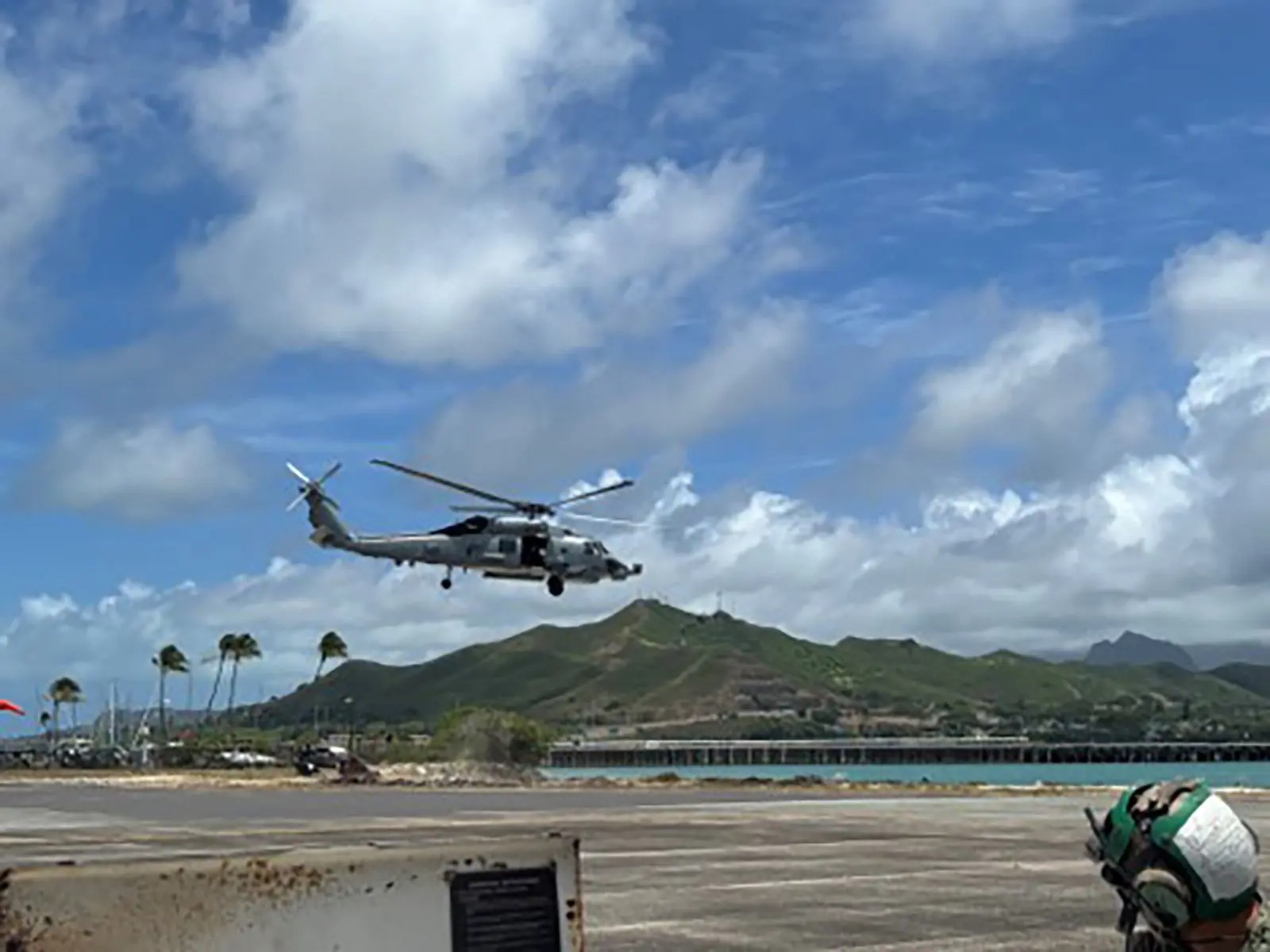
Lockheed Martin has demonstrated an artificial intelligence system for anti-submarine warfare aboard United States Navy MH-60R helicopters during RIMPAC 2026 off Hawaii, retraining the software on newly encountered underwater sounds and pushing the updates back to aircraft in flight, according to the company.
The system, called SensorMAX, takes acoustic data from sonobuoys dropped by the helicopters and monitors it continuously, feeding a stream to the aircrew while also sending information to a ground station. When a new target appears, operators on the ground label the noise signature, retrain the model on that data and transmit a small update packet back to the crew. Lockheed Martin says each retraining cycle takes under five minutes.
Two MH-60R helicopters equipped with the system flew a series of missions against an undersea threat during the exercise. According to the company, the interface allows aircrew to manage up to eight sonobuoy feeds at once, twice what existing equipment handles, and the updated models were sent to the helicopter and the wider fleet over an encrypted data link. The company states the exercise showed that helicopters paired with AI acoustic analysis can detect and track underwater targets faster than traditional methods.
Devon Rodgers, vice president and general manager for undersea mission systems, said in the release that “today’s battlespace requires the defense industry to accelerate capability delivery and seamlessly integrate commercial technology”, adding that the company is investing its own money in maturing AI capabilities so the Navy has the technology it needs.
Lockheed Martin describes the software as portable and sensor-agnostic, capable of processing data from different sensor types and of running in the air, at sea or ashore. Over-the-air delivery of the model updates is enabled through a collaboration with FUSE Inc, which the company says allows trained models and mission software to reach deployed aircraft without interrupting operations.
Sonobuoys are expendable listening devices dropped into the water in patterns, transmitting what they hear back to the aircraft by radio. Interpreting those signals has traditionally rested on the skill of the sensor operator, a role that takes years to train and one where the volume of data has grown faster than the number of people able to read it. Placing pattern recognition software alongside the operator is intended to narrow that gap, and similar work has been pursued for the P-8A Poseidon and in various NATO programmes.
The MH-60R Seahawk is the US Navy’s primary maritime helicopter, flown from cruisers, destroyers and carriers, and carries dipping sonar as well as sonobuoys along with torpedoes for prosecuting contacts. The type is also operated by Australia, India, Denmark, Norway, Greece, South Korea and others, and has been offered in several further competitions.
RIMPAC, the Rim of the Pacific exercise, is held every two years around Hawaii and is the largest international maritime exercise in the world, routinely involving more than twenty nations and dozens of surface ships, submarines and aircraft. Anti-submarine warfare has become a growing focus of the exercise as the Chinese submarine force has expanded and Russian boats have returned to Pacific patrol patterns, and the event is frequently used by industry to trial equipment in an operational setting alongside participating navies.



Perhaps it’s time for the US Navy to look at a S-3 Viking Successor with AI Anti-submarine Technology..?
Best existing solution would be the MQ-9B SeaGuardian.