

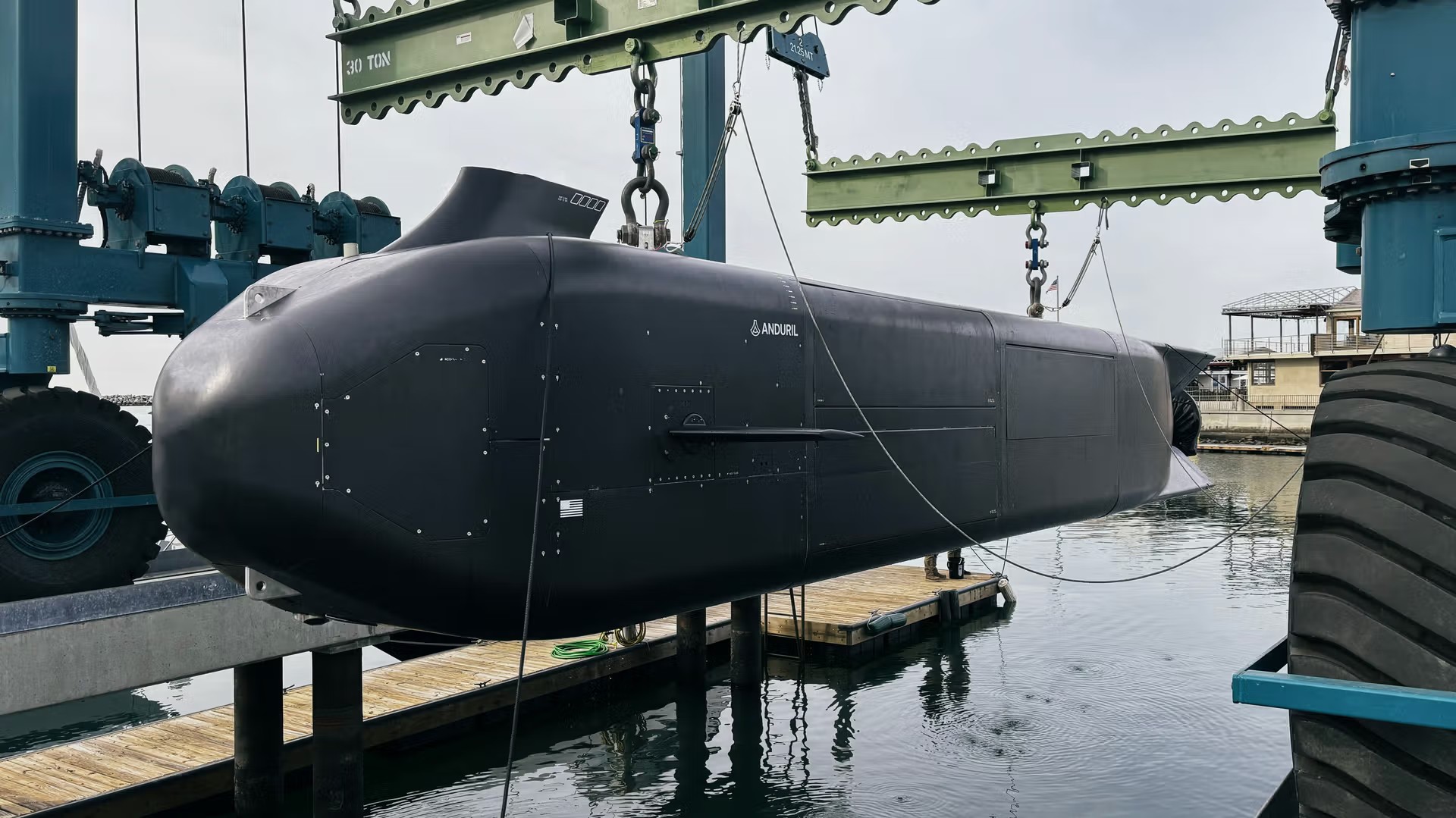
The U.S. Navy and the Defense Innovation Unit have selected defence technology firm Anduril to participate in a programme aimed at developing extra-large autonomous underwater vehicles, intended to help address operational gaps in long-range undersea missions.
The selection forms part of the Combat Autonomous Maritime Platform Project (CAMP), a U.S. Department of Defense initiative designed to rapidly prototype and field extra-large autonomous underwater vehicles, often referred to as XL-AUVs.
Under the programme, Anduril will carry out a long-duration demonstration of its Dive-XL autonomous underwater vehicle within four months of contract award. The demonstration is intended to test the platform in operationally representative conditions and evaluate its endurance and range.
According to the company, the selection followed a competitive Commercial Solutions Opening run by the Defense Innovation Unit. Anduril said it had previously conducted what it described as the longest XL-AUV demonstration to date, designed to validate the platform’s extended-range performance and operational endurance. The company stated that its autonomous undersea vehicles have collectively completed more than 42,000 kilometres of operations and accumulated over 6,700 hours of mission time.
The CAMP initiative is intended to enable the U.S. Navy to experiment with extra-large autonomous underwater vehicles at scale and develop a pathway toward wider operational use of such systems.
The company pointed to its previous work with the Royal Australian Navy as part of the Ghost Shark programme, under which it delivered an extra-large autonomous underwater vehicle and a dedicated production facility. That project, Anduril said, demonstrated an approach designed to accelerate delivery timelines compared with traditional procurement programmes.
Production of the Dive-XL platform currently takes place in Sydney, Australia, while the company also operates a facility in Quonset Point, Rhode Island, intended to manufacture dozens of Dive-XL vehicles and hundreds of smaller Dive-LD platforms each year.




Apparently Boeing is desperate to get out of Orca, no surprise silicon valleys most questionable defence meme company wants to wet its beak.
These large UUV’s are probably useless for most tasks and anything they can do well is probably easily done by a sea glider, autonomous mine or smaller UUV for a fraction of the cost.
Perhaps you should write a letter to the Navy’s of US, UK, France, Spain, Germany, Italy, Japan, Australia, China, Russia etc etc etc and point out that every single one of their professional naval commanders is wrong and should stop wasting money by developing this technology.
The reasons for developing large UUV is because they have the range, payload and capability to do the tasks that none of the systems you mention can and where the only alternative is a manned mini sub.
And yet the people furthest along on the journey to XLUUV’s seem to be back tracking.
The laws of physics and economics appear to make their wide scale adoption difficult. To accomplish their mission they need significant amounts of power and communications. Power and communications are in short supply for any underwater vehicle.
The air force went through a similar progression ten years ago. Remember UCAV’s? Now the USAF is firing propeller planes off the back of trucks.
If I want a platform to go to sea and hunt warships I don’t need a XLUUV I can just send an autonomous USV or a torpedo/mine out on its own.
If I want to cover a large area with sensors I can send sea gliders.
If I’m sticking a sonar 2076 on something then I probably want a man near by to make sure it doesn’t become Russia salvage or just malfunction and beach on some arctic islands thousand of miles from home.
From what I know these are the reasons Boeing wants out of XLUUV.
For low speed fuel cell or even nuclear battery might well work.
These things are not supposed sprint around.
If they need to be told to phone home that can be stimulated via ELF out of routine or they can periodically inductively couple to distributed transponders on the seabed.
Lots of solutions to the inventive of mind.
Do they have to pay royalties to the estate of J R R Tolkien? 🙂