

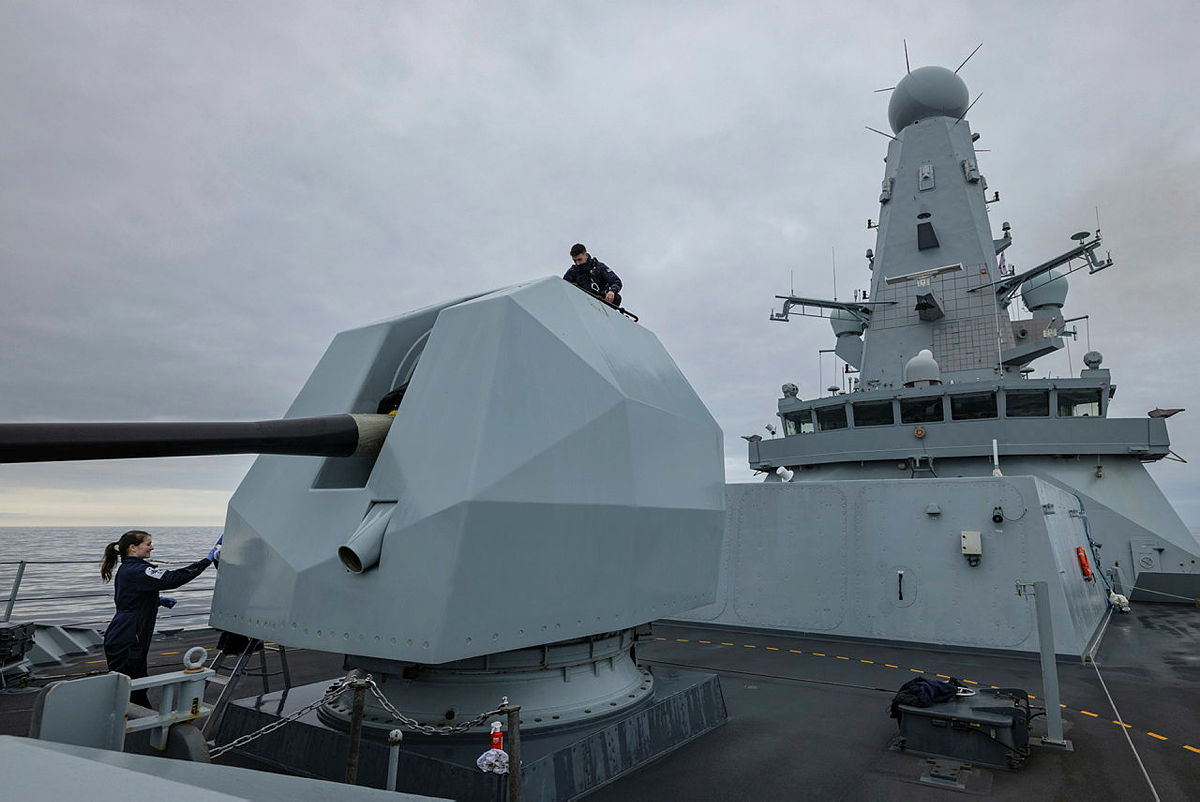
A Royal Navy destroyer has entered the Mediterranean Sea, approaching Gibraltar as it continues its deployment towards the Eastern Mediterranean.
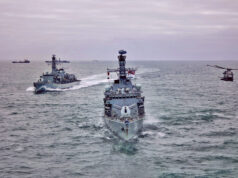
HMS Dragon, a Type 45 air defence destroyer, was sighted near the Strait of Gibraltar this morning as it transited from the Atlantic into the Mediterranean. The Portsmouth-based warship is en route to waters off Cyprus, where it is expected to bosot UK defensive capabilities in the region.
The vessel departed the United Kingdom on 10 March following a rapid period of preparation, with work that would normally take several weeks completed in a matter of days. Its deployment comes as the UK seeks to reinforce protection for British personnel and infrastructure, including RAF Akrotiri, which has faced recent drone threats.
As a Type 45 destroyer, HMS Dragon is designed primarily for air defence and is equipped with the Sea Viper missile system, capable of countering aircraft, missiles and drones over a wide area. The ship can also operate a Wildcat helicopter armed with Martlet missiles, extending its reach against aerial and surface threats.
The UK recently expanded its military presence on Cyprus at RAF Akrotiri with additional aircraft, helicopters and surveillance assets.
RAF Typhoon and F-35 fighter jets have continued conducting defensive air operations across Jordan, Qatar, Cyprus and the wider region in support of British interests and allied forces. The Ministry of Defence also confirmed that a Merlin helicopter is being deployed to the region to provide additional airborne surveillance capability.
HMS Dragon
HMS Dragon is a Type 45 Daring-class air-defence destroyer of the Royal Navy. Built by BAE Systems on the River Clyde, the ship was launched in 2008 and commissioned in 2012. She is one of six vessels in the class designed to provide area air defence for naval task groups, replacing the Type 42 destroyers. The ship is based at Portsmouth and typically operates with a complement of around 190 to 200 personnel.
The principal capability of HMS Dragon is advanced air and missile defence, delivered through the Principal Anti-Air Missile System (PAAMS), known in Royal Navy service as Sea Viper. The ship is equipped with 48 Sylver A50 vertical launch cells capable of firing Aster 15 and Aster 30 missiles, with engagement ranges of approximately 1.7 to 30 kilometres and 3 to 120 kilometres respectively. The system enables the detection, tracking and engagement of multiple aerial threats simultaneously. Future upgrades under the Sea Viper Evolution programme are intended to introduce a ballistic missile defence capability. Plans across the class also include the integration of Sea Ceptor, which would replace Aster 15 and allow the full missile silo capacity to be dedicated to longer-range Aster 30 interceptors.
In addition to its primary air-defence role, HMS Dragon carries a range of weapon systems for surface and close-in engagements. These include a 4.5-inch Mark 8 naval gun, two DS30B 30 mm guns, and two Phalanx close-in weapon systems for point defence against incoming threats. The ship also carries heavy and general-purpose machine guns for force protection tasks. Anti-ship capability was originally provided by Harpoon Block 1C missiles, which were withdrawn from service in 2023, with a planned transition to the Naval Strike Missile in due course.
The ship has an embarked aviation capability supported by a large flight deck and enclosed hangar. HMS Dragon can operate one or two Wildcat helicopters, which may be equipped with Martlet lightweight multirole missiles, Sea Venom anti-ship missiles, or anti-submarine torpedoes. Alternatively, the ship can deploy a Merlin helicopter configured primarily for anti-submarine warfare, typically armed with up to four torpedoes. This aviation component extends the ship’s surveillance, strike and undersea warfare reach beyond the capabilities of its onboard systems.
HMS Dragon has participated in a range of exercises and operations since entering service, including NATO deployments and multinational exercises focused on integrated air and missile defence. Type 45 destroyers have demonstrated their effectiveness in live-fire scenarios, including engagements against high-speed targets during exercises such as Formidable Shield, validating the performance of the Sea Viper system under operational conditions.




Its a pity that this excellent effort by the RN has been accompanied by so much negative press.
However for reasons beyond their control i think Iran 2026 will be looked on as the historic low point for the Royal Navy. The optics are terrible around this and whether the presence of Dragon is mission critical or not we still needed to show the world that we are relevant at the top table. The French were extremely lucky with timing which allowed their carrier group to be able to respond quickly and show skin in the game at short notice….again optics.
I hope we will be on an upward trajectory from here.
At the end of the day we as a nation are paying for decisions made 14-20 years ago.. the learning which will not be taken is that you cannot cut your navy based on present geopolitical and geostrategic conditions.. you cannot cut only assume the worst and build its using a worst case model.. because you cannot determine what will happen in 20 years time and so you must assume the worst.. essentially Cameron assumed the best possible geopolitical picture based on nothing more than hopes and dreams..
With Frigates, MCMV, RFA, amphibious, yes.
The T45s issue is province of the previous rabble, and lots else.
I’d have the lot interviewed on camera and shamed, but that’s not going to happen.
Given Blair hasn’t been prosecuted over Iraq, people aren’t going to be questioned over defence spending decisions…
Good point, Spock….yes, he should have been. As I said, it’s not going to happen.
Always amused me that Blair keeps coming up when they are talking about peace committees and the like for the middle east.
Yes it seem a bit obscene to me.. the irony is pure brilliance though.
While simultaneously condemning Starmer for not getting fully onboard with Trumps attack on Iran.
Guess once a warmonger, always a warmonger.
I think he just wants to be perceived less bad by being able to say Starmer also did it.
I’m pretty sure he knows that he’s universally despised in the U.K. for Iraq.
I think it does show that there should be some form of primary legislation related to a legal minimum capability around defence.. personally I think we should have a binding referendum on minimum capabilities.. if 30 escorts were enshrined in law then heads would have rolled.
Not really, as you would need to also legally define what an escort is etc, and that definition would rapidly get out of date. Plus the next government could just reverse the law, as there is a convention then no government can do anything that the next one can’t unwind.
What there needs to be is more honesty at senior levels of the mod /navy. If admirals had told the truth about cuts years ago they might not have happened. Well that and the need for the media to report the news rather than trying to influence it to their own agendas.
A referendum is unnecessary and quite frankly haven’t we had enough of those… 🫣
But there should be some set requirements or targets to meet/ maintain. The Bank of England has a requirement to meet 2% inflation, the NHS has various targets, councils, etc.
But I wouldn’t define it so legalistically. Couple of hundred years ago they might have said 30 ships-of-the-line… I’d define the requirements to be met, with it up to the MoD and the Armed Services to decide how. So a requirement to be able to defend British managed airspace: land or airborne warning(?), what mix of airborne intercept and SAM, etc could then vary as technology and tactics evolve.
It would need giving the MOD independence to spend it’s budget without policital influence, like the bank of England has. That will never happen as defence budget is heavily used in every country to win votes by creating jobs.
Yes, but… if you want to have sovereign capability then the flip-side is you have to create jobs in the U.K….
Give the work abroad, lose sovereign capability…
How do you get the balance?
I don’t believe in the modern era of sovereign capability as it doesn’t really exist. Every piece of kit needs parts from a huge global supply chain. Unfortunately you have to rely on allies helping. The aim should be to have a distributed chain so not over rely on a single nation like we rely on the US.
Yep indeed.. it’s a whole group effort. But the main issue is that the opposition should stay quiet during international crisis.. when it’s over they can pick fault to their heart’s content.. but while it’s going on total solidarity.. because they are not in the room so their job is to support HMG.
Especially as they were responsible for much or most of the losses.
Who was at fault is irrelevant. Now we need action and lots of it.
Quite.
Can you explain that to @Duker?
The cartoon in the telegraph yesterday was a brilliant skit on Len Deighton’s creation Harry Palmer. Harry Stalmer – THE IMPMESS FILE – an inaction spy thriller – with Harry holding a banana like a gun!
Historically this has been the convention. Parliament supports the government on international affairs during a crisis. Joy of popularism, is you need to constantly find something to complain about and side against.
Ironically they really should have kept quiet as it’s badly damaged their reputation with the voters, who are by and far in majority in favour of staying out of this mess.
In the case of the build up to WW2 very few MPs supported the Government in appeasing Hitler. Indeed the Government fell for that reason and Parliament supported Churchill who criticised his own Government and built a coalition based upon opposition support. If the Government is wrong it is wrong.
Time will tell if Iran was on the cusp of having a nuclear weapon thus forcing the hand of the US and Israel. If true the information should have been shared with the international community especially NATO with a view to united action.
The conservative are correct in saying now that vastly more defence effort is needed. Stuff what has happened in the past – that cannot be changed. Defence needs to be boosted and now or we are in trouble.
They said that pre 2024 GE, do convenient that they’d increase the budget after, knowing it’s a meaningless commitment.
I believe Labour are playing the same game now, delay to the next government.
And so the charade that any of them give a jot, until it’s too late, goes on.
Oral questions on Defence passed again today, with barely a murmur.
Yup, but there are now very frequent defence questions in the house and it has got through to people just how depleted our defences are. To a certain extent UK has been coasting forwards on its reputation.
Danielle clearly Labour are focused on what thie supporters are demanding which is not defence. Defence is one of those things that the electorite just assume the Government is managing. If every MP got tonnes of emails on Defence they might change thier tune but I feel that it is not a common topic. That need to change or we need leaders with a little more backbone.
👍
‘While press coverage has indicated that it is a short technical step from 60% enrichment to 90%, perhaps it is not evident to the public that 99% of the work needed to enrich the full stockpile to 90% has already been performed…
Starting in February 2021, the IAEA was no longer able to verify and monitor centrifuge manufacturing in Iran…
Iran’s supply of 60% enriched uranium, when processed to so-called “weapons-grade,” 90% enrichment, would provide the fuel for nine nuclear weapons. Importantly, starting from the 60% enriched material, a single cascade of 175 IR-6 centrifuges could produce the “weapons-grade” material needed for one nuclear weapon every 25 days.’
I will bow to your knowledge on the subject although I’m guessing that whilst T almost definately has experts to tell him that he might not have consulted them. The point is I suppose that if a person has reason to believe that they are about to be attacked that is normally reason enough to defend yourself (and others).
I only read what the IAEA puts in its reports.
We never used to mess around like this.
The Iranian regime would nuke Israel and, most likely, us (Little Satan) in the blink of an eye if they could.
We have unilaterally disarmed and put ourselves in great danger; our foreign and domestic policy now dictated from overseas.
Not good; really not good at all.
We thought NK would take quite Some time to Perfect the Bomb..! Wrong..! And its leadership is Not Considered quite as unpredictable as IRANs…Amazingly!
At the very different, at that point in 1936 there was not a true crisis.. it was more like the 2020 period, the crisis point was a major military defeat which caused the PM to resign.. Labour supported the conservative government as the loyal opposition.. individual MPs have the ability to bitch and whinge as they so wish.. but the leaders of the opposition parties they should not be..
I believe that the key reason was that Chamberlain was terminally ill. They also needed someone who parliament and the public could get behind. Churchill saving the expeditionary force was the key. Remember we are not at war at the moment and nor should we be. The potential argument is of we should be defending international shipping lanes and allies from a war in the region. I suspect we should ignore the personalities involved and do the right thing with the assets at hand.
The US security chief resigned stating there was no evidence that Iran posed a threat to the US and the US got played by Israel. The UK and Europe plus the UN nuclear watchdog has been stating for a while that their wasn’t also. Nazi Germany was a very different story.
Not to mention that trump has used the war as an excuse to start trading with Russia again, and has effectively destroyed NATO over his comments and threats, increasing the threat to europe and the UK.
Kent might be right however the at the same time he might be wrong. There has been bad blood between Iran and the US for many decades (and the UK has not had a perfect relationship). The US elected Trump to make this sort of call for his country and potentially for the defence of Israel if asked. Not a wise move if Iran had planned such a strike however the leaders of Iran have made some dubious decisions over time.
No question Iran is a problem, but going in without a plan isn’t a solution. Just makes things worse.
In 2013, Miliband orchestrated parliament’s opposition to Cameron and any discussion of intervention in Syria after Syrian use of chemical weapons.
That spineless decision by parliament led to Obama failing to act in support of his ‘red line’ and arguably destroyed Western deterrence leading to the chaos we see today.
Incidentally, it is Miliband’s expensive pursuit of net zero that prevents this country rearming…and his, again orchestrated, opposition in Cabinet that bullied the hapless PM into initially refusing use of UK bases to the US.
That was a formal vote in parliament.. if parliament is asked for its views then that question asked can and should be debated.. miliband did not criticise the government.. he argued a point.. he may or may not have been wrong.. in that particular case 39 of the governments own MPs voted against it… votes are fine..scoring political points in the media and doing down your own nation is not the role of the opposition in a crisis.
It was party political, as is the government’s decision making at the moment.
‘Until last night’s extraordinary defeat of the government (the last time a prime minister lost a vote over an issue of peace and war was in 1782), Ed Miliband was facing one of the most politically dangerous decisions of his leadership. Having wisely refused to either rule in or rule out the use of military action against Syria until after the UN weapons inspectors had reported, he would eventually have had to come off the fence. Either position would have been fraught with risk. Had he supported intervention (as seemed most likely), he would have faced a significant Labour rebellion with further frontbench resignations (shadow transport minister Jim Fitzpatrick stood down in advance of last night’s vote). Had he opposed it, he would have run the risk of being confounded by a successful operation.’
He let not just the country but the entire world down. Russia went on to use CBRN agents on UK soil, killing one British citizen and badly injuring a policeman.
That is what happens when politicking replaces credible deterrence.
Start with the arch cretin cameron
Correct, there’s no such thing as Hard Power on a budget.
Coincidentally what is the origin of the word Budget? Budge it…to the right?
Not so long as 14-20 years. It is also decisions taken during that period. Constant delays in construction to save money in recent years and decommissioning ships early that might be nackered but would still do a job, plus putting off maintance resulting in said state.
The last conservatives government and now most of the reform MP (former conservatives) should be keeping a low profile over this, as they are to blame for this mess. Not 100% as also the last labour added to it, but certainly high percentage and instead the media let’s them point fingers at the current government.
That’s how most politicians make policy decisions on any topic. Either ‘best possible’ scenario, or ‘implausible, happy-clappy fantasy-land’ scenario.
Jonathan, you are correct about long-term planning, and that is something I’ve been writing about on this site for a long time. The T45 order for six was a mistake considering the number of County Class and Sheffield Class destroyers that went before them. The chickens have come home to roost, and any T45 replacement must be in realistic numbers. As for the future, it has to be China and its global ambitions, especially naval. I fear dominance and the possibility of exclusive portage or even forceful rerouting of critical Western trade routes. With adequate planning now, the RN’s contribution to combined naval challenges with friends and allies will ensure the freedom of international trade routes. The concept of much-reduced crew numbers to assist increased numbers of hulls is the most likely way forward, and one that could be applied to a batch 2 Type 26 if such an option is feasible.
Really you cannot compare the numbers of County and T42’s with T45.
Yes, there should have been 8 T45’s – building 12 of them was never really going to happen particularly after Horizon fell apart.
UK should focus on moving forwards to building more of what we have hot production lines for where costs are known.
Sadly you can; one has to remember that both County and Sheffield were state-of-the-art vessels, and their true value came during the Falklands War. Had we had a carrier group, both Sheffield and Coventry would probably have had cover via Gannet radar, and the County was hit by a primitive land-based setup. We should have built 12 Type 45s that would have allowed up to 6/7 sea-ready in a crisis as opposed 2?
All the money is spent on propping up thBBC and the migrants nissues
Well put, Jonathan.
Even for those opposed to war and military build up for its own sake the logic is unbeatable. You can’t pull a defence system together in a few years let alone the few days that may be your only warning. A healthy country needs to be on its toes with the ability to defend against what’s coming tomorrow.
Cameron was the arch typical smug Etonian with a stock broker as a father.
He and Osborne gutted the military.
How he has the theme try to attend the Cenotaph service each year, leaves me speechless.
I remember the program bark royal and the episode where Cameron stood before the crew to tell them how jolly proud by the country is of them all while neglecting to tell them that they were sailing back to Portsmouth’s on a ship that would be decommissioned on its arrival. not an uncommon occurrence either.
And yet the current government continues to cut, its clawed back the defense budget through NI and Tax rises which have neutered any rise now or in the future. It great to put on a pair of politically coloured specs of choosing but were 18 month into this government and we have nothing positive on defence, just a budget cut by the back door.
Yes, all relevant.
I was amused at the 8 sailors of MTXG deployed to the straights seen in the DT, representatives of E Sqn, the “Expeditionary” side of the MTXG that’s not tied to the 3 HMNBs.
How do they operate in a war zone if HMG decide to use them? The straights are not a benign environment.
How do they deploy the USVs without mother vessels beyond x distance from the shoreline?
Where are the mother vessels?
In effect, 24 MCMV in the late 90s early 2000s have been reduced to a handful of personnel, 1 Sandown in Faslane, and 4 Hunts in varying states in Pompey, 1, the ex HMS Brecon, as a training vessel.
Plus MTXG, with cutting edge USVs in minimal number as phase 2 keeps getting kicked down the road and has not been ordered yet, neither have the 3 LSVs.
Lots of chickens fluttering about HMG, the MoD, and the Admiralty at the moment, and oh!! The IRONY of that idiot Lord West being interviewed again bemoaning a lack of assets. Lord Carter was rolled out as well.
They can’t operate in a hot war zone, no anti-mine vessel can. The USN knows this.
Its even moved two of its LCS ships, that are assigned to the middle-east and configured for anti-mine operations, away from Bahrain to the safety of Malaysia!
Maybe this will be the kick up the arse and learning experience they need to show them that their autonomous boat fetish is a load of BS and that autonomous vessels are nothing more than adjuncts to actual ships…import adjuncts moving forward but adjuncts nonetheless.
This maybe the crisis that saved the Royal Navy… what’s betting the DIP gets binned and iteration V10.2 gets written.
Exactly. We’ve been banging that drum for a while!
Autonomous is fine, in ADDITION to, not instead of, hard warfighting assets.
Don’t give them another excuse to delay DIP!
Yes. I’m also of this opnion. Better they get it wrong immediately and move something forward. Changing minds can be done later, but only if you have a position to change. As long as it’s after April the Chancellor can ignore underfunding for another year, or can magnanimously kick in a billion in the summer and play the hero; the blame for indecision lies with the MOD although not the fault. If they delay the DIP until it’s perfect they will delay forever.
I’m begining to worry there will be those arguing for exactly that. MOD can’t plan correctly, therefore should not plan at all. Better to be nimble, agile, keep their powder dry. Only pay for anything where there is a rock solid case. Let the Treasury figure out the details and make sure MOD don’t overspend. That’s their job. And the Treasury does such a good job compared to the bungling fools at MOD. I can think of no worse conclusion. The DIP cannot come soon enough.
That is what is going on here – fame of chicken.
Treasury are saying no more cash till we believe your budget and stop hiding things.
MOD are playing the – it is urgent card.
Bit of silliness but i think DIP needs to move
into its CIP phase to
BIP…Buy it Please, and for right now AIP…Action it Please.
Release version 1
You can add to or takeaway from it afterwards.
The “still to be sorted” can go into WIP!
*CIP…Cost it Please
You are onto something there – more phases so more room for delay.
The ability to deploy from the shore line and not risk a mother ships would seem to be a bonus in the current situation. The vessel are autonomous and capable of operating outside line of sight.
Now that’s the thing. I’ve read up on these, as it’s an area I’m trying to get my head round, as in, how many RNMB, how many USV, what type.
Beyond line of sight? How far?
So what we’re saying is we will not use MCM tech again except in a fully benign environment?
That wasn’t the case clearing approaches in 2003.
And if these little things are out in the middle of the straights whose looking for other ships?
Without a mother or an actual MCMV on station nearby? An aerial Drone? Where? What? Do the MTXG co ordinate with Protector?
Fine tech, no doubt, and with systems at RN warship standards according to NL, accounting for their high cost. But for me the RN, like all of the military, rushes to dispose before new kit is fully ready.
And now, we have a big problem in the Gulf and 8 men. Whether we should become involved or not, we’d struggle even if we decided to.
🐔 🏠
At the end of the day the mine warfare bit is all a bit academic.. because Iran is essentially using learning from the Black Sea campaign.. small surface drones.. move a warship into an enclosed littoral with lots of small surface drones and your going to have a mission killed warship.. why do we think the USN is nowhere near the straits.. I suspect trump told them to go in and they informed him 1) we don’t have enough escorts for that ( the USN only has 90 escorts total ) as they only have 6-8 ABs in the western Indian occean.. 2) if we went in we would loss small number of escorts we had in short order ships..
Essentially the USN has found its limits.. yes it can plop 2 carrier battles groups into a region.. but it cannot control a littoral.. I’m not sure anyone now could… it’s been created around the dominance of the carrier battle group.. but the carrier battle group is a tactical asset for open sea control.. not slogging it out within 30 miles of the coast..
It’s profoundly interesting and makes choke points and areas where littoral combat will take place hugely more interesting..
1) a nation near a choke point can cut that point and there is nothing conventional naval forces can now do about it..
2) traditional naval forces can probably no no longer force a choke point
3) traditional navel forces can now no longer closes a choke point
4) littoral operations against a contested coast are probably now the naval version of the charge of the light brigade..you will need to accept massive losses..
Just imagine trying to undertake the Falklands campaign against a drone armed enemy with good ISTAR, it would have been suicide.
The simple truth is to force the straits trump is going to need a mass of escorts that only European, China and Japan can provide ( china has about 170, Europe has 120, Japan has 45+ ) it’s going to be pure pain.. ships will be mission killed.
In reality the only navy that is really set up to forcing a strait against drones is china.. because it build an entire sub navy to force a strait ( 72 well armed corvettes it can afforded to throw away like chaff.. because it builds them in about 12- 18 months in batch’s of about 12).
Basically I’m not sure what the US does other than..
1) reduce Iran to tinder by air which will take an age kill hundreds of thousands.. cost untold billions, murder the worlds economy and leave 40% of the USN loitering around the gulf for ever, all the while the worlds economy folds.
2) undertake a land invasion to secure the coast of the strait ( hundreds of thousands of troops for ever.. being slowly blown up)
3) give up…. Which will mean china steps in to rebuild, take over as the ally of choice for many in the region and make the US look weak and reduced, reducing even further it’s allies trust in it…
4) someone get the worlds navies to go into a shooting gallery to escort tankers.. for all eternity.. so tying up the European and allied navies giving Russia and china operational freedom across the worlds oceans..
It’s a mess beyond mess and why no American President has ever gone full on war with Iran.. I suspect Trump will soon announce victory and go for option 3 but everyone apart from his MAGA base will know he won the battle and lost the war.
‘Iran’s top security official, Ali Larijani, and the head of the paramilitary Basij force, Gholamreza Soleimani, have been killed in Israeli air strikes.
“Larijani and the Basij commander were eliminated last night and have joined Khamenei, the head of the annihilation programme, along with all those eliminated from the Axis of Evil in the depths of hell,”
Larijani would be the most senior Iranian official to be assassinated since the Supreme Leader, Ayatollah Ali Khamenei, was killed on the first day of Israeli and US strikes on 28 February.
They triggered a war that has spread across the Middle East, with Iran retaliating by launching missiles and drones at Israel and Arab states hosting US military facilities.’
The key to ‘littoral warfare’ was amply demonstrated in 1944.
Why have no warships been taken out by ‘Shahed’ drones so far? Warships move…Low and slow over sea with thermal day/night, digital auto C2/fire control, is a sitting duck.
An insurgency has already started in Iran. It has been started by an oppressed Arab minority.
Any sensible contingency plan would have factored in a transition from air/sea to land/air. There appears to be an element of making it up as you go along but the broad strategic thrust of removing enriched weapons grade uranium before ICBM/Nuclear warhead integration occurs must be the right way to go.
We support but we are not seen to support. We seem to be making it up as we go along also.
No warships have been hit because they are 200+ miles off in the ogin.. but them in the strait they will be seen and attacked..
Great we are killing a few people off we spent a decade killing Taliban leaders.. there is always another religious nut job to take over…they are extremists you can keep blowing them up..
And yet Shaheds have a range of 1000km+
The only conceivable reason for putting warships within the Straits would be for convoy escort/mine countermeasures..
Low and slow Shaheds would be sitting ducks.
In fact the only thing preventing convoys at the moment is insurance (business).
“The Iranian coastline that dominates the Strait and the northern Persian Gulf is not ethnically Persian, but overwhelmingly Arab.
Khuzestan Province, Iran’s southwestern littoral, is home to approximately three to four million Ahvazi Arabs who have faced documented discrimination, cultural suppression, and economic marginalization by Tehran. The province contains over 90 percent of Iran’s oil production capacity.
The Jamestown Foundation has documentedthat Ahvazi Arab militant organizations, including the Arab Struggle Movement for the Liberation of Ahwaz (ASMLA) and its military wing, the Martyr Mohye al-Din al-Nasir Battalions, have conducted attacks against oil pipelines, IRGC patrols, and regime infrastructure for over two decades.’
A decapitated totalitarian regime is like a headless chicken. Iranian C2 is in bits so someone has to pick up the pieces. Carpe Diem.
The key to victory lies, as usual, within a land/air campaign. The U.S. can either support an (already happening) insurgency or let the U.S. Marines get stuck in.
Air/Maritime Air has its limitations.
Good post. Silly questionsbit are these Shahed’s preprogrammed or guided in flight? If the later can these be interrupted in transit? Can their place of launch of be tracked?
‘Russian modified Shahed uses a combination of SatNav and inertial navigation. Integration of online cameras and modems allows real-time adjustment of flight trajectories and evasive manoeuvres. Shaheds approach at 2,000-2,500 meters then dive almost vertically onto targets.
Shahed drones are typically launched from mobile launchers disguised as civilian trucks, with each vehicle capable of firing up to five drones simultaneously. The Russians typically launch hundreds of these drones at once from multiple directions, with the unmanned aircraft following different routes, often navigating by cellular network towers.’
Germany’s Skynex GBAD system has worked well against low-altitude drone swarms clustered in small areas. Its 35mm programmable rounds cost $500 each and detonate near targets. Helicopters have emerged as the most effective means of destroying Shahed drones since the changed Russian tactics.
We should remember that we are at (cold) war with Russia and have been probably since we (and the U.S.) foolishly and unnecessarily, in my view, bombed Serbia in 1999.
‘…assistance to Iran is coming from Russia’s drone experience in its own war with Ukraine. Iran is getting firsthand knowledge of Russia’s tactical guidance on how many drones should be used in operations and what altitudes they should strike from.
Russia has also been providing Iran with the locations of US military forces in the Middle East as well as those of its regional allies…’
Ukraine has sent counter-drone experts to the Gulf region.
Difficult to jam due to inertial navigation, but that is not accurate against manoeuvring targets. Launch sites tend to be dispersed ‘Fred in a shed’ so can be located and suppressed but loads of them.
Clearly, the further away the launch sites can be pushed, the better…which, regarding the Straits, means diversionary insurrections in the interior of Iran and boots on the ground on the northern tip of the Straits…
Yes but the Shahad range is irrelevant because kill chain matters more than range. That is why drones are about the littoral.. essentially within the horizon of the shore, and it’s not really air drones which seem to be the big threat, it’s the surface drones..
Re land forces the simple fact is no matter the tribal and tensions, an outside army comes in they alway in short order become the invaders are hated by everyone and suffer a massive insurgency leading to an eventual withdrawal and the guys with the most will to do the most horrible things step back into power. It happens every single time, history does not repeat itself but it has a rhythm and the rhythm of a western army invading a Middle Eastern nation is always the same.. you can quote any mix of tribals groups and tensions it will be meaningless. Forces on the ground will need to be in massive numbers, play right into the hands of the nutters, take a decade and involve 1000s of casualties before the U.S. losses the will to live and abandons the place back to the nutters…
Coalition navies have been rehearsing tactics against swarms of small boats for some years now.
The U.S. is permitting Iranian and other vessels to transit the Straits for the time being.
The area of the Northern tip of the Straits is occupied by Ahwazi Arabs, the most persecuted minority in Iran.
REPMUS 2025 identified the requirement for:
‘Enhanced sensors, ISR, and command‑and‑control to spot low‑signature drones in cluttered coastal and convoy environments before they reach weapons range.
The integration of unmanned systems on the defensive side: coordinated drone and USV layers, not only manned ships, to screen ports and convoys.
Coalition interoperable C2, e.g. Ukraine’s DELTA system, which coordinated over 100 unmanned platforms’
All of this has been known about for years. A massive wake up call. But L3Harris could supply quick fix interoperable hand held C2 and comms off the shelf tomorrow for not much money.
In the Gulf, the U.S./Israel has air supremacy, AEW (Hawkeye, Crowsnest not tested in REPMUS), shed loads of helicopters and Uncle Tom Cobley.
SF/USMC limited in/out deployments, massive suppression of launch sites for the duration of a convoy’s passage through the Straits, 12-14 hours, will do the job.
The U.S. strategy is clear. Venezuela is an illustration. Clearly the intention is that decapitation will continue until they find someone that they can do business with. Meanwhile vessels supplying China, and others, are permitted to transit the Straits. Iran still receives revenue.
It is, of course, a complete shambles but the evidence from the IAEA regarding the Iran nuclear threat was an existential clincher for Israel; you know the rest…
It’s of a tin pot South America state run by people who are there to make money.. it’s a fundamentalist religious state.. governed by nutters who believe they will be rewarded in heaven.. it he’s treating it like corrupt South American criminal gang he’s a fucking idiot.
‘it’s a fundamentalist religious state.. governed by nutters who believe they will be rewarded in heaven’
Or not really…
‘Transparency International UK have identified up to £200million worth of UK property suspected to have been bought up by the Ayatollah…Mojtaba Khamenei, is claimed to own a string of mansions on ‘Billionaires Row’
‘…court documents from Turkey and the US contain evidence that Iran has been hiring criminal gangs to carry out killings on foreign soil…One name repeatedly surfaced in these documents: Naji Sharifi Zindashti, an Iranian criminal boss, known for international drug smuggling.’
the IRGC also developed a diversified business empire that helps finance the regime as well as its own military and ideological agenda. That empire includes core industrial sectors like oil and transportation as well as banking, telecommunications, agriculture, medicine, and real estate.
The IRGC uses affiliates to engage in business activities. For example, the Khatam al-Anbiya engineering firm has built refineries, a railway line, a dam, and a natural gas pipeline. It also controls Tehran’s international airport. These IRGC-affiliated foundations…accounted for more than half of Iran’s GDP…’
Umm since when has collecting wealth and power been an indication that someone is not an extremist nutter or the country will not attack any invaders..
Putting western or another boots on the ground in an Islamic country and not expecting a nightmare insurgency to occur is like not expecting the sun to set.
‘since when has collecting wealth and power been an indication that someone is not an extremist nutter or the country will not attack any invaders..’
You mean…just like Maduro/Venezuela?
‘Putting western or another boots on the ground in an Islamic country and not expecting a nightmare insurgency to occur is like not expecting the sun to set.’
Malayan emergency 1948-60
Borneo 1963-66
Oman Dhofar war 1965-79
Liberation of Kuwait 1990-91
Kosovo 1998-99
The key here is both fast in/out Commando raids to de-fang the IRGC in the vicinity of the Straits and (if requested) to support Arab and Kurdish insurgencies, short term.
Time to bin the expeditionary policy and go back to 5 process of being able and strong enough to wage war. Um fed up of this fast reaction/ deployment gif. When it takes five days to put a warship to see it shows it to be a folly
From my point of view (in Italy)… It seems like a piss take… We have been made to look fools…. I don’t give a monkeys about politics but this is our all time low…. The Italians laugh at our 18 knots and I can’t say much……. Starmer you traitor…. Tell the Muslims we are friends…. The world is watching… Rule Britannia……
Watching us sink further into the mire is the best we can hope for. Two big 🩶 ornaments do not make a navy. Yet some would believe it does
I obviously have no bad to say of our lads and lasses in uniform, they are the best, god bless them all 🇬🇧
Not sure it will have much to do, but its there if needed. Sorry its high lighted the sad state of the Bristish under armed forces. I do hear good things from friends in the Army that things are getting better and there does seem to light at the end of the tunnel. Will take years to put right the sad deline but it will get better just not yet which know we all wish it would.
Shame on those that let things get to the shoddy state that has embarassed the nation and annoyed those serving. They are doing the best they can with what little they have.
I obviously have no bad to say of our lads and lasses in uniform, they are the best.. God bless them all. 🇬🇧
I think what gets my goat is the amount of political crowing from the opposition.. in time of international crisis it’s the job of the loyal opposition to “shut the fuck up” and stand behind the government.. it’s what every opposition does… the fact it was on the conservative governments watch that the navy collapsed is besides the point.. at the point of international crisis other nations should see nothing but solidarity.. anything else is increases our perceived geopolitical and geostrategic weakness with our allies and enemies alike and that damages the UKs security situation..
What you’re referring to is the difference between politicians and statesmen…
The Conservatives did order T31 and T26 – very, very delayed!
They did but they had to cope with there being No Money after Labours Mismanagement. The two party system would only work if the Population received education in Economics divorced from Socialism as practiced by Labour, Liberals and now the Greens. I’m not saying the Conservatives had all the answers but at least they had some.
The job of the opposition is to hold the government to account. It would be a bit silly of the leader of the opposition not to criticise the hopeless indecision and incompetence of this government, particularly given that she said this in June 2025:
‘Iran is a direct threat to the UK and has been for years. Our security services have stopped multiple Iranian terrorist plots and assassination attempts on UK soil. Its ballistic missiles can reach Europe. We should support any ally that seeks to damage Iran’s nuclear programme and eliminate the threat posed by the terror-exporting Revolutionary Guards.
Anti-British sentiment is almost as central to the ayatollahs’ deranged ideology as their obsessive hatred of Israel and the United States. They use the term “Little Satan” interchangeably to refer to both the UK and Israel.
Iran uses influence through mosques, schools and fake charities to radicalise and corrupt our own population: taking advantage of our democracy to advance its theocracy.’
The opposition is doing its job, and being consistent, in stark contrast to the government.
Its perhaps because the 73 oil crisis was caused by just 7% of the world oil being cut off the opposition parties are concerned, we’re currently faced with 20% if the strait remains closed. Its irrelevant harping on about past governments the above fact has been know by this government and the last, the last has gone and this one has done nothing in 18 months that could conceivably be counted towards ensuring there’s not a crisis. Just a few weeks ago I read that the UK government state the gulf countries preferred us to train them rather than have presence, how wrong that was. As a grey empiricalist or rationalist its obvious.
Umm did I or you hear anything about withdrawal of forces from the gulf.. nope. And the US have actually withdrawn a lot of there own forces.. the littoral combat ships that are meant to do mine warfare are gone..
But in the end highlight why we got into crisis a or b should be done before the crisis or after the crisis.. not for political point scoring during the crisis.. during the crisis you shut the fuck up, unless it’s existential and must be said.
Trouble being, roo stand behind the circus of kier starmers government, is to invite more chaos. This is the most dislikew government and PM since Thatchers in the 1980’s.
I don’t disagree they are a bit shite.. but our problem is fragmentation and disintegration of consensus.. we need to protect that.. think of the slightly shite tug of war team all tugging in one direction, they will always beat the brilliant team that are all pulling in different directions.. that’s our modern political discourse.. but they are all a bit shite and all pulling in opposite directions on principle..
During the NATO naval exercise REPMUS/Dynamic Messenger 2025 off the coast of Portugal, Ukrainian forces leading the opposing team delivered a surprising result
A multinational naval group commanded by UkR officers used Magura V7 naval drones to penetrate the defences of NATO “Blue” forces to successfully strike multiple targets, including at least one allied frigate
In one scenario, the simulated attack hit the frigate so many times it would have likely sunk in a real combat situation.
The exercise included five scenarios involving convoy defence, port protection and convoy attacks. In every scenario, the “Red” force led by the UkR planners defeated the defending NATO group
A UkR source commented that the problem wasn’t that “they couldn’t stop us – they couldn’t see us”
The moment became even more surreal when, five minutes after one simulated strike, the NATO side asked “So, are you going to attack us or not?”
This was a powerful demonstration of something the Black Sea war has already proven:- Ukraine’s drone warfare is reshaping how naval battles will be fought in the future.
Yet there’s so many that still dismiss the usefulness of drones 🤦🏻♂️
And so many also dismiss the increasing impact of GBAD counterdrone interceptors.
‘One key innovation has been an acoustic detection network built by Ukrainian engineers from simple components. Mounted microphones and smartphones on poles were used to listen for the distinctive sound signatures of incoming drones and missiles before sending data through mobile networks to an AI system to track aerial threats.’
Countering low and slow is not complicated. We’ve been doing it since 1914. It simply requires someone who knows what they are talking about (from Ukraine), a delegated budget, a battlelab (which we have) and high level authorisation to get cracking.
Surface drones.. not airborne GBAD is sod all use to a ship being attacked in the littoral by small surface drones.. and that is what Ukraine showed in REPMUS.. 6 meter low to the water drones modern warships are not designed to counter them.. hard to detect, fast and small.. we have all watch the recordings of these Ukrainian drones dodging through light and medium gun fire as well as attack by small ship fights to hammer the target ship.. and in REPMUS they showed they can do exactly the same thing to a modern western frigate.. any navy that does not now recognise the extreme danger the littoral represents to large surface combatants is going to loss them.., why do you think the USN has not sent any escorts anywhere near the strait.. they are rightly fearful of an AB being overwhelmed by surface drones..
That will be a surprise to the RN procurement team that acquired Bofors cannon (with programmable ammo) and minigun systems, both specifically designed to counter both air and surface close in threats.
REPMUS 2025 identified the requirement for:
‘Enhanced sensors, ISR, and command‑and‑control to spot low‑signature drones in cluttered coastal and convoy environments before they reach weapons range.
The integration of unmanned systems on the defensive side: coordinated drone and USV layers, not only manned ships, to screen ports and convoys.
Coalition interoperable C2, e.g. Ukraine’s DELTA system, which coordinated over 100 unmanned platforms’
All of this has been known about for years. A massive wake up call. But L3Harris can supply quick fix Coalition interoperable hand held C2 and comms off the shelf tomorrow for not much money.
In the Gulf, the U.S./Israel has air supremacy, AEW (Hawkeye, Crowsnest not tested in REPMUS), shed loads of helicopters and Uncle Tom Cobley.
SF/USMC limited in/out deployments, massive suppression of launch sites for the duration of a convoy’s passage through the Straits, 12-14 hours, will do the job.
There are ships transiting the Straits right now. The only thing stopping expensive ships transiting is, frankly, business…
Costal and littoral.. there is an important distinction.. just look at the gulf.. the USN is not willing to go into the littoral due in the main to risk from small boats and autonomous systems.. but it’s perfectly safe sitting out to sea and pounding the hell out of Iran.. sea based drones have turned the littoral into a death trap.. but the high seas are still the domain of the major combatants..
If a mothership of sorts use its drone buddy ships as a picket fence against seaborne and air treats it then makes itself a bigger value “hit me” target so all this could all be self defeating.
It’s why in the end the mother needs to be a warship that you can lose.
Because I think we have forgotten a truth, in a major maritime conflict we are going to lose warships and lots of them..
So consider what sea control of the littoral may need to look like.
Blue water: you will need a carrier battle group to establish air superiority or at least deny air superiority to the enemy. Operating hundreds of miles from the contested littoral. With this you may want an amphibious group that can make swift strikes into the littoral. It will need a standard escort group of high end AAW and ASW, but it will also need large ASW drones out to sea to protect against Attack subs and large AAW drones down the threat axis.
Blue water to littoral interface drone control ship/littoral strike ship. This is essentially the command and control hub for the littoral operations. It will need a number of large ASW/AAW drones/minimally crewed platforms to essentially protect it and go down the threat axis.
Deep in the littoral: minimally crewed boats to do human required stuff, small ship flights a supply of airborne drones as well as a supply of small surface ( 5-7 meters) ASuW drones for both fleet protection and strike..
Essentially each band into the littoral becomes more and more attritional focused as you get closer to the contested coast.. with your strategic platforms and high end escorts never going near the place.. I suspect the rule for the littoral will be if you don’t want to loss it don’t send it.
Transiting the Straits takes 12-14 hours, just the ticket for Land/Air in/out combined operations. The U.S. have air supremacy, satellite imagery, AEW, Israel, the Royal Navy, the Fleet Air Arm, The Royal Marines….
You cannot do one operation.. transit across the strait of Hormuz is a 24\7 affair.. there are about 3000 merchant vessels and 20,000 sailors stuck in the gulf at present waiting for transit .. on a normal day around 5-5 ships every hour of every day transit the Strait.. organising some massive set piece naval battle to suppress a few guys launching few drones for a few hours is pissing up a stick.. you need almost 24/7 complete sea control..
Of course you can do one operation. It’s called a convoy. And you can do it again and again.
Why are the Houthi so quiet?
Their supply of weapons has been cut off and there is an insurgency in South Yemen led by Tarek Saleh…Houthi political and security leaders have also been alerted that their cellphones are under surveillance by the US and Israel. Fearing potential Israeli assassinations, Houthi leaders have been instructed not to appear in public.
That is precisely the modus operandi for Iran.
‘U.S. Energy Secretary Chris Wright added that the Navy should be able to escort tankers through the strait by the end of this month.’
‘The US has dispatched the 31st MEU to the Middle East…Only the 31st Marine Expeditionary Unit (MEU) is capable of the “size, scope, and scale” needed for the type of “amphibious operations” expected in the conflict against Iran’s regime.’ They will arrive in a couple of weeks.
A MEU to put boots on the ground in an Islamic country.. at its peak the west had 150,000 troops deployed at one time in Afghanistan and the west lost.
An MEU is a light brigade..to actually do anything on the ground in Iran your going to need 100,000+ troops.
Crisis Response: The 31st MEU is designed to be the first on the scene, providing rapid, scalable capabilities for humanitarian aid, disaster relief, and emergency operations.
Amphibious Operations and Raids: It maintains a battalion landing team with small-boat capabilities to execute maritime raids, seizure of infrastructure, and amphibious assaults.
President Trump has ruled out ‘Boots on the ground’ but he has not ruled out ‘maritime raids, seizure of infrastructure.’
That’s an oxymoron.
Not necessarily. During previous tanker wars, the IRGC utilised offshore platforms to launch assaults. The 31st will certainly have a role within that contingency. As for the rest, we will have to wait and see.
It don’t really matter… We just sit on the fence and throw crap at the janks.. But if Iran got nuclear we would be asking why the janks let it happen…
It’s ironic? That our MCM Capabilities are stopping so low just as min warfare is back in vogue Russia and Iran have sowed mines in dangerous areas for years.
Bit long for a trip from Portsmouth to Gibraltar? Or is this delayed reporting cos, Opsec and whatnot?
Via a few days work up in Plymouth.
😁
3 days in the channel for pre deployment training from what I have understand
It’s called making the world laugh… We have become a fucking joke… I know I live abroad and I see the TV…
Sea might have
All current governments blaming the previous ones , but 14 years was long enough for any government to reduce our forces to just about 3rd rate . Shame on them to put all our lives at risk . Accountability never seems to exist for huge judgements of national errors .
The Shocking thing is that HMS Dragon has taken a week to reach Gibraltar instead of the 3 days it should. That means its done less than 200 miles a day, around 170 nautical miles. Within the capabilities of a Frigate from 1805 or my displacement 1920s Motor Launch.
Don’t follow Jonno?
The ship needs to work up, she was just out of maintenance.
With the RN so ridiculously small now retaking another asset isn’t so easy.
The navy is ships if they can’t use ships then we are up a creek chum.
I think you’re being generous, the ship wasn’t ready to leave port she’s deliberately being slowed down to prepare and instead of onboard munitions at her home port the government desperate for a good headline put her to sea so she has to stop to onboard stores and rearm. The government has been really under prepared for this conflict or any other global military event. We’ve now got 2 wars raging and the inaction is staggering. Its ideologically focused on Europe which is why its failed so badly in getting a single ship to sea.
I try to be when I can….
Gunbuster has explained many times of late just why it took so long for all the masses of ignorant complaining that she did not appear in an instant in the gulf.
Ok we’re off the hook, Trump’s position today is:
“We no longer ‘need,’ or desire, the Nato countries’ assistance — WE NEVER DID!”
Of course that might change tomorrow, or this evening, in an hour, or anytime and everytime someone new talks to him…
In your own time HMS dragon, take much longer and the next war / international incident will have started.
No getting away from it totally embarrassing.
The Argies will be watching on thinking the Falklands are up for grabs.
Just a question guys from someone who nothing about Defence matters..would the deployment of Apche helicopters be of any or more useful than the wildcat?
Less useful as the apache is more focused on ground targets..
1) it could use its stinger missiles but it only carries 4.. vs the wildcat carrying 20 martlet missiles
2)the 30mm cannon, but in many situations you don’t want to randomly fire off 30mm cannon shells into the environment..
3) it’s not fully navalised so operating over the sea is less good for the apache than the fully navalised wildcat
Finally you have the people. The wildcats pilots have been specifically training to get a kill chain and destroy drones in the marine environment.. apache crews have not.
Thank you for your reply
‘AH-64 Apache attack helicopter has evolved into a counter-drone platform in recent years. The Israeli Air Force pioneered this role 2018 and before. The U.S. Army has now formally codified it and added new capabilities in the process. The Apache is getting proximity-fuzed 30mm cannon shells for its chin-mounted M230 cannon that will add to its drone-killing arsenal, giving it a cheaper and more plentiful engagement option than some of the alternatives.’
Thank you for your reply
Well that’s our entire fleet gone then.
The cuts made by the Cameron/Clegg coalition and the failure of the last government have come home to roost!
Do we need a warship to protect 2 airfields in Cyprus don’t we have a fixed air cover system that isn’t attached to a ship.
Cyprus is a NATO country and the member of the EU so why the embarrassment of the French and Greek navy being there.
If the T31 is being designed to be able to operate in the Persian Gulf this conflict they must be cross-check listing against their gun, missile, radar, ew fit? Are they adequate, could they handle the intensity? Do we need more? To avoid mission kill would a secondary radar be useful? Could Dragonfire be added? Bonkers suggestion but could high pressure water hoses be used for VSHORAD against drones as there’s plenty of water around?
So HMS Dragon is finally on her way 😊 But it’s so sad what this and previous government’s have done to our Armed forces over the year’s . Former PMs should hold there heads in shame and held account ,not that it will ever happen .
The problem is with the UK and is stance is disjointed, the Strait of Hormuz is treated in UK debate as a distant geopolitical problem, mainly relevant to oil prices or to the United States’ role in the Middle East. That framing understates the risk. In reality, Hormuz represents one of the most serious external vulnerabilities affecting the UK’s economic stability, supply chains, and domestic resilience. Its importance does not disappear with decarbonisation. In several respects, it becomes harder to manage rather than easier.
Roughly twenty percent of global oil supply and around a quarter of seaborne oil trade passes through the Strait of Hormuz each day, making it the single most important energy chokepoint in the world. There is no alternative route capable of absorbing that volume at scale. Even partial disruption, such as reduced tanker traffic, higher insurance costs, or intermittent closures, has repeatedly produced global price shocks and physical dislocation. For import dependent countries with just in time logistics, those effects propagate quickly and unevenly.
The UK is structurally exposed to this kind of disruption. It imports most of its crude oil and refined fuels, has limited domestic refining capacity, and operates fuel distribution with very thin buffers. Forecourts and depots typically hold only days of supply. When global markets tighten, the UK is competing for cargoes on spot markets against larger buyers, often with less ability to absorb prolonged price volatility. Historically, this means stress appears first as patchy availability and diesel shortages rather than simply higher prices.
Importantly, disruption at Hormuz does not need to run the world out of oil to cause UK level problems. The 1973 oil embargo removed only around seven percent of global supply, yet it triggered rationing, prioritisation, and severe distribution strain in the UK and other import dependent economies. Modern systems are more efficient but also more tightly coupled, which means shocks travel faster. Diesel remains the critical vulnerability. It underpins food distribution, emergency services, public transport, power maintenance, and construction. Once diesel supply tightens, governments intervene rapidly because the consequences are social and political, not merely economic.
Strategic petroleum reserves and coordinated releases through the International Energy Agency can mitigate short term shocks, but they are not a solution to sustained disruption at Hormuz. Even large releases offset only a fraction of the daily volume that moves through the strait, and they do nothing to resolve shipping bottlenecks, withdrawn insurance cover, or refinery mismatches. Recent assessments warn that prolonged disruption at Hormuz overwhelms reserve release mechanisms and forces markets to rebalance through demand destruction instead. For the UK, that translates into prioritisation, rationing, and lost economic momentum.
It is also important to understand how the UK government typically handles this kind of risk. Publicly, ministers emphasise that there is no plan for rationing and describe talk of shortages as speculative. At the same time, officials openly acknowledge that contingency planning is under review if disruption persists or worsens, including protections for essential services and critical supply chains. This is not contradictory behaviour. It is standard crisis management. Governments avoid triggering panic buying or market instability through premature alarm, while quietly preparing options, including rationing frameworks, that would be politically and operationally impossible to design after a crisis has already broken. Recent UK statements on fuel security follow this familiar pattern of reassurance combined with behind the scenes preparedness.
A common counter argument is that these vulnerabilities fade as the UK approaches Net Zero. In practice, they do not. Even a fully decarbonised UK would remain exposed to Hormuz through global supply chains. Food, pharmaceuticals, chemicals, construction materials, and manufactured goods are energy intensive and globally distributed. Disruption to oil flows raises shipping costs, fertiliser prices, chemical feedstock availability, and industrial input costs worldwide. Those pressures feed directly into UK shelves and factories regardless of how domestic electricity is generated.
Moreover, Net Zero systems themselves are not oil free. Heavy transport, aviation, shipping, construction, mining, backup generation, and emergency services will continue to rely on liquid fuels for decades. The materials required for renewables, including metals, processed components, and specialist chemicals, are moved through logistics networks that remain oil dependent. A Hormuz shock therefore affects not only legacy fossil fuel use, but the resilience of the energy transition itself.
For these reasons, the Strait of Hormuz is not just an energy market concern but a national security one. Severe disruption produces second order effects that governments cannot ignore. These include public disorder, pressure on emergency services, food supply strain, and loss of confidence in state competence. Preventing those outcomes is a defensive task, not simply an economic one.
From a UK perspective, maintaining freedom of navigation through Hormuz is therefore not about distant wars or abstract global order. It is about protecting domestic stability from predictable external shocks. Distance does not equal insulation in a globally integrated system. Even in a Net Zero future, the Strait of Hormuz remains a narrow point through which disproportionate risk to the UK continues to pass.
The bottom line if this persists we’re up a stream with out any propulsion mechanism and the government knows it.