

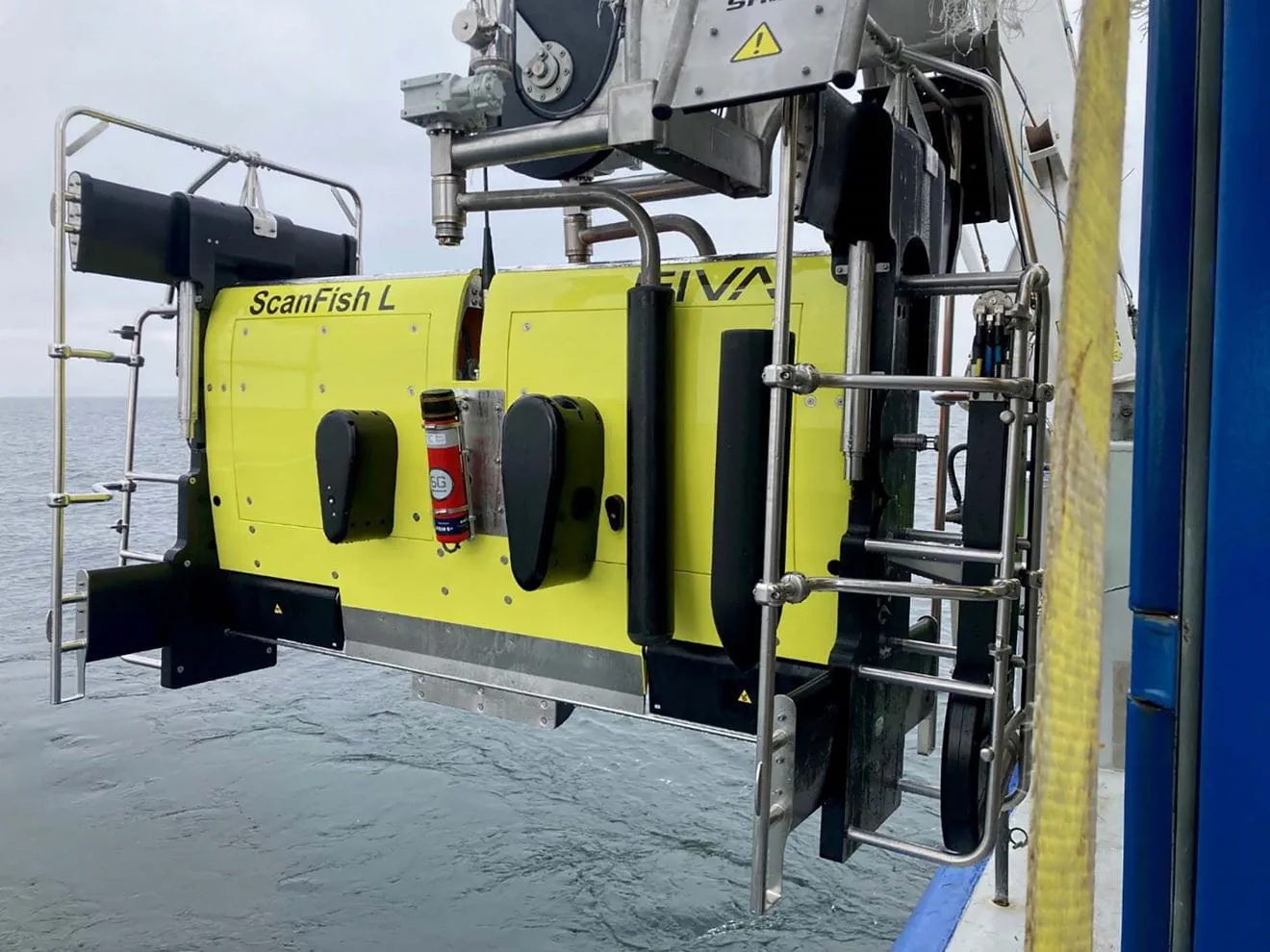
A specialist Royal Navy team has conducted the first sea trials of a new autonomous underwater surveying system, deploying it from a research vessel off the coast of Denmark.
The Hydrographic eXploitation Group sent two teams to work with Danish manufacturer EIVA on the Containerised Remotely Operated Towed Vehicle, a bespoke launch-and-recovery system for the ScanFish oceanographic survey platform. The towed vehicle is designed to operate at depths of up to 1,000 metres and carries a range of sensors including side-scan sonar, a sub-bottom profiler, oceanographic sampling equipment, and high-end optical cameras, according to the Royal Navy.
The trials form part of the Royal Navy’s broader push towards what it describes as a “hybrid navy,” incorporating autonomous and remotely operated systems alongside traditional platforms.
HXG, which is based at HMNB Devonport in Plymouth, deployed the system from the University of Aarhus research vessel RV Aurora in the Bay of Aarhus. The team spent two days at EIVA’s facility in Skanderborg before moving the containerised system to the ship, where it had to be integrated with Aurora’s GPS, underwater positioning sensors, and bridge monitoring systems.
Once at sea, the team practised launch and recovery of the 800kg ScanFish vehicle before progressing to test its full sensor suite and conducting emergency ascent drills.
CPO (H) Kirsty Warford, assigned as second-in-command of Team 5, was quoted as saying: “Having a background in traditional ship-based military surveying for almost 20 years, being assigned as the 2i/c of Team 5 and developing the novel capabilities of the ROTV has been a real contest.”
She added: “Having to think differently about remotely collecting data for multiple sensors at depth while maintaining the need to position the vehicle accurately and precisely up to 4000m astern of the vessel has caused a few headaches!”




I’m all in favour of the “hybrid navy” concept, but only as deployable effectors alongside manned vessels. Systems like this are a great capability, but they need a ship to deploy them; if manpower is going to remain a constrained resource, that ship also needs to be contributing beyond what existing survey or MCMVs are capable of.
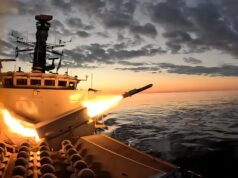
What we could really do with is a sloop. A 30/40mm gun, Dragonfire, a launcher for Martlet (Naval Group already have a modular launcher that could support it), and sufficient space for forecasted systems. Avoid the LCS problem by building to semi-naval standards, capable of perhaps 26 knots at most, lean manned in the extreme but with space for embarking decent groups of extra crew/marines/cadets, etc.
Phase them in as a replacement for the current minehunters and OPVs, they can provide both the useful capability and small ship command experience that is currently sorely missing
This is to be towed off the back of Proteus, an 800kg vehicle is a big rig.
The current Batch 2 Rivers have a 16 tonne crane, 25 Knots, and capacity for 50 additional crew on board. Why not use these now while developing a new batch of OPV with additional warfighting capabilities. Shorter version of the T31?
The thing is the batch 2 rivers are built to warship standards in everyway apart from the weapon systems added.. it’s better to build some commercial standard vessels to haul around this capability. If your going to have a well armed OPV your better off up arming the rivers 2.. because the foundations are essentially the best you will find in any OPV.. that’s why they are so expensive, the RN ordered a warship in everything but armament.
Deeper diving ROVs than this with SALMO being acquired for Proteus.
I wonder if buying Danish kit will help with the sale of the T31’s to the Danish? I’ll buy yours if you buy mine!
Oilfield workclass ROV’s are generally 2 to 5 tonnes excluding launch and tether systems which can be another 80 to 100 tonnes. Lots of exoerience in private sectore managing such large units.