

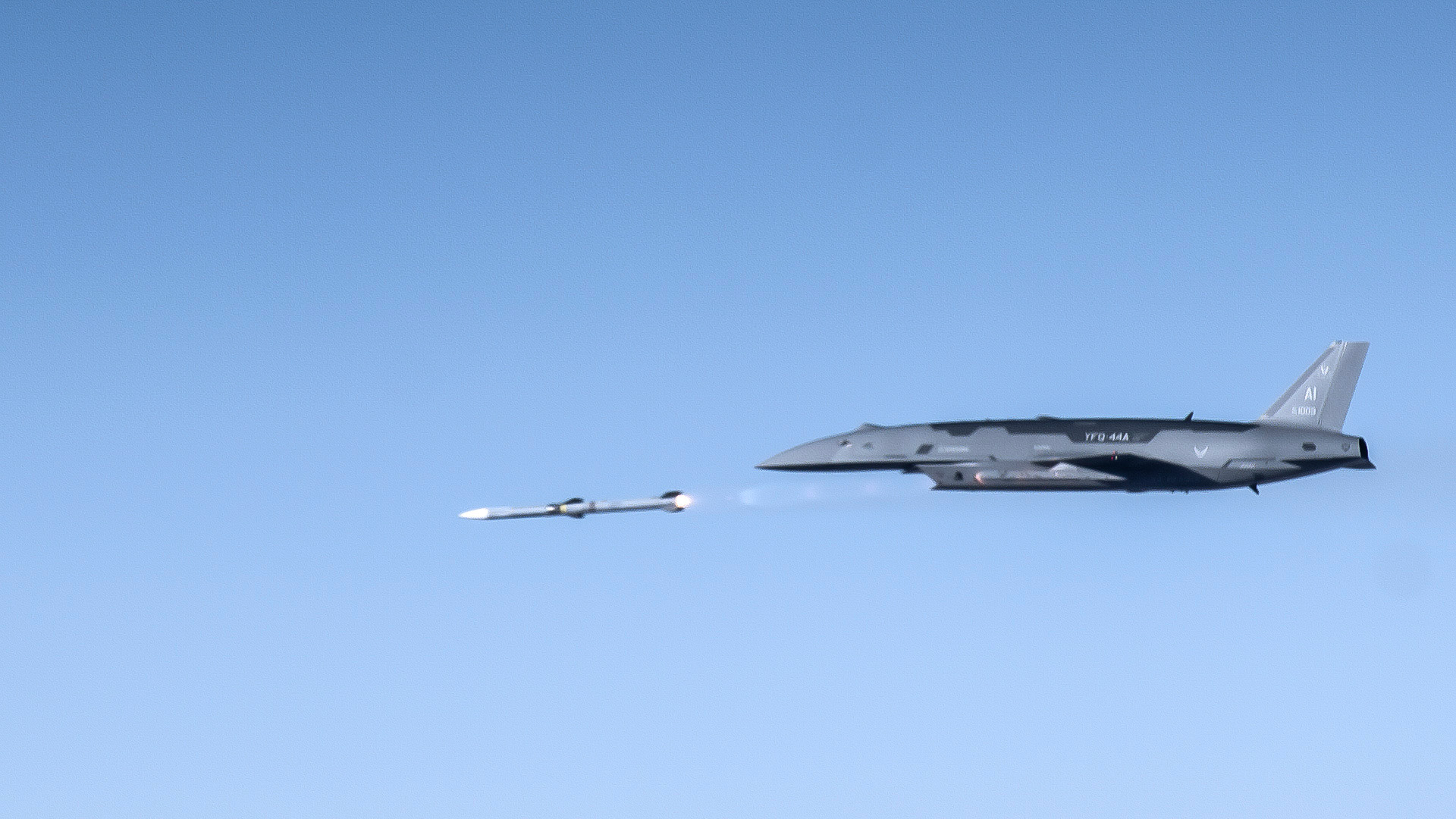
The US Air Force has carried out a live weapons test involving a YFQ-44A Collaborative Combat Aircraft, with the uncrewed aircraft firing an AIM-120 air-to-air missile during a flight over the Mojave Desert.
The firing formed part of the service’s continuing development of Collaborative Combat Aircraft, or CCA, which are being designed to operate alongside crewed combat aircraft while carrying out elements of their missions under automated control.
According to a US Air Force news update, the YFQ-44A released an AIM-120 against a digital target in secluded airspace over California. The event followed earlier trials in which the aircraft carried inert weapons and engineers assessed how the platform behaved with the additional load.
Those captive-carry flights were used to gather handling data before the test programme moved on to integration between the aircraft and the weapon. Subsequent work examined the data link connecting the YFQ-44A to the missile system and checked that commands issued by an operator were correctly executed in a simulated environment.
The latest test moved that sequence into a live weapons event, allowing engineers to compare their digital models with data generated during an actual missile release.
Air Force Chief of Staff General Ken Wilsbach said, as quoted in a news update: “This live-fire test is an important next step in the development of Collaborative Combat Aircraft. We’re one step closer to delivering capabilities to the warfighter.”
The Air Force stressed that the CCA programme retains human control over weapons employment. Although the aircraft can perform parts of a mission autonomously, the service said it will not independently decide to fire a weapon. Release authority remains with a human operator exercising command and control over the platform.
General Dale White, Department of War direct reporting portfolio manager for Critical Major Weapon Systems, said, as quoted in the same news update: “Moving from inert carriage earlier this year to this weapon release demonstrates program maturity, allowing us to validate our digital integration models with actual data.”
He added: “These tests provide operational validation that Collaborative Combat Aircraft can execute the weapon employment sequence autonomously within pilot-defined parameters, accelerating capability delivery to the warfighter.”
The distinction between autonomous execution and human weapon-release authority is central to the concept being tested. Under the arrangement described by the Air Force, a human establishes the parameters and authorises employment while the aircraft carries out parts of the resulting sequence using onboard automation.
The live-fire event was conducted with support from the 412th Test Wing’s Air Dominance Combined Test Force. The team includes serving military personnel, government civilians and contractors who worked on the models and procedures required to conduct the firing safely.
The AIM-120 Advanced Medium-Range Air-to-Air Missile is already widely used by US and allied combat aircraft. Integrating the weapon with an uncrewed CCA provides the Air Force with a means of testing whether such aircraft can carry and employ existing air-to-air weapons while operating as part of a wider force.
Collaborative Combat Aircraft are intended to supplement crewed fighters with additional sensors, weapons and mission capacity. The US Air Force has described the platforms as semi-autonomous systems that could extend the reach and awareness of crewed aircraft while increasing the number of aircraft available in contested environments.



This YFQ-44A has the Geoffrey de Havilland factor. “If it looks right, it probably is right”.