

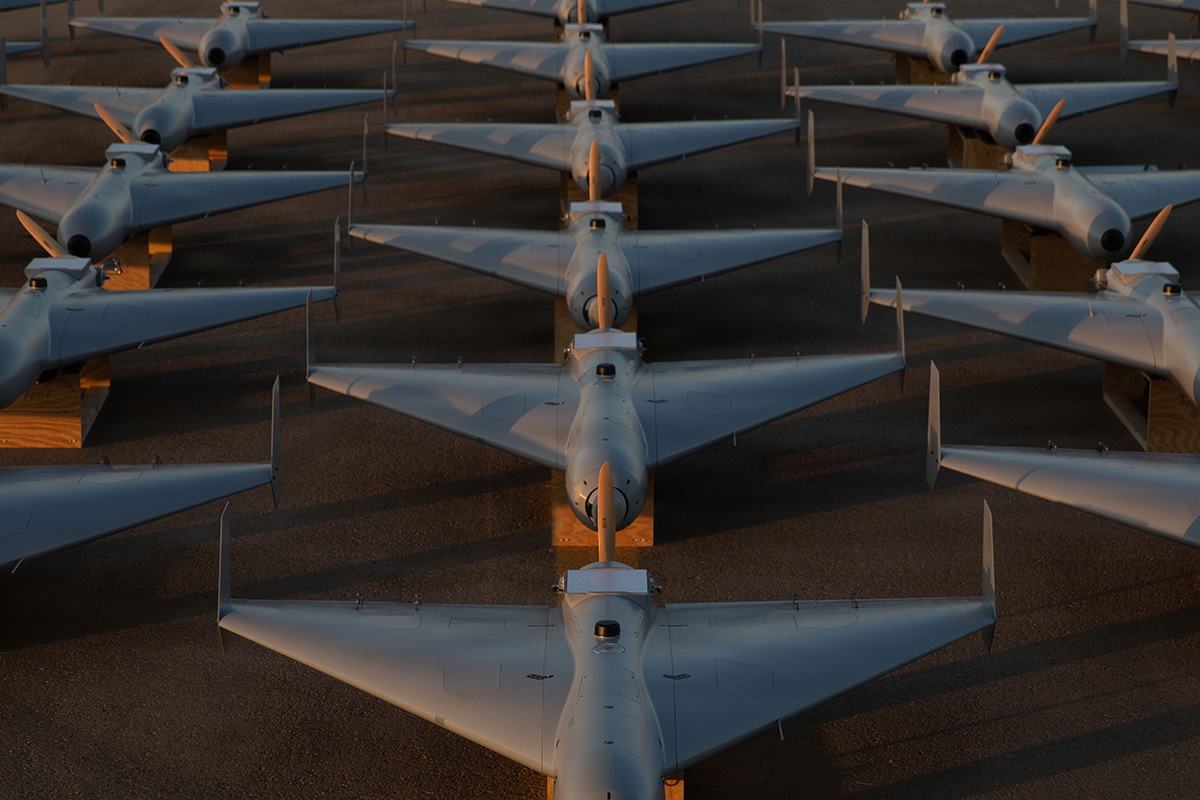
An Italian Eurofighter shot down a drone over north-eastern Latvia in the early hours of Friday, in an incident the Latvian armed forces attribute to Russian electromagnetic warfare pushing the aircraft off course and into NATO airspace.
The drone came down near the village of Rugāji in the Balvi region, close to the Russian border. Latvia’s National Armed Forces said NATO fighter jets had successfully shot down a foreign unmanned aerial vehicle that entered the country “as a result of Russian electromagnetic warfare”.
A NATO spokesperson said two Italian Eurofighters based in Lithuania were scrambled and one of them destroyed the drone, with two Turkish F-16s based in Estonia also launched. “All aircraft were operating under NATO command,” the spokesperson said, adding that an investigation is ongoing.
Airspace alerts were issued across several eastern and southern regions of Latvia and lifted at 4.50am local time. Finland separately restricted airspace and a sea area in the eastern Gulf of Finland as a precaution, with the Finnish Defence Forces saying no drones entered the country and the restrictions lifted shortly after 7am.
Latvia’s defence ministry confirmed this was the second time a drone had been shot down in Latvian airspace, following a first incursion in June that was also handled by NATO fighters.
Baiba Braze, the Latvian foreign minister, thanked Italy for “maintaining (the) integrity of NATO airspace”.
The origin of the drone was not immediately established, and the Latvian statement did not identify it. Earlier on Friday more than 50 Ukrainian drones attacked targets in Russia’s western regions including Leningrad and Tver, striking the port of Ust-Luga and a warehouse belonging to the e-commerce company Wildberries.
The electromagnetic warfare claim is a recurring problem along the alliance’s eastern flank, and is more likely rather than a deliberate incursion. Jamming and spoofing of satellite navigation signals has been widespread across the Baltic region since 2022, affecting civil aviation and shipping as well as military traffic, and a drone relying on GPS to hold its track can be pushed across a border by interference intended for something else.
Whether the aircraft was Russian or Ukrainian in origin therefore remains open, and neither Latvia nor NATO has said. Drones from both sides have come down in NATO territory during the war, with Romania recovering fragments on multiple occasions and Poland scrambling aircraft repeatedly during Russian strike waves against western Ukraine.
Baltic Air Policing has run continuously since 2004, when the three Baltic states joined NATO without fighter forces of their own. Allied detachments rotate through Šiauliai in Lithuania and Ämari in Estonia on four-month tours, and the mission has shifted from routine interception of Russian aircraft transiting to Kaliningrad towards the more demanding business of intercepting small, slow targets that radar systems designed for fast jets do not handle easily.







Can’t see a Ukrainian drone going that far off course, especially with having to fly over the entirety of Belarus to get there.