

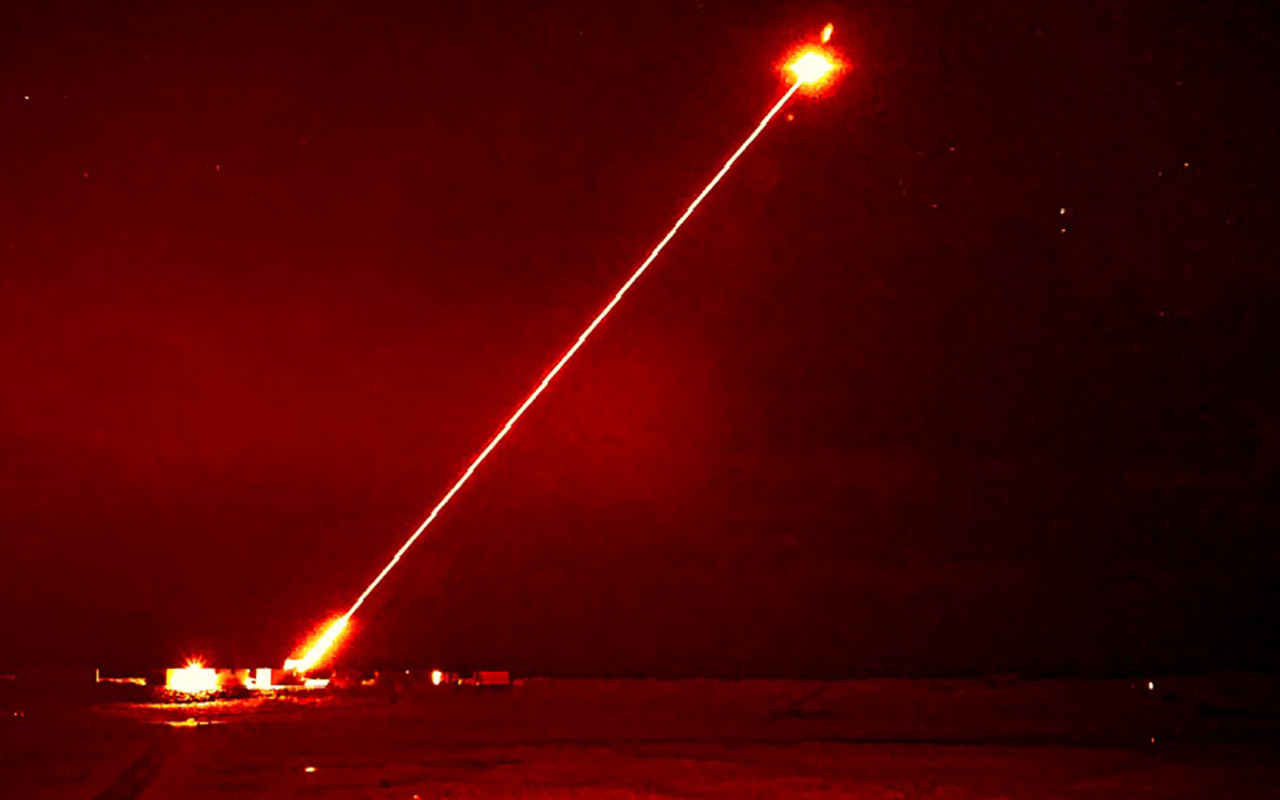
The Ministry of Defence has declined to say what directed energy weapons it is developing alongside DragonFire, telling Parliament only that further announcements will be made when appropriate, in a written answer published this week.
Luke Pollard, the Minister of State for Defence, was responding to Ben Obese-Jecty, the Conservative MP for Huntingdon, who asked with reference to paragraph 93 of the Defence Investment Plan what other systems were in development.
Mr Pollard said: “The Defence Investment Plan commits £490 million to Directed Energy Weapons over the next four years. This investment will deliver DragonFire and help ensure the UK remains at the forefront of this technology within NATO, while laying the groundwork for the next generation of DEW capabilities in collaboration with UK industry.”
He said: “This forms part of a longer-term investment programme. The DIP also sets out plans to invest at least £20 billion in new weapons and munitions between 2030 and 2035, including DEW for both land and maritime platforms.”
He added: “Further announcements on DEW will be made when appropriate.”
The reference to land platforms is the detail that carries most weight. DragonFire has been developed as a naval system and is due to be fitted to a Type 45 destroyer, but a land-based directed energy weapon would address a different problem, namely the drones and loitering munitions now used in volume against ground forces and fixed installations.
The British Army has already trialled a separate laser system mounted on a Wolfhound armoured vehicle, and has tested a radio frequency directed energy weapon designed to disable multiple drones at once rather than engaging them individually. Neither has been announced as a programme of record.
The economics are what drive interest in the technology. A laser engagement costs a few pounds in electricity against targets that cost thousands, which reverses the cost exchange that has troubled Western forces since Houthi drone attacks in the Red Sea saw multi-million pound missiles fired at aircraft worth a fraction of that. The constraints are power generation, cooling, and performance in poor weather.
DragonFire itself is being developed by MBDA with Leonardo and QinetiQ under a Defence Science and Technology Laboratory contract, and demonstrated high-power firings against aerial targets at the Hebrides range in 2024. The Ministry of Defence subsequently brought forward the planned in-service date, aiming to have it aboard a Royal Navy ship before the end of the decade.
The £490 million figure covers four years, which places directed energy some way down the list of Defence Investment Plan commitments. The plan allocates £26 billion to naval base infrastructure alone.










Thanks George. Good to know research continues. It would not be sensible to throw more money at gaining capacity whilst much of the theory needs to be developed in real world effects that are as yet speculative.
I don’t suppose they want to go too public on what their planning – let’s keep Mr P guessing!!
Ladies and Gentlemen. Off subject but I need to ask your opinions. I have just read an analysis by Mark Felton on You Tube entitled Operation Paper Tiger-Britain’s useless Aircraft Carriers. Now I am aware that the RN is going through difficult times and would not want to paper over real problem issues, but I have never read a more one-sided trashing of the carriers than this and in particular never seen such an article where literally not one single comment can be found that does not mock, deride, insult and belittle the Royal Navy and the QEs. I think of Russia’s disastrous experiences with Carriers and other ships recently with Tow Tugs accompanying, France’s record downtimes with Charles de Gaulle and even the mighty USN having problems with theirs!. Anyone viewing this rubbish who was not familiar with at least a rudimentary knowledge of the facts would consider them only usefull as scrap iron! We have two big carriers with a range of 10 000 miles in the tank and 40 plus F35bs fromwhich to embark. Surely SOMEONE could present at least a reasonable case for the Crown here? Or am I out there alone in my ignorance or MORE TO THE POINT-are these agents provocateur presenting a seriously damaging one sided view?
I need a beer( the Boks playing NZ in a couple of hours.
ps Hi Daniele-what do you think-have a look at the comments on this article-I am angry(bad for my BP at 77 🙂
Yes I saw this on my YouTube page and ignored it. A title like that shouts clickbait. A lot to criticise but one would expect some objectivity and titles of that nature don’t get attached to objective commentary. It’s too easy, especially in the military sphere to find all manner of evidence to produce a hit piece to support a pre determined opinion, a balanced one is far more informative even if it points in a critical direction.
One could have a field day with the US navy presently what with a destroyer in the South China Sea mimicking their Russian counterparts by having to be saved by a tug and their only aircraft carrier in the region having to be withdrawn to replace one where sailors were living in horrible conditions having to shit in buckets and some diving overboard as a result to get a flight home. And that’s after a laundry blowing up. Meanwhile other ships were eating appallingly because the Iranians had so disrupted their logistic in the region and we know how US sailors live on their stomachs. Meanwhile the pride of their fleet still can’t fly F-35s, though the supreme leader has decided to rectify the issue by going back to obsolete technology wasting more time and effort than it is actually going to take to get the remedy introduced on future vessels. I wonder if we will get a Felton or indeed Telegraph or Mail hit piece on any of these issues. Issues are easy to find in advanced military platforms which is why a more intelligent look is required. Recently we had. Telegraph hit piece saying we should get rid of all Typhoons and scrap GCAP and just buy F-35s as if that platform hasn’t had more than its share of controversy. Meanwhile you can find various hit pieces in the US and elsewhere saying we shouldn’t touch F-35s. Geez even Congressman Mark Kelly highlighted it’s dire short comings and industrial performance recently in Committee.
Spy is correct. You get more clicks for sensationalist one-sided claptrap than you do for balanced analysis — at least in the short term. If you have no self respect it’s the way to go. We all know muck-raking is rewarded by the algorithm, the more outrageous the better, and you sound pretty outraged to me. However, engaging is generally not worth your time. You can’t correct the whole of the Internet.
The reality is as long as the RN can scrap up 2 ASW a pair of T45s and an SSN ( a big ask at present) and the RAF gives it 2 squadrons of F35s then that is a set of firepower/sea control only 3 Nations on earth could counter on the high seas as well as strike power that would worry any nation… and 2 of those nations are allies..
The Russians will always encourage the trolls to try and rubbish the carriers, because they are a nightmare the Russians cannot counter.. as long as they are adequately supported..
Let’s take the high north.. Russia and the UK are contesting sea control to allow easier access to strike the other.. now if you don’t have a carrier all your assets are out of range of practical tactical fighter air cover.. that means the RNS SSNs are hunted by strategic range ASW aircraft, its ships are at risk from long range maritime strike aircraft.. at the same time it becomes harder for the RAF to undertake long range strikes as all its strike aircraft are fighters with an untankered combat radius of 1000kms.. that slows sorties and means to strike it needs tanker support close to Russia ( those tankers will be over contested seas and Skys).. it also means Russia strike aircraft ( which are longe range strategic bombers) can only be intercepted close to the UK..
Now you stick that carrier battle group 1000 Kms between the UK and Russia.. all of a sudden from contested skies.. the UK now has air dominance of that key bit of ocean..
UK ASW aircraft work under air cover, Russian ASW aircraft can no longer operate and have to stay under Russian land fighter cover..
UK strategic AEW and ISTAR aircraft can now safely work under UK air cover..
UK tankers can now fligh safely under UK air cover..
This makes the F35s profoundly more effective as the carriers have full access to strategic air assets ( ISTAR, ASW, AEW and tanker)..
Typhoon strikes can flow through this protected airspace with all the strategic aircraft including its support and protection they need as they fly strike missions against Russian forces
Russian strategic aircraft including its strike aircraft cannot operate in the same airspace as the F35s and protected UK strategic air..
Russia has no real answer as it has no carrier..
Russian surface vessels are now under UK air dominance and so are dead.
The UK now has sea control..
The Russian SSN force in that sea is living under UK air and sea dominance.. the UK SSNs are freed from the Risk of air and surface ASW.. the UK now has control of the sub surface battle..
So the fight moves to the Russian bastions and not the North Sea..
The thing about the carriers is that they are the linchpin to RN and RAF sea and air control in the high north.. but for that they need ASW escorts, AAW escorts, 1-2 SSNs 2 squadrons of F35s and strategic air ( ASW, AEW, ISTAR and tankers).. the carriers are sometimes you build a strategic war in the north around.. it’s not they are shite the issue is HMG has lessened all the other capabilities that need to be rapped around the carrier and the RAF are just not committed to fighting the war at sea that will be the inevitable UK Russian conflict point..
Not much to add to this, beyond one crucial issue – while the carriers allow us to achieve air dominance in the High North, we’re currently desperately short on the ability to achieve sea control.
Our fighters, MPAs, submarines, and the vast majority of aircraft lack anti-ship missiles. We depend entirely on guided bombs, torpedoes, guns, and helicopter-based light- and middleweight missiles to attack surface ships, while our opponent, for all their faults, has far more offensive power.
We’re also likely to be outnumbered. In a scenario without US support, there is precious little any of our European allies can commit to the High North without leaving the Baltic, North Sea, and Atlantic wide open. The Norwegians would be invaluable, with AShM-armed frigates and corvettes, and an SSK force that (allowing for availability) could roughly double the number of hulls we could have in the area, but the Russian Northern Fleet can still a comparable number of surface ships but a far higher number of submarines to sea. Combined with the potential for Pacific Fleet reinforcements along the northern passage, our single deployed Astute and the 1-3 RNoN Ula-class could potentially be facing an eclectic mix of perhaps 3-5 SSNs, 3-5 SSKs, and 2 SSGNs, as well as the presence of the Russian SSBNs.
I’ll add the caveat that our assets are broadly much newer and more advanced than the Russian fleet, and it’s probable that some of the strength they have on paper couldn’t actually be deployed in a war, but that doesn’t mean we should be treating them as a paper tiger. The RN (with RAF support) should be looking to maintain at least a small individual quantitative and qualitative advantage over the Russian fleet; if we can probably beat them alone, then the addition of NATO forces would provide the bulk to deter the Russians trying it in the first place.
Spot on.
And while we no longer can have and likely never will again have multiple fleets across the globe each with a CSG, neither could we build carriers of the quality of the QE class in a few years.
The whole point is to have the capability should the need arise for a carrier and we can just about manage that. With the new frigates slowly coming into service, this is finally going to improve.
Now, should we ideally have had three carriers, twelve Type 45s, and nine Astutes, so that two CSGs would be realistic to run at a time? Yes. But that opportunity has come and gone.
Hi mate.
Surprising for a Mark Felton video, he’s usually excellent.
We’ll speak later. 👍
I think the very poor state of the Royal Navy has gone to his head.
Typical YouTube , yes the carriers could do with more F35s I suppose but the ships themselves are far from bad vessels . However they could do with giveing theses Ships an AD System for more protection . Has other Navy’s carriers all have better protection .Problem been HMG been tight 💰
Thank you gentlemen! I feel a lot better after your comments-as always, the best and most balanced is on UKDJ-pity about the Boks though 🙁
😆