

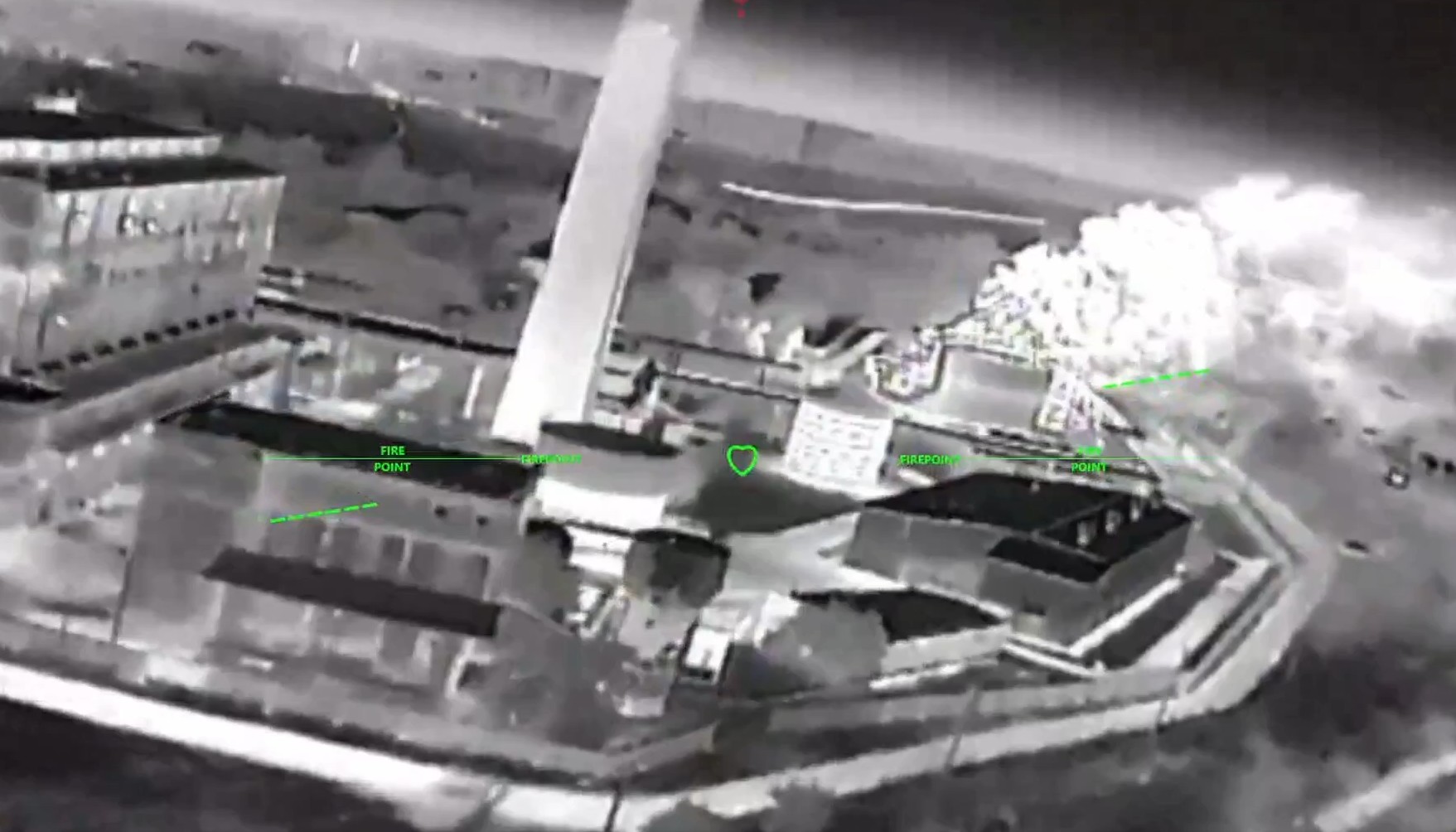
An adviser to President Putin has said British factories producing drones for Ukraine could be attacked by what he called unknown sources, as part of a possible Russian response to UK military support for Kyiv, in an interview with BBC Newsnight.
Andrei Fedorov, a former Russian deputy foreign minister who advises the Kremlin, was speaking to Adam Fleming on the programme on Monday. Asked what a semi-military response might involve, he said: “For example, something might happen with enterprises, with factories which are producing drones for Ukraine, etc, etc.”
Pressed on whether he meant British factories in Britain being attacked militarily by Russia, he said: “They could be attacked not by Russia, but by from unknown sources.”
Fedorov said pressure was building on Putin to act against the United Kingdom, telling the programme: “There’s a very serious political and public pressure on President Putin today, to undertake certain measures against UK, because he is considering UK as part of the war in Ukraine, and assistance from the UK is considered as a direct involvement of UK in this war.”
Asked where that pressure came from, he said: “It’s coming from the public opinion polls, it’s coming from journalists, from mass media, it is coming from military. And UK, of course, as considered in the context of Ukraine, is evil Number 1.”
He said Putin had described current developments as the opening of Pandora’s box, and that there had been a very negative reaction in the Kremlin.
On what form a response might take, Fedorov told the programme: “In the coming future we will face a new stage of escalation, in the Ukrainian conflict, and sooner or later, there might be not only verbal but maybe some visible reaction from Russia towards the UK.”
He said the options under discussion included a technical reaction, possibly a hacker attack from an unofficial source, along with political steps, and that he could not entirely exclude something semi-military.
Asked whether he personally would be content with such an attack, he said he would not, adding: “The problem is that we are now facing, in front of the danger, that Ukrainian conflict will be beyond Ukrainian borders. And remembering that UK is a member of NATO, and UK is a nuclear state, the risk is, of course, much higher than it was before, even a couple of months ago.”
Challenged on how such an attack could be justified under international law, he said: “Frankly speaking, who cares today about international law?” He said many in Russian society believed the president had waited too long to answer the UK.
On cyber targets, he said a hacker attack would be directed at a specific enterprise or system rather than broadly, and confirmed when asked that this would mean something governmental, security or military related, “especially to production of the drones or some components for Storm Shadow missiles.”
Fedorov linked the Kremlin’s assessment directly to the transfer of missile blueprints, saying the step meant that from Moscow’s point of view Britain was much more involved, and that a system capable of producing missiles, whether Storm Shadow or a Ukrainian modification, would be considerably more effective than what came before.
He described Moscow as considering the actions of the British Prime Minister as direct military involvement in the conflict.
On the domestic picture, Fedorov acknowledged that fuel queues and Ukrainian strikes on warehouses, including those belonging to the online retailers Wildberries and Ozon, were having an effect, but said he could not say public opinion had changed seriously. He noted that parliamentary elections are due on the 18th or 20th of September and that the war is regarded as a consolidating factor for them.
Put to him that anti-war parties had been blocked from standing, he confirmed that Yabloko had been kicked out of the race.
Fedorov holds no current government office, and his remarks carry no official standing. Figures of his kind are used periodically to place a position in the public domain without the Kremlin owning it, and the construction he uses, attacks carried out not by Russia but by unknown sources, is the same formula applied to the sabotage of undersea cables, arson at warehouses across Europe and parcel bombs placed on cargo aircraft.
British defence manufacturing sites have been treated as a protective security concern for some time. MI5 has warned repeatedly about Russian sabotage plots on British soil, and several prosecutions have followed attacks on premises linked to Ukraine, including an arson at a warehouse in Leyton in east London in 2024 for which men were convicted under the National Security Act.
The interview was broadcast on BBC Newsnight on 24 August.





These factories should be better protected in general, we have enough problems with our own people attacking them for the Palestine or Iran causes.
“Unknown sources”…
There’s been too much media coverage of all this and what Britain is doing and supplying to Ukraine. Maybe too late but why not tone it all down. Less publicity, bit more smarts. Hope any UK factories have good levels of security and any intruders can be handled.
If they actually wemt ahead with this its an act of war.
This was my initial thought, im not sure what further signalling could make their intent clearer? What we do in response is less clear…
Then we would have to prosecute war against unknown sources, whenever in Russia they may be.