

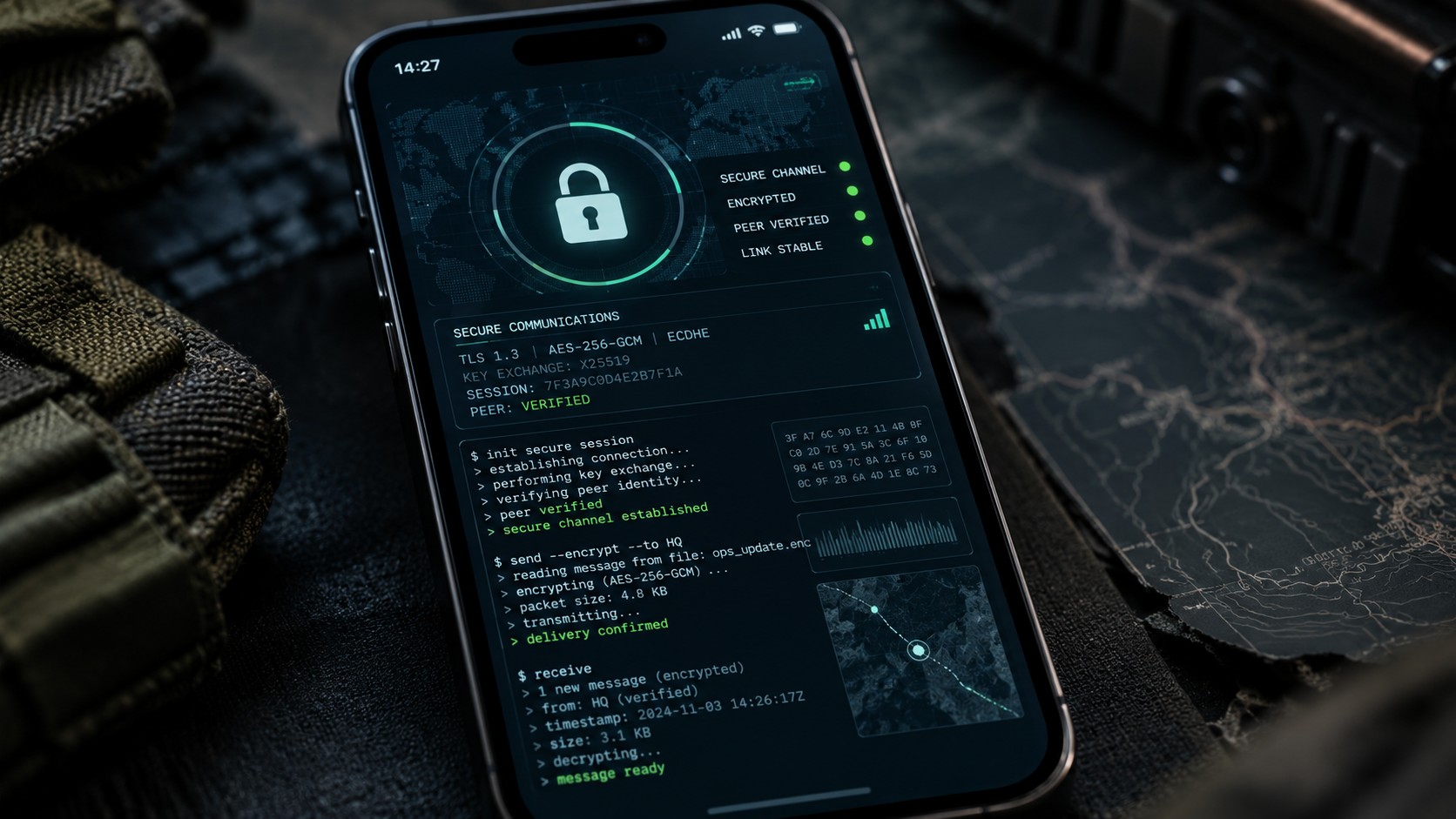
A British company founded by veterans has launched a version of its secure communications platform that gives forces end-to-end encrypted messaging, controlled location sharing and cryptographically verified photographs on an ordinary smartphone, according to Labrys Technologies.
The platform, called Axiom, is being shown at Apex Europe in London on Wednesday and Thursday, with the fourth version becoming generally available in November. It is already in use by defence users in Britain and allied NATO nations.
Anyone who has watched a headquarters run on WhatsApp will recognise the problem the company describes. Command and control increasingly happens on mobile devices over commercial encrypted messaging applications, with no control over where the data sits or who can reach it. A force can encrypt a message, but it cannot prove where a photograph was taken or who took it, cannot reliably verify where its own people are, and cannot keep the underlying data on its own infrastructure.
Axiom combines three capabilities that commercial applications do not offer together. Every message and image is end-to-end encrypted, so that nobody including Labrys can read a user’s communications. Location is shared only on the user’s terms, with control over who sees it and for how long. Every image carries cryptographic proof binding the time, the device and the identity of whoever captured it, along with verified location, which turns a standard phone into a source of tamper-evident reporting.
Each customer can also host the platform on its own servers, keeping its data under its own control and in its own jurisdiction, which the company presents as sovereignty whether the customer is British or allied.
The fourth version introduces full end-to-end encryption using the Matrix protocol, which allows federation and interoperability with other applications built on the same standard, among them NATO’s NI2CE messaging application.
Gus Lersten, chief executive and co-founder, said: “Having served, I know what it’s like to make decisions that carry real weight using tools that were never designed for the job. When we started Labrys, we were coordinating teams all over the globe using off-the-shelf tools. Nothing available provided what we needed, so we decided to build our own platform. We built Axiom so that what reaches a decision-maker is provably real, and the data behind it can stay in their control. Apex Europe is where we show the community what that changes.”
Verified imagery is the part of this with the widest application. Doctored or misattributed photographs have become a standing feature of modern conflict, and a picture that carries proof of when and where it was taken, and on which device, is worth considerably more to a staff officer than one that does not.
Labrys raised a $20 million Series A last year, holds ISO 27001 certification and Cyber Essentials Plus assurance, and sells through the G-Cloud 15, Tactical Communications Systems, Dynamic Market and RCloud government frameworks. Co-founder Luke Wattam speaks on the keynote stage at Apex on Wednesday afternoon.








I’m sure it’s a vast improvement on the general off the shelf solutions, but I don’t know of any ‘secure’ platforms that have encrypted the graphics driver. At some point in the process of being displayed on a screen the data becomes unencrypted.
The only 100% certain method of making sure communication security isn’t compromised is by doing the decryption on a device which isn’t connected to the net, which is a right faff.
Still it’s going to be a big improvement on What’s app and telegram.
I’m also wondering how well it coped with GPS spoofing 🤔
This isn’t new.
What isn’t?
Competitor to TAK?