


Construction of the British site for the Deep Space Advanced Radar Capability will begin in April 2027 under a contract the United States Space Force signed with Northrop Grumman in August 2024, with planning permission sought in March this year and initial authority to operate already issued, according to a written answer published this week.
Luke Pollard, Minister of State for Defence Readiness and Industry, was responding to Ben Obese-Jecty, the Conservative MP for Huntingdon, who had asked what progress had been made on establishing the capability, referring to paragraph 81 of the Defence Investment Plan.
Mr Pollard said: “The Deep Space Advanced Radar Capability (DARC) is a ground-based radar system that will provide 24/7, all-weather capabilities to detect, track, identify and characterise objects up to Geostationary Earth Orbit. DARC will require three permanent radar sites and a radar operations centre to provide 360-degree coverage: in Australia, the UK and the US. Construction of sites in Australia (Exmouth) and the US (IROC, Eglin) have been completed.”
He said: “The USSF signed a contract with Northrop Grumman on 23 August 2024 for construction of the UK site starting April 2027.”
On the regulatory position, he said the department has completed an environmental impact assessment including a landscape and visual impact assessment, to ensure the project has minimal impact on the local skyline, and that this formed part of a town planning application submitted to the local planning authority in March 2026.
He added: “The Defence Electromagnetic Authority, working with the Office of Communications, has issued an initial Authority to Operate. MOD and the Civil Aviation Authority is completing the necessary safety of flight procedures for local airspace.”
What DARC does
Most existing radars are optimised for low Earth orbit, where the majority of satellites and debris sit a few hundred kilometres up, and objects in geostationary orbit at around 36,000 kilometres have been tracked largely by optical telescopes, which depend on clear skies and darkness. A radar capable of reaching that altitude works regardless of weather or time of day, which is what the reference to 24/7 all-weather capability in the answer describes. The three sites, spread across Australia, Britain and the United States, provide continuous coverage of the geostationary belt as the Earth turns.
Geostationary orbit holds communications satellites, missile warning satellites and a substantial share of the space infrastructure military operations depend on, and both Russia and China have demonstrated satellites capable of manoeuvring close to others, which is a behaviour that cannot be characterised without being able to see it happening.
The United Kingdom site is at Cawdor Barracks in Pembrokeshire, west Wales, an existing defence site the Army had been due to vacate. The answer’s references to the local skyline and to safety of flight procedures for local airspace reflect the physical scale of the installation, which involves large parabolic dish antennas across a substantial footprint.
The programme is a trilateral effort under the AUKUS partnership, jointly funded by the three nations, with the American site at Eglin Air Force Base in Florida and the Australian site at Exmouth in Western Australia, which the answer confirms are both complete.
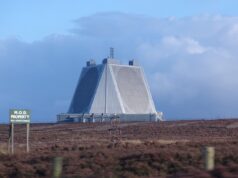
Britain’s wider space programme sits under UK Space Command, established at RAF High Wycombe in 2021, which brings together military space operations alongside the existing space domain awareness assets including the Fylingdales radar in North Yorkshire, itself part of the American ballistic missile early warning system.










So the USSF still owns the radar and site, but it’s on UK soil, which is where our “claiming of capability” comes from… Hmmm,
Let’s hope Planning Permission isn’t denied. 🙂 Honestly, its the sort of construction that the Gov just needs to tell the council that it’s been approved by them, don’t even try getting in the way.
As a nation we do seem to be good at being able to see exactly what’s going on. It’s just a shame that we’re not so good at doing anything about it (e.g. land-based balistic missile defence)