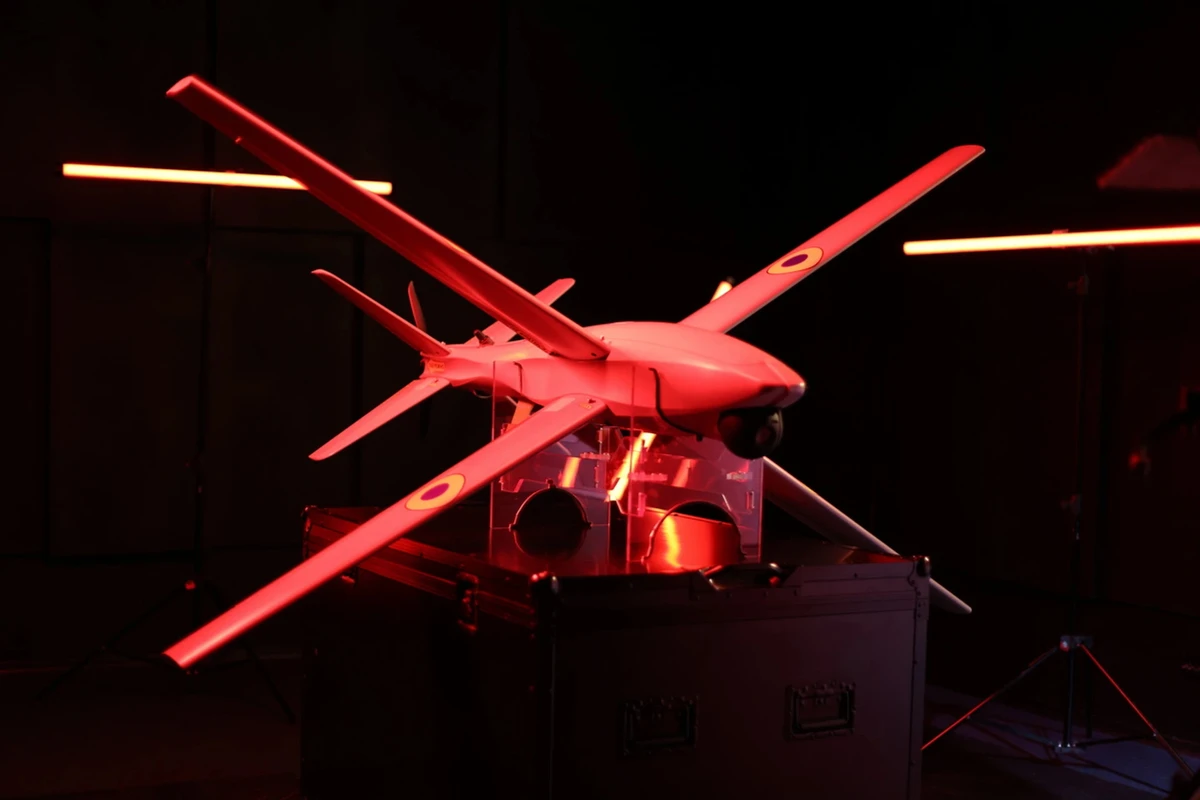
Ukrainian defence manufacturer UKRSPECSYSTEMS has publicly identified itself as the maker of the RAM-2X precision-strike uncrewed aerial system, revealing a weapon the firm says has already been used extensively in combat and produced at scale rather than a new developmental design.
The company unveiled RAM-2X under its own name at the MSPO defence exhibition in Kielce, Poland, on 8 September, after previously withholding its involvement for Ukrainian security reasons. UKRSPECSYSTEMS says the system has been manufactured and employed operationally at large scale by Ukraine’s Defence Forces.
Speaking to the UK Defence Journal ahead of the announcement, Rory Chamberlain, Managing Director of UKRSPECSYSTEMS UK, said the company had wanted to discuss the system publicly for some time but had been prevented from doing so by Ukrainian security considerations.
He said those restrictions had now reduced sufficiently to allow UKRSPECSYSTEMS to identify itself as the manufacturer and begin discussing a capability that had previously remained largely hidden behind operational footage and battlefield reports.
Chamberlain told us RAM-2X became fully operational in 2024. Asked what the company meant when it described the system as being used at large scale, he would not provide an exact figure but said the scale was already in the “tens of thousands”, adding that this was a low estimate. On the company’s account, RAM-2X has already been developed, adapted and employed through several years of high-intensity war before the company has been able to put its name publicly alongside the system.
In its formal announcement, Chamberlain said: “RAM-2X isn’t new to the battlefield; what is new today is that we can finally talk about it publicly. It has been developed through combat and continuously improved using feedback from the Ukrainian units operating it.
“What matters is not simply the range or performance of an individual aircraft. RAM-2X demonstrates a different approach to precision strike: matching the effector to the target and generating military effect at a price and scale that can be sustained in war. And when RAM-2X is connected with SHARK-M, the result is much more than two drones. Persistent reconnaissance and precision strike become part of the same operational system – finding, tracking and engaging demanding targets at depth.”
Combat footage opened to public scrutiny
Alongside the reveal, UKRSPECSYSTEMS has opened what it calls the X-Archive, a collection of combat footage the company says was supplied by Ukrainian military units operating RAM systems and cleared for public release. The initial material concentrates on Russian air-defence equipment, with the company saying RAM systems have been credited with strikes against more than 450 air-defence-class targets.
That figure is the company’s own and refers to RAM systems collectively, so it should not be read as confirmation that RAM-2X alone conducted all 450 engagements. UKRSPECSYSTEMS is progressively releasing footage that it says can now be publicly associated with the RAM family after previously circulating without attribution.
Chamberlain also gave the UK Defence Journal additional detail on how the desired effect against such targets has changed during the war. He said RAM-2X had moved from an approach in which attacks could seek a mission kill, disabling a system sufficiently to take it out of the fight, towards one where Ukrainian forces increasingly sought complete destruction. The reason, he explained, was that equipment left damaged on the battlefield could subsequently be used as a decoy, changing the Ukrainian concept of operations.
Chamberlain said: “So now we aim for total kill on all the systems.”
He said SHARK reconnaissance aircraft remain over the area to provide rapid battle damage assessment after an engagement, allowing the unit to establish the effect of the strike.
Dmytro Khasapov, General Director of UKRSPECSYSTEMS, said: “This is not the beginning of RAM-2X’s story. It is simply the first time we are able to tell that story publicly. RAM-2X was developed in Ukraine, through combat, against real targets and in one of the most demanding electronic-warfare environments in the world. When we say combat-proven, we mean evidence, not a marketing claim. That is why, alongside RAM-2X, we are opening the X-Archive so people can see declassified evidence of the system at work.”
Up to 180km range with a 3.5kg warhead
RAM-2X is intended for precision strikes against high-value targets at operational-tactical depth. UKRSPECSYSTEMS gives the aircraft a range of up to 180 kilometres, endurance exceeding two hours and a 3.5kg warhead. According to the company, the system incorporates automatic target lock and tracking, while available options include optical navigation for operations where satellite navigation is denied and AI-based object recognition.
That electronic-warfare resilience is particularly important in Ukraine, where satellite navigation, control links and communications are routinely subjected to jamming and other forms of interference.
Rather than presenting RAM-2X as an isolated aircraft, UKRSPECSYSTEMS is positioning it as part of a broader reconnaissance-strike architecture connecting sensors, communications, ground control, software and effectors.
SHARK-M links reconnaissance directly to strike
A central element of that architecture is the relationship between RAM-2X and the company’s SHARK-M reconnaissance UAS, a pairing UKRSPECSYSTEMS calls the “Killer Duo”. SHARK-M is used for persistent reconnaissance and targeting, while RAM-2X provides the strike component. The company says the reconnaissance aircraft can also act as a communications relay in heavily contested electronic-warfare conditions.
Asked how closely the two aircraft are integrated, Chamberlain told the UK Defence Journal that information is shared automatically between the systems. That matters particularly for attacks at depth because targets may move between initial detection and the arrival of the strike aircraft. Persistent surveillance, he said, allows the target to remain under observation throughout that process.
Chamberlain said: “They’re all automatically shared. So it’s that full integration, and you have to understand that in Ukraine, your targets are often moving, and when we are looking at the deep strike as well, and the time onto target, it’s important that you have ISR with persistence there.”
The company’s wider argument is that shortening the connection between finding a target and attacking it can be as important as the performance of the strike aircraft itself.
Battlefield imagery used to train target recognition
Chamberlain also explained how UKRSPECSYSTEMS is using years of reconnaissance imagery to develop the AI-based object recognition offered with RAM-2X. He said the company’s ISR systems have been observing Russian targets since the beginning of the full-scale invasion, building up imagery as equipment, camouflage and operating practices have changed.
That includes seeing targets in low light, partly hidden by vegetation or otherwise presented differently from a clean reference image. Chamberlain said this material is used to train recognition systems across RAM-2X, SHARK and the company’s wider portfolio.
The approach, he said, allows the recognition tools to be updated as Russian forces adapt their own methods, rather than relying on a static library of target imagery.
More than 1,500 drones produced each month
The scale of UKRSPECSYSTEMS’ wider operation has also increased considerably during the war. Chamberlain told the UK Defence Journal that the company now employs well over 4,000 people and is approaching 5,000, while producing more than 1,500 drones per month across its portfolio.
He declined to disclose the exact mix of aircraft making up that monthly output or how far production exceeded the 1,500 figure, citing operational security. The company says it is also working to much shorter development cycles than those normally associated with conventional defence programmes.
Chamberlain said hardware changes could be introduced approximately every three weeks, while software could be updated around every six weeks, with broader system updates occurring on roughly three-month cycles or faster. He said that pace was necessary because equipment that works effectively on the Ukrainian battlefield cannot be assumed to remain effective indefinitely as enemy tactics, electronic warfare and countermeasures evolve.
UK interest as exports begin to open
The public disclosure of RAM-2X also comes as UKRSPECSYSTEMS begins looking beyond Ukraine, with the gradual easing of Ukrainian defence export restrictions opening opportunities with NATO customers.
Chamberlain told the UK Defence Journal that the company is already seeing British interest and hopes ultimately to offer the capability to the British Army. He said: “So you know the Ukrainian export rules are starting to relax, and with the start of the drone deal, that means the export is open for those NATO customers, and obviously we have the UK showing interest, which is great, and we hope to bring this for the British Army.”
He added that there was also considerable interest elsewhere within NATO.
Commander calls RAM-2X a ‘game changer’
The commander of Ukraine’s 15th “Black Forest” Brigade, using the callsign Sarmat, whose formation has operational experience with the system, told us: “RAM-2X has been a game changer for the Ukrainian battlefield. For destroying HVT targets over 150km RAM-2X is the best.”
The unit price of RAM-2X has not been publicly disclosed, but the UK Defence Journal understands it is priced as a genuine consumable, allowing it to be employed in substantial numbers rather than treated like a scarce, high-end missile. We understand that a successful RAM-2X strike can in some circumstances destroy equipment valued at two to three orders of magnitude more than the cost of the UAV itself, and potentially four orders of magnitude at the upper end.
For context, the UK Defence Journal understands a P-18 Terek radar to be valued at around $3.6 million, an S-400 launcher at approximately $15 million and a Buk-M3 launcher at around $30 million. Those figures do not mean every RAM-2X sortie attacks equipment of that value, but illustrate the economics behind matching comparatively inexpensive precision-strike UAVs against high-value battlefield systems.
The comparison with conventional precision weapons is not exact, though. Different weapons have different ranges, payloads, survivability and target sets, but the underlying concept is to make precision strike affordable enough to be used repeatedly and replenished at wartime scale.
Chamberlain said this ability to change quickly was fundamental to the company’s approach, arguing that equipment has to remain relevant to battlefield conditions rather than simply meeting a fixed specification. He told the UK Defence Journal that UKRSPECSYSTEMS continually adapts its systems as operating conditions change, adding that the evidence of their performance was already visible in combat.
Why this all matters
Asked finally why he was personally so enthusiastic about RAM-2X and the wider UKRSPECSYSTEMS approach, Chamberlain pointed less to any single specification than to the speed at which the system changes with the battlefield. He said: “You know, this is not, dare I say, a snake oil kind of scenario. The images are there. The reality is there.”
Larger changes, he said, come every few months or faster as Ukrainian units encounter new threats, tactics and countermeasures. Chamberlain said: “You have to be relevant on a battlefield to win a war.”
That, perhaps more than the 180km range or the numbers produced, is the point UKRSPECSYSTEMS is trying to make with RAM-2X. The aircraft being shown at MSPO is not a frozen design emerging from a development programme, but a weapon the company describes as shaped by combat, changed by combat and still changing with it.
RAM-2X is being displayed alongside the wider UKRSPECSYSTEMS portfolio at MSPO in Poland from 8 to 11 September, marking the first time the company has been able to publicly connect its name to a strike system that it says has already spent years operating in the war in Ukraine.