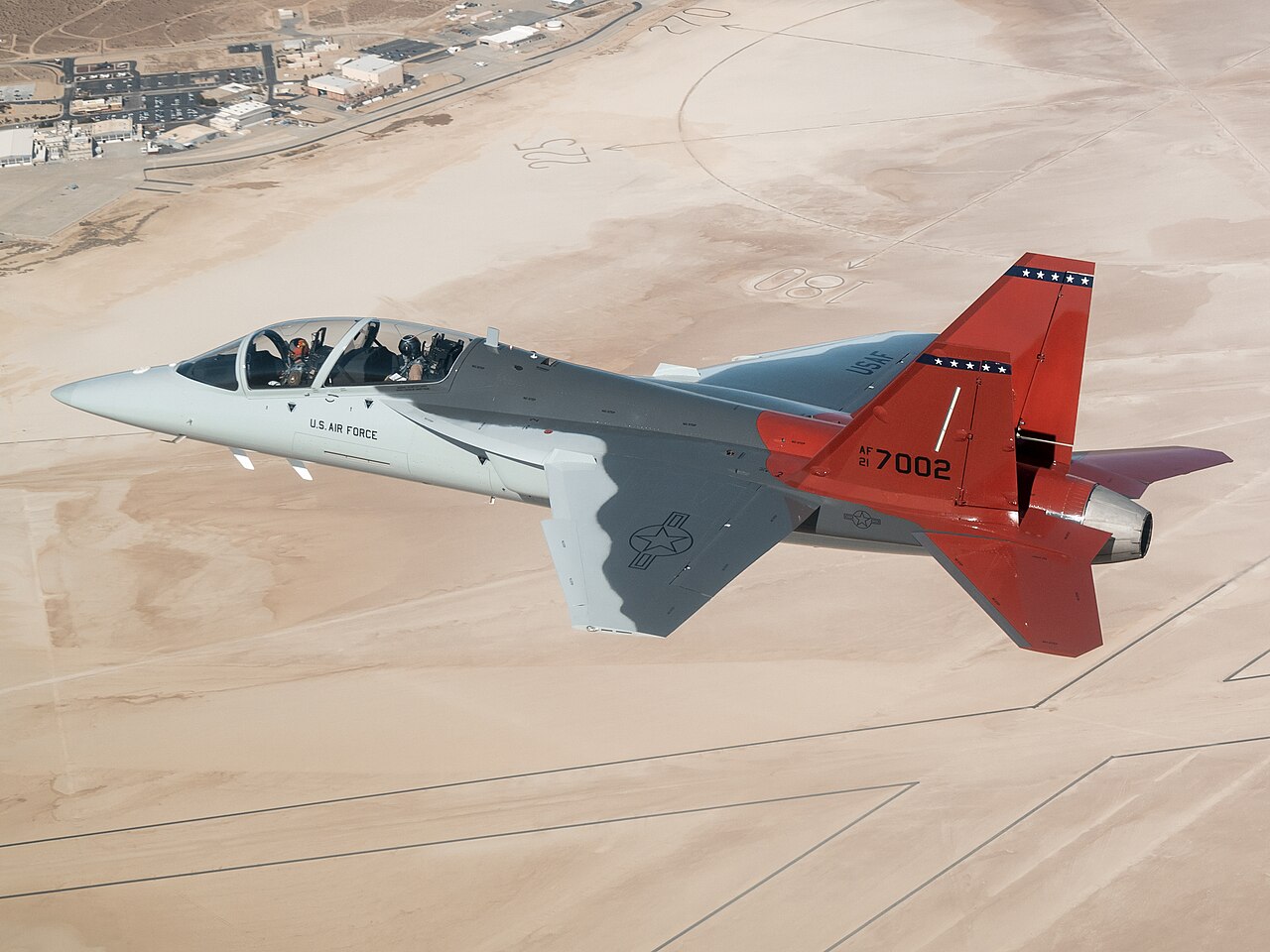
US Air Force instructor pilots have flown a T-7A Red Hawk trainer while digitally linked to ground-based simulator cockpits, the first live-virtual-constructive (LVC) flight between the aircraft and its Ground-Based Training System inside Air Education and Training Command, according to the US Air Force.
The flight took place on 16 September at Joint Base San Antonio-Randolph, Texas, and involved instructor pilots from the 99th Flying Training Squadron alongside civilian simulator instructors from the 12th Training Squadron. Red Hawk aircraft APT-4 was flown by Lt. Col. Michael Trott, the 99th FTS commander, and Lt. Col. Phillip Bourquin, the squadron’s operations officer. On the ground, two simulator cockpits were flown by Robb Erickson, a retired Air Force colonel, and Ryan Sparkman, a retired lieutenant colonel, both civilian simulator instructors with the 12th TRS.
According to AETC, the simulators were connected to the airborne jet through secure, high-bandwidth tactical data links while it manoeuvred in local military training airspace, giving instructors on the ground the same operating picture as the crew in the air. The architecture allows the jet and simulator cockpits to track one another’s flight parameters, sensor sweeps and weapons employment at the same time. In practice, that means a student in a simulator can fly as a virtual wingman or adversary against a real aircraft, while instructors inject constructive threats such as surface-to-air missile rings, electronic warfare jamming and simulated enemy aircraft into both sets of cockpit displays.
Erickson, who leads the 12th TRS T-7A civilian simulator instructors, said in the release: “Accomplishing this capability for the first time inside AETC represents a paradigm shift in how we train and build combat-ready aircrews.” He added: “When APT-4 took flight, we weren’t just flying another training sortie. We established a live, bi-directional data link fusing an airborne aircraft directly into our simulators and synthetic battlespace.”
The Air Force says LVC training lets aircrews rehearse fifth and sixth generation tactical scenarios without the cost, maintenance demands and airspace limits of putting large numbers of real adversary aircraft in the air. “The power of LVC lies in its density, complexity and interconnectivity,” Erickson said. “By tethering our simulators directly to the live aircraft out in the airspace, student pilots can experience the realistic, sensor-saturated operational environment they will face in front-line fighters and other combat aircraft.”
Sparkman was quoted in the release as saying: “The synthetic injection we proved today challenges aircrews with threat presentations and sensor-management puzzles that were impossible to replicate on our legacy flying platforms.”
That legacy platform is the Northrop T-38 Talon, which has trained US Air Force fighter and bomber pilots since the early 1960s. Boeing, partnered with Saab, won the Advanced Pilot Training competition in 2018 with what became the T-7A, under a contract covering up to 351 aircraft and 46 ground-based training systems. The programme has since experienced delays linked to issues including the escape system and flight control software, pushing back its entry into service. The 99th Flying Training Squadron, which traces its lineage to the Tuskegee Airmen, inspired the Red Hawk name and the aircraft’s red tail markings.
AETC says the flight sets a technical baseline for modernising the undergraduate pilot training syllabus as the 12th Flying Training Wing prepares to receive the production fleet. “This initial flight confirms that our core digital architecture is sound,” Erickson said. “Proving that the T-7A and our simulators can communicate and fight together in the same virtual sky keeps us squarely on track to deliver cutting-edge training for tomorrow’s warfighter.”